Looking Ahead by Looking Back – 2022’s Improbable Games and Coincidences

As MLB Opening Day approaches, Baseball Roundtable is  looking forward to another season in which – as usual – fans can expect to see something new, different or at least improbable every time they go to the ballpark.  After all, in 2002 alone, fans saw six triple plays (including the first-ever MLB CF-to-3B  triple play); four no-hitters; four games in which the winning team plated 20 or more runs; a player picking up his tenth win on the mound and his 25th home run at the plate in the same game; a pitcher  with only three balks in an eight-season MLB career tying an MLB record by committing all three balks in the same inning … and I could go on and on.  With that in mind, and to get in the mood for another season of big-league ball, I would like to use this post to reflect on Baseball Roundtable’s Top Dozen  Improbables from the 2022 season.   I’ll also throw in a few bonus Improbables from seasons past.

Baseball Roundtable Top Dozen MLB Improbables From 2022

Number One … A Beer and a Burger, Please.
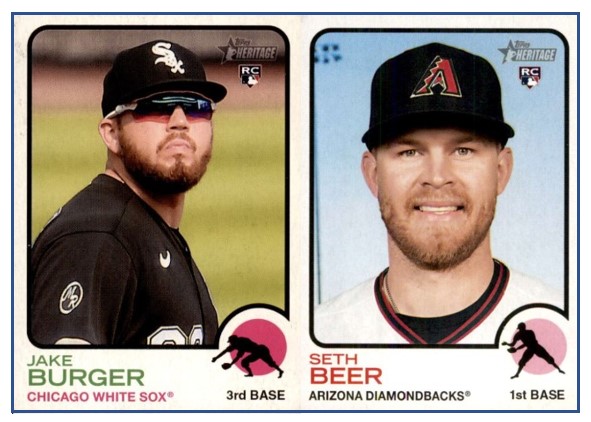
This one is kind of a two-fer.  April 7 was National Beer Day – and guess  what? Diamondbacks’ DH Seth Beer (gotta love that baseball name) hit a walk-off home run to push the Diamondbacks past the Padres 4-2.  It was just Beer’s second career homer and first career walk-off long ball – and the only home run he would hit in 2022.  Beer ended the 2022 season at .189-1-9 in 38 games.

Then, on May 28 (National Hamburger Day),  White Sox’ 3B Jake Burger homered in the Sox 5-1 win over the Cubs. It was Burger’s fourth homer of 2022 and fifth of his career. Burger finished with a .250-8-26 stat line for 20222 (51 games).

A Beer and a Burger.  That kind of coincidence in a single season is the kind of Improbable that catches The Roundtable’s eye.

Bonus Improbable from the Past

On September 23, 1969, fans in Cincinnati saw Dodgers’ pinch hitter John Miller hit his second (and final) MLB career home run.  They also witnessed Miller becoming just the second MLB player ever to homer in his very first MLB plate appearance (for the Yankees on  September 11, 1966) and very last MLB plate appearance. How improbable was that feat?  Remember, Miller hit only two home runs in his entire (32-game) MLB career – and, to this date, is still only one of two players to homer in his first and final plate MLB appearances. Miller’s final MLB stat line .164-2-3.

What further makes Miller’s homer an Improbable is how close he came to not homering in his final at bat.   Miller almost came to the plate one more time – on September 27, as the Dodgers and Giants faced off at Dodger Stadium.  That game was tied 1-1 in the bottom of the eleventh inning. Southpaw Ron Bryant was on the mound for the Giants and, after getting Dodgers’ SS Maury Wills to pop out, he gave up singles to LF Manny Mota and CF Willie Davis. Dodgers’ manager Walt Alston sent the right-handed hitting Miller up to hit for LA pitcher Jim Brewer.  Giants’ skipper Clyde King –playing the percentages – brought in veteran righty Don McMahon to pitch.  Alston countered by calling Miller back and sending up left-handed swinging Len Gabrielson (who singled in the winning tally.)  Without the switch, Miller’s final plate appearance home run could have become just an obscure next-to-last at bat dinger.

Number Two … The Rangers Didn’t have a Prayer.

Now, these days, “Immaculate Innings” (three up, three down, three strikeouts, nine [pitches) are not all that improbable – after all, there were seven  of them in 2022 alone. But how improbable is it to see two Immaculate Innings in one game? It’s only been done once – on June 15 of last season.  And, the “Improbability Factor” was raised even further by the fact that those two Immaculate frames were thrown by two pitchers on the same team and the same three opposing batters were the strikeout victims.

On June 15, Astros’ pitchers Luis Garcia and Phil Maton pitched their way into the record books. The two Houston hurlers each tossed an “Immaculate Inning.”  It was, as noted,  the first-ever MLB game in which two pitchers each tossed an Immaculate Inning and, of course, also made them the first and (currently) only teammates to toss an Immaculate Inning in the same game.

Garcia tossed his nine-pitch, three-whiff fame in the bottom of the second, while Maton achieved the feat in the bottom of the seventh. The Astros, by the way, won the game  (started by Garcia) 9-2 and four Houston pitchers notched a total of 14 strikeouts. Also of note is that the Rangers’ 1B Nathaniel Lowe, 2B Ezequiel Duran and 3B Brad Miller (the 6-7-8 hitters) were the victims in both Immaculate Innings – making them, of course, the first and currently only three players to be victims in two Immaculate frames in the same game.

Garcia finished the season at 15-8, 3.72 (28 starts)  – with 157 whiffs in 157 1/3 innings pitched. Maton was 0-2, 3.84 in 67 appearances – with 73 strikeouts in 65 2/3 innings.

Bonus Improbable from the Past

On September 12, 1962, fans in Baltimore saw the Senators’ Tom Cheney throw a sixteen-inning complete game, as the Senators topped the Orioles 2-1.  Now, a sixteen-inning complete game was much more probable back then,  what was improbable was Cheney’s 21 strikeouts, the highest total ever for a pitcher in an MLB game. What makes it even more improbable is that, in 1962, Cheney averaged   7.6 whiffs per nine (for his career,  he averaged 6.7 whiffs per nine innings).  In 1962, Cheney went 7-9, 3.17 in 37 games (23 starts). His career mark (eight seasons) was 19-29,  3.77.  

Number Three … You Balkin’ to Me? 

On September 27 of last season, in the eighth inning of a Marlins/Mets game (in New York), Mets’ 1B Pete Alonso came to the plate with  two outs and Mets’ 2B Jeff McNeil on first base.  McNeil scored during Alonso’s at bat, but no RBI was awarded.  Had an RBI been assigned it could have gone to Mets’ pitcher Richard Bleier who – during Alonso’s plate appearance – was charged with three balks (sending McNeil, to second, third and, finally, home).  Hence a Baseball Roundtable RBI – Run Balked In. (Bleier and Marlins’ skipper Don Mattingly would argue –  and did – so, maybe, the RBI should go to the umpires.) The Marlins won the contest 6-4, but neither Bleier nor Mattingly were around to see it.  Both were ejected.

This one comes up high on the Improbables list since the three balks (which tied the MLB mark for balks in an inning) are the only balks Bleier has been charged with in seven MLB seasons (308 appearances – 299 2/3 innings pitched).  Bleier finished 2022 with a 2-2, 3.55 record (with one save) in 55 appearances.

Number Four … Twenty-One Equals Luck in more than Black Jack.

In 2002, MLB established  September 15 as Roberto Clemente Day. This past season, Roberto Clemente Day saw an expanded list of  players, coaches and manager wearing Clemente’s’ number 21 on Clemente Day – all the players, coaches and managers in the Pirates/Mets game; along with all Puerto Rican born players.  In addition, the 2022 Clemente Award Nominees, past Clemente Award Winners and players who wore number 21 during the 2021 recognition had the opportunity to wear 21.

Among the players donning number 21 in the September 15 Royals-Twins game (at Target Field), were Twins’ SS Carlos Correa (usually number four) and Royals’ C Salvador Perez (usually number 13).  I single these two players out because, on that day, each of these one-day number 21’s  went yard – and it was the 21st home run of the season for each of them.  It’s the kind of cosmic numerical coincidence that catches The Roundtable’s attention. Oh, and the Twins prevailed 3-2.

Number Five …  Won’t Somebody Put the Ball in Play?

Okay, how’s this for improbable – an inning that featured six batters, three base runners, 28 pitches, no runs scored and not a single ball put in play? Yep, it happened (and without the aid of an extra-inning Ghost Runner).

On June 17, Evan Lee was on the mound for the Nationals, who were trailing the Phillies 5-3 in the top of the seventh innings. Here’s what happened:

  • Nationals’ DH Bryce Harper walked on four pitches.
  • RF Nick Castellanos walked on four pitches – two of which were wild pitches – sending Harper to third base.

Carl Edwards replaced Lee on the mound.

  • SS Didi Gregorius walked on four pitches, loading the bases. (So far, no balls in play and not even one strike thrown).
  • CF Odubel Herrera struck out looking at a 2-2 pitch.
  • 3B Alec Bohm fanned looking at a 3-2 pitch.
  • 2B Bryson Stott struck out on an 0-2 pitch.

The Phillies, by the way, own the game 5-3.

Number Six …. Lucky Seven? Maybe Not So Much.

Seeing a team bash seven or more  home runs in a game.  A bit improbable, but not overly so.  It’s been done 116 times in MLB history.  Seeing the home team accomplish the feat? 53 times.  All those home runs  being solo shots?  Just six times.  The team with seven or more long balls losing losing the game?  Just six times.  Having seven or more solo home runs account for all of the teams runs? Just once.    That was on August 4 of last season, when the Angels hammered seven solo home runs in an 8-7 loss to the A’s.  Here’s the count down:

First Inning – DH Shohei Ohtani

Second Inning – C Kurt Suzuki

Third Inning – RF Taylor Ward

Fourth Inning – LF Jo Adell

Sixth Inning – 1B Jared Walsh

Seventh Inning – Ohtani

Ninth Inning – CF Mickey Moniak

Number Seven … Three’s Company.

On July 4 of last season, the Twins celebrated with MLB first-ever 8-5 triple play. In the bottom of the seventh, the White Sox had runners on second (Adam Engel, pinch runner) and first (Yoan Moncada, single) and  in , with the score knotted at two apiece.   Twins’ CF Byron Buxton made an impressive (and improbable … Okay, perhaps not for Buxton) running catch in deep centerfield  on a fly ball by AJ Pollock. The runners were going (more evidence that the  catch was improbable) and when Buxton throw came in to 3B Gio Urshela (between second and third), Engel (who had started on second) had already rounded third and  was headed toward home, while, Moncada (who had started on first had rounded second. Urshela who chased down and  tagged Moncada (for out number two) as he reversed direction and retreat toward second base. Urshela then continued toward second, tagging the keystone sac to retired Engel for out number three  –  and  the first-ever 8-5 Triple Play in MLB history.  Improbable?   Well, Baseball Almanac show a total of 733 MLB Triple plays since 1876. This one was number 731 and the first started  by a centerfielder since 2010 – as well as the first-ever MLB triple killing involving only a centerfielder and third baseman.  The Twins, by the way, own the game 6-3 and triple play hero Buxton had contributed a two-run home run.

Bonus Improbable from the past.

On July 17, 1990, 34,113 fans at Boston’s Fenway Park not only got to see a tense 1-0 Red Sox win.  They were witness to the Improbable – one team returning two triple plays in one game – an improbable feat that still has happened just once in MLB history. The triple killings  in the fourth and eighth innings were both were of what The Roundtable see as  the “purest” variety (ground ball leading to outs at third, second and first).   In the fourth, with the bases loaded, former Twin (then Boston right fielder) Tom Brunansky hit a ground ball to Twins’ third sacker Gary Gaetti, who stepped on the bag and threw to second baseman Al Newman (for out number-two), who relayed to first baseman Kent Hrbek to complete the triple play.  In the eighth, with runners on first and second, Red Sox second baseman Jody Reed grounded to Gaetti at third, and the around-the-horn triple play was duplicated.

Number Eight …  Swing and a Miss, Now, that’s Rare.
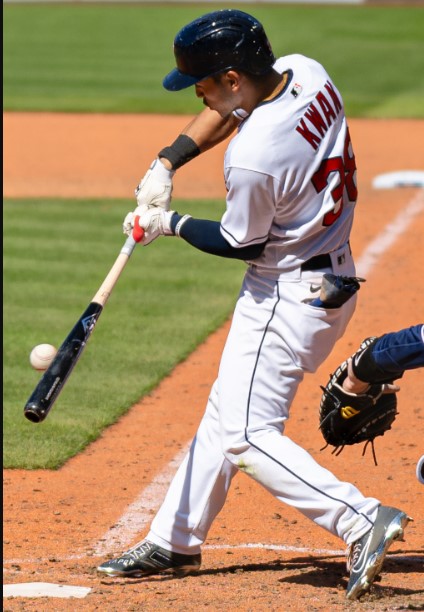
Photo: Erik Drost, CC BY 2.0 <https://creativecommons.org/licenses/by/2.0>, via Wikimedia Commons

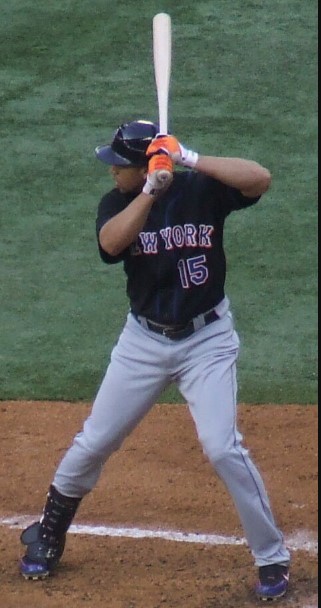
On April 13, Guardians’ rookie outfielder Steven Kwan did something he hadn’t done in his entire MLB career (to that point), he swung and missed a pitch. It came in his sixth MLB game, in his 25th MLB plate appearance, his sixteenth at bat, 117th pitch and 40th swing.  An eventual miss probably was probable (I apologize, couldn’t resit the word twist), going an entire career without a swing and miss seems unlikely.  Still, it caught my attention. (And actually, Kwan did make some contact, foul tipping the pitch into the catcher’s glove – which counts and a swing and miss.) For those who like to know such things, the first MLB pitcher to get a ball past Kwan was Nick Lodolo of the Reds, the pitch was a low-80s curveball and Kwan ended up striking out in a six-pitch at bat.  In those first six MLB games, Kwan collected ten hits (two doubles, one triple), eight walks and one hit-by-pitch  (a .526 batting average and  .655 on-base percentage). He finished his rookie campaign at .298-5-52, with 19 steals.

Kwan was a fifth round draft choice (2018) out of Oregon State University, where he hit .329 over three seasons (156 games). In three minor-league seasons (217 games), he stroked the ball at a .301 pace – including .328-12-44 in 77 games at Double- and Triple-A last season.

Number Nine … First All Latino Lineup.

On September 15 – MLB Roberto Clemente Day 2022 – Rays’ manager Kevin Cash made a bit of history sending  the first all-Latino lineup to the plate (against the Blue Jays in Toronto)

It went like this:

3B Yandy Diaz (born in Sagua le Grande, Cuba)

RF  Randy Arozarena (La Habana, Cuba)

SS Wander Franco (Bani, Dominican Republic)

1B Harold Ramirez (Cartagena, Colombia)

DH Manuel Margot (San Cristobal, Dominican Republic)

LF David Peralta (Valencia, Venezuela)

2B Isaac Parades (Hermosillo, Mexico)

C – Rene Pinto (Maracay, Venezuela)

CF Jose Siri (Sabana Grande de Boya, Dominican Republic)

The Rays, by the way, prevailed 11-0 over the Blue Jays.  For those who like to know such things, the Rays’ starting and winning pitcher was Shane McClanahan.

Baseball Roundtable Side Note:

After the close of the 1963 season, MLB had it first (and what proved to be only) All Hispanic All Star Game – featuring such stars as Tony Oliva, Minnie Minoso, Orlando Cepeda, Roberto Clemente, Luis Aparicio, Juan Marichal and others. One of The Roundtable’s favorite trivia questions is “Who was the inning pitcher in the only MLB All Hispanic All Star Game? The answer: A Latino All Star with an improbable name …  Alvin O’Neal McBean. McBean was born in the Virgin Island to Inger Emanuel and O’Neal Alfredo McBean.

Bonus Improbable from the Past

On September 1, 1971, the Pittsburgh Pirates fielded the first MLB lineup consisting of all  “players of color.”

Rennie Stennett 2B

CF Gene Clines

RF Roberto Clemente

LF Willie Stargell

C Manny Sanguillen

3B Dave Cash

1B Al Oliver

SS Jackie Hernandez

P Dock Ellis

The Pirates prevailed in the contest 10-7 – with six members of the starting lineup enjoying multi-hit games.

Number Ten  … Probably Will See This Again, but Don’t Want To.

This one was up close and personal. On April 13, 2022, I braved Minnesota’s uber-chilly spring to take in the Twins-Dodgers at Target Field.  Despite the fact that the Twins were down 3-0, there was plenty of drama on the field and plenty of excitement in the crowd, After seven frames,  many of us anticipated a chance to see Dodgers’ starter Clayton Kershaw try for MLB’s 24th-ever Perfect Game.  At the time, Kershaw had thrown just 80 pitches (53 strikes) and had fanned 13 batters. Only three balls had been hit out of the infield. He was cruising and it was a masterful performance to watch.

Kershaw, however, did not come out to pitch the eighth. Dodgers’ skipper Dave Roberts instead put in Alex Vesia. I might add the change was met with a chorus of boos, from Twins fans and a large contingent of Dodger Faithful seated behind the third base dugout.

Now, there’s never been a combined Perfect Game, so I had a bit of hope. One out and five pitches after Vesia took the mound, Twins’ catcher Gary Sanchez lined a single to right and the Perfect Game and even the no-hitter were gone. (The Twins, ultimately, lost 7-0 and Sanchez’ single was their only safety.)

Why did this disappointment rate to high on the Improbables list. Later, I learned, via the Elias Sports Bureau, that only twice since 1900 has an MLB pitcher been pulled after the seventh inning with a Perfect Game intact.  Both times, Roberts was the manager.  (The first was on September 10, 2016, when he pulled Rich Hill – a reported finger issue –  after seven innings with Perfect Game intact against the Marlins (and the Dodgers up 5-0). Hill had thrown 89 pitches (62 strikes) and fanned nine. Hill was replaced by Joe Blanton and ten pitches and two outs later, Marlins’ LF Jeff Francoeur collected the first of two Miami hits in the game.

Number Eleven … It’s Nice to be First.

In the April 7, 2022, Angels game, Shohei Ohtani became the first MLB player to throw his team’s first pitch of the season and also be in the batter’s  box to take his team’s first pitch of the season – as he started on the mound and lead off at DH.  He also recorded his team’s first strikeout of the season getting the first batter he faced  and made his team’s first out of the season, grounding our short-to-first on the first pitch he saw in the first inning (remember, he was batting first.)

Number Twelve  – Let’s Get This Party Started.

On August 24 of last season, Mariners’ 24-year-old rookie right-hander George Kirby started against the Nationals in Seattle.  And, he got off to  quite a “start.”  Kirby opened the game by throwing 24 straight strikes (before his first called ball). According to STATS, that represents a record number of strikes to start off a game (at least since the initiation of pitch tracking in 1988). Kirby did not throw a called ball until he was facing his eleventh batter – with two out in the bottom of the third.  Over that span, he fanned three batters, and gave up five singles and one run. While the Mariners eventually lost the game 3-1, Kirby had a solid outing – seven innings (eight hits, one run, no walks and nine strikeouts). He threw 85 pitches (69 for strikes).

Kirby, a first-round pick in the 2019 MLB draft (out of  Elon University), already had  well-earned reputation as a strike thrower. In 30 minor-league outings, he went 7-4, 2.26 and walked just 21 batters in 117 1/3 innings (139 strikeouts). Coming into the August 24 outing, he had walked just 13 in 90 2/3 MLB innings. He finished his rookie MLB season at 8-5, 3.39, with 22 walks and 133 whiffs in 130 innings.

Bonus Improbable from the Past

By the way, should inquiring minds want to know, the generally accepted record for consecutive strikes thrown in a game (at any time) is 38 – by the A’s Bartolo colon on April 18, 2012 (versus the Angels).  Overall, the streak lasted from the second pitch of the fifth inning until the seventh pitch of the eighth frame.  Surprisingly, Colon struck out just two batters during the streak.  He also gave up two hits during the streak of strikes. A few notes:

  • 35 of the 38 pitches were fastballs (two change ups and one slider).
  • There was only one swing and miss (17 strikes looking).
  • There were ten foul fouls and ten balls put in play.

Primary Resources: Baseball-Reference.com; Baseball-Almanac.com; MLB.com


Baseball Roundtable – Blogging Baseball Since 2012.

100Baseball Roundtable is on the Feedspot list of the Top 100 Baseball Blogs.  To see the full list, click here.

Baseball Roundtable is also on the Anytime Baseball Supply Top 66 Baseball Sites list.  For the full list, click here

I tweet (on X) baseball @DavidBaseballRT

Follow Baseball Roundtable’s Facebook Page here.  More baseball commentary; blog post notifications.

Member: Society for American Baseball Research (SABR); Negro Leagues Baseball Museum; The Baseball Reliquary. 

“Slim Sallee” – A Pitch-To-Contact Icon

Photo: George Grantham Bain Collection (Library of Congress)Redvers at en.wikipedia, Public domain, via Wikimedia Common

When it comes to pitching to contact, southpaw Harry Franklin “Slim” Sallee set a pretty high bar in 1919. That season, Sallee went 21-7, 2.06 for the Reds.  In 227 2/3 innings pitched, Sallee walked just 20 batters and fanned only 24.  In the process, he recorded the:

  • Fewest strikeouts (in a season) by a pitcher winning 20 or more games (since 1900). The next fewest is 37 strikeouts by the White Sox’ Hollis Thurston in his 20-14, 3.80 1924 season (291 innings pitched);
  • Fewest walks surrendered in a 20+-win season (since 1900) – second on the list is Giants’ Hall of Famer Christy Mathewson, with 21 walks in his 25-11, 2.06 season for the Giants in 1913;
  • Fewest strikeouts per nine innings in a 20+-win season since 1900 (0.9); The second-fewest belong to the White Sox’ Hollis Thurston at 1.1 in 1924.
  • Third-fewest walks per nine innings in a 20+-win season since 1900 (0.8). Christy Mathewson walked 0.6 batters per nine innings in a 25-11 season in 1913 and 0.7 batters per nine frames in a 24-13 season in 1914.

Note:  Baseball Roundtable used 1900 as a cutoff point on these particular stats because the rule counting the first two foul ball as strikes was not enacted until 1901 (National League, with the American League following in 1930) Similarly, the number of balls required for a walk was not reduced to four until 1889.  Notably, none of the pitchers to win 20 or more games after 1888 walked fewer batters than Sallee in 1919. 

Pre-1900 Records

For those who like to know such things. The fewest strikeouts ever in season of 20 or more wins were recorded in 1875 by the the Philadelphia Whites’ (National Association) William “Cherokee” Fisher, who fanned just 18 batters in a 22-19, 1.99 season (358 innings pitched). The fewest walks in a season of 20 or more wins was also set in 1875 – by the Hartford Dark Blues’ (National Association) William “Candy” Cummings, who walked just four batters (416 innings pitched) in a 35-12, 1.60 season. (It did take nine balls to draw a walk then.)

Let’s take a deeper look at Sallee’s 1919 season. He:

  • Notched 29 appearances (28 starts) and 28 complete games;
  • Threw eight complete games with zero strikeouts and nine complete games with zero walks;
  • Threw five of his complete games with no walks and no whiffs (included among those in the previous bullet);
  • Threw four complete-game shutouts, in which he walked a total of zero batters and fanned just one.

Sallee – as a 22-year-old – was purchased by the St. Louis Cardinals (from the Williamsport Millionaires) in August of 1907. In his third minor-league season (1907), he had gone 22-5  for Williamsport.

The slim 6’3” lefty  made his MLB debut on April 16, 1908, pitching two innings of two-run ball (four hits, three walks, zero whiffs) in a relief role (against the Pirates). In his next outing (May 7), he threw a complete-game, four-hit shutout against the Giants. Sallee went on to pitch in 14 MLB seasons (1908-1921 … Cardinals, Giants, Reds), going 174-143, 2.56 with 476 appearances (306 starts), 189 complete games and 25 shutouts. He recorded 573 walks and 836 whiffs in 2,821 2/3 innings.  Sallee won 15 or more games in six seasons.

Sallee was a crafty control pitcher – who could spot and throw to each hitter’s weakness –  with an unorthodox windup and  baffling delivery that  batters often said made the ball appear to be arriving from first base.

His overall record could have been better had he not spent the first eight-and-a half seasons of his career with the Cardinals (1908-1916). During that span, the Cardinals finished above .500  only twice  – and for the full 1908-16 seasons, they went 508-802.  During his time with Saint Louis, Sallee was 106-107, 2.67. In 1913, when the Cardinals were a woeful 51-99-3, Sallee won 19 games (15 losses). No other Cardinal starter won more than ten that campaign and no other Redbird starter put up a .500 or better record.

In the Society for American Baseball Research (SABR) bio on Sallee (written by Paul Sallee & Eric Sallee), they quote a Baseball Magazine article pointing to Sallee’s “imperturbable calm which nothing can disturb, faultless control, and back of all a scheming, crafty brain wise to all the quirks and twists of a pitcher.”  The SABR bio also notes that Sallee was not always the easiest player to deal with and that his career included training rule violations, fines, suspensions, threats of retirements and issues with alcohol.  Regardless, Sallee was one of the top pitchers of his time.

Let’s close this Spring Training post, with another Baseball Roundtable chart.

Primary Resources: Baseball-Reference.com; Baseball-Almanac.com

Baseball Roundtable – Blogging Baseball Since 2012.

100Baseball Roundtable is on the Feedspot list of the Top 100 Baseball Blogs.  To see the full list, click here.

Baseball Roundtable is also on the Anytime Baseball Supply Top 66 Baseball Sites list.  For the full list, click here

I tweet (on X) baseball @DavidBaseballRT

Follow Baseball Roundtable’s Facebook Page here.  More baseball commentary; blog post notifications.

Member: Society for American Baseball Research (SABR); Negro Leagues Baseball Museum; The Baseball Reliquary. 


Results of Baseball Roundtable Survey on 2023 MLB Rules Changes

 The Baseball Roundtable polls are closed and the results of the reader survey on MLB rules changes for 2023 (and one possible future change) are in.  The winners – at least among the 118 respondents to the Roundtable fan poll – were  the Shift Ban and the Pitch Clock, while the changes respondents loved to hate were making the Ghost Runner in extra innings permanent and the Limit on Pick-off Attempts.

Note:  Baseball Roundtable will repeat survey at the All Star break – after fans have had a chance to see the new rules in action.

Notably, while there were a few, “leave the game totally alone” responses, most appeared to evaluate each rule change on its own merits.

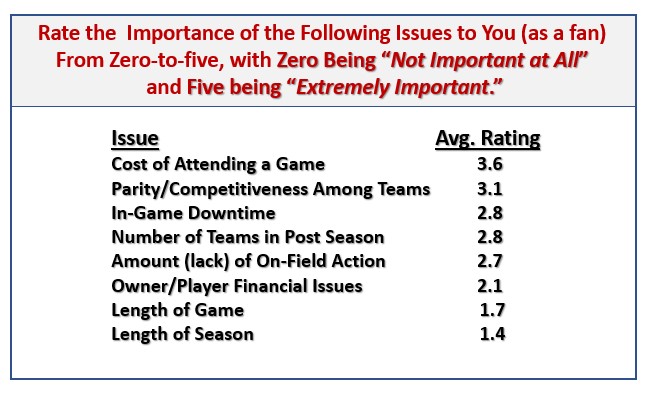
Before we look at the 2023 Rules Survey results, here’s a snapshot from an early 2022 Baseball Roundtable survey on factors affecting readers’ decisions to attend an MLB game.  I’d note here that In-Game Downtime and Amount (lack) of On-Field Action both far outpaced Length of Game.

With that bit of background, Let’s look at the final results of the 2023 rules change survey.

—-Shift Ban—-

Two infielders must be on each side of second base and within the boundaries of the infield as a pitch is thrown.  Also, infielders may not switch sides during a given inning (you can’t move your best infielder to the opposite side of the second base bag for a specific hitter).  Side note:  A team may still choose to bring an outfielder into the infield as a fifth infielder. Penalty:  A Ball is called.

Angels infield sift during 2015 Spring Training; Photo: Jon Gudorf Photography, CC BY-SA 2.0 <https://creativecommons.org/licenses/by-sa/2.0>, via Wikimedia Commons

This rule  change saw  48.4 percent  of respondents Loving or Liking it and 39.2 percent  Hating or Disliking it.

 Love it … 15.3%

Like it … 33.1%

Hate it … 13.7%

Don’t Like it … 25.5%

Neutral/No Opinion … 2.5%

Note: In an early 2022 reader survey, 55.9% liked the prospect of a shift ban; 35.1% disliked it.  To view the full 2022 survey (which deals with a wider range of MLB rules), click here. 

Baseball Roundtable Take:  I like the restrictions (shifts seem way overused to me), but would have preferred allowing teams to use the shift a specific number of times per game (say three) – forcing managers to make a strategic decision on when to use a shift.  (The shift has long been a part of the game, just not to the extent we see it today).

—–Base Sizes—–

The size of bases is  increased from 15 x 15 inches to 18 x 18 inches.

Neutral/No Opinion was the leading answer here, with 35 percent of respondents in that category. Those Hating or Disliking the new base size did outnumber those loving or liking it by a 41.0 percent to 23.9 percent margin.

Love it … 9.4%

Like it … 14.5%

Hate it … 20.5%

Don’t Like It … 20.5%

Neutral/No Opinion … 35.o%

Baseball Roundtable Take:  If you consider this a safety issue, giving fielders and runners more space to operate in, I’m on board.  If the argument is that it will increase action on the base paths, my answer is “Yawn.” Baseball may be a game of inches, but I don’t think six fewer  inches between the outside edge of the bases is gong to make much difference.

—–Pitch Clock—–

In 2023, there will be 30-second time limit between each batter, 15-second pitch clock with bases empty (pitcher must deliver the ball within 15-seconds of receiving it), 20 seconds with runner(s) on base.  Also, batters must be in the batter’s box and ready by the time there are eight-seconds left on pitch clock.  Note: Here’s where it gets sticky for me.  With runners on base, the timer resets if the pitcher steps off the rubber or attempts a pickoff (these are  “disengagements), with a limit of two disengagements per plate appearance (more on that later). The timer is also reset  if a baserunner advances  during a plate appearance. In addition,  batters are allowed one time out during a plate appearance.  Penalties: Pitcher violation- called Ball; Batter violation – called Strike.

A  majority of respondents fell into the Love It-Like It cadres (56.8 percent to 38.9 percent in the Hate It/Don’t Like It groups).

Note: In the early 2022 Roundtable reader  survey,  55.5% of respondents liked the idea of a strictly  enforced pitch clock; 31.4% disliked it. Both the supporting and opposing numbers increased in the new survey, while there were fewer neutral responses.)

Baseball Roundtable Take:    The jury is still out for me on this one. I’m fine with a pitch clock with the bases empty, as well as with the one batter’s time out per plate appearance. I’m not sure about the limit on “disengagements”  with runners on base.  I tend to enjoy the pitcher-base runner “cat-and-mouse” game.  Also, the “disengagement” limits (more on this in a later question), at least in my mind, complicate the experience for the average fan trying to follow the game. So, I’m in a “wait-and-see” mode on that portion of this change.

—-Limiting Pick-Off Attempts (disengagements) During a Plate Appearance—–

Pitchers will be allowed just two “disengagements” (pick-off attempts, fake pick-offs, stepping off the rubber, defensive time out) per plate appearance – with the disengagement count reset if a runner advances a base within the plate appearance. No penalty on a third pick-off  attempt if it produces an out. Penalty: If a pitcher steps off or attempts a pick-off a third time, it is treated as a Balk (runners advance) – unless the pick-off is successful (an out is recorded), then there is no penalty.

Interestingly, while a majority (56.8 percent) of respondents Loved or Liked the pitch clock, an ever larger majority (68.9 percent) hated or dislike the limiting of pick-off attempts (which , in part, prevent pitchers from circumventing the pitch clock with actual or feigned pick-off attempts).

Love It … 6.0%

Like It … 19.7%

Hate It … 49.2%

Don’t Like It … 23.1%

Neutral/No Opinion … 5.1%

Note: In the  2022 reader survey 72.5% disliked the idea of limiting pickoff attempts; 14.3 percent liked it.

Baseball Roundtable Take: Again, I like the pitch clock with no runners on base. I do not, however, support limiting pick-off attempts.  As noted earlier, I like the pitcher-base runner “cat and mouse” game – and consider pick-off plays to be on-field  “action.”  I do appreciate the third pick-off not being a violation if an out is recorded (which prevents runners from taking extraordinary leads after the allowed two pick-off attempts/disengagements).

Still, I’d feel better with just eliminating or restricting “fake” pick-offs (stepping off the rubber and “looking” the runner back).  My preference would be, if the pitcher disengages, he has to take the risk of making the throw. 

—–Extra-Inning Ghost Runner—–

The rule placing a runner at second base at the start of each extra inning is now permanent.  This is the rule change that respondents really loved to hate – with 75 percent responding they Hated or Did Not Like it (63.6 percent in the “Hate It” group).

Note; Compared to the 2022 survey, reader opposition, while still strong, was down from 82.4% to 75%, while support was up from 14.3% to 19.5%.

Baseball Roundtable Take:  Totally agree with the bulk of  survey respondents.  To me this rule change is a step too far. My stance is that  “earned” runners not “gift” runners should decide a ball game.  Yes, it will shorten extra-inning contests (I’m not convinced that’s a good thing). However, it also changes the basic structure and strategy of the game. 

—–Restrictions on Position Player Pitching—–  

Last season, position players could only be brought in to pitch in extra innings or if the player’s team was trailing by at least six runs. In 2023, the restrictions will be in extra innings or if the players’ team is trailing by at least eight runs (at any time) or ahead by at least ten runs in the ninth inning.

Well, 17.8 percent Love or Like this change, 53.4 percent Hated of Disliked it and 28.8 percent were in the Neutral/No Opinion group. .

Love It … 3.4%

Like It … 14.4%

Hate It … 27.1%

Don’t Like It … 26.3%

Neutral/No Opinion … 28.8%

Baseball Roundtable Take:  I was surprised  to see 30 percent with strong (Love It or Hate It ) opinions.  I did not expect strong opinions either way on this one.  This difference, really makes no difference to me.

—–LOOK TO THE FUTURE … Automated Strike Zone—–

Readers were asked about their opinions on the possible use of electronic devices to determine balls and strikes. Give a bit of an  edge to the umpires – even with their shortcomings – here. The Hate It and Dislike It groups had a 54.3 percent to 38.1 percent edge.

Love It … 12.7

Like It … 25.4

Hate It … 39.0

Don’t Like It … 15.3

Neutral/No Opinion …  7.6

Note: In the 2022 reader survey 54.1 % disliked the idea of an electronic strike zone, while 32.7% liked it.

Baseball Roundtable Take: Not a fan of this potential  change.  I do like to watch those pitchers with the skills to “expand” the strike zone at work. Still, if it comes to this, I can live with it. I do miss the days, however, when the philosophy was that – whether at the plate or on the basses” – the umpires “call” would even out.

————————————–

READER COMMENTS: 

Now, for a sampling of reader comments.

Automated Ball and Strike Calls

Regarding the automated strike zone, I don’t support a 100% computer-controlled system. However, I would support using it for “challenges” on balls and strikes, so long as it could be done with limitations on when or how many challenges can be used.  CHRIS (did not give a state)

_____

I like the balls and strike rules used in AAA last year. If I remember right, the batter, pitcher, catcher or either manager can ask for a very limited review of a pitch, then they show one of the computer generated views of where the pitch was. If the pitch is not reversed, the team that requested the review loses one of their appeals. EDDIE (California)

_____

LOVE the Robo Umps w/ balls & strikes. You simply can’t continue to track pitches with a computer, show the fans the real location in real time, and have umpires blow the call. Research shows 34,000 missed calls in a season. Each game averages approximately 300 pitches. That is 113 FULL games worth of missed balls and  strikes. Unacceptable. The hitters are the best in the world and can discern with expert precision. You can’t allow a bad ump to take that expertise away, while simultaneously showing the fans at home the truth. Since the chances of success vary so wildly between starting 1-0 or 0-1, we cannot allow bad umpiring to continue to cause this unnecessarily.  No Name Given, but noted permission  to use the comment.

Limit on Pick-Off Attempts

Instead of limiting pickoff attempts, I would ban leading off first base. Treat it like tagging up on a fly out. I’d also require mid-inning relievers to enter from the dugout, and no warm-up pitches.  My pitcher friend hates my reliever proposals! RICHARD (Minnesota)


Pitch Clock

I went to a minor league game last year. Went to the concession stand to pick up food and beverages……..missed about an inning and a half or so. Pitch clock was too fast.  RON, North Carolina

General

Certain things baseball needs to do to modernize the game as well as to cut the length of games and make the games more appealing.  However, some of these rules changes are just stupid and don’t address the real issues. DAN (no state given)

—–

I think that we have to allow ourselves to see how the game might improve for the greater good, despite my misgivings or questions about whether the changes are consistent with the spirit of the game.  STEVE (Michigan)


Baseball Roundtable – Blogging Baseball Since 2012.

100Baseball Roundtable is on the Feedspot list of the Top 100 Baseball Blogs.  To see the full list, click here.

Baseball Roundtable is also on the Anytime Baseball Supply Top 66 Baseball Sites list.  For the full list, click here

I tweet (on X) baseball @DavidBaseballRT

Follow Baseball Roundtable’s Facebook Page here.  More baseball commentary; blog post notifications.

Member: Society for American Baseball Research (SABR); Negro Leagues Baseball Museum; The Baseball Reliquary. 


Book Review – The Greatest Summer in Baseball History: How the ’73 Season Changed Us Forever

The Greatest Summer in Baseball History:  How the ’73 Season Changed Us Forever


By John Rosengren

Sourcebooks, Naperville, IL

$16.99 

(To be released April 1, 2023 … May be pre-ordered at indiebound.org and amazon.com)


In  1973, Major League Baseball appeared to be at a crossroads.  The game was facing the blowback from 1972’s first-ever players’ strike; the balance of power between players and owners had changed dramatically; the American League had adopted a controversial rule change (the Designated Hitter); racial animus was coming to the forefront as Henry Aaron closed in on the iconic Babe Ruth’s career home run record; Reggie Jackson was redefining the image of the baseball superstar; and George Steinbrenner and Charlie Finley were breaking the norms as baseball owners.  Forbes Magazine, in fact, predicted major league baseball “could well vanish from the scene in twenty years.”

In The Greatest Summer in Baseball History: How the ’73 Season Changed Us Forever, award-winning author John Rosengren gives readers a vivid picture of the forces and individuals that helped redefine baseball in 1973 – putting the game on a new, more colorful (and, at times. more controversial) path.

In his well-researched and well-written book, Rosengren provides the expected descriptions of the on-field action in pennant races, post-season games and record-chasing endeavors. He also takes readers behind the scenes (into the dugouts, clubhouses and executive offices), examining the personalities who were reshaping the game. He also ties the course of the baseball season with the events of the times (like the Watergate Scandal, the withdrawal from Vietnam, the Billy Jean King/Bobby Riggs Battle of the Sexes and George Steinbrenner’s legal troubles.

Rosengren tells the tale of the 1973 MLB season without pulling any punches. For example, he details how  a resurgent Orlando Cepeda successfully put his mark on the Designated Hitter position, as well as how a declining Willie Mays struggled through his final MLB season (with the Mets). When recounting Reggie Jackson’s 1973 season, Rosengren reports that Reggie Jackson led the American League in home runs, RBI and game-winning hits, but also notes that Jackson was a new kind of superstar, one who played for the ego and the money.

With his usual thoroughness, Rosengren traces the development of Jackson’s ego all the way from his high school days (football scholarship offers from 48 colleges) until his trade to the Yankees, when he  announced “I did not come to New York to be a star, I brought my star with me.” As he describes Jackson’s approach to stardom – often irritating and even offensive to many (even his teammates) – Rosengren notes that Jackson also added a new level of excitement to the game.

“Jackie Robinson changed the color of the game; Reggie infused it with color. He broke the duller barrier.”  

                                                               The Greatest Summer in Baseball History

Baseball Roundtable Note: “The Greatest Summer in Baseball History: How the ’73 Season Changed Us Forever” was first published in 2008 under the title “Hammerin’ Hank, George Almighty and the Say Hey Kid: The Year that Baseball Changed Forever.”  The book is being re-released this year, the 50th anniversary of the 1973 season.

Without giving too much away, let’s take a look at a few examples of how Rosengren approaches the stories of the 1973 season.  We’ll start with Hank Aaron’s 1973 season, unfolding as he approached the iconic Babe Ruth’s hallowed 714 career home runs (Aaron would close 1973 with 713 regular-season long balls). Rosengren details Aaron’s on-field accomplishments, as well as the stress of the pursuit and the mountain of racially-based  threats against not just Aaron himself, but also his family.

“It (the pursuit of Ruth’s record) should have been the most enjoyable time of my life, and instead it was hell.”

            Hank Aaron, noted in The Greatest Summer in Baseball History

What intrigued me was that Aaron was nearly as disturbed by Atlanta’s indifference to his pursuit of the record as he was by the race-based hate mail. For example, on Hank Aaron Poster Day at Atlanta Stadium (April 29, 1973) – when the Braves planned to give out posters to the first 20,000 youngsters –  a total of only 12,152 (youngsters and adults) were reported in attendance. After the game, Aaron commented that  “Atlanta overwhelmed me with its indifference.” Later in the season, when Aaron popped his 711th round tripper (September 17), only 1,362 fans showed up in Atlanta. “That was a pretty strong statement of what Atlanta though of me and my record,” Aaron observed.

There were, of course, positive moments – and Rosengren shares those as well. On August 6, “Hank Aaron Day” was held in the former home of the Braves, as Aaron’s Atlanta squad took on the Brewers in an exhibition game in Milwaukee. There, Aaron basked in an extended standing ovation from more than 33,000 fans. There was a similar response at the 1973 All Star Game and Atlanta fans did come around, putting 40,000 plus in the seats (and out of their seats for a five-minute  standing ovation) for Atlanta’s final home game of the season.

The point here is that – as with other topics in the book – Rosengren enables us to relive the significant events of 1973, the good and the bad.  And, he does it with detail and accuracy, as well as with entertaining and active prose.

Rosengren also gives readers a look at the Mets, who made won the NL East title and made it to the World Series, despite being in last place on August 30 and not topping .500 to stay until September 22.-

“Excitement for the Mets in New York seemed directly proportional to disgust for the Nixon Administration.”

                                                        The Greatest Summer in Baseball History

Rosengren shares a game-by-game account of the of the 1973 Mets/Reds NL Championship Series – identifying the heroes and the goats.  Part of the tale that particularly grabbed me took place in Game Two.  In the fifth inning of that contest – with the  Reds up 9-3 – Pete Rose (breaking up a  double play) took out Mets’ shortstop Buddy Harrelson.  The action resulted in a bench-clearing brawl.  It was not your usual push-and-shove in-field match, but one marked by some pretty heavy punches. (Rosengren includes a blow-by-blow account, including Reds’ pitcher Pedro Borbon’s taking a bite out of a Mets player’s cap.)  Once the field was cleared, the excitement was far from over. When Rose took his place in left field the next inning, the fans greeted him with what Rosengren terms ”a barrage of insults and an artillery of garbage.” It took more than ten minutes and a visit to the outfield by peacekeeper Willie Mays to quiet the crowd.

“I’m no damn little girl out there. I’m supposed to give the fans their money’s worth and try to bust up double plays – and shortstops.  I’ll be honest, I was trying to knock him into left field.”

                          Pete Rose, after his NLCS collision with Bud Harrelson

Rosengren tells the story of the 1973 World Champions A’s  and the deep rift between the players and owner Charlie  Finley.   A rift so deep that, at one point, the A’s players discussed going on strike during the 1973 World Series. Rosengren shares the story of Reggie Jackson flipping the bird at owner Charlie Finely after delivering a pinch-hit home run and gives readers a look at Finley –  defying post-heart attack doctors’ orders – and continuing his meddling ways from a wheelchair (with a bottle of yellow heart pills in his pocket).

And, there’s much more in the book, including (but, as they say, not limited to):

  • Orlando Cepeda overcoming gimpy knees to be named 1973’s first-ever Outstanding Designated Hitter of the Year;
  • The rift(s) between, Hank Aaron and Baseball Commissioner Bowie Kuhn; Willie Mays and Mets’ skipper Yogi Berra; George Steinbrenner and the Federal Court system;
  • The forces behind, skepticism surrounding and impact of the Designated Hitter rule;
  • George Steinbrenner’s zealous efforts to prove Gaylord Perry was throwing spitballs;
  • Willie Mays’ moments of struggle and moments of glory in his final season.

Ultimately, The Greatest Summer in Baseball History is a highly informative and entertaining look at a watershed year for baseball. If you’re a baseball fan, you’ll enjoy the action and  John Rosengren’s take on the people, events and social forces that shaped the season and the future course of the National Pastime.

____________________________________________________

About the Author

John Rosengren is an award-winning journalist and author, whose articles have appeared in more than 100 publications, ranging from The Atlantic to Sports Illustrated. He is a lifelong baseball fan and a member of the Society for American Baseball Research.

He has written ten books including:

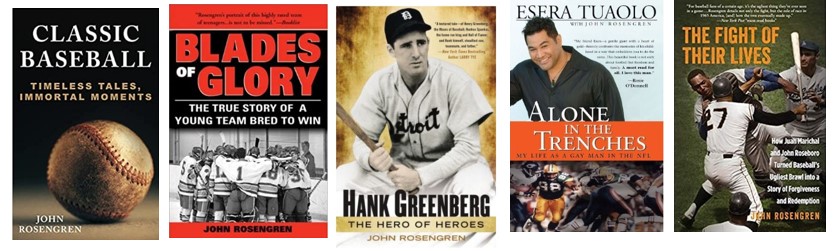
The Fight of Their Lives: How Juan Marichal and John Roseboro Turned Baseball’s Ugliest Brawl into a Story of Forgiveness and Redemption

Hank Greenberg: The Hero of Heroes

Classic Baseball: Timeless Tales, Immortal Moments

Blades of Gory: The Story of a Young Team Bred to Win

Alone in the Trenches:  My Life as a Gay Man in the NFL. (With Esera Tuaolo)

Life is Just a Party (short story collection)

Clean Heart (Novel)

Rosengren is a Pulitzer Prize nominee.  Among his many awards is the 2017 Donald Robinson Award for Investigative Journalism.

___________________________________

A Brief Interview with the Author

Roundtable:    When did you first develop your passion for baseball?

Rosengren: I fell in love with baseball as a young boy. My father took me to Twins games at Met Stadium and passed along his love for the game through his stories and explanations of how the game was played. That love grew with my collection of Topps baseball cards, which I still have tucked into a few shoe boxes in my basement.


Roundtable: Did you ever play organized ball … from Little League on?

Rosengren: I started playing T-ball in as a six-year-old and continued playing until my junior year of high school when I was an outfielder on the JV team. I returned to the game in my 40’s, playing catcher and outfield for the Richfield Rockets in the 35-over wooden bat Federal League.


Roundtable:  What spurred you to delve so deeply in the 1973 season?

Rosengren: I wanted to write a book that chronicled a season and figured the ’73 season, with all of the events that happened that year, was one of the most formative years in the history of the game. It also happened to be a significant year in the history of our country, so 1973 was a rich subject. It helped that I remembered the season fondly from my youth, because that increased my interest in learning more about it.


Roundtable:  How long did the research for The Greatest Summer take and were there any specific challenges to getting the full picture?

Rosengren: I spent about two years researching the season until I got to the point where I felt I could tell its story with authority.


Roundtable:  Is there a specific goal or philosophy you bring to your efforts when putting together  a book?

Rosengren: I want to be able to tell a story in a compelling way and to write about substantial subjects. The racial injustice exposed by the opposition Hank Aaron faced in his pursuit of Ruth’s career home run mark is an example of the gravitas that makes this more than simply “a baseball book.”


Baseball Roundtable – Blogging Baseball Since 2012.

100Baseball Roundtable is on the Feedspot list of the Top 100 Baseball Blogs.  To see the full list, click here.

Baseball Roundtable is also on the Anytime Baseball Supply Top 66 Baseball Sites list.  For the full list, click here

I tweet (on X) baseball @DavidBaseballRT

Follow Baseball Roundtable’s Facebook Page here.  More baseball commentary; blog post notifications.

Member: Society for American Baseball Research (SABR); Negro Leagues Baseball Museum; The Baseball Reliquary. 


Voice Your Opinion on MLB Rules Changes

Pitch clocks, Banned Shifts, Ghost Runner Permanency, Electronic Strike Zones and more … Baseball Roundtable Wants Your Opinions on new MLB Rules for 2023 and a couple of changes that could be on the horizon.  Click here for the survey.  We’ll keep it open until the end of February

Baseball Roundtable – Blogging Baseball Since 2012.

100Baseball Roundtable is on the Feedspot list of the Top 100 Baseball Blogs.  To see the full list, click here.

Baseball Roundtable is also on the Anytime Baseball Supply Top 66 Baseball Sites list.  For the full list, click here

I tweet (on X) baseball @DavidBaseballRT

Follow Like Baseball Roundtable’s Facebook Page here.  More baseball commentary; blog post notifications.

Member: Society for American Baseball Research (SABR); Negro Leagues Baseball Museum; The Baseball Reliquary. 


Triple Crown Moundsmen – Big Names with Big Seasons

In Baseball Roundtable’s last post, we took a look at MLB’s (batting) Triple Crown Winners – with an emphasis on those who earned that distinction in multiple seasons. (For that post, click here.)  This post will look at a less publicized Triple Crown category, focusing on those  hurlers who won MLB’s pitching Triple Crown (Wins-Earned Run Average, Strikeouts); again emphasizing those with multiple qualifying seasons.  The list reads like w “Who’s Who” of moundsmen. You might recognize some of them by their  nicknames The Left Arm of God, The Big Train, Rocket, Big Six and a couple of well-known Lefty’s.”  Of the 32 pitchers who have recorded at least one Triple Crown season, 19 are in the Hall of Fame  (three of those not in the Hall have yet to be eligible).

So, let’s get on with it.

Pitchers with Three Triple Crown Seasons

Asterisk = Hall of Famer


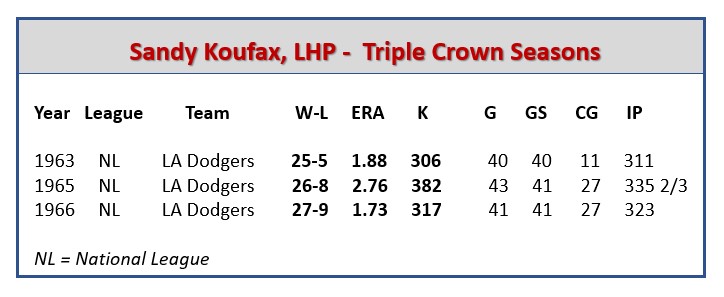
Sandy Koufax* … 1963, 1965, 1966

Photo: Publicity still, public domain, via Wikimedia Commons

Hall of Famer Sandy Koufax (aka “The Left Arm of God”) earned three pitching Triple Crowns in the midst of one of the most dominant streaks in MLB pitching history. From 1962 through 1966, Koufax went 111-34, with a 1.95 earned run average and 1,444 strikeouts in 1377 innings. In that five-season stretch, Koufax led the NL in:

  • Earned Run Average all five seasons;
  • Wins in three campaigns;
  • Shutouts three times;
  • Strikeouts three times (all three with 300+ whiffs);
  • Complete games twice;
  • WHIP four times;
  • Strikeouts per nine innings four times.


In that five-season span, he also won three Cy Young Awards earned one  NL MVP Award and threw four no-hitters (one a perfect game).

“I can see how he won 25 games. What I don’t understand is how he lost five.”

                      Hall of Fame catcher Yogi Berra on Sandy Koufax (1963)

If it were not for traumatic arthritis in his  pitching elbow – which forced his retirement at age 30 (after one his finest seasons) – Koufax probably would have eventually moved into first place on his own in the pitching Triple Crown list.  In his final MLB season, Koufax led all of MLB in wins (27); ERA (1.73); strikeouts (317); innings pitched (323); starts (4, tied); complete games (27); shutouts (tied, five).

For his career Koufax was 165-87, 2.76, with 2,396 whiffs in 2,324 innings.

_______________________________________________

A Tale of Two Pitchers

Sandy Koufax started as a hard thrower who, some observed, saw his control diminish as his velocity increased.  In Spring Training 1961, it has been reported, Dodgers’ catcher Norm Sherry, urged Koufax to loosen his group on the ball, take a little bit off his fastball and make more use of his curve and change-up.

As the chart below shows that advice apparently made an impression (or, perhaps, Koufax just matured – he was only 25 in 1961).

“I became a good pitcher when I stopped trying to make them miss her ball and stated trying to make then hit it.”

                                                           Sandy Koufax

__________________________________________________

Walter Johnson* … 1913, 1918, 1924

Photo: Charles M. Conlon, Public domain, via Wikimedia Commons

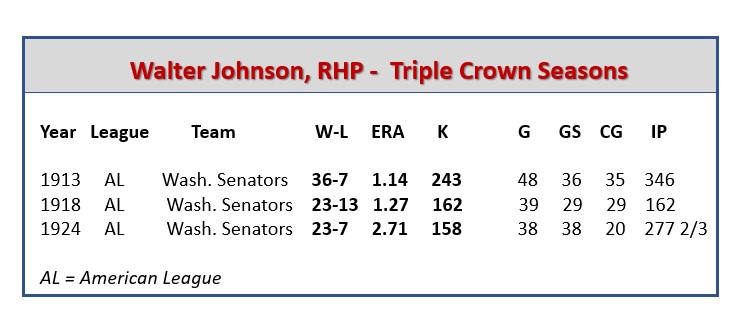
Hall of Famer Walter “The Big Train”  Johnson notched three Triple Crown seasons in a  21-season MLB career that saw him win 417 games with 12 seasons of 20 or more wins. In his first Triple Crown season, Johnson also led the AL in complete games (29), shutouts (11), innings pitched (346), WHIP (0.78). He also notched (among qualifiers) the fewest walks per nine innings and most strikeouts per nine innings. That performance earned him one of his two AL MVP Awards. His second MVP Award would come 11-seasons later (1924), when he as picked up his third pitching Triple Crown.

How good was Walter Johnson?  In his  career, he led the American League in:

  • Strikeouts 12 times;
  • Wins six times;
  • ERA five times;
  • Starts four times;
  • Complete games six times;
  • Shutouts seven times;
  • Innings pitched five times.

Between 1910 and 1916, Johnson won 25 or more games in every season. You get the idea.

No Need to Dust Off  Plate … Nobody’s Coming Home

Walter Johnson’s 110 career shutouts are the all-time MLB high,  20 ahead of runner-up Grover Cleveland (Pete) Alexander.

Johnson finished his career with a 417-279 record (second in wins only to Cy Young); a 2.17 ERA; 531 complete games (fifth all-time) in 666 starts;  and 3,509 strikeouts (ninth all-time).

“His fastball looked about the size of a watermelon seed and it hissed at you as it passed.”

                                           Hall of Famer Ty Cobb on Walter Johnson

______________________________________________

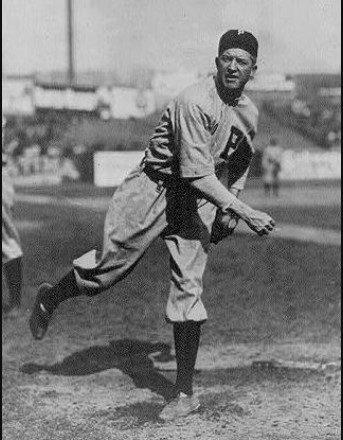
Grover Cleveland Alexander* … 1915, 1916, 1920

Photo: Mattingly23, Public domain, via Wikimedia Commons

Grover Cleveland (Pete) Alexander made his MLB debut with the Philllies in 1911 – at the age of 24 – and he wasted no time in showing his potential on the major-league stage.  In that rookie season, he led the National League  in wins (28 – versus 13 losses), complete games (31), shutouts (7) and innings pitched (367),  while finishing fifth in ERA and second in strikeouts.

Of note is the fact that Alexander Alexander’s professional baseball career almost ended before he ever made it to a major-league mound. In a July 1909 Missouri League game, Alexander, running between first and second, was hit in the head by the shortstop’s attempted double play relay. According to Jan Finkel’s Society for American Baseball Research Alexander biography “”Reports vary, but he was unconscious between 36 and 56 hours. He awoke suffering from double vision, which he endured during the fall and winter into the next spring.” It’s possible the injury contributed to epilepsy that would later take its toll on the future Hall of Famer.

In his first Triple Crown season (1915), Alexander led the NL not only in wins (31), ERA (1.22) and strikeouts (241), but also in complete games (36), shutouts (12), innings pitched (376 1/3) and  WHIP (0.842).

Lucky Number Seven

In his first seven MLB seasons (1915-17), Pete Alexander led the NL in wins and strikeouts five times each (three times reaching 30 or more victories).

Over his 20-season MLB career, Alexander led the NL in wins six times, ERA five times, complete games six times, shutouts seven times, innings pitched seven times and strikeouts six times.

Alexander’s baseball career was interrupted in 1917 by military service in World War. He reportedly suffered from shell shock (which we would now term Post Traumatic Stress Disorder), as well as ear and arm injuries.  His injuries, coupled with epilepsy and ongoing issues with alcohol, likely had had an impact on Alexander’s mound achievements.  For example, in his first seven seasons (1911-1917), Alexander led the NL in strikeouts five times. In his final 13 seasons (post World War I service), he led the league in whiffs just once.  From 1911 through 1917, Alexander was 190-88, winning an average of 24 games  per season with a 2.12 ERA. From 1918 through his retirement in 1930, he went 183-120, winning an average of 14 games per season) and posting  a  2.96 Era.

Still, Alexander maintained the pinpoint control that was his trademark as a moundsman. Over his 20-season MLB career, he walked only 1.6 batters per nine frames and, from 1914 through 1929, walked just 1.4 batters per nine innings, never reaching 2 batters per nine frames in any season.

Put It There, right There, Pal

Over his MLB career, Pete Alexander recorded the fewest walks per nine innings in his league five times and finished in the top two a total of ten times.   

Over his 20-MLB seasons, Alexander went 373-208, 2.56 with 436 complete games and 90 shutouts  in 600 starts (696 appearances). His 373 MLB wins are third all-time and his 90 shutouts second, (first in the NL). He won 20 or more games nine times, with 30 or more wins in three of those seasons. He led the NL in ERA five times, complete games six times, shutouts seven times, innings pitched seven times and strikeouts six times. His 16 shutouts in 1916 remain tied for the most-ever in a single MLB season.

“He (Pete Alexander) could pitch into a Tin Can. His control was always remarkable – the finest I’ve ever seen.”

            Grantland Rice in “Winningest Pitchers: Baseball’s 300-Game Winners”

Another Roundtable” one thing leads to another” moment: ” Grover Cleveland Alexander is the only MLB player named after a past president, who later had a future president play him in a movie. (Ronald Reagan played Alexander in the 1952 movie The Winning Team.)


Players with Two Pitching Triple Crowns

Asterisk = Hall of Famer

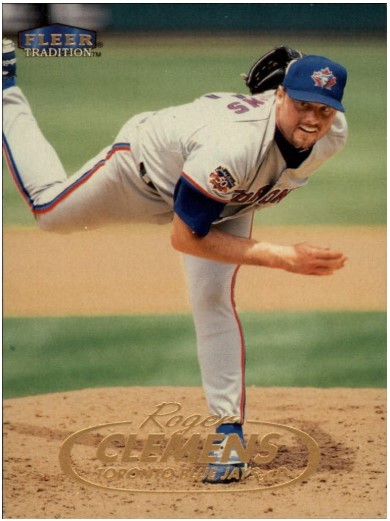
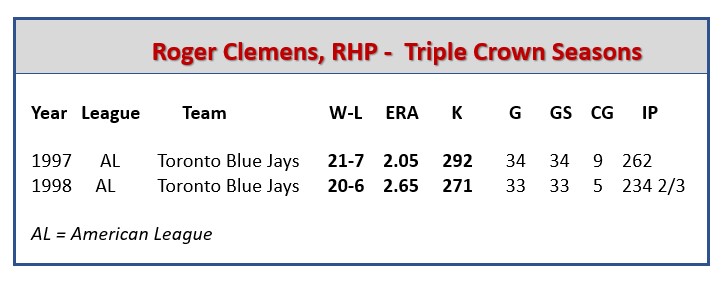
Roger Clemens … 1997, 1998

Roger Clemens put together consecutive Triple Crown seasons for the Toronto Blue Jays in 1997 and 1998. They were his age-34 and age-35 seasons, 14th and 15th MLB campaigns.  By the start of the 1997 season, he was already a five-time All Star with a 192 MLB wins on his resume.

Clemens played in 24 MLB seasons (1984-2002 … Red Sox, Blue Jays, Yankees,Astros) – taking the mound from age 21 to age 44.  He led his league in wins four times, ERA seven times, strikeouts five times, complete games three times and shutouts six times. Along the way, Clemens won a record  seven Cy Young Awards and was the 1986 American League MVP. His overall stats were: 354-184 (ninth in career  MLB wins), 3.12, with 4,672 strikeouts (third) in 4,916 2/3 innings pitched (16th).

Twenty Times Two

Roger Clemens is the only MLB pitcher to record 20 strikeouts in a nine-inning game twice. In those two games (April 29, 1986 and September 18, 1996)  – both for the Red Sox – he pitched 18 innings, gave up eight hits and one run, while walking zero and fanning 40. For those who liked to know such things, the one run came on a Gorman Thomas (Mariners) home run on a 1-2 pitch in the top of the seventh inning of the 1986 outing.

___________________________________________________________

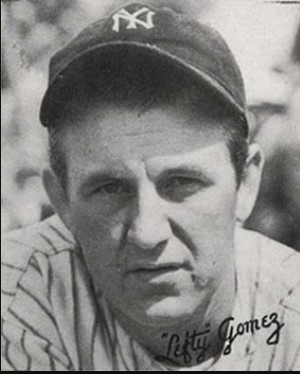
Lefty Gomez* … 1934, 1937

Photo: Goudey Gum, Public domain, via Wikimedia Commons

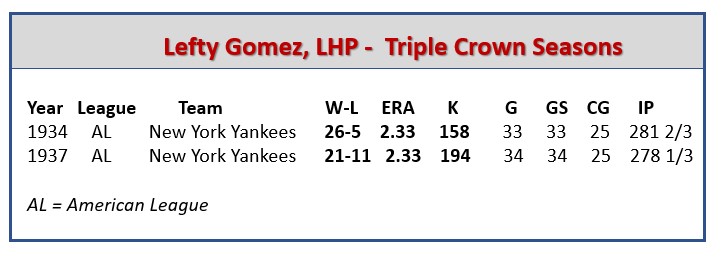
Hall of Famer Vernon “Lefty” Gomez, captured the American League pitching Triple Crown in 1934 and 1937. Those were the only two seasons in which Gomez led  the AL in wins, the only two seasons he led in ERA and two of the only three seasons he led in strikeouts. He also led the AL in complete games once, shutouts three times and innings pitched once

Gomez finished with a career mark of 189-102 (including four seasons of 20+ wins), 3.34, with 1,468 strikeouts in 2,503 innings pitched, and 173 complete games in 320 starts.  He was 6-0, 2.86 in seven World Series starts.

Quick with the Quip

Lefty Gomez was known as one of baseball’s most engaging and entertaining characters, His plaque in the New York Yankees’ Monument Park reads “Noted for his excellent wit, as he was fast with a quip and a pitch.”

Gomez pitched in 14 MLB seasons (1930-42 for the Yankees and one game in  1943 for the Senators). He was an All Star in seven seasons.

__________________________________________________

Lefty Grove* … 1930, 1931

Photo: Goudey, Public domain, via Wikimedia Commons

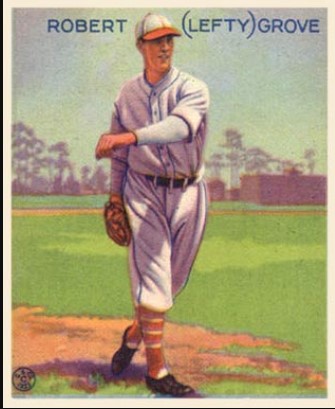
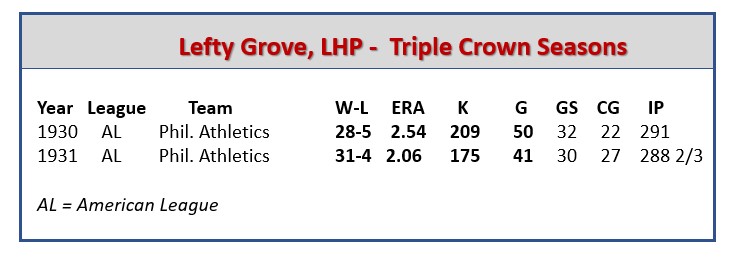
Hall of Famer Robert “Lefty” Grove notched back-to-back Triple Crown seasons for the Philadelphia Athletics in 1930 and 1931.  Those campaigns were part of a seven-season stretch (1927-33) in which he won 20 or more games each season (31 in 1931), leading the league in wins, ERA and strikeouts four times each.


Put Me In Coach

In his 1930 Triple Crown season, Gomez not only led the Al in wins, ERA and whiffs, he also topped the league in saves (noted retroactively) with nine. That season, he made 52 starts and 18 relief appearances. He was 23-2, 2.55 as a starter and 5-2, 2.03, with nine saves  as a reliever.

Grove pitched 17 MLB seasons (1925-41 … Athletics, Red Sox) going 300-142, 3.06, with 298 complete games in 457 starts.  He led the AL  strikeouts seven times – his first seven MLB seasons (1925-31). He also led the league in ERA nine times, complete games three times, shutouts three times,  He was the 1931 AL MVP.

_______________________________________________

Christy Mathewson* … 1905, 1908

Photo:  trialsanderrors

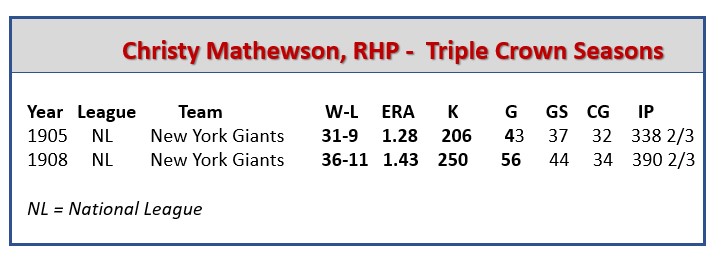
In Hall of  Famer Christy “Big Six” Mathewson’s second Triple Crown season (Giants 1908), he not only led the National League in wins (37) ERA (1.43) and strikeouts (259), but also in pitching appearances (56), saves (5), starts (44), complete games (34), shutouts (11), innings pitched 390 2/3 and WHIP (0.827).

Christy Mathewson was, in many ways, the All-American boy (one of his nicknames was “The Gentleman Hurler) – handsome, honest, well-educated, well-read and well-spoken. At Bucknell University, he played football, basketball and baseball and  was a bright student, a class president and a member of the band, glee club and a pair of literary societies.

Christy (Mathewson was the greatest pitcher who ever lived. He had knowledge, judgment, perfect, control and form. It was wonderful to watch him pitch, when he wasn’t pitching against you.”

                                              Hall of Fame Manager Connie Mack

Mathewson played in 17 MLB seasons (1900-16 … Giants, except for one game with the Reds in 1916).  He won 20 or more games in 13 seasons (30 or more four times) and led NL in wins four times, ERA five times, complete games twice, strikeouts five times and shutouts four times. He led in strikeouts-to-walks ratio nine times, including eight consecutive seasons (1907-14).

Mathewson finished his career with a 373-188 record, a 2.13 ERA, 2,507 strikeouts (in 4,788 2/3 innings)  and 435 complete games in 552 starts.

_________________________________________

Pitchers with Single Triple Crown Seasons

Asterisk = Hall of Famer

2020 –  Shane Bieber, Indians. American League … 8-1, 1.63 ERA, 122K

2011 –  Justin Verlander,  Tigers, American League  … 24-5, 2.40 ERA, 250K

2011 – Clayton Kershaw, Dodgers, National League… 21-5, 2.28 ERA, 248K

2007 – Jake Peavey, Padres, National League … 19-6, 2.54 ERA, 240K

2007 was the only season in which Jake Peavey led the league in wins.  In fact, it was the only season in which he won more than 15 games.  He led the NL in strikeouts twice and ERA twice in his 15 MLB seasons.

2006 –  Johan Santana, Twins, American League … 19-6, 2.77 ERA, 245K

2002  – Randy Johnson*, D-backs, American League … 24-5, 2.32 ERA, 334K

Randy Johnson had five seasons of 300+ whiffs, including four consecutive (1999-2002).

1999  – Pedro Martinez*, Red Sox, American League…. 23-4, 2.07, 313K

In 1999, Pedro Martinez led the AL in wins by five, won the ERA title by 1.37 earned runs per nine frames and had 113 more strikeouts than the AL runner-up.

1985  – Dwight Gooden, Mets, National League … 24-4, 1.53 ERA, 268K

1972  – Steve Carlton*, Phillies … 27-10, 1.97, 310K

Steve Carlton won the 1972 pitcher Triple Crown for the last-place  Phillies (who finished 59-97).

1945  – Hal Newhouser*, Tigers, American League … 25-9, 1.81 ERA, 212K

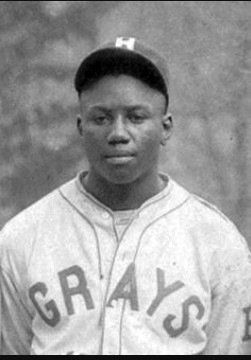
1943 – Johnny Wright, Homestead Grays, Negro National League II … 18-3, 2,54 ERA,  94K

1940  – Bob Feller*, Indians, American League … 27-11, 2.61 ERA, 261K

1939  – Bucky Walters, Reds, National League … 27-11, 2.29, 137K

1938  – Ray Brown*, Homestead Grays, Negro National League II … 14-0, 1.88 ERA, 70K

Between 1935 and 1942 (eight seasons), Ray Brown led the Negro National League II in wins six times. 

1934 – Stuart “Slim” Jones, Philadelphia Stars, Negro National League II … 20-4, 1.24 ERA, 164K

1924  – Arthur “Dazzy” Vance*, Brooklyn Robins, National League … 28-6, 2.16 ERA, 262K

Dazzy Vance led the NL in strikeouts in seven straight seasons (1922-28).

1918 – James “Hippo” Vaughn, Cubs, National League … 22-10, 1.74 ERA, 148K

1913  – George “Rube” Waddell*, Athletics, American League 27-10, 1.48 ERA, 287K

In 1902, Rube Waddell started the season with the Los Angeles Angels of the California League. He joined the Philadelphia Athletics in mid-season (making his first appearance June 26). He went on (in that short span) to win 24 games (the league’s second-highest total), put up the league’s second-best ERA (2.05) and lead the league in strikeouts (205).  He would go on to lead the league in whiffs in each of the next five seasons.

1901 – Denton “Cy”  Young*, Boston Americans, American League … 33-10, 1.62 ERA, 158K

1894 – Amos Rusie*, New York Giants, National League … 36-13, 2.78 ERA, 195K

1889 –  John Clarkson*, Boston Beaneaters, National League … 49-19, 2.73 ERA, 284K

1888 – Tim Keefe*, New York Giants, National League … 35-12, 1.74 Era 335K

1884  – Guy Hecker, Louisville Eclipse, American Association … 52-20, 1.80 ERA, 385K

In 1886, Guy Hecker went 26-23, 2.87 on the mound  – and led the American Association in batting with a .341 average. He appeared in 49 games on the mound, 22 at first base and 17 in the outfield.

1884 – Charles “Old Hoss” Radbourn*, Providence Grays, National League  60-12, 1.38 ERA, 441K

In 1884, Old Hoss Radbourn started 73 games and completed 73 games. He also come on in relief in two games and appeared in seven games in the outfield, five at first base, two at shortstop and one at second base.

Side Note: Some sources credit Radbourn with “only” 59 wins in 1884, baseball-reference lists the total at 60.

1877 – Tommy Bond, Boston Red Stockings, National League … 40-17, 2.11 ERA, 170K

Primary Resources:  Baseball-Reference.com; Baseball-Almanac.com, “The Baseball 100,” by Joe Posnanski, Avid Reader Press, 2021.


Baseball Roundtable – Blogging Baseball Since 2012.

100Baseball Roundtable is on the Feedspot list of the Top 100 Baseball Blogs.  To see the full list, click here.

Baseball Roundtable is also on the Anytime Baseball Supply Top 66 Baseball Sites list.  For the full list, click here

I tweet (on X) baseball @DavidBaseballRT

Follow Baseball Roundtable’s Facebook Page here.  More baseball commentary; blog post notifications.

Member: Society for American Baseball Research (SABR); Negro Leagues Baseball Museum; The Baseball Reliquary. 


A Look at MLB Triple Crown Winners – Starting with “Three-for-Three” Oscar Charleston

Major League Baseball, in 2020, declared the Negro Leagues from 1920-1948 to be Major Leagues.  That change should prompt a new look at some old trivia – and some adjustments in how we view the record books. The inclusion of Negro  League statistics is possible to a great extent by the work of the creators of the Seamheads.com Negro League Data Base, as well as the finding of study by the Negro League Researchers and Author Group and the work of the Negro Leagues Baseball Museum.  Baseball-Reference.com also deserves kudos for its efforts to incorporate Negro League statistics into its data base.  Note: Keep in mind, MLB is counting only league records not barnstorming or exhibition exploits, there were not uniform record-keeping standards during the era and statistics and game records are not yet fully incorporated.

These efforts, as noted, are producing  some changes in the Major-League record books – many of particular interest to trivia buffs. For example, Mike Schmidt, with eight MLB home runs title, has long been considered number-two in that category – trailing only Babe Ruth’s 12 home run crowns.  Well, between 1930 and 1946 Josh Gibson won 11 Negro National League II home run titles. Then, there is Satchel Paige, long listed as one of a handful of pitchers with a losing record  to be enshrined in the Baseball Hall of Fame. With the addition of his eligible Negro Leagues stats from 1927-47, he is now credited with a 121-81 major league won-lost mark. And there are other popular trivia question answers that have or may change.  For example, Leon Day of the Newark Eagles has joined Bob Feller as one of (now) only  two pitchers to have  thrown an Opening Day no-hitter.  And, Baseball-reference.com now shows a handful of Negro League players who fashioned a .400 batting average in the seasons after Ted Williams’ .406 in 1941. Most of those involved season in which the player appeared in less than 50 games.  However, in 1943, the Homestead Grays’ Josh Gibson hit .466 in 69 games.

With this situation in mind, Baseball Roundtable will present occasional post that reflects the inclusion of Negro League statistics into the MLB record books.  Let’s start with Triple Crown winners.

Q:  Name the four major-league players who have won multiple (batting) Triple Crowns.


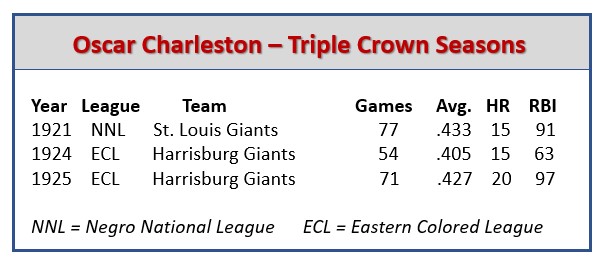
Three Triple Crowns – Oscar Charleston – 1921, 1924, 1925

Photo: Almendares baseball club (Cuba), Public domain, via Wikimedia Commons

Hall of Famer Oscar Charleston (OF/1B) was one of the stars of the Negro Leagues. Among major leaguers, his .364 career average (over 18 seasons and 916 games …  1920-27, 1929, 1933-41– 916) trails only Ty Cobb’s .366 (among players with 3,000 career major-league plate appearances).   Charleston led his league in runs scored six times,  home runs five times, RBI four times, total bases four times, batting average three times (each time hitting over .400), hits three times, triples three times, doubles twice, stolen bases twice. In his prime seasons 1920-27  -ages 23-30), Charleston averaged .384,with 108 home runs and 623 RBI in 596 games.

In his book “The Baseball 100,” Joe Posnanski placed Oscar Charleston at number-five, behind only Willie Mays, Babe Ruth, Barry Bonds and Hank Aaron.

Hall of Famer Honus Wagner on Oscar Charleston

“Oscar Charleston could have played on any big league team in history if he had been given the opportunity. He could hit, run and throw. He did everything a great outfielder is supposed to do. I’ve seen all the great players in the many years I’ve been around and have yet to see one greater than Charleston.

Pittsburgh Courier, August 21, 1954

Charleston spent much of his MLB career as a player-manager and led the Pittsburgh Crawford to Negro National League II pennants in 1933, 1935 and 1936.

__________________________________


Two Triple Crowns – Ted Williams, Josh Gibson, Rogers Hornsby

Ted Williams … 1942, 1947

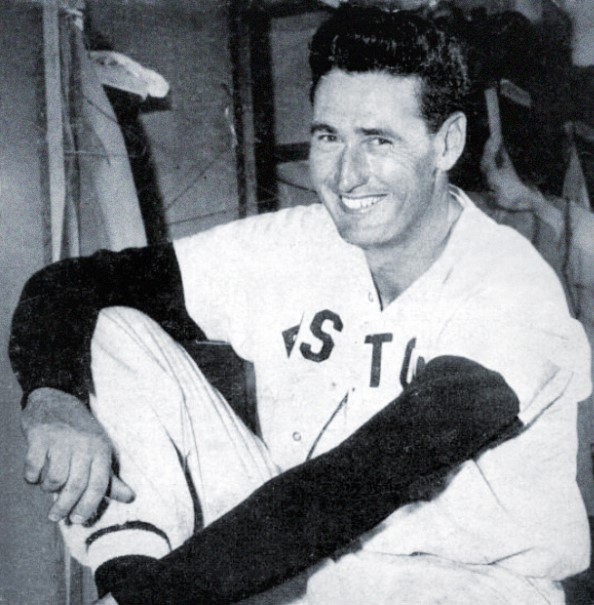
Photo: Baseball Digest, back cover, May 1949 issue. [1], Public domain, via Wikimedia Commons

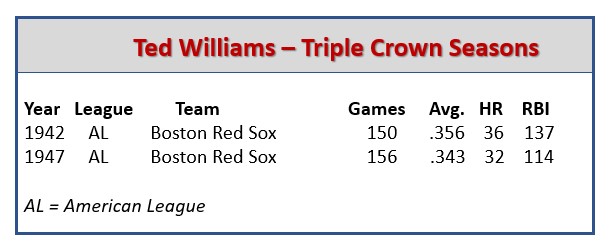
Hall of Fame outfielder Ted Williams might have won three or more triple Crowns if it wasn’t for World War II. He won his first Triple Crown in 1942 (at the age of 23) with a .356-36-137. Teddy Ballgame missed the 1943-45 seasons due to military service and came back to win a second Triple Crown in 1947 with a .343-32-114 line.   In 1949, William missed a third Triple Crown by just one base hit. He led the AL with 43 home runs, tied for the RBI lead with 159, but lost the batting title to the Tigers’ George Kell by .3427 to .3429. Side Note: In 1946, in his first year back on the big-league diamonds after a three-season absence, Williams hit .342-38-123 – finishing second in the AL in all three Triple Crown categories. 

Williams played in  19 MLB seasons (1939-42, 1946-60), all for the Red Sox. An All Star in 17 seasons, he led the AL in runs scored six times, batting average six times, total bases six times, home runs four times, RBI four times and doubles twice. He also led the AL  in on-bases percentage 12 times and  slugging percentage nine times. The two-time MVP also led the AL in walks eight times and  and intentional walks nine times.  Williams hit .316 or higher in 18 of his 19 MLB seasons. His only season under that figure was 1959, when – as a 40-year-old, he hit .254-10-43 in 103 games.

Ted Williams’ final stat line was .344-521-1,839, with 1,798 runs scored (2,292 games). Looking at his spots in MLB’s career top 20: He is eleventh all time in average (among players with 3,000 plate appearances); first in on-base percentage (.482); second in slugging percentage (.634); 20th in runs scored; 20th in home runs; 16th in runs batted in; 20th in extra-base hits; fourth in walks; and sixth in intentional walks.

Ted Williams had two .400+ batting average seasons. His iconic .406 in 1941 (.406-37-120 in 143 games) and 1953 – after returning from flying more than 30 combat missions  in Korea.  He was mustered out in time to get in 37  games over the final two months of the season. Over those contets, Williams went 37-for-91 (.407), with 13 home runs and 34 RBI. 

________________________________________

Josh Gibson 1936, 1937

In 1936, Pittsburgh Crawfords’ catcher Josh Gibson won the Negro National League II Triple Crown with a .389-18-66 line in 50 games. He came back even stronger in 1937, with a second Triple Crown (with the Homestead Grays), improving on all three stats (.417-20-73).  Overall, Gibson played 14 (now) MLB seasons (1930. 1933-40, 1942-46). He led his league in home runs 11 times, RBI seven times, total bases six times, runs scored five times and average three times. He was a nine-time Negro Leagues All Star. In 1943, Gibson appeared in 69 games for the Homestead Grays hitting .466, scoring 93 runs, hitting 20 homers and driving in 109.   He led the league in home runs and RBI, but lost the batting title to Tetelo Vargas of the New York Cubans, who hit .471 in 30 games.

For his career (598 games), Gibson hit .374-165-730. Note: His 2,511 plate appearances fall short of the 3,000 necessary to make the career batting average list.

Gibson would most likely have moved well up the statistical rankings had he not suffered significant health problems. In 1943, he collapsed at home and was diagnosed with a brain tumor. He passed away in 1947 at the age of 35. From 1943-46, despite health issues, Gibson hit .382-50-249 in 209 games – leading the Negro National League II in home runs all four seasons.

Josh Gibson led the Negro National League II in home runs for seven straight seasons (1933-39) and led the league in RBI in six of those campaigns.

________________________________________

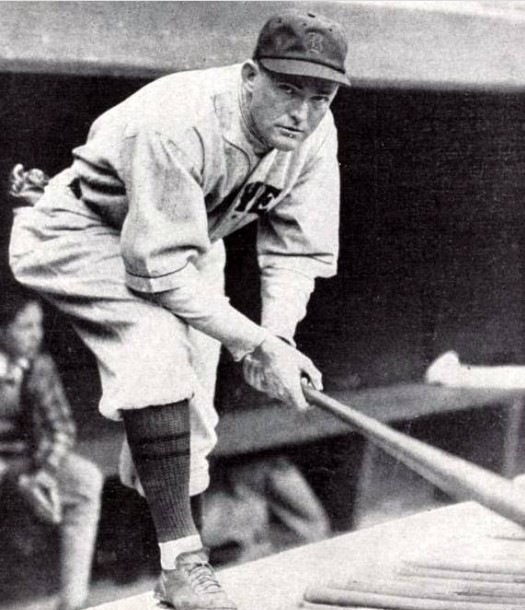
Rogers Hornsby – 1922 and 1925

Rogers Hornsby, in putting up a .358 carer batting average, hit .400+ in three season – winning the National League batting title all three times  (1922, 1924, 1925) and capturing the NL Triple Crown in 1922 and 1925. Both of Hornsby’s Triple Crowns were “no-doubters. In 1922, the powerful second baseman won the batting title by 47 points, had a 16-home run edge over the NL second finisher and topped the runner-up in RBI by 20.  In 1925, he won the NL batting crown by 36 points, the home run crown by 15 dingers and led in RBI by 13.

Hornsby played 23 MLB seasons (1915-37 … Cardinals, Giants, Braves, Cubs, Browns).  He hit .358, with 2,930 hits,  301 home runs 1,584 RBI and 1,579 runs scored in 2,259 games, He led his league in batting average seven times, total bases seven times,  runs scored five times, hits four times, doubles four times, RBI four times,  triples twice and  home runs twice.  Hornsby’s .358 career average is the highest in MLB-history for a right-handed batter (minimum 3,000 plate appearances.)

In the six seasons from 1920 through 1925, Rogers Hornsby averaged .397 – and won six consecutive batting titles.

_______________________________________

Here are your one-time Triple Crown winners:

2012 … Miguel Cabrera, Detroit Tigers, American League  … .330-44-139

1967 … Carl Yastrzemski, Boston Red Sox, American League … .326-44-121

1966 … Frank Robinson, Baltimore Orioles, American League … .316-49-122

1956 … Mickey Mantle, New York Yankees, American League … .353-52-130

1942 … Ted Strong, Kansas City Monarchs, Negro American League … .364-6-32

1942 … Lennie Pearson, Newark Eagles & Homestead Grays Negro National League II … .347-11-56

1937 … Joe (Ducky) Medwick, Cardinals, National League … .374-31-154

1934 … Lou Gehrig, New York Yankees, American League … .363-49-166

1933 … Jimmie Foxx, Philadelphia Athletics, American League … .356-48-163

1933 … Chuck Klein, Philadelphia Phillies, National League … .368-28-120

1930 … Willie Wells, St. Louis Stars, Negro National League … .411-17-114

1926 … George (Mule) Suttles, St. Louis Stars, Negro National League, … .425-32-130

1923 … Oscar (Heavy) Johnson, Kansas City Monarchs, Negro National League … .406-20-120

1912 … Henry (Heinie) Zimmerman, Chicago ?Cubs, National League … .372-14-104

1909 … Ty Cobb, Detroit Tigers, American League … .377-9-107

1901 … Napoleon (Nap) Lajoie, Philadelphia Athletics, American League … .426-14-125

1887 …  James (Tip) O’Neill, St. Louis Browns, American Association … .435-14-123

1878 … Paul Hines, Providence Grays, National League … .358-4-50

Note: RBI were not an official MLB statistic until 1920. 

Primary Resources:  Seamheads.com; Baseball-Reference.com

Baseball Roundtable – Blogging Baseball Since 2012.

100Baseball Roundtable is on the Feedspot list of the Top 100 Baseball Blogs.  To see the full list, click here.

Baseball Roundtable is also on the Anytime Baseball Supply Top 66 Baseball Sites list.  For the full list, click here

I tweet (on X) baseball @DavidBaseballRT

Follow Baseball Roundtable’s Facebook Page here.  More baseball commentary; blog post notifications.

Member: Society for American Baseball Research (SABR); Negro Leagues Baseball Museum; The Baseball Reliquary. 


Brief Mound Appearances – A Portside Show

It’s the off-season and, as usual, while I await the start of Spring Training, I find myself musing about a variety of baseball topics and statistics.  This time, it’s brief – very brief – pitching appearances.  So, while this post my seem, at times, a bit like watching a series of unrelated slides (some or you do remember slides, I hope), there is a central theme.

One first observation, as  I looked at the leading pitchers when it comes to brief appearances (I chose one-batter and one-pitch mound appearances), it was clear the lists was dominated by left-handed sidearmers – with offerings ranging submariner Mike Myers’ angling fastball to Tony Fossas’ slow, sidearm curve.

How dominant were lefty sidearmers on these lists? When you look at the top five pitchers in terms of one-batter and one-pitch appearances, seven pitchers hold the top ten places (three appear on both lists).  All seven are southpaws and five of the seven are sidearmers or submariners.   This  portside dominance, by the way, has been recognized with an adaption of the term  “LOOGY”  to describe a “Left-handed One Out Guy.”  With recent rule changes, however, this terminology may be on the way to becoming extinct. (More on that a bit later).

Let’s get on to  the lists – starting with the one-batter appearances.    

Photo: Keith Allison on Flickr, CC BY-SA 2.0 <https://creativecommons.org/licenses/by-sa/2.0>, via Wikimedia Commons

The career leader in one-batter appearances is submariner Mike Myers – with 320 one-batter appearances in 13 MLB seasons (1995-2007 … Marlins, Tigers, Brewers, Rockies, Diamondbacks, Mariners, Red Sox, Yankees, White Sox).  Myers was signed by the Giants in the fourth round of the 1990 MLB Draft – out of Iowa State University, where he went 6-5, 2.65 over two seasons (14 games as a starter/18 as a reliever).

Myers credits Hall of Famer Al Kaline with encouraging him (in 1996, Myers’ seventh pro season and second in the major leagues) to “drop down” into the submarine motion. Myers went on to pitch in the majors through 2007 – going 25-24, 4.29 with 14 saves.  His status as one of the kings of the brief appearance is reflected in the fact that he threw a total of 541 2/3 innings in 883 MLB appearances (0.61 innings per appearance – all in relief) – walking 256 and fanning 429. He averaged just 41.6 innings per season over his MLB career and pitched 50 or more innings in only four campaigns (a high of 64 1/3 innings in 83 1996 appearances). Myers twice led the AL in appearances and made 60 or more appearances in 12 seasons. Over his MLB career, Myers held left-handed batters (1,263 plate appearances) to a .219 average, while righties (1,122 plate appearances) hit .301 against him. Myers’ best season was 2000, when he went 0-1, with a 1.99 earned run average and one save in 78 games (45 1/3 innings) for the Rockies. Notably, that season, Myers put up a 2.00 ERA at hitter-friendly Coors Field.

Mikey Myers led the American League in pitching appearances in 1996 and 1997 (83 and 85 games, respectively). In each of those seasons, his earned run average was north of 5.00 (.5.01 and 5.70).

Note: In the chart above, all are southpaws and all but Dan Plesac were submariners or sidearmers.

Now, the one-pitch appearances.

Javier Lopez is the King  of the One-Pitch Outing – and is likely to retain the crown.

 DISCLAIMER, KIND OF

MLB didn’t start tracking pitch counts until 1988, so the one-pitch inning records noted here – unless otherwise explained – are from 1988 forward. 

Photo: Lopez SD Dirk on Flickr, CC BY 2.0 <https://creativecommons.org/licenses/by/2.0>, via Wikimedia Commons

Javier Lopez was a left-handed, sidearming relief specialist who forged a 14-season MLB career (2003-2016 … Rockies, Diamondbacks, Red Sox, Pirates, Giants). Lopez’  MLB tenure took place after MLB started tracking pitch counts and before the 2020 rule requiring a relief pitcher to face three batters or finish a half inning (except in cases of injury or illness.). In his career, Lopez made 839 appearances (no starts) and averaged about 2/3 of an inning (0.64 innings) and 2.7 batters faced per appearance.  He was the king of the one-pitch appearance. During his career, he came into a game, tossed one pitch a record 34 times and was done for the day (six times in 2015 alone).

In 281 (33.5 percent) of his MLB appearances, Javier Lopez faced just one batter.

Now, you might think that most of one-pitch those appearances ended an inning. Nope. In fact, only 14 of those 34  appearances involved Lopez recording the final out of the frame. Under current rules, Lopez would have had to  remain in the game in twenty of his one-pitch appearances – which is why I’m pretty sure he will remain king of the one-pitch inning.

In his 34 one-pitch outings, Lopez held hitters to a .206 average. He gave up f0ur singles. two doubles and one home run and induced 19 ground outs (three double plays), five fly outs and one pop out (two batters were safe on infield errors.)

Note: On the chart above, all are southpaws and all but Mike Stanton are sidearmers.

Lopez was signed by the Diamondbacks out of the fourth round of the 1998 MLB draft. He played his college ball at the University of Virginia, where he was primarily used as a staring pitcher. He began his professional career as a starter, but struggled in that role and was converted to a reliever in his fourth season (2001). He made his MLB debut with the Rockies in 2003 and went 4-1, 3.70, with one save in 75 appearances (58 1/3 innings), walking 12 and fanning 40. He went on to pitch in 14 MLB seasons (2003-16 … Rockies, Diamondbacks, Red Sox, Pirates, Giants), going  30-17, 3.48 with 14 saves and  533 1/3 innings pitched (358 strikeouts) in 839 appearances (all in relief).  He did his best work with the Giants, going 17-8, 2.47, with ten saves over seven seasons (2010-16). Lopez  held lefties to a to a .202 average (1,242 plate appearances) versus .297 for right-handers (1,031 plate appearances).

One Thing Leads to Another …

Looking at the Impact of the Three-Batter Rule

If you are wondering, like the Roundtable was,  how much the 2020 rule requiring  relievers to pitch to “three-batters or end of an inning”  altered pitching strategies, here are some stats. In 2019, there were 1,100 instances in which a pitcher faced just one batter in an appearance and 110 in which that pitcher tossed just one pitch. (There were also nine instances in which a pitcher was not credited with a batter faced in an appearance, usually involving  a pick off or caught stealing).  In 2021, the  first full season with the new rule, there were 660 one-batter appearances (a 40 percent drop), 64 one-pitch appearances (a 42 percent drop) and 13 zero-batters-faced appearances

Special Mention …  Jesse Orosco

Jesse Orosco ranks fourth  on he list of one-batter appearances and second on the roster of one-pitch appearances (keep in mind that pitch count tracking did not really became a “thing” until Orosco’s ninth MLB season.)

Orosco was signed out of the second round of the 1978 MLB Draft by the Twins. He played college baseball for Santa Barbara City College (1978), where he won All-Western State Conference honors. In 1979, after one solid rookie-level seasons (4-4, 1.12, with six saves in 20 appearances), the Twins sent Orosco to the Mets in the trade that brought Jerry Koosman to Minnesota,

Orosco went on to a 24-season MLB career (1979, 1981-2003 … Mets, Dodgers, Indians, Brewers, Orioles, Cardinals, Padres, Yankees, Twins).

While he never led his league in appearances, Jesse Orosco holds the all-time MLB record for regular -season mound appearances with 1,252.

Orosco, a two-time All Star went 87-80, 3.16, with 144 save in 1,252 appearances (four starts). He pitched 1,295 1/3 MLB innings, walking 581 and fanning 1,179, He averaged 1.03 innings per appearance. Orosco’s best season was 1983 (Mets), when he went 13-7, 1,47, with 17 saves in 62 appearances (110 innings).

How About a Two-Fer … or Twelve Can Be A Lucky Number

On July 31, 1983, the Mets and Pirates faced off in a doubleheader (Remember those?) in New York. Both games went twelve innings and the Mets’ Jesse Orosco earned both victories. In the first game, Orosco pitched four scoreless frames (innings nine through twelve) and picked the win as the Mets triumphed 7-6. In Game Two, he came on in the top of the twelfth in a scoreless game, pitched a scoreless inning and picked up his second win of the day, as the Mets tallied a run in the bottom of the inning.

Orosco is somewhat unique on these lists of brief appearances in that: 1) his career began before the  LOOGY became a thing; and 2) he was pretty much a full-time closer until 1987.  From 1979 through 1987, Orosco went 47-47, 2.73 with 107 saves.  He pitched 595 2/3 innings in 372 games (1.60 innings per game).  Then, from 1991 through 2003, he went 40-33, 3.52 with 37 saves – logging 699 2/3 innings in 880 appearances (0.80 innings per game). In the eight seasons from 1979 through 1987, Orosco logged 25 one-batter appearances (6.6 percent of his total appearances), while in 16 campaigns from 1991 through 2003, he notched 212 one-batter appearances (25.7 percent of his total appearances).

___________________________________________

More of Baseball Roundtable “One Thing Leads to Another”

On July 22, 1986, southpaw Jesse Orosco was involved in an unusual set of pitching changes.

  • With the Mets and Reds tied 3-3 in Cincinnati, Mets’ manager Davey Johnson brought Orosco to the mound to open  the bottom of the tenth, replacing Rick Aguilera. Orosco was the Mets’ fifth pitcher to take the mound in the game.  Aguilera, however, was not one of them.  Aguilera had been used as a pinch hitter for pitcher Doug Sisk (batting sixth) in the top of the inning.  
  • In the bottom of the tenth, Orosco struck out Reds’ RF Dave Parker, gave up a single to PH Pete Rose and fanned CF Eddie Milner (while Eric Davis, who had come in to run for Rose, stole second and third).
  • With right-handed hitting SS Wade Rowdon coming up (and a runner on third), Johnson brought righty Roger McDowell to  the mound. He didn’t, however, pull Orosco from the game. Rather , Johnson made a number  moves and substitutions that ended up with Orosco playing right field – and new players at C and 3B. It all worked out, as McDowell got Rowdon to ground out to end the inning.
  • McDowell faced the first three batters in the bottom of the 11th and, with a runner on second and two out, Reds’ left-swinging outfielder Max Venable was due up. Johnson brought Orosco back to the mound, but didn’t take McDowell out of the game.  Instead, McDowell moved to RF – and Orosco fanned Venable.
  • Orosco pitched a scoreless twelfth frame and, when  the 13th inning opened, McDowell  (who by this time was playing left field) came back to the mound, with Orosco going back to RF and Mookie Wilson, by then playing RF, moved to LF. McDowell pitched the 13th and 14th frames (with Orosco in RF), before the Mets eventually won 6-3 by virtue of a 14th inning three-run home run by Howard Johnson

In the game, the Mets used 21 players, with five pitchers taking the mound – and  and five different players manning  RF, three playing LF and two different players each used at C, 3B, and SS.   

_______________________________________________

Moving right along, how about a look at a couple of pitchers who got the maximum “Output” from a single pitch?

Three-for-One … With a Little Help from My Friends

While this occurred before MLB began tracking pitch counts, it is well documented enough to be included here. On July 27, 1930, the Reds’ righty Ken Ash – recorded three outs and picked up a victory, while throwing just one pitch.  Notably, Ash got a little help from the Cubs’ base-running foibles.

Ash came on in the bottom of the sixth with: the Cubs leading the Reds 3-2 (two runs had already scored in the inning); runners on  first and third (Cubs’ LF Danny Taylor on first, CF Hack Wilson on third); no outs; and 1B Charlie Grimm at the plate. Grimm hit  ground ball to Cubs’ 2B Clarence Blair, and Wilson made the mistake of breaking for home. Blair threw behind Wilson to 3B Tony Cuccinello, who threw to C Clyde Sukeforth, who tagged out Wilson for the first out.  Grimm, meanwhile, rounded first and decided to try for second on the play, but Taylor was still on the second base bag. So, Grimm reversed direction and headed back toward first, Sukeforth threw to 1B Joe Stripp, who tagged Grimm for out number two. As the play at first unfolded, Taylor took off for third and Stripp threw to Cuccinello for the third out. Ash was lifted for a pinch-hitter in the bottom of the sixth, as the Reds scored four runs to take a  lead they would not relinquish – giving Ash the victory.,

Ash would finish the season 2-0, 3.43 (one save) in 16 appearances. Ash played in just four MLB seasons (1925, 1928-30 … White Sox, Reds), going 6-8, 4.96 with three saves in 55 games (13 starts).

Lucy Number 13

On July 13, 1995, the Mariners’ RHP Jeff Nelson also got the most out of a  one-pitch mound appearance, at least in terms of outs. Nelson came on in relief of Tim Belcher, with the Mariners trailing the Blue Jays 4-1, with two runners on base (Blue Jays’ RF Shawn Green at second and SS Alex Gonzalez at first).  On Nelson’s first pitch to Sandy Martinez, the Jays’ catcher popped a bunt toward the mound. Nelson let the ball drop, then picked it up and fired to SS Luis Sojo covering second. Sojo tagged Green (still on the bag, but forced to go to third) for the first out. Sojo then touched the second base bag forcing Gonzalez; and then fired to 1B Tino Martinez to retire Sandy Martinez.

Note: Some smart fielding on this play. 1) Nelson letting the popped up bunt drop; and 2) Sojo knowing to tag Green before touching the second base bag. Had he stepped on the bag first, Gonzalez would have been out and Green, no longer forced to go to third, would have been safe on second. .  

Nelson pitched in 15 MLB seasons (1992-2006 … Mariners, Yankees, Rangers, White Sox), going 48-45, 3.41, with 33 saves in 798 appearances (all in relief).

How About Zero-Pitch Appearances?

Well, as usual with Baseball Roundtable, one thing again led to another, and after looking into one-batter and one-pitch appearances, I began digging into zero-pitch appearances.

Since 1988, there have been two dozen official pitching appearances of zero pitches.  As the  chart below shows, southpaws again dominate this brief outing category, holding 19 0f 24 spots.  Note:  In this chart, these outings – unless otherwise noted – consisted of a pick-off (and in, some cases rundown) at first base.

A handful of these zero-pitch outings captured my attention.

Two of those zero-pitch outings actually resulted in a win for the hurler in question.

All in a Day’s Work

On May 1, 2003, Orioles’ southpaw reliever B.J. Ryan was called in from the bullpen, with the Orioles’ trailing the Tigers 2-1 (in Detroit). Tigers’ SS Omar Infante was on first, with two out and RF Bobby Higginson (batting third in the order) at the plate.  Before sending a pitch to the plate, Ryan sent a pick-off throw to 1B Jeff Conine. Infante was eventually retired on the play (pitcher – to first – to shortstop), ending the inning. The Orioles then came back to take a 3-2 lead in the top of the eighth.  Buddy Groom relieved Ryan (now the pitcher of record) in the bottom of the inning, the Orioles held their lead and Ryan got a win … without ever throwing a pitch.

Ryan pitched in 11 MLB seasons (1999-2009) and went 21-28, 3.37, with 117 saves in 560 games.  The two-time all Star’s best season was 2006 (Blue Jays), when he went 2-2, 1.37, with 38 saves.

This Could be the Last Time

On July 7, 2009, Rockies’ southpaw Alan Embree notched a zero-pitch win. This  one caught the Roundtable’s attention because it was  the final win of the 39-year-old Embree’s 16-season MLB career. In the top of the eighth, with the Rockies and Nationals tied at four apiece, Embree was summoned to the mound with two outs and a runner on first (PH Austin Kearns). Before throwing a pitch, Embree picked off Kearns on a play that went Embree to 1B Todd Helton to SS Troy Tulowitzki back to Embree. The Rockies scored in the bottom of the inning to take a 5-4 lead, closer Huston Street replaced Embree (who had been pinch hit for) and saved the game – and the win – for Embree. So Embree, while not tossing a  pitch got a win, an assist and a putout.

Embree went 39-45, 4.59, with 25 saves in a 16-season MLB career (1992, 1995-2009 … Indians, Braves, Diamondbacks, Giants, White Sox, Padres, Red Sox, Yankees, A’s, Rockies). Notably., 17 of his 25 career saves came for the 2007 A’s.

Put A Bow on It

Let’s Wrap this Whole Thing up

On October 1, 2000, Rockies’ righty Jerry Dipoto was called to the mound for the final time in his eight-season MLB career. It was the bottom of the sixth and Dipoto’s Rockies were trailing the Braves 5-3 (three runs had scored in the inning). Braves’ LF Reggie Sanders was on first, there were two outs and RF Brian Jordan was at the plate.  Before tossing a pitch Dipoto picked Sanders off first, ending the inning.  So, in his last MLB appearance, Dipoto – while recording 1/3 of an inning pitched – did not actually pitch at all.

Save The Last Out for Me

Cubs’ southpaw Mitch Williams recorded the only zero-pitch save (since 1988). It happened at Wrigley Field on April 28, 1989. In that game, Williams was called in to relieve Cubs’ starter Paul Kilgus, with two outs in the ninth and the Cubs on top of the Padres 3-1.  At the time, the Padres had scored once in the inning and had runners on first (RF Luis Salazar) and second (LF Carmelo Martin). Before tossing a pitch to Padres’ SS Gary Templeton, Williams picked Salazar off second (Williams to SS Shawn Dunston), earning a zero-pitch save.

Williams, a one-time All Star, pitched in 11 MLB seasons – going 45-58, 3.65 with 192 saves in 619 games. He saved 30 or more games in three seasons. 1989, the year of his zero-pitch save, was Williams All-Star season.  He went 4-4, 2.76, with 36 saves and led the league in appearances with 76.

In 1980, Mitch Williams – as a 21-year-old rookie with the Rangers –  led the AL in appearances with 80 and went 8-6, 3.58 with eight saves. Despite that performance, he did not receive a single vote in the Rookie of the Year balloting(won by the Indians Joe Charboneau).

Not a Lucky Break

Not a Great Finish

On July 15, 2005, Mike Stanton of the Nationals was called into a game in a tough spot. It was the bottom of the tenth inning, the Nationals and Brewers were tied at 3-3 and the Brewers had runners on first and third with one out when Stanton came to the mound to take over from Luis Ayala.  Conventional wisdom? Intentionally walk 1B Lyle Overbay to load the bases and set up a possible double play. Unconventional outcome? The game resumed after Stanton’s warm-ups and, before tossing a pitch, Stanton balked in the winning run.  Game over, without Stanton throwing a single pitch.

Stanton pitched 19 years in the major leagues (1989-2007 … Braves, Yankees, Red Sox, Mets, Nationals, Giants, Ranger, Reds), He appeared in 1,178 games, picking up 69 wins (63 losses), with 84 saves and a 3.92 ERA. In 1993, he saved 27 games for the NL West-leading Atlanta Braves.

Mike Stanton appeared in 53 post-season games, going 5-2, 1.54, with one save over 22 2/3 innings, with 21 walks (nine  intentional) and 47 strikeouts.

Now that Doesn’t Seem Fair

Photo: Erik Drost, CC BY 2.0 <https://creativecommons.org/licenses/by/2.0>, via Wikimedia Commons

On June 29, 2018, Indians’ southpaw Oliver Perez became the first pitcher credited with allowing a baserunner, in a game in which he didn’t throw a single pitch. Perez was brought into the game in the  seventh inning, with two outs, runners on second and third and the Indians trailing the A’s 2-0. A’s leadoff hitter and CF, left-handed swinging Dustin Fowler, was scheduled to bat.  A’s Manager Bob Melvin sent in right-handed swinging Matt Canha to pinch hit for Fowler and Indians’ manager Terry Francona chose to intentionally walk him. No pitches thrown under the relatively new “wave ‘em to first” rule, but the walk and baserunner were charged to Perez. Right-handed hitting Chad Pinder came in to pinch hit for lefty-swinging Matt Joyce and Francona countered with right-hander Zack McAllister. Perez left the mound  after allowing a baserunner via a walk, without ever tossing a pitch in the contest. Fortunately, McAllister fanned Pinder on four pitchers and Perez was off the hook.

Perez, still active in 2022, has pitched in 20 MLB seasons (2002-2010, 2012-2022), going 74-94, 4.37, with five saves in 703 games (195 starts).

Roundtable Extra … A Brief Outing That Lasted an Entire Career

Larry Yount, brother of Hall of Famer Robin Yount, made his MLB debut on September 15, 1971 – coming on in the top of the ninth to replace Skip Guinn (who had been pinch hit for in the previous half inning).   The score was 4-1 and, if all worked out, Yount would face LF Ralph Garr, 1B Hank Aaron and C Earl Williams.  All did not work out. Yount had experienced some elbow pain in the bullpen warming up and, as he continued to warm up on the mound, it only got worse. He called the trainer to the mound and, after a bit of discussion, Yount walked off the field – officially registering an MLB appearance, but not tossing a single pitch. Yount pitched two more season in the minors, but never came to the major-league mound again.  Note:  This was before the pitch-tracking era began, but has between widely enough reported to earn its spot.

Primary Resources:  Baseball-Reference.com; Baseball-Almanac.com

Baseball Roundtable – Blogging Baseball Since 2012.

100Baseball Roundtable is on the Feedspot list of the Top 100 Baseball Blogs.  To see the full list, click here.

Baseball Roundtable is also on the Anytime Baseball Supply Top 66 Baseball Sites list.  For the full list, click here

I tweet (on X) baseball @DavidBaseballRT

Follow Baseball Roundtable’s Facebook Page here.  More baseball commentary; blog post notifications.

Member: Society for American Baseball Research (SABR); Negro Leagues Baseball Museum; The Baseball Reliquary. 
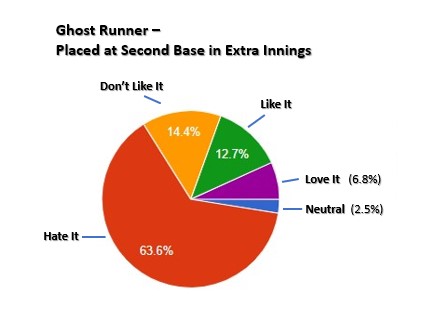
 

Baseball Roundtable Book Review … Bronx Epitaph – How Lou Gehrig’s “Luckiest Man” Speech Defined the Yankee Legend

Bronx Epitaph – How Lou Gehrig’s “Luckiest Man” Speech Defined the Yankee Legend

By Steven K. Wagner

State University of New York Press (2023)

$27.95


Whether you are a fan of Lou Gehrig, a follower of the Yankees or just would  like to know the back story behind one  of baseball’s most iconic  moments, Steven Wagner’s “Bronx Epitaph – How Lou Gehrig’s ‘Luckiest Man’ Speech Defined the Yankee Legend” has something for you. It is a well-researched and well-written  tale that uses the words of Lou Gehrig’s Farewell Speech to lead us through the story of the Hall of Famer’s Life and the relationships that led him to his luckiest man conclusion.

The speech was  made (between games of a doubleheader) on Lou Gehrig Appreciation Day (July 4, 1939) – an event honoring a Yankee legend, a true “Iron Man,” then facing a debilitating, career-ending and life-threatening disease (Gehrig would live only 698 more days).  It was a speech  the humble Gehrig was reluctant to deliver and one that did not  receive extensive coverage at the time.  Yet, Gehrig’s remarks, which opened with “For the past two weeks, you’ve been reading about a bad break. Today, I consider myself the luckiest man on the face of the earth”  and the  image of a tearful Gehrig at the microphone, are considered among the most iconic moments and images in baseball lore.

His (Gehrig’s) speech was a baseball moment that had nothing to do with playing.  It was baseball ‘s Gettysburg address.

                                                                    Marty Appel, Baseball Historian

In Bronx Epitaph, author Steven  Wagner presents what is clearly  the most deeply researched and best-documented version of Lou Gehrig’s farewell speech.  Only four sentences of the speech captured on film are known to be available  and there is no known complete audio recording of Gehrig’s remarks. In his research, Wagner used not only available film and audio, but news accounts from a wide range of publications – giving particular credence to quotes or paraphrases that appeared in multiple stories.  In fleshing out the story of the speech and Gehrig’s life, Wagner also interviewed a host of players – all former Yankees – and even a fan who was in the stands that day. In the process, Wagner developed not only the most in-depth accounting of Gehrig’s farewell speech, but an equally in-depth look at Gehrig’s life and character.

Using the Farewell Speech – and filling in the back story of each sentence – Wagner tells the tale of Gehrig the ballplayer and Gehrig the man. We see a fierce and talented competitor, a dedicated teammate, a humble and caring person, an individual of great integrity and a man who recognized and was thankful for all those who contributed to what he saw as a great and ”lucky” life.  In Yankee manager Joe McCarthy’s words, as quoted in Wagner’s book, Gehrig was “the finest example of a ball player, sportsman and citizen that baseball has ever known.”

The emotional nature of Gehrig’s speech (and the day itself) may be reflected  in the fact that the speech almost didn’t happen. Here’s how Wagner describes it,  “As Gehrig stood on the grass that day, struggling to hold back his tears,  Mercer (sportswriter Sid Mercer, emcee of the event) announced that the Yankee was too overcome with emotion and would not be speaking. He then thanked the crowd for coming out to honor the man. Unfortunately for their quiet hero, those in the crowd would not be dismissed lightly and they quickly and collectively took over, rising to their feet and chanting his name over and over. Finally, (Joe) McCarthy, a father figure to the slugger, put his hand on Gehrig’s back and gently ushered him over to the microphone, urging him to speak.” The rest, as they say, is history.

In the introduction to Bronx Epitaph, Wagner takes the reader through Gehrig’s childhood, when his family often faced economic challenges; through his high school years,  when he excelled at both baseball and football (and, as Wagner reports “At first declined to play on the baseball team because he was shy about appearing in front of crowds;” through his years at Columbia University (where he was a fullback on the football team and a pitcher/first baseman on the baseball squad;  and on to highlights of  his Hall of Fame career as a Yankee.

But the story really starts when Wagner begins to recreate and analyze Gehrig’s farewell speech – made at a time when Gehrig was facing the toughest  challenge of his life and still thought of himself as the luckiest man on the face of the earth. Gehrig went on to cite the reasons why he felt that way, and those reasons  had nothing to do with fame, fortune, Most Valuable Player Awards or championship rings, but rather were based on the  people and relationships that had built his character and shaped his life.

In his remarks Gehrig thanked the fans;  his teammates; Yankee owner Jake Ruppert; Yankee executive Ed Barrow; Yankee managers Miller Huggins and Joe McCarthy; his Yankee roommate Bill Dickey; the  rival New York Giants; stadium vendors, groundskeepers and office staff; sportswriters; his mother-in-law; his parents; and his wife.

“He (Gehrig) was a beloved player, because of who he was, not just because of how he played. What he spoke that day came from his heart. When the people who in your heart are your mother-in -law and ticket takers, that says a lot about your character.”

                                                 Former Yankee Mike Buddie

In his book, Wagner outlines Gehrig’s relationship with each of those he thanked in that speech – telling Gehrig’s  life story along the way. And – as the humble Gehrig would have preferred – also provides  insight into the lives, careers and accomplishments of each individual or group included in his list of thank you’s.

Wagner writes about Jacob Ruppert’s commitment to building the Yankee franchise; how and why Ed Barrow signed Gehrig to his first baseball contract; Gehrig’s relationship with his teammates, particularly roommate Bill Dickey (nicknamed The Man Nobody Knows); Gehrig’s family life and the positive impact that Gehrig’s parents, wife and mother-in-law had on building his “lucky life;” and much, much more. Readers even get a glimpse of Gehrig’s challenging life after he left baseball and some insight into the Gehrig-Ruth rift.

I found Bronx Epitaph to be a great read. As I’ve often said of Baseball Roundtable research “one thing always seems to lead to another.” That’s also true about Wagner’s Bronx Epitaph – one story from Gehrig’s life leads to another and, then, another  – and in the end, they lead to the tale of a great ballplayer and a great person.

Other books by Steven K. Wagner include:

  • The Four Home Runs Club: Sluggers Who Achieved Baseball’s Rarest Feat. Review here.
  • Perfect: The Rise and Fall of John Paciorek, Baseball’s Greatest One-Game Wonder. Review here.
  • Game Won: How the Greatest Home Run Ever Hit Sparked the 1988 Dodgers to Game One Victory and an Unlikely World Series Title. Review here.
  • Seinsoth: The Rough and Tumble Life of a Dodger. Review here.


BASEBALL ROUNDTABLE TALKS WITH STEVEN WAGNER

Roundtable: What prompted your decision to tackle the Luckiest Man speech as a book topic?

Wagner: I’ve always been intrigued by Lou Gehrig, not only his greatness but his squeaky-clean persona. However, it’s The Speech that I found most intriguing – how a man near the peak of his athleticism could have everything taken away from him and still consider himself lucky. As I looked into the speech and read assumed transcripts, I decided to put together a more likely transcript and look into exactly why he said what he did on that warm summer day.

Roundtable: How long did the research take and what was the most challenging aspect?

Wagner: I probably spent six months researching for the book. I think the most difficult part was searching for quotations from publications that haven’t existed for decades. I then compared quotes from one news source to another to determine what Gehrig truly did say and what he didn’t say.

Roundtable: Were there any surprises along the way?  Things you didn’t expect to learn about Gehrig or any of the other principals in the book?

Wagner: I didn’t realize at the outset that Gehrig had no interest in speaking that day, that manager Joe McCarthy actually patted him on the back and encouraged him to talk, which he only reluctantly did. I really think McCarthy understood better than anyone the mark that Gehrig would have on history by speaking. I also didn’t realize that earlier in the day a little-known player named Johnny Welaj was honored at home plate in similar fashion. Before it was Lou Gehrig Appreciation Day it was actually Johnny Welaj Day.

Roundtable Note:  In true Baseball Roundtable fashion,“one things always leads to another” and you’ll find more about Welaj at the end of this post.

Roundtable:  If you had to sum up Lou Gehrig in a single sentence, how would you do it?

Wagner: No player in major-league history had the impact on baseball that Lou Gehrig did, and The Speech played a big role in the legacy he left.

Roundtable: You’ve written about one game careers (Paciorek): the Gibson World Series home run; Four-Homer Games; and Bill Seinsoth’s career.  How do you select what players, events or topics you are going to explore?

Wagner: I always choose topics that I know I’d enjoy writing about and that I believe others would enjoy reading about. If I can’t enjoy working on a book project, it’s unlikely I can put enough into it to make the reader enjoy it.

________________________________________________

One Thing Leads to Another  … J0hnny Welaj Shares Lou Gehrig’s Day

In traditional  Roundtable “one thing leads to another” fashion, one of author Steven Wagner’s answers led me to look deeper into Johnny Welaj – who also had  a “Day” on July 4.  Welaj, it runs out was a Washington Senators’  rookie outfielder, with 31 MLB games under his belt. The 25-year-old was in his fourth professional season.

As David E. Skelton reports in his Society for American Baseball Research Johnny Welaj biography, Welaj was born in Pennsylvania, but grew up  in Manville, New Jersey (40 miles from New York City) – and was “a standout athlete in football, basketball, and especially baseball,” at Bound Brooke High School (and later in semi-pro baseball in the area). Signed by the Senator in 1936, the speedy Welaj, as noted, made his way to the major leagues by 1939. With the senators visiting nearby New York City on Independence 1939, Skelton reports that hundreds of Welaj’s friends, relatives and neighbors traveled from Manville to Yankee Stadium to celebrate “Johnny Welaj Day” before the first game of the twin bill. Reportedly, Welaj was not aware that the Gehrig appreciation event would be taking place between games of the doubleheader.

Welaj played in just four MLB seasons (1939-41, 1943), hitting .250-4-74, with 36 steals in 293 games. (His MLB career was uninterrupted by military service.) He played in 15 minor-league campaigns – the final one in 1956  at age 42. A true baseball lifer, Welaj spent seven decades in the game as a player, coach, manager and front office executive (including a ten-year stint as the Texas Rangers’ Director of Stadium Operations).

______________________________________________


Baseball Roundtable – Blogging Baseball Since 2012.

100Baseball Roundtable is on the Feedspot list of the Top 100 Baseball Blogs.  To see the full list, click here.

Baseball Roundtable is also on the Anytime Baseball Supply Top 66 Baseball Sites list.  For the full list, click here

I tweet (on X) baseball @DavidBaseballRT

Follow Baseball Roundtable’s Facebook Page here.  More baseball commentary; blog post notifications.

Member: Society for American Baseball Research (SABR); Negro Leagues Baseball Museum; The Baseball Reliquary. 
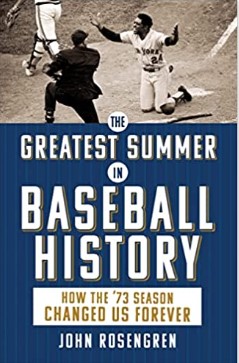
Baseball Roundtable Fan Hall of Fame Ballots In – Readers Throw a Shutout – Scott Rolen Top Vote-Getter

Scott Rolen, top vote-getter in Baseball Roundtable Readers’ Hall of Fame Balloting. Photo: User Darwin’s Bulldog on en.wikipedia, CC BY-SA 3.0 <http://creativecommons.org/licenses/by-sa/3.0/>, via Wikimedia Commons

The Baseball Roundtable (unofficial) Fan Hall of Fame Balloting is closed and the  votes are counted.  The end result? Roundtable readers threw a shutout – with no player reaching the 75 percent support needed for induction in the official balloting.

In this post, I’ll pass on the results of the reader voting, as well as share a few observations on the differences between the Roundtable fan ballots and the publicly announced (to date) Baseball Writers Association of America official balloting (as reported by the Baseball Hall of Fame Vote Tracker).

For those interested in a deeper dive into Hall of Fame voting, I would recommend the BBHOF Vote tracker (at bbhoftracker.com). The site offers an updated listing of public votes (total and individual ballots), as well as commentary on voting trends and implications.  All of the official ballot  totals used in this post are as of January 14, with 39.4% of ballots made public.

Roundtable Side Note

Roundtable reader (and voter) Ralph from North Carolina won the randomly drawn Fan Ballot prize package, which included: a complete 1993 Topps set (with Derek Jeter’s rookie card); a Bob Gibson replica Cardinals jersey; a Tony Oliva HOF bobblehead; a replica Ernie Banks Wrigley Field flag; and a Bert Blyleven HOF “How to Throw a Curve Ball” baseball. 

So, on to a few observations. No player received the necessary 75 percent support in the fan ballot, while Scott Rolen and Todd Helton have each drawn more than 75 percent support among the official ballots made public (again via bbhoftracker.com) as of January 14.

As you can see, the top five in the fan ballot mirrored the top five in the public official balloting (to date). The only exceptions being that fans placed Jeff Kent in the top five, while Gary Sheffield was  the top five in the BBWAA public ballots.

Voting percentages tend to fall in the official balloting when final results are reported.  At this point, it appears Rolen has the best chance of making it into the Hall in 2023, while Helton may end up very close.  Below are the full results of the Baseball Roundtable reader voting.

Overall, readers tended to spread out their ballots among more players (some home-team bias, perhaps). Reader voters cast votes for 6.23 players per ballot, as opposed to 6.42 among the writers. Thirteen players on each ballot did not receive enough votes to remain on the ballot for 2024.  However, only two players received  zero votes on the fan ballot, as opposed to 12 on the official ballot (again, that is on ballots made public to date).

Carlos Beltran, top vote-getter among first-timers.  Photo: Jeffrey Hayes, CC BY 2.0 <https://creativecommons.org/licenses/by/2.0>, via Wikimedia Commons

The strongest newcomer to the ballot (among both groups) was Carlos Beltran – at 53.5 percent (sixth) among readers and 57.1 percent (sixth) in  the official balloting. Reader votes and the public official votes to date indicate only two ballot first-timers will carry over to next year (Beltran and Francisco Rodriguez) on the ballot (5 percent minimum support).

Among the  biggest differences (beyond Rolen’s and Helton’s totals) between the reader ballots and the public  official ballots to date are:

  • Gary Sheffield (29.3% among readers; 65.4% among writers);
  • Francisco Rodriguez (41.4% among readers; 9.0% among writers);
  • Torii Hunter (26.3% among readers; 1.9% among writers).

Again, thanks to all the readers who voted.  And, remember bbhoftracker.com is a great source for more in-depth information on the official balloting.


Baseball Roundtable – Blogging Baseball Since 2012.

100Baseball Roundtable is on the Feedspot list of the Top 100 Baseball Blogs.  To see the full list, click here.

Baseball Roundtable is also on the Anytime Baseball Supply Top 66 Baseball Sites list.  For the full list, click here

I tweet (on X) baseball @DavidBaseballRT

Follow Baseball Roundtable’s Facebook Page here.  More baseball commentary; blog post notifications.

Member: Society for American Baseball Research (SABR); Negro Leagues Baseball Museum; The Baseball Reliquary.