Baseball Roundtable’s Baseball Reliquary Shrine of the Eternals Ballot

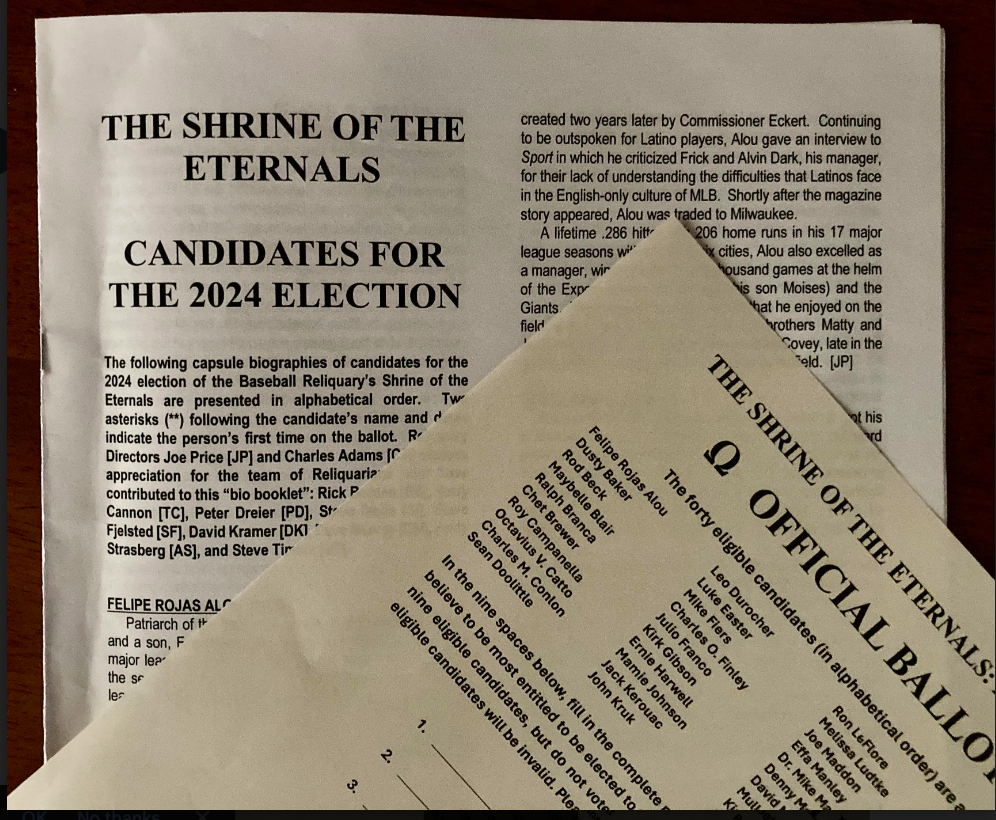
Early this week, a welcome baseball gift in the mail – my 2024 Baseball Reliquary Shrine of the Eternals Ballot – which means I can look forward to some joyous time pondering the character and characters that helped shape the history of our grand game (as presented in the always informative and creative biographies included with the ballot).

I’ll take a look at my choices from this year’s ballot in a bit, but first – for those not familiar with The Baseball Reliquary – a little background.
The Baseball Reliquary is an organization of fans dedicated to the free-spirited celebration of the human side of baseball’s history and heritage. The Reliquary defines itself as “an educational organization dedicated to fostering an appreciation of American art and culture through the context of baseball history and to exploring the national pastimes’ unparalleled creative possibilities.”


Reliquary (rel′ə kwer′ē)

Noun- a container or shrine in which sacred relics are kept and displayed for veneration.

While its “home” is at Whittier College (also home to the Institute for Baseball Studies), the Reliquary is more than just a place.  The Reliquary really resides in the hearts of its founders, members, contributors and honorees – who all are important parts of the organization’s joyful (often irreverent, but always well-informed and fan-centric) celebration of all things baseball.  This celebration is fueled through The Reliquary’s Shrine of the Eternals, collection of historic artifacts, exhibitions and extensive baseball-related research collection – books, periodicals and papers from distinguished authors, historians and journalists.

The Whittier (CA) College Institute for Baseball Studies is the first humanities-based baseball research center associated with a U.S. college or university,

The Shrine of the Eternals

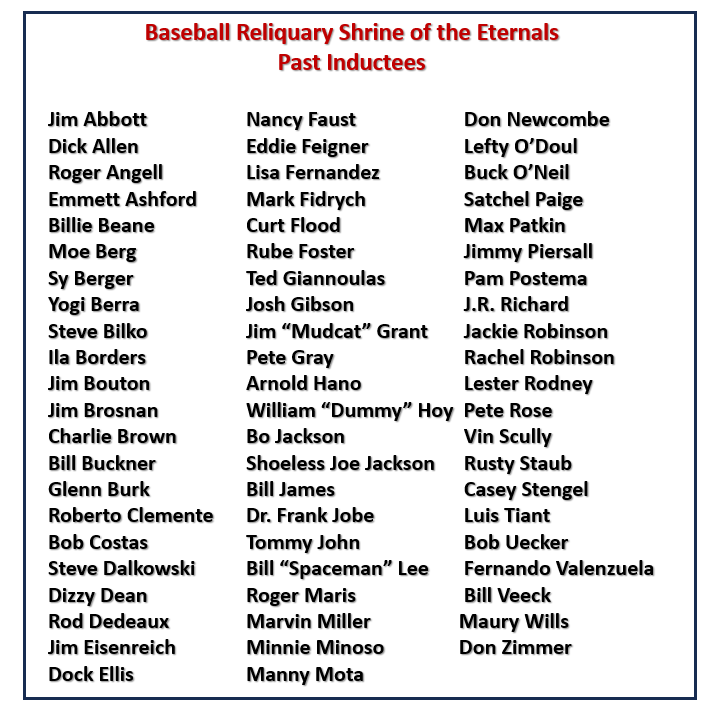
The Shrine of the Eternals is the Reliquary’s best-known element and its honorees include (among others) a one-armed major league outfielder, a pitcher who once threw a no-hitter while high on LSD, a team owner who sent a midget to the plate, a man in a chicken suit, a member of Major League Baseball’s 3,000-hit club, a manager who won eight World Championships, a cartoon character who pitched his team to more than 1,000 losses, more than one best-selling author, a statistical wizard and even the sports editor of the Daily Worker (American Communist Party newspaper). The honorees are each unique in their roles in – and contributions to – the national pastime, but they all share the distinction of having made a significant impact on the game.

It’s a shrine to “our” great game that connects:

  • Mark “The Bird” Fidrych and the San Diego Chicken;
  • Dr. Frank Jobe and Dr. Mike Marshall (not to mention Dock Ellis);
  • Bob Uecker and Yogi Berra;
  • Luis Tiant and Charlie Brown;
  • Roberto Clemente and Pete Gray;
  • Rube Waddell and Bill “Spaceman” Lee.

This year’s candidates range from players like Rube Waddell, Felipe Alou, Mike Marshall and Julio Franco to such  luminaries as renowned baseball photographer Charles M. Conlon, Wiffle Ball inventor David Nelson Mallany, umpire Joe West, “Kissing Bandit” Morganna Roberts, broadcaster Ernie Harwell and baseball executive Kim Ng.

You get the idea.

Note: The Reliquary also recognizes distinguished service to baseball by a fan (The Hilda Award) and contributions to the preservation of baseball history (The Tony Salin Award).

Artifacts

The Baseball Reliquary’s Collection of what The Roundtable would term “art-ifacts” is as diverse as its roster of Shrine honorees.  The collection includes (but is “oh-so not limited” to) the Walter O’Malley Tortilla, the Roger Bresnahan Potato, the Eddie Gaedel Jock Strap, a Babe Ruth cigar, a Mother Teresa autographed baseball (a whole case actually), a heat-twisted 45-rpm record from the White Sox’ ill-fated Disco Demolition Night; and a San Diego Chicken game-worn costume.

Exhibits

The Baseball Reliquary’s Exhibits have covered such varied topics as Latino and Black baseball history, baseball in foreign policy, baseball literature and art, a celebration of baseball cards, and even the self-defining “Lasordapalooza.”

Join Now and Vote

New members joining The Baseball Reliquary through its website ( www.BaseballReliquary.org  ) by April 22, will receive a copy of the 2024 Shrine of the Eternals biographies and ballot and the opportunity to vote, by April 30, for this year’s nominees. 
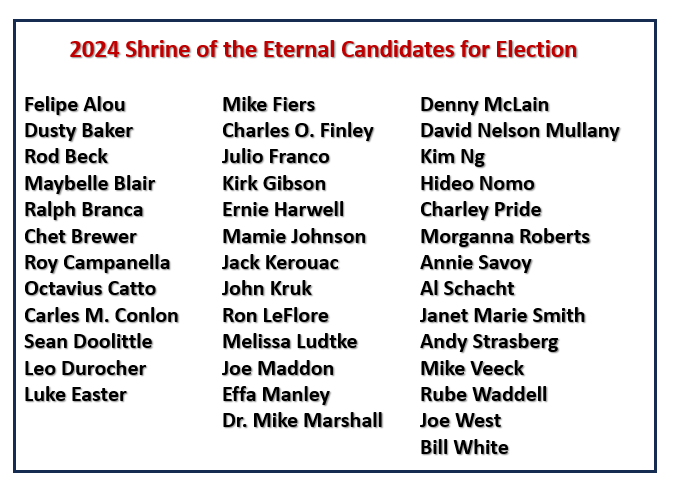
 

—–THE SHRINE OF THE ETERNALS 2024 BASEBALL ROUNDTABLE BALLOT—–

Now, on to the Shrine of the Eternals. Before I share my ballot, here’s what the Reliquary has to say about this honor.

“Similar in concept to the National Baseball Hall of Fame, the Shrine of the Eternals differs philosophically in that statistical accomplishment is not the principal criterion for election. The Baseball Reliquary believes that the election of individuals on merits other than statistics and playing ability will offer the opportunity for a deeper understanding and appreciation of baseball than has heretofore been provided by “Halls of Fame” in the more traditional and conservative institutions. 

“Criteria for election shall be: the distinctiveness of play (good or bad); the uniqueness of character and personality; and the imprint that the individual has made on the baseball landscape. Electees, both on and off the diamond, shall have been responsible for developing baseball in one or more of the following ways: through athletic and/or business achievements; in terms of its larger cultural and sociological impact as a mass entertainment; and as an arena for the human imagination.”

Each year, the Baseball Reliquary submits a list of candidates to its members and the top three vote-getters are honored.  Reliquaries can vote for up to nine nominees.

Here’s a look at those who are getting my votes for this year.

CHARLES M. CONLON (1868-1945) … Picture Perfect

Charles M. Conlon is responsible for some of the most iconic images from baseball history.  From 1904 to 1942, he documented the course of the national pastime (as a hobby), while working as a proofreader for the New York Evening Telegram (later the World-Telegram). Carrying a large Graflex camera and cumbersome glass plate negatives to the ballpark, Conlon produced at least 30,000 portraits and action photos, capturing history in black and white.

Although his photos appeared regularly in the Spalding and Reach Base Ball Guides, The Sporting News, and Baseball Magazine, Conlon’s contribution to the images and history of the game really came to the fore with the publication of Neal and Constance McCabe’s books: Baseball’s Golden Age: The Photographs of Charles M. Conlon (1993); and The Big Show: Charles M. Conlon’s Golden Age Baseball Photographs (2011).

The McCabe’s, making the case that Conlon ranks among the masters of documentary photography, assert: “The ballpark was Conlon’s universe, an inexhaustible source of unforgettable images: a catcher’s mangled hand, a madman kicking up his heels, an umpire lost in thought. He documented baseball obsessively at a time when critics of photography—had they known of his existence—would have questioned his sanity for taking thousands of photographs of so trivial and ephemeral a subject.”

Conlon gets my vote for contributing so significantly to the visual history of the game.

______________________________________

SEAN DOOLITTLE (1986- ) … A Stand-Up Guy

Sports Illustrated called reliever Sean Doolittle, “the conscience of baseball.”  He was a VOCAL and ACTIVE advocate for the rights of workers, women, immigrants, the LGBTQ community and veterans, as well as against racism and gun violence.

In his own words “As a kid, I remember my parents would say, “Baseball is what you do, but that’s not who you are’ – like that might be my job, but not the end-all, be-all.  I feel like I might even be able to use it to help other people. Sports are like the award for a functioning society.”

Among the two-time All Star’s many activities of conscience were: organizing a 2015 Thanksgiving dinner for Syrian refuges; writing a 2019 Washington Post op-ed piece in support of union workers; boycotting the 2019 World Series Champion Nationals’ visit to the White House; penning a Sports Illustrated column urging the Veterans Administration to expand mental health services for veterans; using social media to address the topics of racial injustice and gun violence; and much, much more.

Doolittle, who retired from the field in 2023, played in 11 MLB seasons (2012-2022 … Athletics, Nationals, Reds, Mariners).  He appeared in 463 games and put up a record of 26-24, 3.20, with 112 saves and 522 strikeouts in 450 2/3 innings. He had five seasons of 20 or more saves.

Doolittle’s willingness to stand up and speak out for what he believes is right make him a solid Shrine of the Eternal’s candidate. Whether you agree with Doolittle’s opinions or not, as Pete Dreier wrote in the opening of Doolittle’s Shrine of the Eternals Ballot Bio, “Sean Doolittle embodies the Reliquary’s rebellious, iconoclastic and irreverent spirit.”

______________________________________

LUKE EASTER (1915-79) – Scrambling Some Eggs

“Luscious” Luke Easter was one of the most prodigious home run hitters of all time. His titanic blasts were known as “Easter Eggs.” Among his notables, Easter:

  • Was the first player to a homer into the farthest reaches of center field in the Polo Grounds;
  • Hit the longest home run in the history of old Cleveland Municipal Stadium – clearing the distant right field scoreboard; and
  • Was the first player to hit a drive over the CF scoreboard in Buffalo’s Offerman Stadium (at age 42), proving it was no fluke by hitting the second drive to ever to clear the scoreboard just a month later.

Easter began his baseball career in 1937, as an OF/1B and cleanup hitter for the St. Louis Titanium Giants (a company team) – and didn’t play his final game until 27 years later.  Everything about the 6’4”, 240-pound Easter was big – his stature, his bat, his love of the game, his love of life, his relationship with teammates and the fans and, later, even his Buick.

While he began showing his prowess at the plate in the late 1930’s, he really began carving his name into baseball history after getting out of the military in 1943. In 1945, he starred with the barnstorming Cincinnati Crescents (for whom he hit the Polo Grounds home run noted above).

In 1947, he joined the Homestead Grays, where he hit .311, with 10 home runs in 219 at bats.  Research by Society for American Baseball Research Member Justin Murphy indicates Easter followed that up by hitting .363 for the Grays and tying teammate Buck Leonard for the Negro National League (NNL) lead in home runs (13) – helping the Grays to the NNL World Series Championship.

In 1949, Easter signed with the Cleveland Indians and made (what was then considered) his major league debut on August 1 of that season – at age 34 – just the eleventh black player in the major leagues. (MLB has since declared the Negro Leagues from 1920-48 to be major leagues.) While he hit only .222 in 54 games for the Indians, due in part to an injured knee, Easter showed his (already long-proven) power by going .363-25-92 in 80 games at Triple-A San Diego.

Then, in 1950, he hit .280-28-107 in 141 games for the Indians – earning recognition from the Sporting News as the AL’s Most Outstanding Player.  In 1951, he went .270-27-103 for the Tribe and, in 1952, .263-31-97. Age and injuries were already taking their toll, however, and on May 4, 1954, the 38-year-old Easter played his final MLB game.

Ah, but Luscious Luke was not done. He played on in the minor leagues until 1964 – putting up four seasons of 30 or more home runs and 100+ RBI – earning his way into the International League Hall of Fame.

Over his career, Easter also played winter ball in Puerto Rico, Venezuela, Mexico and Hawaii. A Winter-League star, Easter hit .402 for Mayaguez in the Puerto Rican League in 1948-49 (winning league MVP honors); led the Mexican Pacific Coast League (for Hermosillo) in homers in 1954-55; and lead the Puerto Rican Winter League in homers in 1955-56 and 1956-57.

Why does Luke Easter get my vote? Consider that non-other than Bill James rated him the second-best Negro Leagues’ first baseman of all time (behind only Buck Leonard) and Al Rosen (a teammate of Easter on the Indians, as well as a four-time All Star, two-time AL home run leader, 1953 American League MVP and 1989 National Executive of the Year) maintained, “Had Luke come up to the big leagues as a young man, there’s no telling what numbers he would have had.”

____________________________

JULIO FRANCO (1958 –) … One For The Ages (Aged?)

If you believe “Old Guys Rule” – Julio Franco should be your king.

Franco is the oldest player to homer in an MLB game. Franco went deep at age 48 years, 254 days, hitting a two-run shot off Arizona’s Randy Johnson as Franco’s Mets topped the Diamondbacks 5-3 on April 26, 2006. In that same game, Franco also became the second-oldest MLB player to steal base – and, thus, the oldest player to homer and steal a base in the same game.

Franco is also the:

  • Oldest player to hit a grand slam (46 years, 308 days) – connecting as a pinch hitter for the Atlanta Braves in a 7-2 win over the Marlins on June 27, 2005;
  • Oldest player to record a multi-homer game, belting a pair of homers on June 18, 2005 (age 46 years, 299 days), as his Atlanta Braves topped the Reds at Great American Ball Park. Franco started at first base and went two-for-four with two homers and three RBI;
  • Oldest player to hit a pinch-hit home run, in the eighth inning of a Mets’ 7-2 win over the Padres at San Diego (April 20, 2006 – 47 years, 240 days);
  • Oldest player to steal two bases in a game (and in an inning) – (June 16, 3005 – 46 years, 297 days); and
  • Oldest player to be put into a game as a pinch runner (July 29, 2006 – 47 years, 340 days) … he delivered, promptly stealing second base, going to third on an errant throw.

From 1982 to 1994, Franco played primarily as a middle infielder and DH for the Phillies, Indians, Rangers and White Sox – making three All Star teams (MVP of the 1990 All Star Game), earning five Silver Slugger Awards and leading the American League in hitting at .341 for the Rangers in 1991. In that 1991 campaign, Franco collected 201 hits, 15 homers, 78 RBI, 108 runs scored and 36 steals in 45 attempts. At season’s end, he had hit .300+ in five of the previous six seasons – the lone exception being .296 in 1990.

In 1994, when the remainder of the MLB season was lost to a strike, Franco was in the midst of possibly his best campaign.  After 112 games, he was hitting .319, with 138 hits, 20 home runs, 98 RBI, 72 runs scored, and eight steals.  Franco was determined to keep swinging the bat and signed to play in Japan with the Pacific League Chiba Lotte Marines.  In the 1995 Japanese season, Franco hit .306 and won the Pacific League’s equivalent of the Gold Glove at first base.

Franco returned to MLB in 1996, joining the Cleveland Indians, hitting .322-14-76 in 112 games. In August of the following season, the Indians released Franco – who was hitting .284-3-25 at the time. He finished the 1997 campaign with the Brewers, hitting .241 in 14 games with Milwaukee.

In 1998, at age 39, Franco was back in Japan playing for Chiba Lotte; where he hit .290, with 18 home runs and 77 RBI in 131 games. Then, in 1999, he celebrated turning 40 (when most ballplayers are retired or coaching) by hitting for a .423 average in the Mexican League and getting one late-season MLB at bat with Tampa Bay.

As he moved into his forties, Franco was far from finished as a player. He played in South Korea in 2000 (age 41), hitting .327-22-110.  In 2001, the well-traveled batsman was back in the Mexican League (Mexico City Tigers), where stellar play (a .437 average in 110 games) earned him a spot on the Atlanta Braves’ roster in September. Franco hit .300, with three home runs and 11 RBI over the final 5 ½ weeks of the MLB season.

From 2001 to 2007, the ageless wonder – professional hitter and pretty darn good first sacker – played for the Braves and Mets.  From 2001 through 2006 – ages 42 to 47 – Franco averaged .290 over 581 games.  He hit .222 in 55 games in his final MLB season – 2007 with the Mets and Braves.

Even at 49, Franco was not done battering baseballs. In 2008, he could be found at first base with the Tigres de Quintana Roo of the Mexican League (where he hit .250 in 36 games). That season, Franco – after 23 Major League seasons and 30 years after his first professional baseball game – announced his retirement as a player.

Oops? Not so fast. In 2014, at the age of 55, he appeared in seven games for the Fort Worth Cats of the independent United League – going six for 27.   Then in 2015, Franco was signed as player-manager of the Ishikawa Million Stars of the Japanese independent Baseball Challenge League (identified as a semi-pro league).

In 23 MLB seasons, Franco hit .298, with 2,586 hits, 173 homers, 1,285 runs, 1,194 RBI and 281 stolen bases. He also collected 618 minor league (U.S) hits, 316 in the Mexican League, 286 in Japan, 267 in the Dominican Winter League and 156 in South Korea and six in independent ball (U.S.).

Forever young, Mr. Franco – baseball’s Energizer Bunny – got my vote.

_____________________________________________

MAMIE “Peanut” JOHNSON (1935 – 2017) … Playing Big

Mamie Johnson was one of three females to play for the Indianapolis Clowns during the declining days of the Negro Leagues (and the only woman ever to pitch in the Negro Leagues). At 5’3” Johnson looked a little small for the baseball diamond, but she played above her height. Johnson took the mound to the Clowns for three seasons (1953-55), running up a 33-8 record – utilizing a deceptive fastball, curve, change, screwball and knuckleball.   Her exploits are chronicled in the children’s book “A Strong Right Arm: The Story of Mamie ‘Peanut’ Johnson,” by Michelle Y. Green.

________________________________

MIKE MARSHALL (1943 – ) … Is There A Doctor in The House?

This former major-league reliever (14 seasons … 1967, 1969-81) earned three college degrees, including a Ph.D. in Kinesiology from Michigan State University. Kinesiology is the study of muscle movement and Marshall used his knowledge to develop his own exercise program focused on minimizing stress, reducing injury and accelerating recovery time.  While his unorthodox methods, advanced education and outspoken approach often had him at odds with baseball’s traditionalists (and may be part of the reason he pitched for nine teams in 14 seasons), they did get the job done.

The fact is, we never saw a closer quite like Mike Marshall before he came along – and we’re not likely to see one like him again. In 1974, as a Dodger, he put up the grand-daddy of all relief seasons – setting the single-season MLB records for appearances with 106 and innings pitched in relief at 208 1/3. He finished the campaign 15-12, with a league-topping 21 saves and a 2.42 ERA.  That season, Marshall was called on to go more than one inning in 74 games (68.5 percent of the time) and he toiled three or more innings 22 times. He also relieved in 13 consecutive regular-season games – an MLB record later tied (1986) by the Rangers’ Dale Mohoric. Marshall’s efforts won him the 1974 Cy Young Award and recognition as The Sporting News NL Pitcher of the Year.

Marshall led his league in games pitched four times and saves three times – finishing 97-112, 3.14 with 188 saves.

A true “fireman” from an era when closers came in to put out fires and stayed on the mound to ensure they were no flare ups, Marshall gets my vote for the Shrine.

_____________________________________

DAVID NELSON MULLANY (1908-1990) … A New Meaning To Going Yard

Everyone who has ever swung a plastic bat at a whistling WIFFLE® Ball owes a debt of gratitude to David Mullany.

It all started in 1953, when Mullany saw his 12-year-old son trying to use a plastic golf ball for a game of baseball in their Connecticut backyard. Mullany saw the possibilities (and need) for a ball that could be put in play in a confined area without the risk of damage. He set about developing a light, hollow, plastic ball with eight oblong slots cut into one side (which allowed pitchers to fashion a curve, slider, or knuckleball that could produce a great many a good number of swings and misses or “whiffs.”

Mullany, (by the way played baseball for the University of Connecticut) went on to form WIFFLE® Ball, Inc. in 1954 and was granted a patent for the innovative sphere in 1957.

Has the Wiffle Ball impacted the game and those who play it (particularly in their backyards)?  Well, there has been no change in the basic product over time and more than 60 million wiffle balls have been sold since it came to the market. There are now even Wiffle Ball tournaments and leagues around the country.  More than 60 million Wiffle Balls sold. How many millions of hours of baseball pleasure does that equate to?  Enough for my vote.

In 2017, the WIFFLE® Ball was inducted into the National Toy Hall of Fame at The Strong National Museum of Play in Rochester, New York.

. ______________________________________

KIM NG (1968- ) … Breaking New Ground

Kim Ng’s interest in baseball started when, as a young Yankees fan, she played stickball on the street in Queens, New York.  Ng went on to play tennis and softball in high school and four years of softball at The University of Chicago.

After graduating from the University, Ng began her career in baseball in 1990, as an intern with the Chicago White Sox. Her first project was to conduct research on Rule Five draftees, building on her love for and skill in analyzing and interpreting statistics and scouting reports.

From that point, her trajectory showed plenty of velo and launch angle. She became:

  • The youngest person and the first woman to present a salary arbitration case as the Assistant Director of Baseball Operations with the White Sox;
  • An Assistant General Manager with the Yankees (at age 29);
  • MLB Senior Vice President of Baseball Operations, becoming the highest-ranking woman working in the Commissioner’s Office.

Then, in November 1920, Ng was hired as the Miami Marlins’ General Manager – the first woman to serve as GM of a major North American men’s sports team. When the Marlins clinched a playoff berth on September 30, 2023, Ng became the first woman GM in MLB history to lead a playoff team.

In 2022, the University of Chicago awarded Kim Ng the Professional Achievement Award and Forbes ranked Ng #5 on its list of the most powerful women in sports.

When it comes to breaking barriers, this power-hitter get my vote.

__________________________________________

Rube Waddell (1876-1914) … Walk On The Wild Side

Rube Waddell is almost universally recognized as the zaniest player in MLB history (that alone should earn him a spot in the Shrine).  Add the fact that he also was one of the best pitchers (at least when he was focused) in the game and Waddell seems a perfect fit for Reliquary honors.

Waddell was known to:

  • Leave a ball game to chase fire engines;
  • Miss a game he was scheduled to start because he was fishing or playing marbles with neighborhood kids;
  • Bring his outfielders in to sit on the grass and then proceed to fan the side;
  • Wrestle alligators in the off-season; and
  • Much too frequently do battle with owners and managers.

Waddell simply was more interested in the freedom to enjoy life and do things his way than in money or professional stability.  But, when Waddell was on his game, he was arguably the best pitcher of his time. The 6’1”, 195-lb. lefty led the AL in strikeouts six consecutive seasons (1902-1907) – by a wide margin.

In 1902, Waddell joined the Philadelphia Athletics in June – making his first start on June 26 (with just 86 games left in the season). Waddell proceeded to win 24 games (the league’s second-highest total) against seven losses, with a 2.05 ERA.  Despite his shortened season, he led the AL with 210 strikeouts, fifty more than the runner-up (none other than Cy Young).

In 1904, Waddell set a modern (post-1900) MLB record with 349 strikeouts that stood until 1965.  Waddell, elected to the National Baseball Hall of Fame in 1946, finished with a 193-143, 2.16 stat line – leading the AL in strikeouts six times, ERA twice, wins once and complete games once. For more on Waddell, BBRT suggests: “Rube Waddell: The Zany, Brilliant Life of a Strikeout Artist,” by Allan Howard Levy.

Honoring the zaniest player in history – a title it appears Waddell will hold into eternity – just seems right for the Shrine of the Eternals. Rube gets my vote.
Primary Resources: Baseball Reliquary 2024 Shrine of the Eternals Ballot; Baseball-Reference.com


Baseball Roundtable – Blogging Baseball Since 2012.
100Baseball Roundtable is on the Feedspot list of the Top 100 Baseball Blogs.  To see the full list, click here.

Baseball Roundtable is also on the Anytime Baseball Supply Top 66 Baseball Sites list.  For the full list, click here

I tweet (on X) baseball @DavidBaseballRT

Follow Baseball Roundtable’s Facebook Page here.  More baseball commentary; blog post notifications.

Member: Society for American Baseball Research (SABR); Negro Leagues Baseball Museum; The Baseball Reliquary. 

P1031

Baseball Roundtable Reviews Target Field’s New Concessions

Yesterday (April 1), Baseball Roundtable took part in what has become rite of spring – the Twins’ Annual Food and Beverage Preview. Sponsored by the Minnesota Twins and Delaware North (the team’s food and retail partner), this annual media event features a look at (and taste of) the upcoming season’s new Target Field food and beverage offerings.  For true Minnesotans, it’s kind of like munching your way through the State Fair – only in a ballpark.

The Twins Keep Raising the Bar

As I’ve noted here before, when I first began attending MLB games, standard fare consisted of (not always piping-hot) hot dogs and (not always ice-cold) beer (usually just two or three choices) and soda.  For those wanting to step outside the box, there were peanuts, Cracker Jack®, licorice ropes and popcorn (sometimes served in a megaphone-shaped container, popular at the ballpark, not so much at home).  For the really adventurous, there were frozen malt cups (with a wooden spoon after taste).  When pizza and burgers arrived on the scene, we all thought baseball’s culinary landscape was complete.

The 2024 Twins Food and Beverage Preview (like those that went before it) brought home once again how wrong we were about reaching the ultimate in ballpark fare – and how committed the Twins are to continually raising the ballpark food and beverage bar, while also building an ever-stronger Minnesota connections.

Here are a few of Baseball Roundtable’s favorite new Target Field offerings for 2024 – as judged by super-taster Bob King – AKA Bob The Grill Guy – and me.   I’ve noted which are from Minnesota firms.  Note:  Many, not all, of the photos show the sample size from the Food and Beverage Preview, rather than full size offering (generally, if the descriptive sign is in the photo, it’s a full -size offering).  I’ve also noted which new offerings are “Minnesota-made.”  Prices were not available at the event.


—-Baseball Roundtable New Food Favorites—-

Number One – East Coast BBQ Mac N’ Meat (Minnesota Made) … Creamy mac and cheese topped with your choice of barbequed chicken, rib tips or pulled pork. Bob and I both rated this as the number-one new food – and we both recommend going with the rib tips (although all three offerings are tasty).   Just the right amount of “smoke” in the sauce, without overpowering the flavor of meet.  The ribs tips (our favorite) were the moistest and meatiest.   Bob called it some of the best he’s had – and went back for seconds, despite the volume of food we had yet to taste.  High praise from “The Grill Guy.”  If we were to pick a new concession “Grand Slam” this year, this would be it. Section 131.

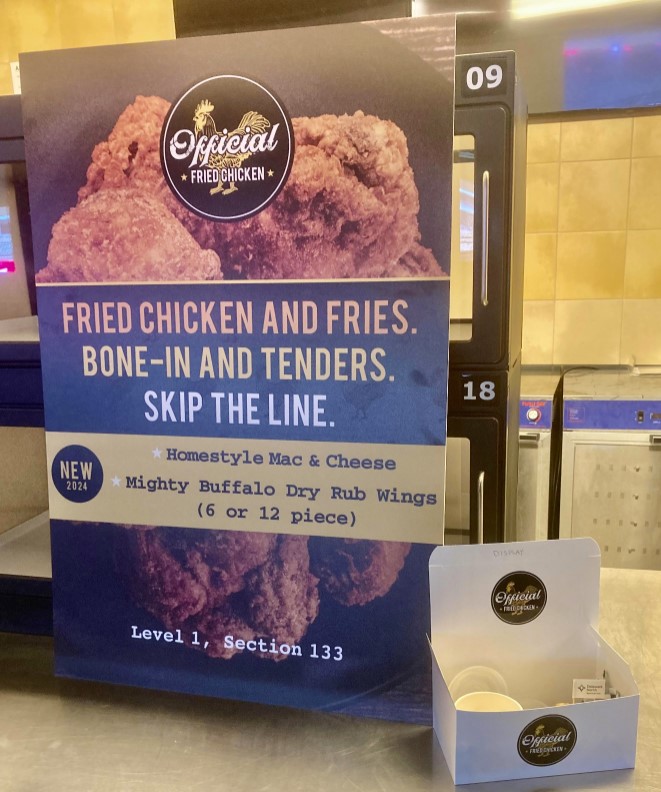
Number Two – Official Fried Chicken Might Buffalo Dry Rub Wings (Minnesota Made) …. A new addition to the Official Fried Chicken line – wings marinated, breaded and pressure-fried. Crisp on the outside, moist on the inside, dry-rubbed with a tasty and proprietary (a secret worth protecting) blend.  We officially declare that Official Fried Chicken knows its chicken. You can’t go wrong with any of their offerings. Section 134.

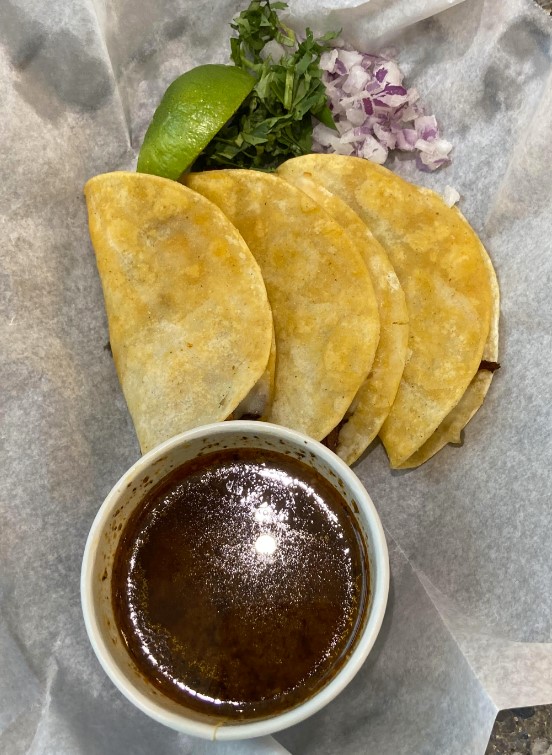
Number Three – Bussin Birria Tacos (Minnesota Made) … Tender, well-seasoned braised beef, topped with melted cheese and served in a just-crisp-enough griddled corn tortilla – with cilantro, chopped onions and a tasty consommé dipping sauce.  Hrbek’s, Section 114.

Number Four – Tie

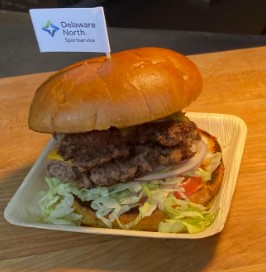
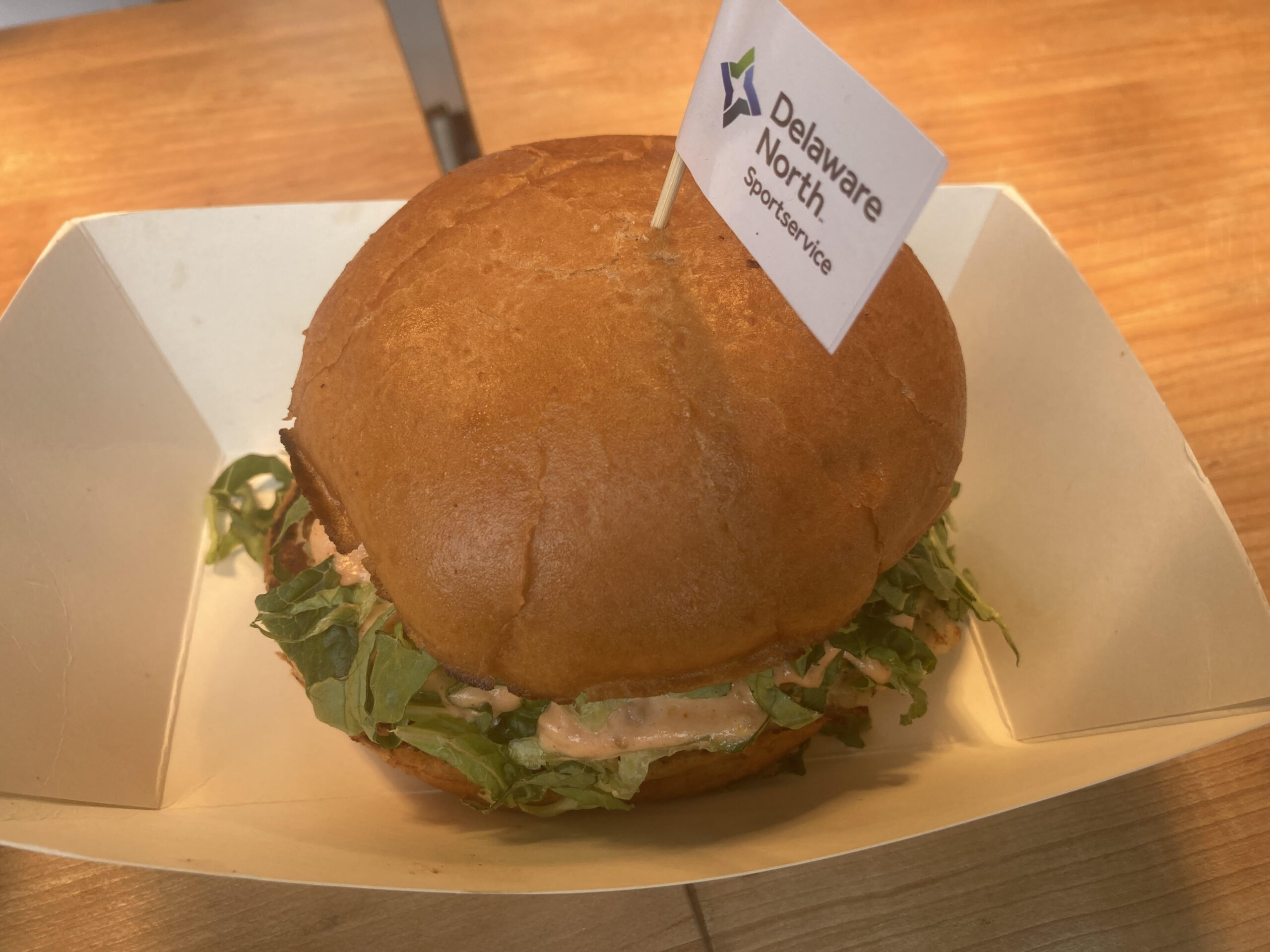
Red Cow Ultimate Burger (Minnesota Made) … Certified Angus Beef done just right, topped with Wisconsin-aged cheddar, lettuce tomato, onion and Red Cow Sauce.  If a traditional burger is what you crave after a 6-4-3 double play, this is the one for you.  Red Cow knows its burgers. (This one is as traditional as starting the tenth inning with no one on base.) Section 233.

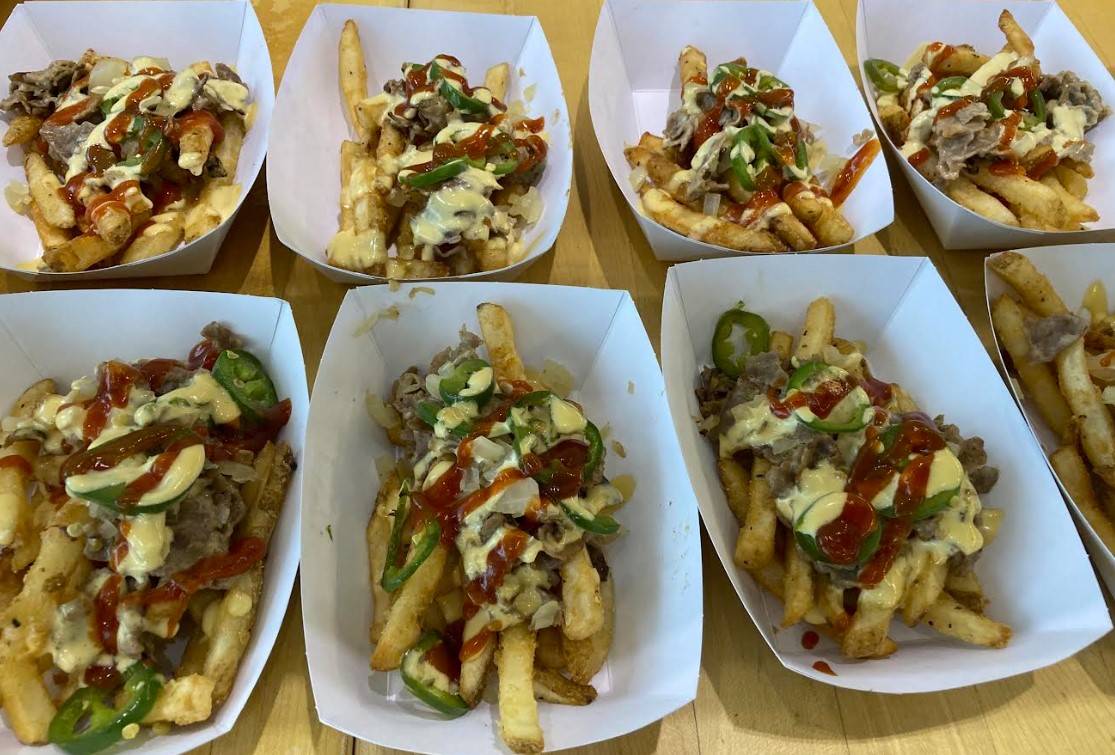
Burger Fries (Minnesota Made) …  A new take on French fries, turning them into potato nachos. Crisp fries topped with juicy Philly Cheesesteak, American cheese, caramelized onions, jalapenos and Two Mixed Up house sauce. The fries make a Minnesota-nice bed for the juicy cheesesteak mixture and the jalapenos add a little “bite.”  Perhaps not for everyone, but we liked them.  Hint: Take and extra napkin or two.  Thrivent Club.


—–Baseball Roundtable New Dessert Favorites—–


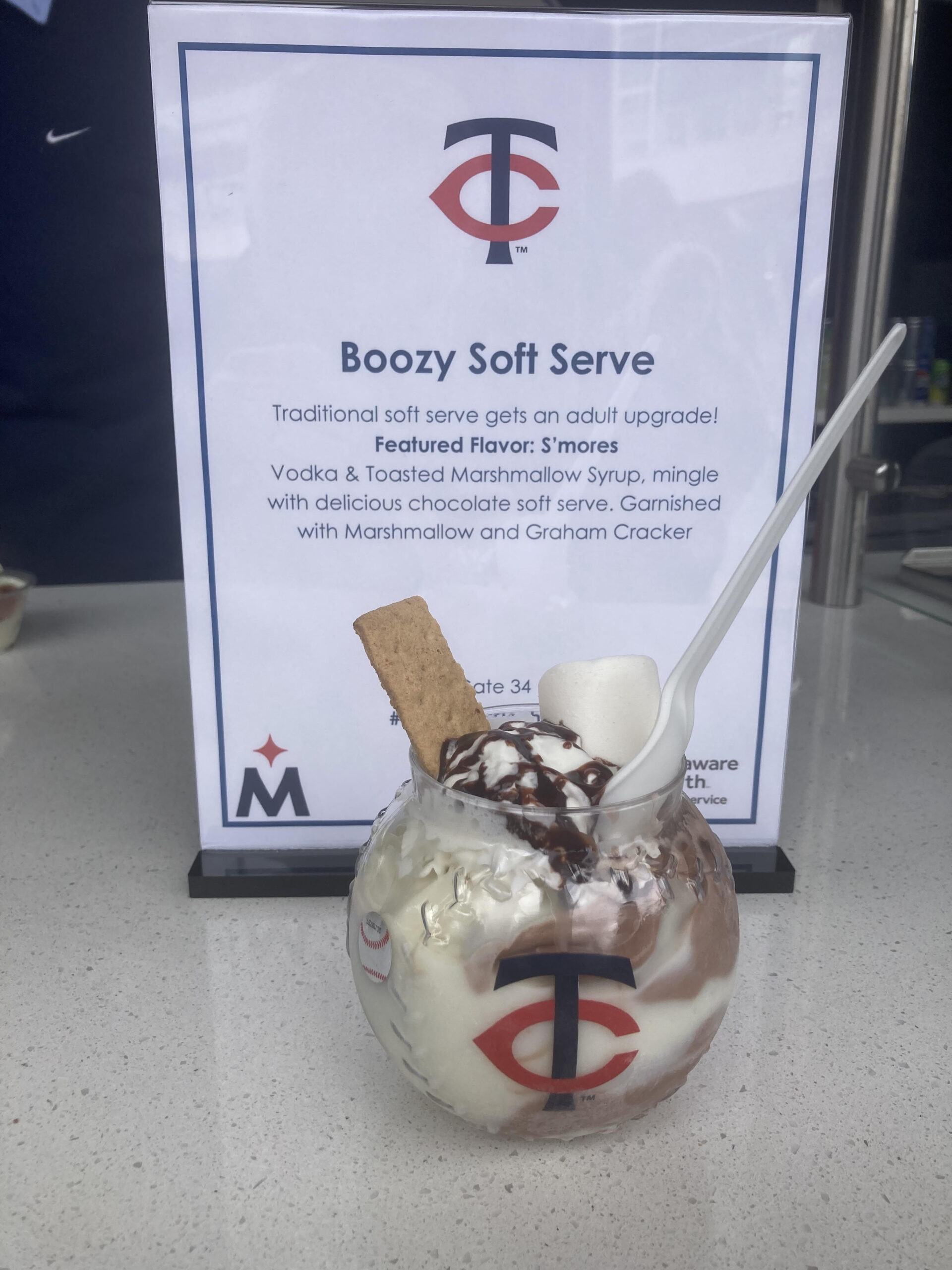
Number OneS’mores Boozy Ice Cream. One of several new desserts that represent a new spin on old favorites. Soft-serve chocolate ice cream mixed with vodka and toasted marshmallow syrup – topped with a marshmallow and graham cracker.  Finally, a dessert designed for ice cream-loving  adults (of which I am one).  This will replace soft serve I usually enjoy on game day.  Hint:  Get the kids their own vodka-free ice cream treat before you order this. You won’t want to share. Gate 34.

Numbed Two – Papa Pete’s Mini Donuts (Minnesota Made) … Traditional fried donuts (think County or State Fair) tossed in cinnamon and sugar, but with new taste possibilities offered by dipping choices like hot honey, salted caramel or chocolate. This is a sweet and tasty deal, great for sharing. Section 136.

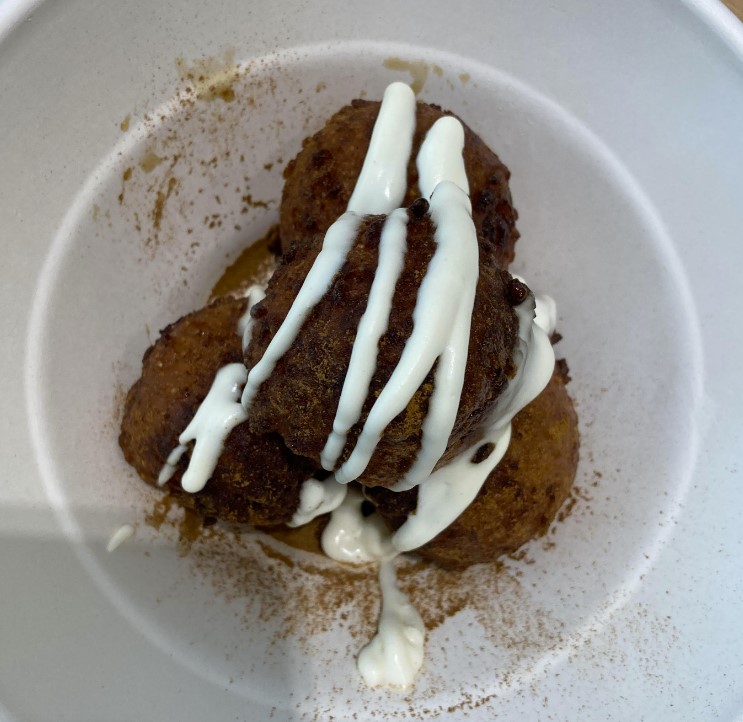
Number Three – STEPCHLD Sweet Potato Fritters (Minnesota Made) …   Are sweet potatoes a ballpark dessert?  They are now. Especially when transform those yams into tasty fritters topped with maple syrup, cayenne pepper and whipped goat cheese.   The whipped goat cheese cuts the sweetness a bit and the pepper adds a touch of warmth.  Look out sweet potato pie, fritters are coming!  Truly a dessert,  Truly on Deck, Right Field.


—–Baseball Roundtable’s Favorite New Adult Beverages—–


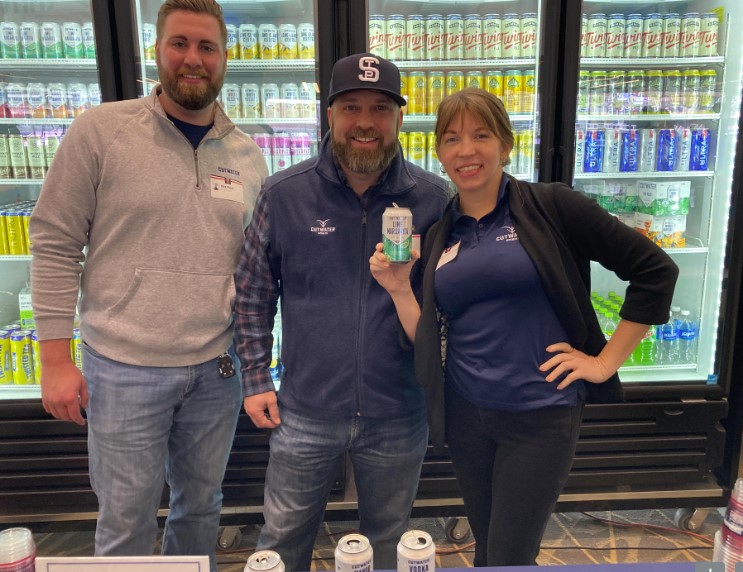
The Cutwater Crew

Number One – Cutwater Mango Margarita …  The Cutwater Cocktail Bar at Minnie and Paul’s offers a range of premium Cutwater premade cocktails. The Mango Margarita was a big winner with both Bob and me. Minnie & Paul’s, underneath the centerfield neon.

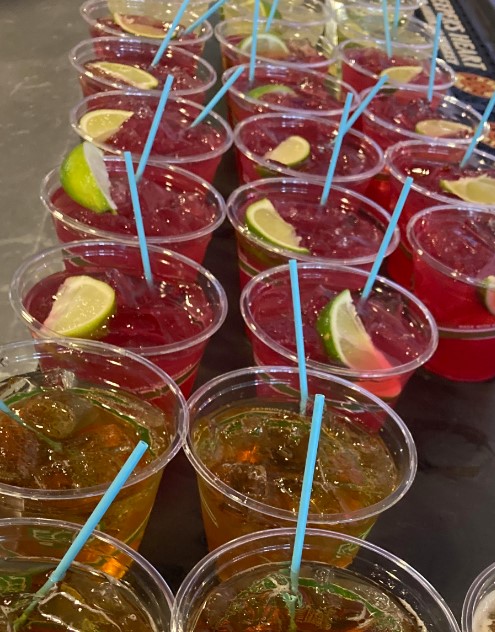
Number Two – Vanilla Creamed Whiskey (Minnesota Made) …  Mixing Keeper’s Heart Rye, with Monin Vanilla Creme Syrup and soda. Taste likes old-fashioned Cream Soda, only with a kick.  Bob noted that he could “get into a lot of trouble with that one.”  You might also consider the Cherry Smashed Whiskey or Irish Mojito. Sophisticated ballpark imbibing. Keeper’s Heart Town Ball Tavern, Section 229.

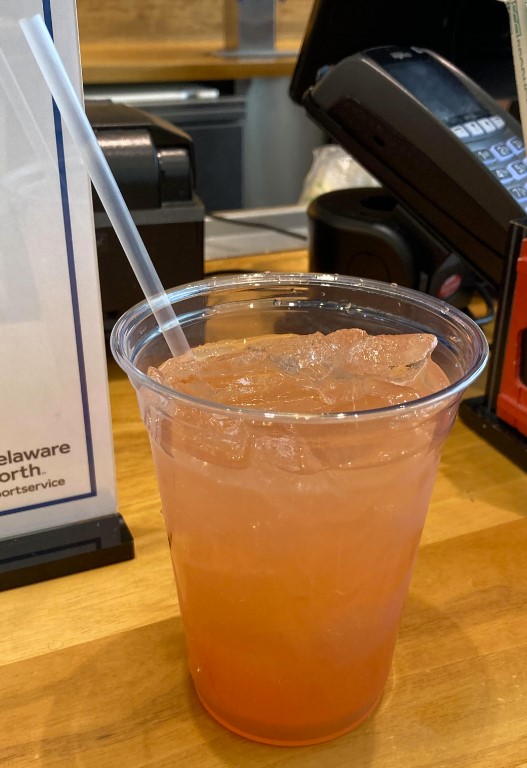
Spicy Watermelon Margarita – Should be a summer favorite.  Refreshingly light. Hrbek’, Section 114  & Keeper’s Heart Town ball Tavern, Section 229.


______________________________________________

—–Other New Offerings—-

Union Hmong Kitchen Banh Mi Brat (Minnesota Made) … Nicely seasoned sausage with pickled vegetables and caramelized garlic aioli.  This puts the James Beard-nominated Union Hmong Kitchen’s twist on the traditional bratwurst. Section 127.

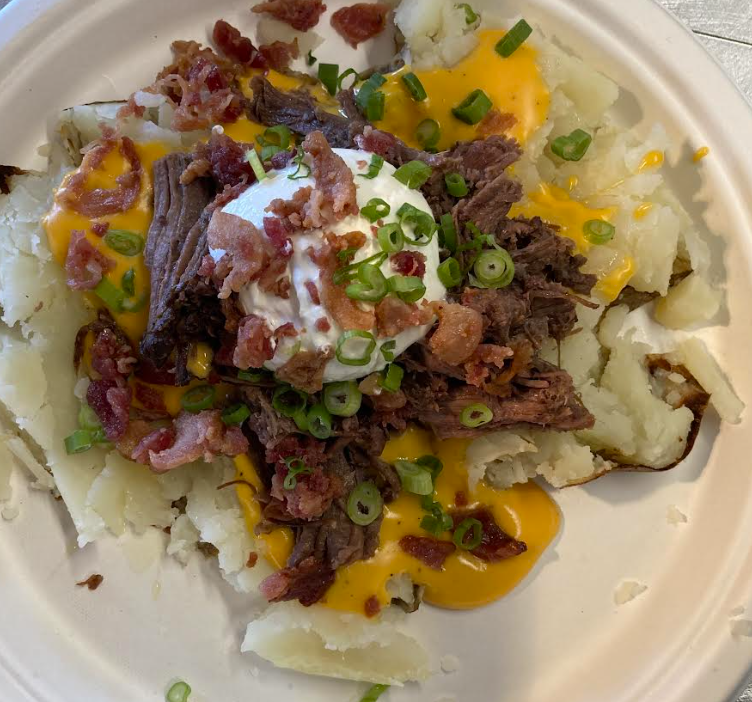
Smashed Baked Potato … Design your own comfort food baked potato, with such toppings as bacon bits, brisket, chili, butter, sour cream, beer cheese and onions. Section 117.

Lord Fletcher’s Walleye Burger (Minnesota Made) … Seared Walleye Burger with smoked tarter sauce. Gate 34 – 10,000 Lakes Bar.

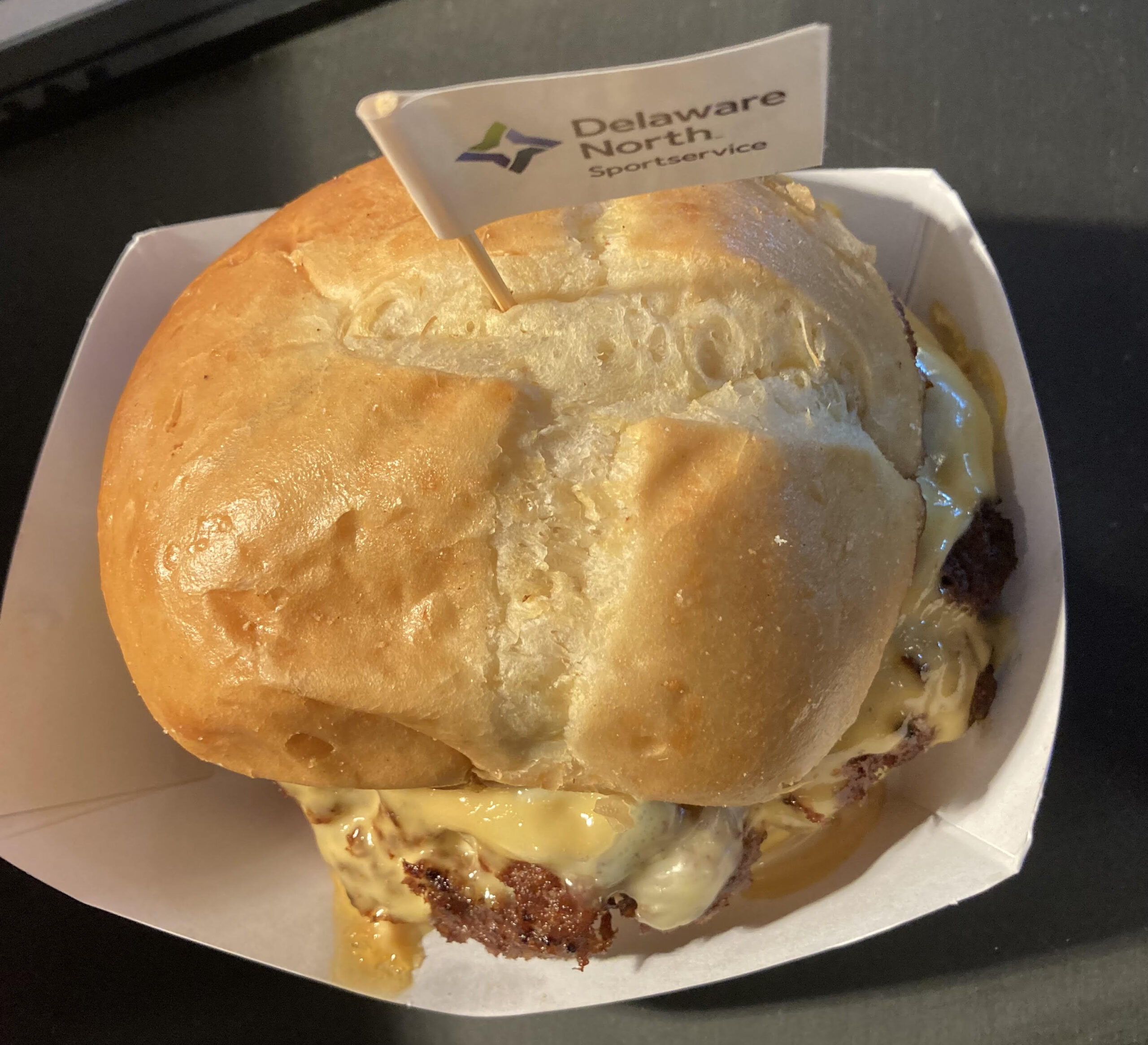
Just A Burger (Minnesota Made) … Double smash burger, topped with lettuce, onion, American Cheese and Two Mixed Up house sauce, served on a brioche bun.  Big enough to share.  Keeper’s Heart Town Ball Tavern, Section 229.

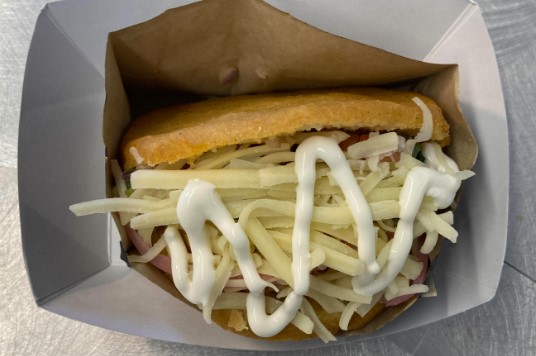
Q’BO Latin Food Chicken Tinga Arepas (Minnesota Made) First of all, an arepa is a South American dish consisting of ground maize dough stuffed with a variety of fillings. At Target Field, you will find crispy arepa stuffed with Chicken Tinga, cheese, sour cream, Pico de Gallo and pickled onions. Truly on Deck Market – Right Field.


Parcelle C.R.E.A.M & BluePrint Smoothies (Minnesota Made)Parcelle specializes in tasty organic, nutritious food offerings.  The BluePrint Smoothie features: blueberry, avocado, banana, blue spirulina, vanilla protein, coconut milk and agave, while the C.R.E.A.M. Smoothie has strawberry, banana, coconut milk, dates, agave syrup, collagen, peptide and aloe. Section 126.

A Double Header – Curds and Cakes – Section 232

A picture is worth a thousand words.  Here’s 2,000 words worth of images – and one additional word.  Yumm!

—–An Old Standby—–

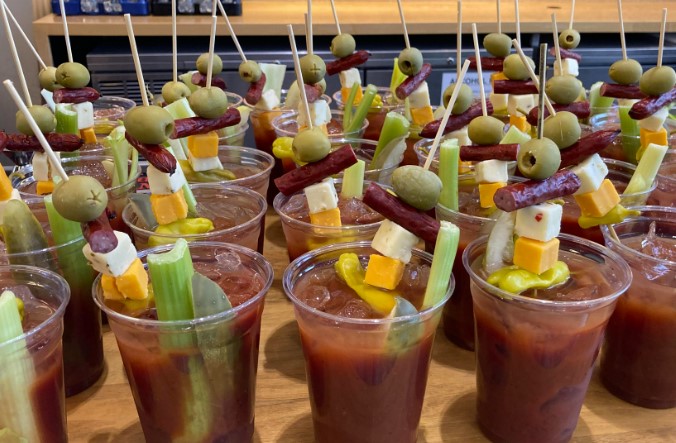
Target Field has always taken pride in its Bloody Mary’s.  The Ultimate Bloody Mary.  Hrbek’s, Section 114.

—–And Don’t Forget—-

The all-inclusive Legends Landing (Sections S,T,UV) …  Al- inclusive game tickets starting at $42 each, with all-you-can eat hots dogs, burgers, chicken tenders, chips, peanuts, assorted Pepsi products , bottled water and frozen desserts.

The Family Value Stands (Located in Sections 120, 133, 311) … A menu of traditional ballpark staples, all priced under $5..


There you have it.  Go Twins – and happy eating.


Baseball Roundtable – Blogging Baseball Since 2012.

100Baseball Roundtable is on the Feedspot list of the Top 100 Baseball Blogs.  To see the full list, click here.

Baseball Roundtable is also on the Anytime Baseball Supply Top 66 Baseball Sites list.  For the full list, click here

I tweet (on X) baseball @DavidBaseballRT

Follow Baseball Roundtable’s Facebook Page here.  More baseball commentary; blog post notifications.

Member: Society for American Baseball Research (SABR); Negro Leagues Baseball Museum; The Baseball Reliquary. 

P1030

Pitchers with Multi-Homer Games as Hitters … Down the Rabbit Hole

Welcome to another of Baseball Roundtable’s “When I start looking into a topic one thing always seem to lead to another” posts.  This one started out the “Where is the asterisk when you need it?” and ended up with a look at players who had multi-homer games when they also took the hill as a pitcher.  This took me down a research rabbit hole that included 71 multi-homer games by 58 different pitchers – with names and credentials ranging from Babe Ruth and Shohei Ohtani to Garland Buckeye and Elon Hogsett (and a lot in between, like “DonsCardwell, Drysdale and Newcombe and even Phil Collins).  But I’m betting ahead of myself.

Note: Given statistical accuracy and game formats, I am limiting myself to the Modern Era (post-1900). Also, not all Negro game stats (1920-48) have been fully documented and incorporated into the MLB record books.

Another Ruth/Ohtani Comparison

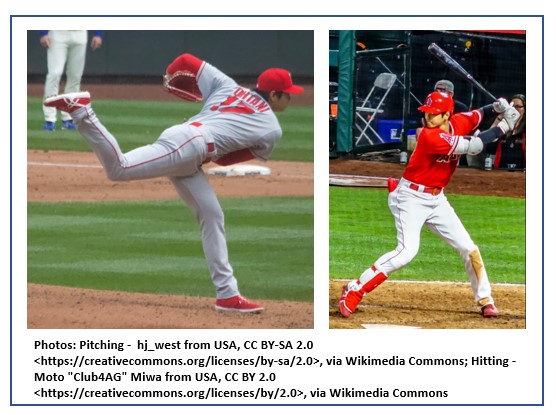
Let me explain how this all started. Browsing through Baseball-Reference.com, I noted that, while Shohei Ohtani has had 16 multi-homer games in his seven MLB seasons (171 total homers), he has had only one two-homer game in a contest in which he also pitched. That came in a June 27, 2023, 4-2 Angels win over the White Sox. In that game, Ohtani hit his second home run in the bottom of the seventh inning – after being replaced on the mound in the top of the inning (remaining in the lineup at DH). So, technically, that separates him from players who hit two (or more) homers in a game while in the lineup as a pitcher. Perhaps not a big “difference,” but (for The Roundtable) a statistical “distinction.”

This led me to look for any other pitchers/players who also had a multi-homer game in which at least one homer came after they had been pulled from the mound. I found one.  Babe Ruth, who had 72 multi-homer games, had just one multi-homer contest in which he also pitched.  That came on June 13, 1921, when Ruth made a rare start on the mound for the Yankees. Ruth homered to lead off the third inning (off Howard Ehmke). He was pulled from the mound in the top of the sixth, with two-on, no outs and the Yankees up 10-4. But, he didn’t’ go to the dugout. He moved to CF.  In the bottom of the seventh, now-centerfielder Ruth hit his second homer of the game (a two-run shot of Ehmke). So, like Ohtani, Ruth’s sole game in which he pitched and hit two home-runs also featured one homer after he left the mound. The Yankees, by the way, prevailed 13-8.

______________________________

For those who like to know such things.

In 1918, when Babe Ruth won 13-7, 2.22 for the Red Sox and won his first home run title (with 11 dingers), he hit two homers as a pitcher, six as a centerfielder, two as a first baseman and one as a left fielder. In 2023, when Shohei Ohtani went 10-5, 3.14 and won the AL home run title with 44, he hit seven home runs in games in which he pitched (four of those while he was still in the game at pitcher). He was in the lineup as DH for all 44 long balls.  

________________________________


Now for some additional pitcher’s multi-homer game tidbits.

A Handful of Multi-Homer Games

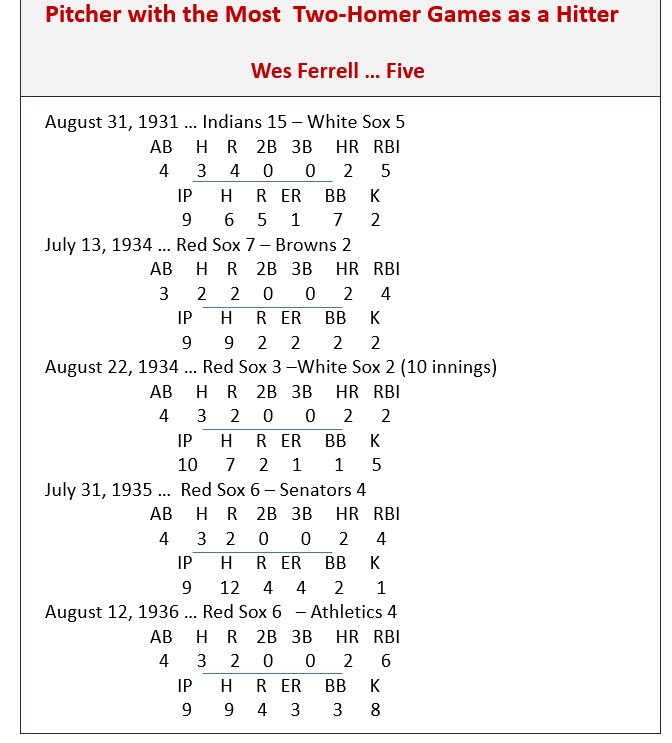
No pitcher had more multi-homer games than Wes Ferrell with five. (Five is officially a handful, isn’t it?)

We Ferrell: Photo – Acme Newspictures via Yi Auctions, Public domain, via Wikimedia Commons

In his fifteen-season MLB career (1927-41 … Indians, Red Sox, Nationals, Yankees. Dodgers, Braves), Ferrell went 193-128, 4.04 – with six seasons of 20 or more wins – leading the AL with 25 wins (14 losses) in 1935. As a hitter, he went .280-38-208 in 548 games.  Ferrell, notably, appeared in 157 games as a pinch-hitter and 13 in left field.  His 37 home runs as a pitcher are a record for MLB moundsmen (he hit one homer as a pinch hitter).

Other pitchers with multiple, multiple-homer games are:

Don Newcombe      3

Jack Harshman        2

Dick Donovan          2

Tony Cloninger         2

Lew Burdette           2

Rick Wise                  2

Red Ruffing             2

Pedro Ramos           2

_________________________________________

Thirteen Can Be a Lucky Number

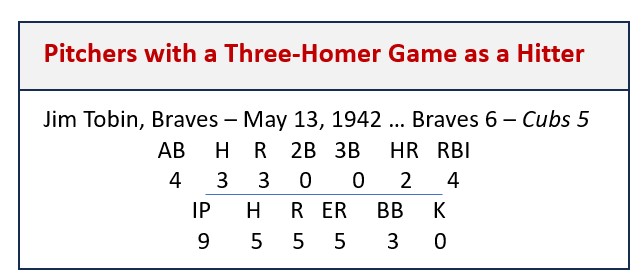
On May 13, 1942, as the Braves topped the Cubs 6-5, Braves’ pitcher Jim Tobin became the first (still only) modern-era pitcher to hit three home runs in a single game. Tobin hit a solo shot leading off the fifth (off Jake Mooty) to tie the game at two; a solo shot off Mooty to open the seventh (with the Braves trailing 4-2); and a two-run shot in the eighth, breaking a 4-4 tie, off Hiram Bithorn.  Tobin went the distance in the game, giving up five runs (three earned) on five hits and three walks.

Tobin pitched in nine MLB seasons (1937-45 … Pirates, Braves, Tigers), going 105-112, 3.44 (287 games/227 starts). As a hitter, he went .230-17-102 in 396 games. He appeared in 92 games as a pinch-hitter and four at 1B.

_____________________________________

Come On Home, Boys

Photo: See page for author, Public domain, via Wikimedia Commons

The Braves’ Tony Cloninger had a pair of multi-homer games, but the one he enjoyed on July 3, 1996 (in a 17-3 win over the Giants in San Francisco) was a record-setter. On that day, he not only racked up his second multi-homer game of the season, but also became the first and still only pitcher to hit two grand slams in a game and set the (still-standing) MLB record for RBI in a game by a pitcher at nine. Here was Cloninger’s game:

First Inning – Grand Slam off Bob Priddy (the Braves scored seven runs in the top of the first);

Third inning – Ground out to short off Priddy;

Fourth Inning – Grand Slam off Ray Sadecki;

Sixth Inning – Flyout to left off Sadecki;

Eighth Inning – RBI single off Sadecki.

Cloninger pitched a complete-game, seven-hitter (three runs, two walks, five whiffs).

Notably, Cloninger’s two-home game came just 17 days after he enjoyed a two-homer contest in a 17-1 Braves’ win over the Mets.

___________________________________

Pitchers with Two Multi-Homer Games in a Single Season

Wes Ferrell, Red Sox                      1934

Don Newcombe, Dodgers            1955

Jack Harshman, Orioles                1958

Dick Donovan, Indians                  1962

Tony Cloninger, braves                  1966

Rick Wise, Phillies                           1971

____________________________________________

Cloninger pitched in 12 MLB seasons (1961-72 … Braves, Reds, Cardinals), going 113-97, 4.07.  His best season was 1965, when he went 24-11, 3.29 for the Braves. As a hitter, he went .192-11-67 in 366 games.

Inquiring Minds Want to Know

After retiring from MLB, Tony Cloninger became a world-class, slow-pitch softball player. In 1978 (six years after his MLB retirement), playing for the United States Slow-Pitch Softball Association’s Slow-Pitch World Series Champion Howard & Carroll team, Cloninger was selected as the third baseman on the Series All-World Team.

_______________________________

Wisely Done, Rick

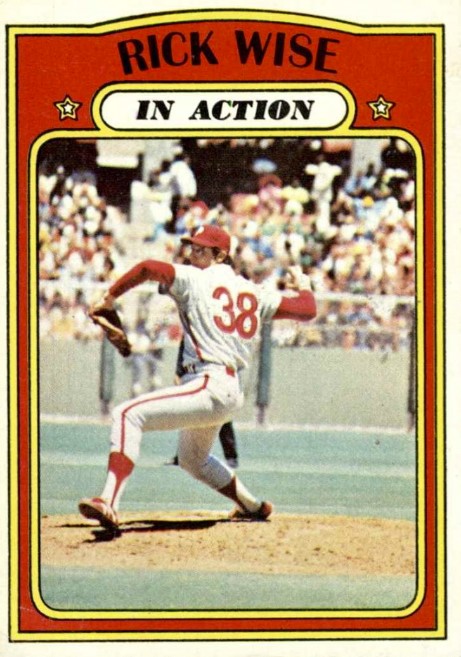
The Roundtable does like MLB unicorns – and, like Cloninger’s two-Grand Slam game, this one. On June 23, 1971, the Phillies’ Rick Wise became the first (and still only) MLB pitcher to hit two home runs and throw a no-hitter in the same game. Wise shut down the Reds in Cincinnati by a 4-0 score – giving up no hits, walking one and fanning three. He also rapped a two-run homer (off Ross Grimsley) in the fifth inning and a solo shot off Clay Carroll in the eighth.  Only a one-out, sixth-inning walk (to the Reds SS Dave Concepcion kept Wise from a perfect game on this day. And, consider the opposition. The Reds’ Lineup included the likes of: RF Pete Rose; CF George Foster; 1B Lee May; C Johnny Bench; and 3B Tony Perez.

Wise played in 18 MLB seasons (1964, 1966-82 … Phillies, Cardinals, Red Sox, Indians, Padres), going 188-181, 3.69. He won 15 or more games in six seasons. As a hitter he went .195-15-66 in 341 games.

Let’s get this Party Started

Another unicorn. On April 2, 2017, the Giants’ Madison Bumgarner became the first (still only) pitcher to hit two home runs on Opening Day. It came against the Diamondbacks (in Arizona) and MadBum homered to lead off the fifth inning (off Zack Greinke) and went deep again (a solo shot with one out, that gave the Giants a 4-3 lead) in the seventh off Andrew Chapin. He also drew a seven-pitch walk in the second inning. Bumgarner got a no-decision in the game – going seven innings, giving up three runs on six hits, while walking none and fanning 11.

In 15 MLB seasons (2009-2023 … Giants, Diamondbacks), Bumgarner went 134-124, 3.47 and was an All Star four times.  As a hitter his stat line is .172-19-65 in 313 games.

Side Note; April 2 is the earliest date for a two-homer game by a pitcher.  The other pitcher to do it?  Zack Greinke (who opposed Bumgarner on Opening Day 2017). Exactly two years later, in the Diamondbacks sixth game of the season, Grienke hit a pair of homers and drove in four runs as his D-backs topped the Padres 8-5 in San Diego.

Whiff N’Poof

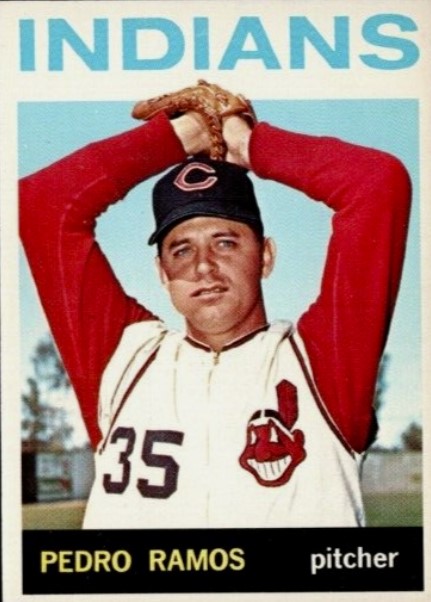
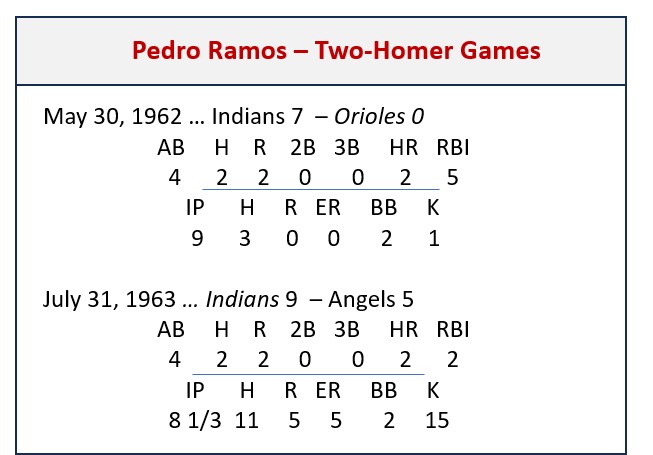
No pitcher fanned more batters in a two-homer game than the Indians’ Pedro Ramos.  On July 31, 1963, in a start against the Angels (in Cleveland), Ramos went two-for-four with a pair of solo home runs. He also fanned 15 Angels batters in a 9-5 win.

____________________________________________

Adding Insult to Injury

In the sixth inning of the Indians 9-5 win over the Angels on July 31, 1963, the Indians tied an MLB record by bashing four consecutive home runs – and Pedro Ramos was part of that record. The home run string began with two out in the seventh inning and included (in order) 2B Woodie Held, P Pedro Ramos, LF Tito Francona and SS Larry Brown.

_______________________________________

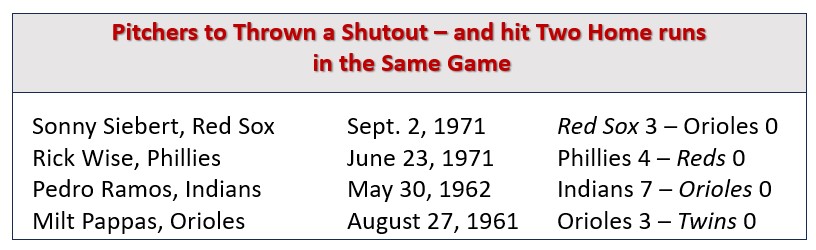
Ramos logged two two-homer games in his career – with wildly different pitching lines.  One was a three-hit shutout, in which he struck out just one batter.  In the second, he gave up five runs on 11 hits and two walks, but fanned 15.

Ramos pitched in 15 MLB seasons (1955-67, 1969-70 … Senators/Twins, Indians, Yankees, Phillies, Pirates, Reds, new Senators). He went 117-160, 4.08 as a pitcher and .155-15-56 in 696 games as a hitter.

Wrong Side of the Ledger

Pedro Ramos is one of only two MLB pitchers to lead his league in losses four consecutive seasons. Ramos (with the Senators) led the AL in losses from 1958 through 1961, with records of 14-18, 13-19, 11-18 and 11-20.  Phil Niekro matched that record in the NL, leading the league in losses from 1977 through 1980, going 16-20, 19-18, 21-20 and 15-18.  (In 1979, Niekro’s 21-20 record led the NL in wins and losses.)  The only other player to lead his league in losses four times is Bobo Newsom (who led the AL in losses I 1934, 1935, 1941 and 1945).

Oh, What A Relief It Is

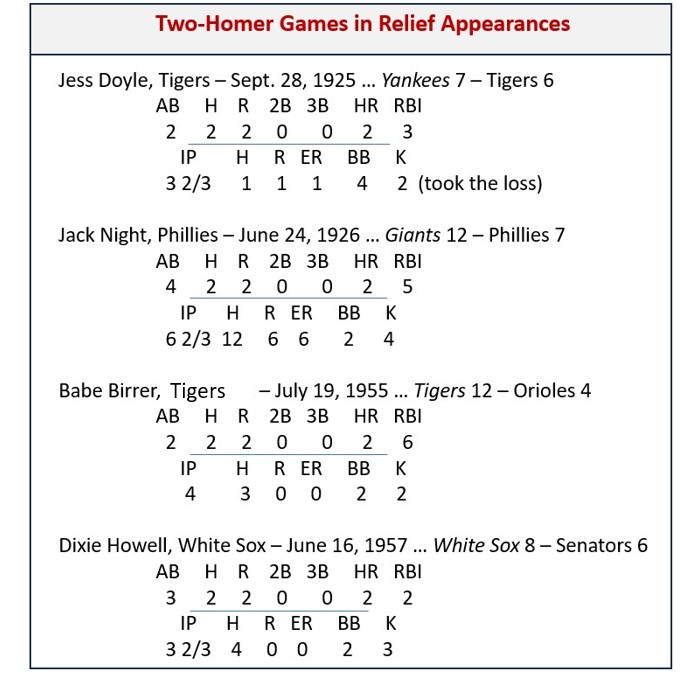
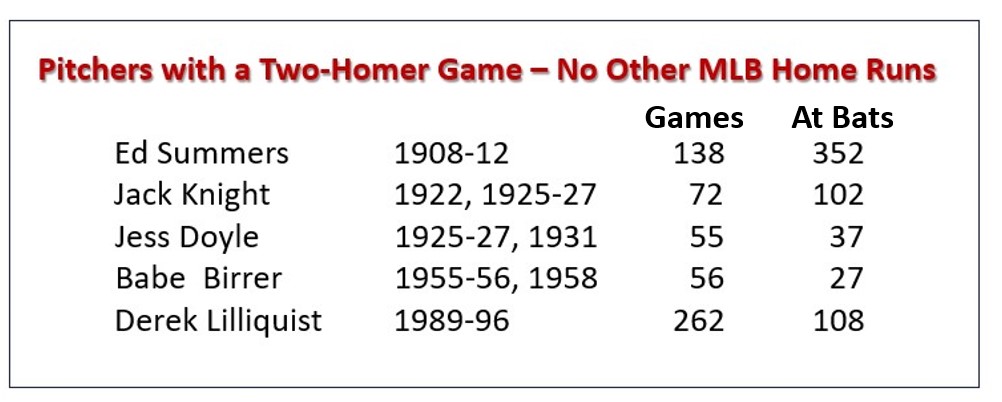
Only four relievers have notcheda  two-homer game as hitter.

Babe Birrer’s two-homer game (July 19, 1955) in relief may be the most interesting.  While he didn’t enter the game until the sixth inning, Birrer drove in six of the Tiger’s 12 runs in a 12-4 win over the Orioles (in Detroit). In his two plate appearances, Birrer:

  • Poked a two-out, three-run homer in the bottom of the sixth (off George Zuvernick);
  • Hit another three-run shot in the eighth (off Art Schallock).

Those, by the way, were the only home runs and RBI in Birrer’s short MLB career (1955-56, 1958 … Tigers, Orioles, Dodgers). He appeared in 56 games, going 4-3, 4.36 in 119 2/3 innings. As a hitter, he went .259-2-6 in 27 at bats.

_____________________________________

Teamwork

The Teams with the most pitchers multi-homer games in their history are:

Indians – Eight: Pedro Ramos (2); Dick Donovan (2); Bob Lemon; Mel Harder; Wes Ferrell; Garland Buckeye.

Phillies – Eight: Rick Wise (2); Randy Wolf; Robert Person; Randy Lerch; Larry Christenson; Phill Collins; Jack Knight.

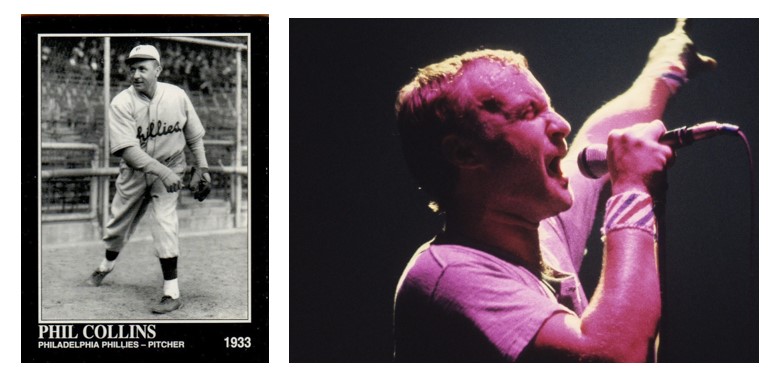
My Favorite Names of Two-Homer Pitchers – Garland Buckeye, Elon Hogsett and Phill Collins (No, not that Phil Collins).

Gotta love Garland Buckeye and Elon Hogsett – pitchers with two-homer games on September 10, 1925 (for the Indians) and August 31, 1932, respectively.

Buckeye, a hefty 6’-260-pound southpaw went 30-39, 3.91 over five MLB seasons (1918, 1925-28 … Nationals, Indians Giants). As a batter, he went .230-5-23 in 108 games.  Garland’s best season was 1925, when he went 13-8, 3.65 for the Indians. He drove in five runs in his two-homer game.

Buckeye’s size made him seem more suited for football – and he suited up at center/guard for the Chicago Tigers of the American Professional Football Association (forerunner to the NFL) in 1920, with the Chicago Cardinals (APFA and NFL from 1921 through 1924) and the American Football League Chicago Bulls in 1926.

Hogsett was also a southpaw and he enjoyed a 11-season MLB career (1929-38, 1944 … Tigers, Browns, Nationals) – going 63-87, 5.02 on the mound (as a starter and reliever (114 starts/216 relief appearances). As a hitter, he was .226-6-27 in 339 games. In his two-homer game, he went three-for-three (two homers and a single), with three RBI.

Phil Collins Photo: Philippe Roos from Strasbourg, CC BY-SA 2.0 <https://creativecommons.org/licenses/by-sa/2.0>, via Wikimedia Commons

Then there is Phil Collins. No not the Genesis/Grammy-winning Phil Collins. This Phil Collins had an eight-season MLB career (1923, 1929-35 … Cubs, Phillies, Cardinals) – going 80-85, 4.66 – and four-times winning 12 or more games in a season. On July 22, 1930, Collins started for the Phillies (makes sense if your name is Phil) against the pirate in Philadelphia. He went three-for-four at the plate, with two homers, a single and four RBI.  He also tossed a complete game (12 hits, five runs, six walks, three whiffs) in the Phillies 11-5 win. Over his career, Collins hit .193-4-44 in 322 games.


MLB Pitchers with Three-Homer Games (Modern ERA)

Jim Tobin, Braves                            May 13, 1942


MLB Pitchers with Two-Homer Games (Modern Era)

Ed Summers, Tigers                       Sept. 17, 1910

Ed Willet, Tigers                              June 30, 1912

Jim Shaw, Nationals                       May 2, 1919

Babe Ruth, Yankees                       June 13, 1921

Art Nehf, Giants                              July 29, 1924

Tony Kaufmann, Cubs                    July 4, 1925

Garland Buckeye, Indians             Sept. 10, 1925

Jess Doyle, Tigers                           Sept. 28, 2925

Jack Knight, Phillies                        June 24, 1926

Phil Collins, Phillies                       July 22, 1930

Red Ruffing, Yankees                     Sept. 18, 1930

Wes Ferrell, Indians                       August 31, 1931
Elon Hogsett, Tigers                       August 31, 1932

Hal Schumacher, Giants                April 24, 1934

Wes Ferrell, Red Sox                      July 13, 1934

Wes Ferrell, Red Sox                      August 22, 1934

Wes Ferrell, Red Sox                      July 31, 1935

Mel Harder, Indians                       July 31, 1935

Red Ruffing, Yankees                     June 17, 1936

Wes Ferrell, Red Sox                      August 12, 1936

Elden Auker, Tigers                        August 14, 1937

Jack Wilson, Red Sox                     June 16, 1940

Spud Chandler, Yankees                July 26, 1940

Bill Lee, Cubs                                   May 7, 1941
Bucky Walters, Reds                      May 20, 1945

Dave Koslo, Giants                         July 7, 1949

Bob Lemon, Indians                       July 24, 1949

Ben Wade, Dodgers                       July 6, 1952

Don Newcombe, Dodgers            April 14, 1955

Don Newcombe, Dodgers            May 30, 1955

Jim Hearn, Giants                           July 9, 1955

Babe Birrer, Tigers                          July 19, 1955

Don Newcombe, Dodgers            Sept. 19, 1956

Dixie Howell, White Sox               June 16, 1957

Billy Hoeft, Tigers                           July 14, 1957

Lew Burdette, Braves                    August 13, 1957

Lew Burdette, Braves                    July 10, 1958

Jack Harshman, Orioles                 July 16, 1958

Don Drysdale, Dodgers                 August 23, 1958

Jack Harshman, Orioles                 Sept. 23, 1958

Don Cardwell, Cubs                       Sept. 2, 1960

Glen Hobbie, Cubs                         July 2, 1961

Milt Pappas, Orioles                       August 27, 1961

Dick Donovan, Indians                  May 18, 1962

Pedro Ramos, Indians                   May 30, 1962

Dick Donovan, Indians                  August 31, 1962

Pedro Ramos, Indians                   July 31, 1963

Earl Wilson, Red Sox                      August 16, 1965

Tony Cloninger, Braves                  June 16, 1966

Tony Cloninger, Braves                  July 3, 1966

Jim Rooker, Royals                          July 7, 1969

Rick Wise, Phillies                           June 23, 1971

Rick Wise, Phillies                           August 28, 1971

Fergie Jenkins, Cubs                      Sept. 1, 1971

Sonny Siebert, Red Sox                 Sept. 2, 1971

Larry Christenson, Phillies            Sept. 5, 1976

Randy Lerch, Phillies                      Sept. 30, 1978

Walt Terrell, Mets                          August 6, 1983

Jim Gott, Giants                              May 12, 1985

Derek Lilliquist, Braves                  May 1, 1990

Darren Driefort, Dodgers             August 8, 2000

Mike Hampton, Rockies                June 5, 2001

Robert Person, Phillies                  June 2, 2002

Randy Wolf, Phillies                        August 11, 2004

Dontrelle Willis, Marlins               Sept. 20, 2006

Micah Owings, Diamondbacks    August 18, 2007

Noah Syndergaard, Mets             May 11, 2016

Madison Bumgarner, Giants        April 2, 2017

Zack Greinke, Diamondbacks      April 2, 2019

Shohei Ohtani, Angels                   June 27, 2003

Primary Resources:  Baseball-Reference.com; Baseball-Almanac.com


Baseball Roundtable – Blogging Baseball Since 2012.

100Baseball Roundtable is on the Feedspot list of the Top 100 Baseball Blogs.  To see the full list, click here.

Baseball Roundtable is also on the Anytime Baseball Supply Top 66 Baseball Sites list.  For the full list, click here

I tweet (on X) baseball @DavidBaseballRT

Follow Baseball Roundtable’s Facebook Page here.  More baseball commentary; blog post notifications.

Member: Society for American Baseball Research (SABR); Negro Leagues Baseball Museum; The Baseball Reliquary. 

P1029

A Couple of Wild Innings – Without the Benefit of the Long Ball

Oh yes, one thing leads to another – again.

Yesterday, the Diamondbacks (March 28) made a bit of Opening Day history.  In their opener against the Rockies, the Diamondbacks scored 14 runs in the third inning – a modern era (post-1900) single-inning Opening Day record – and they did it without the benefit of a home run.  That inning took me back in time to another even more unique frame – which took place on April 22, 1959, when the White Sox plated 11 runs in an inning, while logging just one hit.

Let’s look at both innings.

In yesterday’s 14-run third, the Diamondbacks sent 18 batters to the plate – collecting ten singles, three doubles and two walks.  In the inning:

  • Five of the nine players in the starting lineup collected two hits;
  • Corbin Carroll walked twice;
  • Eight of the nine collected at least one RBI;
  • Eight of the nine scored at least one run, with six scoring twice;
  • The Diamondbacks had two streaks within the inning when seven consecutive batters reached base;
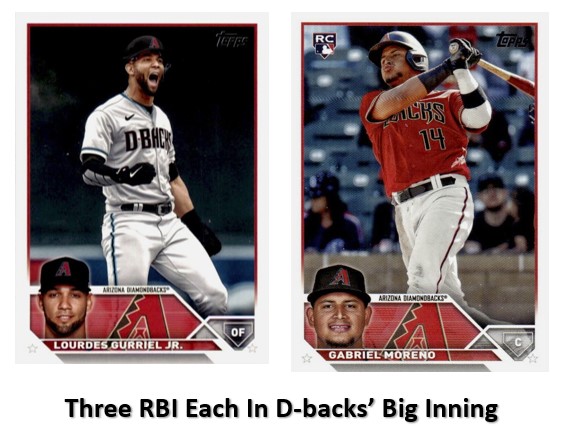
  • Lourdes Gurriel Jr. and Gabriel Moreno each has three RBI.

It went like this:

  • SS Geraldo Perdomo, the number-nine hitter singled off Kyle Freeland;
  • 2B Ketel Marte singled;
  • RF Corbin Carroll walked, loading the bases;
  • LF Lourdes Gurriel, Jr. hit an RBI single;
  • 1B Christian Walker hit a two-run double;
  • C Gabriel Moreno hit an RBI single;
  • 3B Eugenio Suarez hit an RBI single;
  • DH Blaze Alexander flied out to RF;
  • CF Alek Thomas hit an RBI double;
  • Anthony Molina relieved Freeland;
  • Perdomo hit an RBI single;
  • Marte hit an RBI single;
  • Carroll drew his second walk, again loading the bases;
  • Gurriel hit a two-run single;
  • Walker singled, loading the bases.
  • Moreno hit a two-run double;
  • Suarez drove in a run with a sac fly;
  • Alexander hit an RBI single;
  • Jalen Beeks replaced Molina on the mound.
  • Thomas grounded out pitcher to first.

The Diamondbacks came into the inning with a 2-0 lead and did not score after the 14-run third – coming away with a 16-1 win. (From the time that Beeks took the mound for the Rockies, the Rox bullpen held the Diamondbacks to two hits over 5 1/3 innings, with seven strikeouts.

__________________________________________

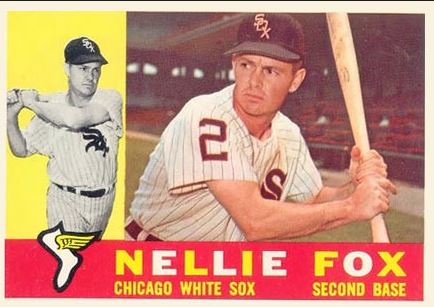
Nellie Fox drew two bases-loaded walks in the seventh inning of the White Sox 20-6 win. For the game. Fox was four-for-five, with a double, two walks ,a run scored and five RBI.

Now for that 1959 game. On April 22, 1959 – in a 20-6 win over the Kansas City Athletics (in Kansas City), the White Sox scored 11 runs in the seventh inning on just one hit (a single). Here are few “numbers” from that 11-run inning:

  • The Sox sent 17 batters to the plate, but collected just one hit;
  • Sox’ hitters stepped into the box with runners in scoring position 14 times;
  • Sox hitters batted with the bases loaded 12 times and never got the ball past the pitcher;
  • Eight different White Sox’ players drew walks;
  • The Sox drew eight bases-loaded walks (and had one bases-loaded hit batsman);
  • White Sox’ 2B Nellie Fox walked twice with the bases loaded in the inning.

Here’s how it went that inning (per baseball-reference.com):

  • 1B Ray Boone was safe on a throwing error by A’s shortstop Joe DeMaestri;
  • RF Al Smith attempted to sacrifice Boone to second (score was 8-6 at the time) and reached on an error by A’s third baseman Hal Smith;
  • LF Johnny Callison singled to right. Scoring Boone and Smith (with the help of an error by A’s right fielder Roger Maris). Callison ended up on third;
  • SS Louis Aparicio walked – then stole second (runners now on second and third);
  • P Bob Shaw walked (loading the bases);
  • PH Earl Torgeson (batting for 3B Sammy Esposito) walked (scoring Callison);
  • 2B Nellie Fox walked (scoring Aparicio);
  • CF Jim Landis reached on fielder’s choice – grounding back to pitcher Mark Freeman, who took the force at home (bases still loaded);
  • C Sherman Lollar walked (scoring Torgeson, bases still loaded);
  • Boone made his second plate appearance of the inning and walked (scoring Fox).
  • Smith made his second plate appearance of the inning and walked (scoring Landis);
  • Callison, who had the only hit of the inning in his first plate appearance, was hit by a pitch (scoring Lollar, bases still loaded). Lou Skizas came in to run for Callison;
  • Aparicio drew his second walk of the inning (scoring Boone, bases still loaded);
  • Shaw struck out.
  • PH Bubba Phillips (batting for Torgeson, who batted for Esposito earlier in the inning) walked (scoring Smith, bases still full);
  • Fox drew his second bases loaded walk of the inning (scoring Skizas);
  • Landis grounded out pitcher to first to end the inning.

The 20-runs the White Sox scored that day were the most they plated in any game that season.  Another side note: It did not start out like it was going to be a good day for the White Sox.  The A’s knocked Chicago’s starting pitcher Early Wynn – who would go on to lead the AL in wins with 22 – out of the game with six runs on six hits and two walks in the first 1 2/3 innings. The Sox actually trailed 6-1 after two frames. A few other stats:

  • The Sox collected a total of 16 hits and 13 walks in the contest; which also saw four Kansas City errors.
  • In addition, to scoring 20 times, Chicago left eleven runners on base.
  • Nellie Fox was the offensive star of the game – with four hits (five at bats), two walks and five RBI.

The A’s used six pitchers in the contest, three in the seventh inning.

The 1959 AL pennant-winning White Sox went on to become known as the “Go-Go Sox” for their ability to manufacture runs despite a punchless offense. (The Sox finished last in the league in home runs and sixth – out of the eight AL teams – in batting average and runs scored, but first in stolen bases and second in walks).

This One Had a Homer

For those that like to know such things, the most runs tallied in any MLB inning is 18, by the National League Chicago White Stockings (Cubs) in a 26-6 win over the Detroit Wolverines on September 6, 1883.  That inning featured 18 Chicago base hits (six doubles, one triple, one home run, ten singles and two Detroit errors. ).  Those 18 hits are also an MLB single-inning record, as are the 29 total bases. Three players logged a record  (tied, but never broken) three  hits in the inning (3B Ed Williamson, SS Tom Burns and 2B Fred Pfeffer). Tom Burns’ two doubles and a home run set the mark for extra-base hits in an inning. Burns and Williamson set the mark (since tied) for runs scored in an inning with three.  Six players had two hits in the inning.

Primary Resources:  Baseball-Reference.com; Baseball’s Biggest Inning, by Art Ahrens, 1977 Baseball Research Journal (Society for American Baseball Research).

COMING SOON – A DEEP DIVE INTO PITCHERS WITH MULTI-HR GAMES (as hitters).

Baseball Roundtable – Blogging Baseball Since 2012.

100Baseball Roundtable is on the Feedspot list of the Top 100 Baseball Blogs.  To see the full list, click here.

Baseball Roundtable is also on the Anytime Baseball Supply Top 66 Baseball Sites list.  For the full list, click here

I tweet (on X) baseball @DavidBaseballRT

Follow Baseball Roundtable’s Facebook Page here.  More baseball commentary; blog post notifications.

Member: Society for American Baseball Research (SABR); Negro Leagues Baseball Museum; The Baseball Reliquary. 

P1028

Opening the Record Book on Opening Day

MLB’s Opening Day is upon us, with the Dodgers and Padres opening the season tomorrow in Seoul, South Korea. I, by the way, am not a big fan of these overseas “Openers” – mostly because of the necessary time gap between the openers for the rest of MLB. Still, Opening Day is a time to celebrate – and I’ll do so with some MLB Opening Day trivia tidbits, as well as my predictions for the 2024 season.

Two disclaimers here. Given statistical accuracy and game formats, I am limiting myself to the Modern Era (post 1900) and not all Negro League game stats have been fully documented and incorporated into the MLB record book. (In 2020, the Negro Leagues from 1920-48 were designated major leagues.)

“You always get a special kick on Opening Day, no matter how many you go through. You look forward to it like a birthday party when you’re a kid.  You think something wonderful is going to happen.’

                                                                                                           Joe DiMaggio

So, let’s look at some Opening Day stats and stories.

 THESE PLAYERS WERE A ‘HANDFUL” ON OPENING DAY

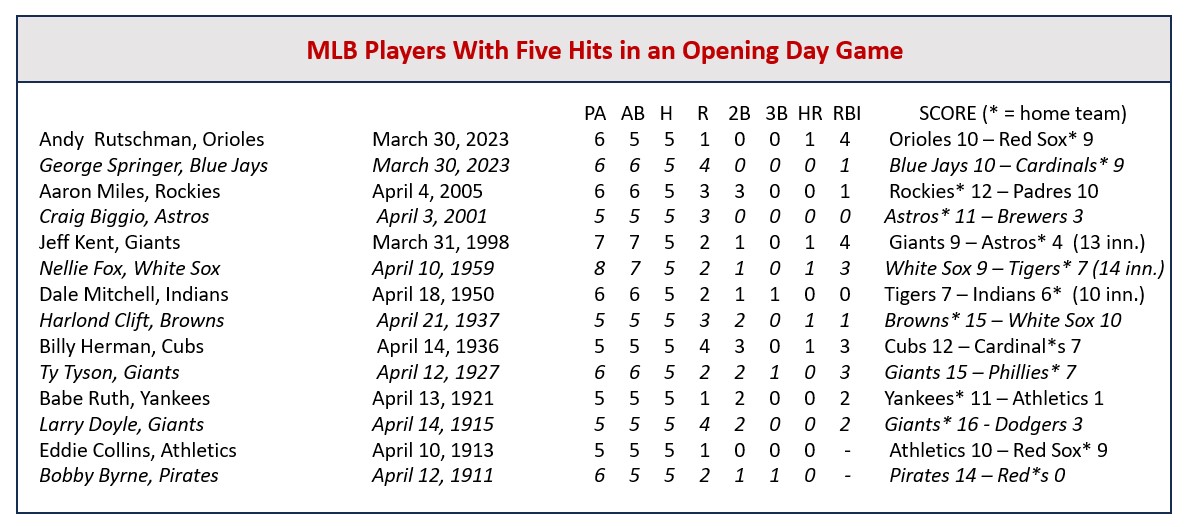
In the Modern Era (since 1901) only 14 MLB players have collected five hits (five is a handful, isn’t it?) in an Opening Day game.  Looking for unicorns within this list, on March 30, 2023, we saw the first (still only) Opening Day in which two players collected five hits (it happened in two different games). The players were Andy Rutschman of the Orioles and George Springer of the Blue Jays. Rutschman also became the first (only) catcher to record a five-hit Opening Day.


Now, there are some potential trivia tidbits (that you can turn into trivia questions) in this list, but here’s one that intrigues The Roundtable.

In a statistical anomaly, seven of the 14 players to enjoy a five-hit Opening Day played the same position.  What position was it?

Your answer: Second base and the players were Craig Biggio; Jeff Kent; Nellie Fox; Billy Herman; Aaron Miles; Larry Doyle; and Eddie Collins. For those who like to know such things, the list also includes three left fielders, two third baseman, one right fielder and one catcher.  As you might guess, most of these players were batting high in the order:  Five leading off, five batting second, two in the three-hole, one at cleanup and one sixth,

________________________________________________

THREE’S A CROWD – OR A CROWD OF THREES

The Opening Day, single-game record of three home runs is shared by four players.  The quarter includes: the Blue Jays’ George Bell, Cubs’ Tuffy Rhodes, Tigers’ Dmitri Young and White Sox’ Matt Davidson.  Here’s another anomaly that would make a good trivia question. Three of the four three-homer Opening Day games were logged against the same franchise.  Who were the unlucky opponent so those three triple-round tripper openers?

Your answer.  The Kansas City Royals.  Here’s the full list.

George Bell … On April 4, 1988, Bell – batting clean-up and serving as the DH – became the first major leaguer to hit three home runs in an Opening Day game, as his Blue Jays topped the Royals 5-3 in Kansas City. Bell’s power outburst was no surprise. He was coming off a 1987 season in which he hit 47 homers, drove in 134 runs and was the AL MVP. Bell went three-for-four with three runs scored and four RBI, hitting all three home runs off Royals’ starter Brett Saberhagen.

Tuffy Rhodes … On a windy April 4, 1994, Rhodes (leading off and playing CF for the Cubs in Chicago) hit three solo shots off Mets’ starter Dwight Gooden. Rhodes also had a single and a walk in five plate appearances. Despite Rhodes’ record-tying performance, the Cubs lost to the visiting Mets 12-8. At the time, Rhodes had played 107 MLB games in four seasons – hitting a total of five home runs. His MLB career consisted of 225 games in six seasons, with a .224 average and just 13 round trippers (with a high of eight in 1994). Rhodes did go on to hit 474 home runs in eleven seasons in Japan.

Dmitri Young … On April 4, 2005 the Tigers’ Young joined Bell and Rhodes on the list of batters with three home runs in an Opening Day game – as the Tigers topped the Royals 11-2 in Detroit. Young started at DH and went four-for-four with four runs and five RBI.  Young, an All Star in 2003 and 2007, hit a total of 21 home runs in 2005 – and 171 in 13 MLB seasons. He hit a career-high 29 round trippers in 2003.

Matt Davidson … On March 29, 2018, as the White Sox topped the Royals 14-7 in Kansas City, DH and (appropriately) cleanup hitter Davidson opened the season with a three-homer, five-RBI game. He went three-for-four with a walk, four runs scored and five RBI. Davidson went deep off three different pitchers: solo shots in the fourth and fifth off Danny Duffy and Blaine Boyer and a three-run blast in the eighth off Brian Flynn. Davidson, in his fourth MLB season, went on to a .228-20-62 campaign.  In his 306 MLB games (2013, 2015-18, 2020, 2022), Davidson has  ja .220-54-157 stat line.

_________________________

A UNICORN OF A WIN

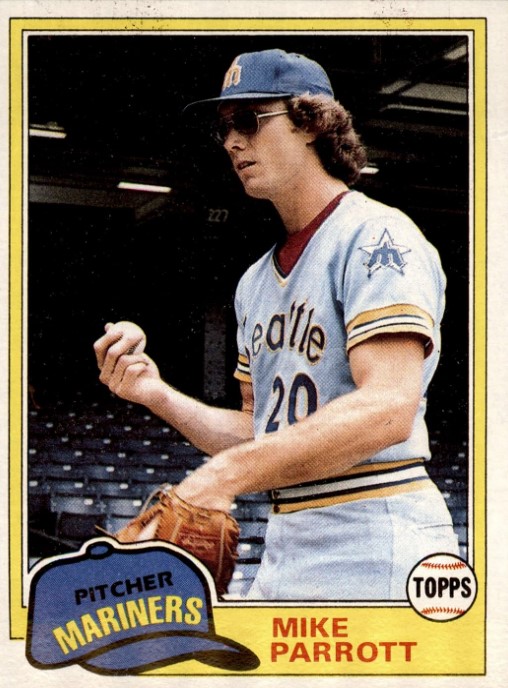
In 1980, Mike Parrot was the Opening Day starter (at home) for the Seattle Mariners – an honor he earned with a 14-12, 3.77 season for the 67-95 Mariners in 1979.   He picked up the win, going 6 1/3 innings in an 8-6 Seattle victory over Toronto. Why then unicorn designation? Parrot would pitch in 26 more games that season (15 more starts) and not record another victory – ending the campaign at 1-16, 7.28. Parrot pitched in five MLB seasons (1977-81, all for the Mariners) – going in 19-39, 4.87.

___________________

WHO’S ON FIRST? NONE OF YOU. 

Who was the first MLB pitcher to throw nine no-hit innings in an Opening Day start? I’ll toss in a little hint here.  It’s not the Feller you may be thinking of – and it’s not a good Day to guess.

MLB has seen a pair of Opening Day no-hitters, Bob Feller of the Indians on April 16, 1940 and Leon Day of the of the Newark Eagles (Negro National League II) on May 5, 1946.

Still, neither of these gentlemen can lay claim to be the first MLB pitcher to throw nine no-hit innings in an Opening Day start. Back on April 15, 1909 – as the Giants opened against the Superbas (Dodgers) in Brooklyn – Giants’ righty Leon “Red” Ames started and, with just the minimum of support, could have made history. Ames held Brooklyn hitless for nine innings, but got nary a run of support from his batsmen.  Ames finally gave up a hit with one out in the tenth and, while he kept the shutout going through the 12th inning, eventually lost 3-0 in 13 innings.  How the game has changed:  Both Ames and Brooklyn starter Irvin “Kaiser” Wilhelm went the distance.

Ames, by the way, had a 17-season MLB career (1903-10), going 183-167, 2.63. His best season was 1905 (Giants), when he went 22-8, 2.74.

_____________________________________

A VICTIM OF CIRCUMSTANCE

Which player became a “victim of circumstance” and set an Opening Day single-game record by fanning five times? That would be Ron Karkovice.

On March 31, 1996, White Sox’ catcher Karkovice set an MLB Opening Day record by striking out five times as Chicago lost 3-2 in Seattle.  Karkovice, however, may have been a victim of circumstance.

First Circumstance: Future Hall of Famer (and whiff artist) Randy Johnson started on the mound for the Mariners – striking out 14 in seven innings (including Karkovice three times). Johnson holds the record for Opening Day career strikeouts with 107.

Second Circumstance:  The White Sox could muster only two runs on four hits over the first nine innings – taking a slim 2-1 lead into the bottom of the ninth (at that point, Karkovice had fanned just three times).

Third Circumstance: The Mariners tied the contest in the ninth, and the game went to 12 innings before the Mariners prevailed 3-2.  In those three extra innings, Karkovice struck out against Norm Charlton (tenth inning) and Edwin Hurtado (twelfth inning) to set the Opening Day record.

____________________________________

PLEASE, (DON’T) GIVE ME A BREAK

Robin Roberts holds the MLB record for consecutive Opening Day starts for the same team – 12 for the Phillies from 1950 through 1961. The record for overall consecutive Opening Day starts belong to Jack Morris at 14 (1980-93 – Tigers,  Twins, Blue Jays.)

More: How the Game has Changed

In the 1950’s (1950-59), Robin Roberts won 199 games and threw 3,011 2/3 innings – an average of 301 innings pitched per season.

I’d like to go a little deeper for a tidbit/question in this category. Hall of Famer Steve Carlton started 14 of the 15 Phillies’ Opening Day games from 1972 through 1986. The one year he missed cost him the record for both overall consecutive Opening Day starts and consecutive Opening Day starts for the same team. Who was the pitcher who interrupted Carlton’s streak? 

In 1976, Jim Kaat (like Carlton, a lefty and future Hall of Famer) got the Opening Day nod from the Phillies. Kaat, at the time, was a three-time 20-game winner, and an All Star for the White Sox the year before (he had been traded to the Phillies in December of 1975).   For those who may be wondering whether Carlton’s health played an issue in Kaat’s Opening Day start, Carlton started the second game of the season and went on to a 20-7 record in 35 starts.

Oh, one other tidbit, Tom Seaver holds the record for total opening day starts with sixteen – 11 for the Mets, three for the Reds and two for the White Sox. Seaver recorded seven wins, two losses and seven no decisions on Opening Day,

____________________________________

Just A chart for your entertainment.

___________________________________________

TOSSING YOU A CURVE ON THIS ONE

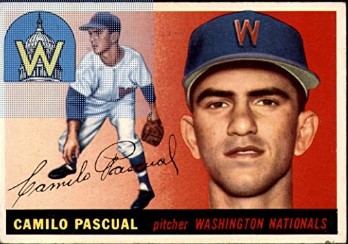
What pitcher holds the mark for the most strikeouts in an Opening Day game? Answer: Camilo Pascual.

This is a bit of a unicorn, as Pascual’s 15 strikeouts on Opening Day 1960 have never been matched. (Three players have fallen just one short of the total: Randy Johnson (twice – 1963 & 1996, Mariners); Don Drysdale (1960 Dodgers); and Shane Bieber 2020 Indians).

On April 18, 1960, Pascual (known for his sweeping curve ball) took the mound at Griffith Stadium for the Washington Senators (against the Boston Red Sox). In 1959, the Senators had finished in last place in the AL, but Pascual had gone 17-10, 2.64, leading the league with 17 complete games and six shutouts. As the Senators’ Opening Day starter in 1960, Pascual picked up right where he left off – tossing a complete game three-hitter, walking three and striking out a still Opening Day record 15 batters in a 10-1 win over the Red Sox. It was one of two 15-whiff games in his career.

Pascual pitched 18 MLB seasons (1954-71), winning 174 and losing 170, with a 3.63 earned run average. He was a five-time All Star, two-time twenty-game winner and led the league in complete games, shutouts and strikeouts three times each.

__________________________________________

WALK DON’T RUN

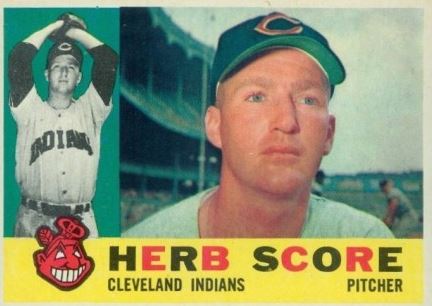
Can you name the pitcher who holds the record for the most walks surrendered in an Opening day game (11)?  Hint, despite the 11 free passes, the opposition only scored three runs (two earned) off him in 11 innings. Answer: Herb Score.

On April 16, 1957, Cleveland southpaw Herb Score set the Opening Day record for pitcher’s walks, delivering eleven free passes to the visiting White Sox.  Despite Score’s wildness, it was a close contest, with Score going the distance in a 3-2, 11-inning loss.  Score struck out ten and gave up just seven hits and two earned runs – stranding 14 Chicago base runners.

Score was the 1955 AL Rookie of the Year, when the 22-year-old lefty went 16-10. 2.85 and led the league in strikeouts with 245.  In 1956, he was even better, going 20-9, 2.53 and again topping the league in whiffs (263). His 1957 season ended on May 7, when he was it in the face by a line drive off the bat of Yankee Gil McDougald.  Score suffered a broken nose, as well as damage to is right cheek bone and right eye.  He was hospitalized for about three weeks and did not return to the mound that season.

Score came back in 1958, but suffered an elbow injury early in the season (some wondered if he had changed his delivery after the McDougald incident, but Score denied that – and had been pitching well to that point). At any rate,  from 1958 until he retired in 1962, Score was 17-26, 4.43.

_____________________________________________

A PAINFUL WAY TO START THE SEASON

On April 9, 1990, Astros’ first baseman and cleanup hitter Glenn Davis was hit by a pitch an Opening Day record three times. Davis came to the plate six times and never put the ball in play – but still made only one out.  Davis (who led the league in HBP that season with eight) was hit by a pitch three times, walked twice and struck out once as the Astros lost to the visiting Reds 8-4.  Davis finished Opening Day with a batting average of .000, but an on-base percentage of .833.

Second Inning – Davis, leading off, HBP (on 1-0 count) from Tom Browning;

Third Inning – Davis (one out, none on) hit by a 2-2 pitch from Browning;

Fifth Inning – Five-pitch walk off Tim Layana;

Seventh Inning – Davis fans on three pitches from Norm Charlton;

Ninth Inning: Runner on second two out, Davis intentionally walked by Rob Dibble (score tied at four);

Eleventh Inning: Davis hit by pitch (one out, one on) on a 2-2 pitch from Randy Myers.

Davis played 10 MLB seasons (1984-93), hitting .259, with 190 home runs and 603 RBI.  He was hit by a pitch 55 times.

______________________________________

OPENING DAY STARTS – GIMME FIVE!

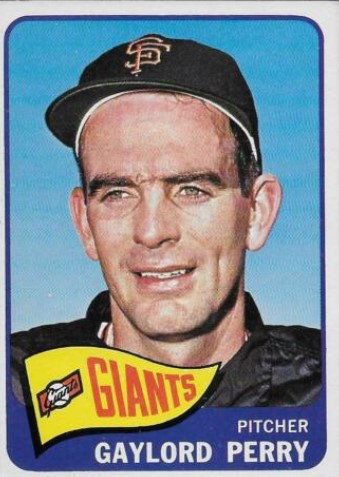
Gaylord Perry ten scoreless innings in relief (seven hits. one walk, nine whiffs).

Gaylord Perry was honored by the most teams with Opening Day starts. He started on Opening Day for an MLB-record five different teams:

  • Giants (1970)
  • Indians (1972 through 1975)
  • Rangers (1976)
  • Padres (1978-79)
  • Mariners (1983)

Perry pitched in 22 MLB seasons (1962-83 … Giants, Indians, Rangers, Padres, Yankees, Braves, Mariners, Royals. He went 314-265, 3.11, with won two Cy Young Awards, led his league in wins three times, wining 20+ games in five seasons.

___________________________________

THE LONGEST DAY– 15 SHUTOUT INNINGS

On April 13, 1926, the Senators’ Walter Johnson pitched a 15-inning, complete-game shutout (six hits, three walks, nine strikeouts) as Washington topped the Philadelphia Athletics 1-0 in Washington.  The opposing starter, Eddie Rommel tossed the second-most innings in an Opening Day appearance – going 14 1/3, as Washington scored the winning run with one out in the 15th.  Johnson, by the way, was 38-years-old at the time.

__________________________________________

YOU CAN’T TOUCH THIS

Jimmy Key holds the record for Opening Day wins without a loss at seven – and he did in the minimum seven starts (Blue Jays, Yankees and Orioles). In those seven wins, he threw 44 1/3 innings, with a 3.05 ERA.

Key played in 15 MLB seasons (1984-98 … Blue Jays, Yankees, Orioles), going 186-117, 3.51. He was a five-time All Star and won 15 or more games in five seasons.

___________________________________

BRINGING THE BOYS HOME SWEET HOME

The Opening Day single-game record for RBI (seven) is shared by the Twins’ Brant Alyea and the Cubs’ Corey Patterson.

On April 7, 1970 – in his very first game as a Twin – LF Brant Alyea drove in an Opening Day record seven runs as Minnesota topped the White Sox 12-0 in Chicago. Batting fifth, Alyea went four-for-four, with two home runs, two singles and two runs scored.  The game, it turned out, would foreshadow a strong April for Alyea.  In 17 April games, he hit .415, with seven runs, 23 RBI, four doubles and five home runs.

On March 31, 2003, the Cubs’ CF Corey Patterson tied Alyea’s record. In a 15-2 win over the Mets in New York, Patterson, batting seventh, drove in seven runs, going four-for-six with two home runs and two runs scored.  Patterson, a career .252 hitter (12 seasons), was a true Opening Day All Star. In seven Opening Day appearances, Patterson hit .440, with seven runs, 12 RBI and three home runs.

_________________________________________

EIGHT IS ENOUGH

Eight is a career magic number for Opening Day. Frank Robinson, Ken Griffey, Jr. and Adam Dunn share the career record for Opening Day home runs with eight each.  Robinsons were all hit in one-homer games, giving him the record for the most Opening Days with a home run.


—-BBRT KINGS OF OPENING DAY – IN THE BATTER’S BOX AND ON THE MOUND—- 


Photo by wild mercury

Perhaps no one looked forward to Opening Day more than Ted Williams – the king of the Opening Day batter’s box.  A career .344 hitter, Williams was even better on Opening Day.  Teddy Ballgame played in fourteen “Openers” and was never held without a hit.  He compiled a .449 Opening Day average (22 hits in 49 at bats), with three home runs, eight doubles, one triple, nine runs scored, 14 RBI and eleven walks.  His Opening Day on-base percentage was .550 and his season-opener slugging percentage was .837.


Photo by pingnews.com

The Washington Senators’ Walter Johnson can be crowned king of the Opening Day hill.  On his first-ever Opening Day start (April 14, 1910), the 22-year-old Johnson tossed a 3-0 one-hit shutout against the Philadelphia Athletics.  Sixteen years (and 13 Opening Day starts) later, a 38-year-old Johnson fulfilled his last Opening Day assignment with a 15-inning, complete-game, 1-0 win (6 hits, 3 walks, 9 strikeouts) over the A’s.  Johnson holds the record for Opening Day pitching victories with nine and shutouts with seven.


Primary Resources: Baseball-Reference.com; Baseball-Almanac.com; MLB.com


Baseball Roundtable – Blogging Baseball Since 2012.

100Baseball Roundtable is on the Feedspot list of the Top 100 Baseball Blogs.  To see the full list, click here.

Baseball Roundtable is also on the Anytime Baseball Supply Top 66 Baseball Sites list.  For the full list, click here

I tweet (on X) baseball @DavidBaseballRT

Follow Baseball Roundtable’s Facebook Page here.  More baseball commentary; blog post notifications.

Member: Society for American Baseball Research (SABR); Negro Leagues Baseball Museum; The Baseball Reliquary. 

P1027


Double Play Oddity – When Mets’ Infielders Joe Torre ands Felix Millan Became MLB’s Top DP Combo

On July 21, 1975, Mets’ infielders Felix Millan (2B) and Joe Torre (1B) became a record-setting double play combination – but that was not necessarily a good thing.

In 6-2 loss to the Astros in New York, Millan went four-for-four (four singles) and each time was forced at second base, as Torre grounded into four double plays in his four plate appearances. Plenty of unicorns here. By grounding into four twin killings, Torre became the first (and still only) National League player to ground into four double plays in a game. (The only other MLB player to “accomplish” this feat is Tigers’ LF Goose Goslin, who grounded not four twin killings as the Tigers topped the Indians 4-1 on April 28, 1934.)  The Millan/Torre combination also  became the first (and still only) MLB combo to be partners on wrong end of a double play four times in a game. Further, Astros’ starter Ken Frosch, who went the distance (11 hits, two runs, one walk, two strikeouts) became the first (and still only) pitcher to induce the same batter to hit into four double plays  in a game. That day, by the way, Millan was batting second and playing second base for the Mets, while Torre was batting third and playing third base (nice symmetry there).  Side note: Some of this could possibly change as Negro League game stats from 1920-48 are further documented and incorporated into the MLB record book.  

Here’s the Millan/Torre story:

  • In the bottom of the first, already trailing 2-0, Millan singled with one out. Torre followed by hitting into an inning-ending double play – Forsch to second baseman Larry Milbourne to first baseman Bob Watson.
  • In the third frame, with the Mets down 5-1, Millan singled with one out and one on. Torre followed by grounding into an inning-ending shortstop Roger Metzger to Milbourne to Watson DP.
  • In the sixth frame, Millan led off with his third one-bagger of the day. This time, Torre hit into a Melbourne to Metzger to Watson twin killing.
  • In the seventh, Millan punched another single (with one man on). Torre followed by grounding into a Metzger to Milbourne to Watson double play.

Double Whammy

Nice coincidence. Torre and Millan each had a consecutive double consonant in their last names. In the game, seven players with a double consonant in their last name (Torre, Millan, Greg Gross, Enos Cabell, Mike Phillips, Hank Webb and Jack Heidemann) took the field.  Also in the game was the double-voweled Ed Kranepoole. Honorable mentions go out to first name, double-consonant players that game (Cliff Johnson, Larry Milbourne and Jerry Grote).

That season, Torre grounded into 22 double plays – second most in the NL. During his 18-year MLB playing career, Torre led the NL in GIDP three times. His final stat line was .297-252-1,185 in 2,209 games.

A few double- play tidbits.

  • Albert Pujols holds the career record for GIDP at 426 (Over 22 seasons (He led the league in GIDP four times.)
  • Miguel Tejada led the league in GIDP he most times in MLB history (five – 2004-06, Orioles and 2008-09, Astros).
  • Jim Rice holds the record for most GIDP in a season at 36 (1984 Red Sox).

As always, when Baseball Roundtable begin looking a topic “one thing seemed to lead to another.”  This led me to the MLB career of Ron Wright.

RON WRIGHT.  Three at bats – six outs – and done

Attitude is everything – and we could all learn a lot from Ron Wright, a one-time MLB prospect who calls his one-game major-league career “the best day of my professional life,” despite the fact that he missed, hit and ran his way into six outs in only three at bats (and a total of nine pitches). Starting his first – and only – game after being called up in April 2002 by the Mariners, Wright began his MLB career by striking out with two on in the second inning – and it was all downhill from there. But I’m getting ahead of myself.

Wright’s day went like this:

Second Inning: With Ruben Sierra on second and John Olerud on first, Wright – who started at DH, batting seventh – took a called third strike (on an 0-2 pitch) from Rangers’ starter Kenny Rogers.

Fourth Inning: With Sierra on third and Olerud on first, Wright  hit a grounder to Rogers (on a 2-2 pitch), who threw to SS Alex Rodriguez at second for the force. Sierra, who had broken for home, was caught in a SS-C-3B-P rundown for a second out, and Wright who tried to take second during the run down was thrown out P-2B.  An unusual triple play.

Sixth inning: Again up with both Sierra and Olerud on base (second and first, respectively), Wright hit the first offering from Rogers  into a more traditional short-to-second-to first double play.

Seventh Inning: Up again with Sierra and Olerud on base (first and third) with one out, Mike McLemore pinch hit for Wright (ending Wright’s MLB stat line).  McLemore, by the way, struck out.

The Mariners trailing 5-1 after six frames, came back to win the game 9-7.

RON WRIGHT HITS/RUNS INTO A TRIPLE PLAY


Wright went back down to the minors before getting another MLB at bat and never made it back. (He did hit .273 with 15 HRs for Tacoma in 2002).  So, his major-league career consisted of three at bats, nine pitches and six outs – strikeout, triple play, double play.  For The Roundtable, the key words are major-league. Ron Wright made it to The Show.

Primary Resources:  Baseball-Refernces.com; Baseball-Almanac.com; MLB.com

Baseball Roundtable – Blogging Baseball Since 2012.

100Baseball Roundtable is on the Feedspot list of the Top 100 Baseball Blogs.  To see the full list, click here.

Baseball Roundtable is also on the Anytime Baseball Supply Top 66 Baseball Sites list.  For the full list, click here

I tweet (on X) baseball @DavidBaseballRT

Follow Baseball Roundtable’s Facebook Page here.  More baseball commentary; blog post notifications.

Member: Society for American Baseball Research (SABR); Negro Leagues Baseball Museum; The Baseball Reliquary. 

P1026


Why I Love the National Pastime

With Spring Training Games in full swing and the 2024 MLB season just around then corner, it seems a good time to again  reflect on ten reasons why I love this game.

Opening Day … A Gift Waiting to be Opened!


  1. Baseball comes along every spring, accompanied by sunshine and optimism.

Baseball is the harbinger of better times.  It signifies the end of winter (not a small thing if you’re from Minnesota) and the coming of spring, a season of rebirth, new life and abundant optimism.   Each season, you start with a clean slate.   Last year’s successes can still be savored but last year’s failures can be set aside (although rival fans may try to refresh your memory), replaced by hope and anticipation.   On Opening Day, in our hearts, we can all be in contention.


  1. Baseball is timeless and, ultimately, fair in the offering of opportunity.

The clock doesn’t run out.  No matter what the score, your team gets its 27 outs and an equal opportunity to secure victory.  What could be more fair?  And then there is the prospect of “extra” innings, bonus baseball for FREE.


  1. Plays and players are distinct (in space and time).

Baseball, while a game of inches, is also a game of considerable space.   The players are not gathered along an offensive line or elbow-to-elbow under a basket. They are widely spaced, each with his own area of responsibility and each acting (as part of a continuing play) in their own time frame.  (On a groundout, for example, the first baseman can’t catch the ball until after the shortstop throws it.)   This enables fans to follow, understand and analyze each play (maybe not always accurately) in detail.   And, baseball’s distinct spacing and timing makes it possible to see the game even when you are not there.  A lot of people grinned at President Gerald Ford’s comment that he “watched a lot of baseball on the radio.”  In my view, he was spot on.  You can see baseball on the radio – you can create a “visual” of the game in your mind with minimal description.    That’s why on summer nights, in parks, backyards and garages across the country, you’ll find radios tuned to the national past time.


  1. The scorecard.

Scorecards piling up.

Can there be anything more satisfying than keeping an accurate scorecard at the ball park?  It serves so many purposes.  The keeping of a scorecard ensures your attention to the happenings on the field.  Maintaining the score card also makes you, in a way understandable only to fellow fans, more a part of the game.   That magical combination of names, numbers and symbols also enables you to go back and check the progress of the game at any time.  “Oh, Johnson’s up next.  He’s walked and grounded out twice.”  It’s also a conversation starter, when the fan in the row behind you asks, “How many strikeouts does Ryan have today?”   And, it leaves you (if you choose to keep it) with a permanent record of the game, allowing you to replay it in your mind (or share it with others) at will.  Ultimately, a well-kept score card enhances the game experience and offers a true post-game sense of accomplishment.


  1. The long season.

Baseball, as so many have pointed out, is a marathon rather than a sprint.  It’s a long season with ample opportunity to prove yourself and lots of chances to redeem yourself.  For fans, the long season also represents a test of your passion for the game.  Endurance is part of the nature of the true baseball fan.  And, and in the end, the rigors of a 162-game season prove your mettle and that of your team.   Not only that, but like a true friend … baseball is there for you every day.


  1. The pace of the game invites contemplation.

Although the relatively new pitch clock has altered this perception a bit, baseball still offers a “pace of game” that invites contemplation. Between innings, between batters, during pitching changes, sometimes even during a plate appearance, baseball leaves us time to contemplate what just occurred, speculate on what might happen next and even share those thoughts with nearby spectators.  Baseball is indeed a thinking person’s game.


  1. Baseball invites, encourages, even demands, conversation.

Reason number six hinted at the importance of conversation, noting that the pace of the game offers time to contemplate the action (past and future) and share those thoughts with others.   I love that about the game, but I also love the fact that whenever baseball fans gather, their passion comes out in conversation – and they find plenty to talk about:

  • Statistics, statistics, statistics. Baseball and its fans will count anything.  Did you know that Yankee Jim Bouton’s hat flew off 37 times in his 2-1, complete-game victory over the Cardinals in game three of the 1964 World Series?  More seriously, statistics are part of a common language and shared passion that bring baseball fans together in spirited conversation.  As best-selling author Pat Conroy observed “Baseball fans love numbers.  They love to swirl them around in their mouths like Bordeaux wine.”  I agree, to the fan, statistics are intoxicating.
  • Stories, stories, stories. Baseball and its fans celebrate the game’s history.  And, I’m not talking just about statistics.  I’m also talking about the stories that give this great game color, character and characters – from Rube Waddell’s zaniness to Joe DiMaggio’s elegance or from Rickey Henderson’s baserunning bravado to Hamon Killibrew’s stoic power.  And, there also are moments in time that mark hardball history, like Ty Cobb sharpening his spikes on the dugout steps, Babe Ruth’s called shot, Willie Mays’ basket catch, Dock Ellis’ LSD-fueled no-hitter.
  • Trivia, trivia, trivia. This may fall close to the “stories, stories, stories” category, but fans cherish the trivia that surrounds our national past time – whether that trivia is iconic or ironic.  For example, it’s ironic that iconic Yankee slugger Babe Ruth holds the best winning percentage against the Yankees of any pitcher with 15 or more decision against them (17-5, .773) or that the Bambino stole home more times than base-stealing icon Ricky Henderson.

Basically, I took a long time to say I love the fact that baseball fans will talk with passion about something that happened in today’s game, yesterday’s game, over time or even in a game that took place on August 4, 1947.  And, as a bonus, all this conversation – all the statistics, stories and trivia – make the games, moments within the games and the characters of the game (heroes, goats and mere participants) as timeless as baseball itself.


  1. The box score.

Today’s box score – a thing of beauty.

My mother used to refer to an accordion as “an orchestra in a box.”  That’s how I view the daily box score – the symphony of a game recorded in a space one-column wide by four inches deep.   Some would say the box score reduces the game to statistics, I would say it elevates the game to history.  What do you want to know about the contest?   Who played where, when?  At bats, hits, stolen bases, strikeouts, errors, caught stealing, time, attendance, even the umpires’ names?   It’s all there and more – so much information, captured for baseball fans in a compact and orderly space.  I am, of course, dating myself here, but during baseball season, the morning newspaper, through its box scores, is a treasure trove of information for baseball fans.


  1. The irony of a team game made up of individual performances.

While baseball and baseball fans live for individual statistics and, while the spacing of the players drives individual accountability, the game is, ironically, deeply dependent on the concept of “team.”

Consider the offense.  Unlike other sports, where you can deliver victory by giving the ball or puck – time and time again (particularly as the clock runs down) – to your best runner, skater, receiver or shooter, in baseball, your line-up determines who will be “on the spot” and at the plate when the game is on the line.  It may be your .220-hitting second basemen, rather than your .320-hitting outfielder.  Yet, even as the team depends on the hitter, he is totally alone in his individual battle with the pitcher.  And, achieving individual statistics that signify exceptional performance also demands a sense of team.  You don’t score 100 runs without a team mate to drive you in (although the statistic remains your measure of performance) …  and, you don’t drive in 100 runs if no one gets on base in front of you.   And, can you think of any other sport that keeps track of – and honors – the team-oriented “sacrifice.”

On defense, the story is the same.  A ground ball pitcher, for example, needs a good infield behind him to optimize his statistical presence in the “win” column.  And the six-four-three double play requires masterful teamwork as well as individual performance – duly recorded in the record books as an assist for the shortstop, a putout and an assist for the second baseman and a put out for the first baseman.  Then there is the outfield assist – a perfect throw from a right fielder to nail a runner at third earns an assist and the third baseman a putout.

Ultimately, baseball is a game of individual accomplishments that must be connected by the thread of “team” to produce a positive outcome.


  1. Baseball’s assault on the senses. (Indoor ballparks fall a bit short here).

The sight of a blue sky and bright sun above the ballpark or a full moon over a black sky above a well-lit stadium.  The feel of the warm sun or a crisp evening breeze.  The scent of freshly mowed grass or steaming hot dogs.  The taste of cold beer and peanuts.  The sound of the crack of the bat, the cheers (or moans) of the crowd, the musical pitch of the vendors.  Baseball assaults all the senses ― in a good way.


Now, I could go on and on, there are lots more reasons to love this game:

  • Its combination of conformity (all infields are laid out the same) and individualism (outfield configurations not so much);
  • Its contributions to culture (literature and movies);
  • Its strategy (hit-and-run, run-and-hit, sacrifice bunts, infield / outfield positioning, pitching changes, etc.);
  • Triples;
  • The 6-4-3 double play;
  • Knuckleballs; and
  • More.

But to protect myself – and you readers – I’ve limited myself to ten.   I probably could have saved a lot of time and words had I just started with this so-perfect comment from sportscaster Bryant Gumbel, “The other sports are just sports.  Baseball is love.”  That says it all.


Baseball Roundtable – Blogging Baseball Since 2012.

100Baseball Roundtable is on the Feedspot list of the Top 100 Baseball Blogs.  To see the full list, click here.

Baseball Roundtable is also on the Anytime Baseball Supply Top 66 Baseball Sites list.  For the full list, click here

I tweet (on X) baseball @DavidBaseballRT

Follow Baseball Roundtable’s Facebook Page here.  More baseball commentary; blog post notifications.

Member: Society for American Baseball Research (SABR); Negro Leagues Baseball Museum; The Baseball Reliquary. 

P1025


10K Games and Shutouts … Youth Will Be Served and Old Guys Rule – or a Tale of Two Nolans

From Bob Feller to Nolan Ryan and Joey Jay to Jamie Moyer, Baseball Roundtable looks t some mound accomplishments for the “ages,” as I wait for the first Spring Training box scores.

YOUTH WILL BE SERVED

Youth was never served (on the diamond) quite like it was for hard-throwing teenager Bob Feller.  As the chart below shows, if you make a list of the youngest pitchers to fan ten or more batters in an MLB game, Bob Feller holds the first nine positions.

How remarkable was “Feller’s Feat” at the time?  Consider that, in Feller’s rookie season, MLB pitchers averaged 3.5 strikeouts per nine innings and there were only 24 double-digit strikeout games notched by MLB pitchers. Feller, who had yet to graduate from high school, had four of them.  By comparison, in 2023 there were an average of 8.9 strikeouts per nine innings and there were 225 games in which a pitcher recorded ten or more whiffs.

Note:  For this post, Baseball Roundtable is using Modern Era (post-1900) National League and American League statistics.  An explanation of the reasoning behind that decision can be found at the end of this post.

Photo: 2003 Topps All Time Favorites


Feller’s four double-digit-strikeout games in 1936 were second only to the six by Van Lingle Mungo (gotta love that name) of the Dodgers. Mungo, however, had 37 starts that season, while Feller (who made his first start on August 23) had just eight. (In his first start, Feller threw a complete game, in a 4-1 win over the Browns.  He gave up just six hits and one-run, while walking four and fanning 15. He faced 11 batters (including pitchers and pinch hitters) in the game and fanned nine of them at least once.  Before that first start, Feller had pitched in six games, going a total of eight innings, giving up 11 hits and seven runs, walking eight and fanning seven. Starting seemed to agree with him more.

Four weeks and four starts later, Feller fanned 17 Athletics in a Cleveland 5-2 win over Philadelphia – setting (at the time) the American League record for strikeouts in a nine-inning game and tying the MLB mark., (Both since broken.)  Side note:  Intimidation may have played a role in that win.   “Rapid Robert” walked nine and hit a batter in that game, whole giving up just two hits.  For more about Feller, as well as a look at a lineup of batters who fared well against “The Heater from Van Meter,” check out the Bob Feller edition of the Roundtable’s “Who’s You Daddy?” series.  Just click here.

Bob Feller had 51 double-digit strikeout games in his career, 16 before his 20th birthday.

Now, if you go 20 games deep in your look at the youngest pitchers to record ten strikeouts in a game, you’ll find:

  • Bob Feller – ten times;
  • Gary Nolan – five times;
  • Bert Blyleven – twice;
  • Felix Hernandez;
  • Dwight Gooden; and
  • Harry Harper.

Bob Feller threw three no hitters in his MLB career.

Hall of Famer Feller pitched in 18 MLB seasons (1936-41, 1945-56), all for the Indians.  He went 266-162, 3.25 and lead the AL in victories six times and strikeouts seven times. If he hadn’t lost three prime years to military service (WWII), he very likely would be among MLB’s 300-gamer winners.

I’d be remiss here if I didn’t give a shout out to Gary Nolan – the only pitcher other than Feller to crack the top ten list (above). Nolan was a teenage phenom and first-round draft choice (Reds), lucky 13th overall, in 1966. He had won more than 30 games as a high schooler, leading his high school team to three straight league titles. He also led his American Legion team to three state titles and had had games of 23 and 25 strikeouts for the squad.

Photo: Hostess via tradingcarddb.com, Public domain, via Wikimedia Commons

Nolan started his professional career in 1966, going a combined 14-8, 2.58 with 229 strikeouts in 176 innings at Rookie- and A-Ball. In 1967,  about six weeks before his 19th birthday, he made his MLB debut in a start for the Reds (versus the Astros) in Cincinnati.  His first MLB inning went: SS Sonny Jackson (strikeout); RF Jim Landis (strikeout): 2B Joe Morgan (walk); CF Jimmy Wynn (strikeout). Nolan got the win, going 7 1/3 innings, (six hits, three runs, two walks, eight whiffs), as the Reds prevailed 7-3.  In his very next outing, he made the double-digit strikeout list.  Facing the Dodgers in Los Angeles, Nolan got a no-decision, going nine innings, giving up eight hits and one run, while walking two and fanning 12.  Over the course of his rookie season, he would record one fifteen-strikeout game, three twelve-whiff games and one ten-strikeout contest.

Say Hey, Willie

On June 7 of his rookie season, Gary Nolan notched 15 whiffs in 7 2/3 innings of a 4-3 Reds’  loss to the Giants. Nolan left with the game tied at 3-3.  At that point, he had faced Giants’ star Willie Mays four times in the game and fanned him four times. (One of just four, four-whiff games in Mays’ career.)

Nolan finished his rookie season at 14-8, 2,58, with 206 strikeouts in 226 2/3 innings.  Since 1901, only Dwight Gooden (276) and Bob Feller (240) have fanned more batters in a “teenage” season.  For those who like to know such things,  Amos Rusie holds the All-time record for strikeouts in a teenage season at 341 (in 548 2.3 innings) for the 1890 Giants.

 Nolan, who faced arm and shoulder issues during his career, pitched in ten MLB seasons (1967-73, 1975-77), almost all with the Reds  (245 appearances with the Reds, five with the Angels).  He went 110-70, 3.08, with 1,039 strikeouts in 1,674 2/3 innings.  He was an All star in 1972, when he went 15-5, 1.99 in 25 starts. Ironically, his highest strikeout ratio (8.2 per nine innings) came in his rookie season. (Nolan did suffer a shoulder injury the following spring.)  Over his career, he had four seasons of 15 or more wins.

OLD GUYS RULE

When you look at the oldest hurlers with ten-strikeout games, as you might expect Nolan Ryan (here’s that second Nolan, mentioned in the header) and Randy Johnson dominate the chart. Ryan has seven of the top ten spots, and is the only MLB pitcher with a ten-whiff game after his 45th birthday.  Johnson’s last double-digit strikeout game came 18 days before his 45th birthday. For the Nolan Ryan edition of “Who’s Your Daddy?,” click here.  For Randy Johnson, click here.

You have to go down to number 13 before you find anyone not named Ryan or Johnson on this “Old Guys Rule” list – and that would be Gaylord Perry, with an 11-tsrikeout game at age 43 years-243 days.

Looking at the top twenty, you would see:

  • Nolan Ryan – 14 times,
  • Randy Johnson – four times; and
  • Gaylord Perry – twice.

I went all the way down to number 50 and found:

  • Nolan Ryan – 34 times
  • Randy Johnson – seven times;
  • Roger Clemens – four times;
  • Gaylord Perry – twice;
  • Rich Hill;
  • Steve Carlton; and
  • Johnny Niggerling.

Johnny Niggeling, the least familiar name on this list, tossed a 13-inning, 12-strikeout game for the Washington Senators on June 15, 1945 – at the age of 41 years-340 days (which puts him at 48 in the top 50). He gave up nine hits, two walks and four runs in a 4-4 tie with the Red Sox.   Knuckleballer Niggeling made his MLB debut at age 34, in his ninth professional season. He went on to pitch in nine MLB seasons (1938-46 … Senators, Browns, Reds, Braves) and went 64-69, 3.22. He had just five double-digit strikeout games – four of them after his 40th birthday.

Nolan Ryan had 215 double-digit strikeout games (the MLB record), with 53 after turning forty.  Randy  Johnson had 212 double-digit whiff contests, with 23 after turning 40.

 Of course, with Baseball Roundtable #OneTningAlwaysLeadsToAnother.

Delving into the youngest and oldest pitchers to record double-digit strikeout games, led me to consider the youngest and oldest pitcher to record a shutout.

Youngest Pitchers to Throw an MLB Shutout


Photo: 1958 Topps

The Youngest pitcher to throw a (Modern Era) shutout is the Reds’ Joe (we called him J0ey) Jay at 18 years-36 days of age.  Jay was signed right out of high school by the Braves in 1953 and (under the bonus rule of the time) because of the amount of his bonus had to be kept on the Brave’s major-league roster for at least two seasons or be exposed to the waiver wire. The youngster (players in his situations were often referred to as “bonus babies”) rode the bench most of the season.  As of mid-September, he had made just one MLB appearance – two-innings of scoreless relief in a 10-0 Braves loss to the Phillies on July 21.  On September 20, with the pennant race pretty much resolved, the Braves gave the teenager his second MLB appearance and his first start. He responded with a seven-inning (rain-shortened, but official) shutout – becoming the youngest MLB pitcher in the Modern Era to complete a whitewashing.  As you might expect the “bonus baby” rule somewhat dampened Jay’s development.  In 1953-54, he appeared in just 18 games (two starts) and went 2-0, 4.18. In 1955-57, Jay spent most of his time in the minor leagues and a 17-10, 3.31 record at Triple-A Wichita in 1957 set him up for a full-time return to the majors in 1958. Jay went on to complete a 13-season MLB career (1953-55, 1957-66 … Braves, Reds), going 99-91, 3.77. For the Reds, he went 21-10, 3.53 in 1961 (his lone All-Star campaign) and 21-14, 3.76 in 1962.


Joey Jay was he first former Little Leaguer to make the major leagues.

The youngest player to throw nine-inning shutouts was Lew Krausse, Jr. of the 1961 Kansas City Athletics.

Lew Krausse, Jr.’s father, Lew Krausse, Sr.,  pitched for the Athletics in 1931 and 1932, going 5-1, 4.50. It was Krausse Senior who signed Krausse Junior to his MLB contract.

Krausse Jr.  went straight from high school to the majors.  In his first professional mound appearance (ten days after his high school graduation) on June 16, 1961, Krausse pitched three-hit shutout over the Angels.  He finished that season at 2-5, 4.85 in 12 appearances (eight starts).

Graduating With Honors

Research by Society for American Baseball Research member Larry DeFillipo shows that in his last two high school seasons, Lew Krause, Jr. went 13-1, 0.09, fanning just over 20 hitters per nine innings. (And yes, that ERA is 0.09.)

Control issues and elbow surgery delayed Krause’s MLB progress and it wasn’t until 1966 that he found a full-time spot on the A’s staff, going 14-9, 2.99. He ultimately pitched in 12 MLB seasons (Athletics, Brewers, Red Sox, Cardinals, Braves), going 68-91. 4.00

There have been (since 1901) 57 shutouts thrown by teenagers, just nine of those by 18-year-olds. Of those nine, only Von McDaniel and Gary Nolan have two shutouts as 18-year-olds.

The leaders in shutouts before a twentieth birthday:

Smokey Joe Wood – five;

Gary Nolan – five;

Pete Schneider – three;

Dwight Gooden – three;

Oldest MLB Pitcher (Modern Era) to Throw a Shutout

Photo: Chamber of Fear on Flickr (Original version)  UCinternational (Crop), CC BY-SA 2.0 <https://creativecommons.org/licenses/by-sa/2.0>, via Wikimedia Commons

Jamie Moyer threw his first MLB shutout for the Cubs (a a 24-yer-old) on August 16, 1986. Twenty-four seasons later, on May 7, 2010, while with Phillies, he shutout the Braves in a 7-0 win in Philadelphia.  At 47 years-170 days of age, it made him the oldest pitcher to record an MLB shutout (Modern Era).  Moyer, by the way, threw only ten shutouts in his 25-season ML:B career (1986-91, 1993-2010, 2013 … Cubs, Rangers, Cardinals, Orioles, Red Sox, Mariners, Phillies, Rockies). Moyer retired with a 269-209, 4.25 record over 696 games (638 starts). He won ten or more games in 15 seasons and was twice a 20-game winner (21-7, 3.27 in 2003 and 20-6, 3.43 in 2001 – both for the Mariners).

There have been 169 shutouts thrown by pitchers forty years old or older.  Here are the leaders:

Cy Young – 15;

Jack Quinn – 12;

Warren Spahn – 12;

Phil Niekro – 11;

Early Wynn – seven;

Nolan Ryan – seven;

Johnny Niggeling – seven; and

Dennis Martinez – seven.


Note: This post looks at leaders from the NL and AL in the Modern Era (post-1900) due partially to the availability and reliability of pre-1900 box scores/game logs and player birth dates.  Further, pre-1900 rules changes make 1901 a logical break when looking at pitchers’ performance.  For example, prior to 1888, a walk required, at varying times, nine, eight, six or five errant pitches. Prior to 1893, the pitching distance was notably less than today’s 60’6” (45-feet, 50-feet and 55-feet, six-inches at times). Foul balls began being counted as strikes in the NL in 1901 and the AL in 1903.  

A second note on the charts.  They may change as Negro League game statistics from 1920-48 are further documented and incorporator into the LB record books.

Primary resources: Baseball-Reference.com; Baseball-Almanac.com; The aaseballCube.com

Baseball Roundtable – Blogging Baseball Since 2012.

100Baseball Roundtable is on the Feedspot list of the Top 100 Baseball Blogs.  To see the full list, click here.

Baseball Roundtable is also on the Anytime Baseball Supply Top 66 Baseball Sites list.  For the full list, click here

I tweet (on X) baseball @DavidBaseballRT

Follow Baseball Roundtable’s Facebook Page here.  More baseball commentary; blog post notifications.

Member: Society for American Baseball Research (SABR); Negro Leagues Baseball Museum; The Baseball Reliquary. 

P1024

The Day Bryce Harper Could Have Left His Hot-Pink Bat in the Dugout … and other On-base Oddities

Well, here are some more Baseball Roundtable musings, as we wait for Spring Training to open. This time it’s rare occurrences and oddities (unicorns, if you will) in some way relate to getting on base or on-base percentage.  I hope you find them interesting and entertaining.

Bryce Harper and an Unblemished Hot-Pink Bat

Photo: Keith Allison, CC BY-SA 2.0 <https://creativecommons.org/licenses/by-sa/2.0>, via Wikimedia Commons

It was Mother’s Day (May 8) 2016 and the Nationals were facing the steaking Cubs at Wrigley Field. (The Cubs were 23-6 and were on a six-game wining streak.)  Bryce Harper was batting in the three-hole and playing right field.

Like most players that day, he was using a special hot-pink Mother’s Day bat.  Little did he know that he would never even swing that stick over the thirteen innings of play that afternoon – or that he was about to become the first (still only) player with seven plate appearances in a game and not a single at bat.  And, to make this more of an MLB unicorn, Harper would reach base in every plate appearance for a 1.000 on-base percentage making him the first (still only) MLB player with seven plate appearances in a game, a 1.000 OBP for the game and not a single at bat.  (Yes, in baseball, we count everything.)

It went like this:

  • First Inning – One on, one out … Four-pitch walk off Cubs’ starter Jake Arrieta;
  • Third Inning – One out, no one on … Five-pitch walk (one called strike) off Arrieta;
  • Fourth Inning –Two runners on, two outs, score knotted 1-1 … Intentional Walk from Arrieta (the only IBB Arrieta would issue all season);
  • Sixth Inning – One on, one out, Nationals up 3-1 … Hit by the first pitch from Trevor Cahill;
  • Eighth Inning – No one on, score tied three apiece … Five-pitch walk from Cahill (one called strike);
  • Tenth Inning – Two on, two out, score still 3-3 … Intentional Walk from Adam Warren;
  • Twelfth Inning – Two on, two out, 3-3 score – Intentional walk from Justin Grimm.

(The Cubbies, by the way, won the game in the bottom of the 13th on a solo, walk-off home run by Javier Baez.

So, Harper came to the plate seven times, got on base seven times, saw 27 pitches (just two strikes) and never swung the bat. In that May 8, 2016 game, Harper also tied the MLB record for the most walks in a game (six).

An In-Post Diversion (more #OneThingLeadsToAnother)

Of the players with six walks in a game only Jimmie Foxx accumulated six walks in just six plate appearances and only Foxx did it in a nine-inning contest.  It happened in a 12-8 Red Sox win over the Saint Louis Browns on June 16, 1938. The Hall of Famer came into the game hitting .350-19-71 over 49 games. (Some places report it at .349.) He finished the season at .349-50-175, leading the league in average and RBI. Over his career, Foxx was a nine-time All Star, Triple Crown winner and three-time MVP.  

In the four-game Nationals/Cubs Series (May 5-8, 2016), Chicago clearly wanted little to do with Harper – no matter what color his bat. In 19 plate appearances, they walked Harper 13 times and hit him once. He ended up with one hit in four at bats for the series (he had a sacrifice fly) – which the Cubs swept.

In his first 12 MLB seasons, Harper, still active, has hit .281-306-889. He was the 2012 NL Rookie of the Year (his age-19 season), going .270-22-59, with 18 steals.  He has been an All Star in seven seasons and he NL Most Valuable Player twice (2015 Nationals & 2021 Phillies).

_____________________________________________________

As always, at the Baseball roundtable, “one thing seems to lead lead to another.”

The Most Time on Base in A Game (9) – With Ties to a 1.000 On-Base Percentage

Max Carey Photo: Bain News Service, publisher, Public domain, via Wikimedia Commons

Max Carey

On July 7, 1922 – Pirates’ CF Max Carey came to the plate nine times in a Pittsburgh 9-8, 18-inning loss to the Giants (in Pittsburgh). Carey collected six hits (five singles and a double) and drew three walks.  In the process, he set a (still standing) record for times on base in a single game and also set the record for most plate appearances for a batter with a 1.000 on-bae percentage for the game. Carey, a Hall of Famer, played 20 MLB seasons (1910-29 … Pirates, Dodgers) and hit .285-70-802, with 1,545 runs scored and 738 steals.  He led the league in stolen bases ten times.

Stan Hack

On August 9, 1942, in the first game of a Sunday Twin Bill (Remember those?), Cubs’ 3B Stan Hack tied Max Carey’s record for most times on base in a single game (nine) and set the record for the most plate appearances in an MLB game in which the batter had a 1.000 on-base percentage.

Hack came to the plate ten times in a 10-8 Cubs’ 18-inning win over the Reds. He collected five hits (four singles and a double) and drew four walks.  Although he had a 1.000 OBP for the game, unlike Max Carey (above), Hack did not reach base in every plate appearance. He also had a run-scoring sacrifice fly. Hack played 16 MLB seasons (1932-47), all for the Cubs.  He hit .301-57-642, with 1,239 runs scored and 165 steals for his career, hitting .300 or higher in seven seasons. He led the NL in hits in 1940 and 1941.

Johnny Burnett

On July 10, 1932, Indians’ SS Johnny Burnett tied the record for times on base in a single game and did it without the benefit of a single free pass – setting the (still standing) MLB record for base bits in an MLB game at nine. In 11 plate appearances, Burnett collected nine hits (seven singles and two doubles), as the Indians lost to the Athletics 18-17 in 18 innings.

Burnett played nine MLB season seasons (1927-35 … Indians, Browns), hitting .284-9-213. 1932 was one of just two seasons in which he played at least 100 games (129). He went .297-4-53. Over his career, Burnett played 263 games at SS, 132 at 3B, 105 at 2B, one in LF and one in RF. Burnett’s nine-hit game came during a 12-game hitting streak (July 4-14), during which he hit .417 (25-for-60), with 21 singles and four doubles (just two walks).


_________________________________________


This Little Piggy Went to First Base – Eight Times

Thanks to some in depth research by Trent McCotter, we know that on June 18, 1893, as the Reds topped the Louisville Colonels 30-12 in Cincinnati, Fred “Piggy” Ward set a record for a nine-inning game by getting on base eight times – and he did it in eight plate appearances.  As McCotter reports. “Although newspaper accounts of the specifics of the game are scant due to Cincinnati scoring 30 runs, all sources agree Ward was two-for-two with five walks and a hit-by-pitch.”  Ward played in six National League seasons (1883, 1889, 1891-94 … Philadelphia, Pittsburgh, Baltimore, Cincinnati, Washington). He went .286-1-90, with 172 runs scored in 221 games.


Most Hits In A Nine Inning Game – Seven

Wilbert Robinson, Baltimore Orioles, June 10, 1892

Photo: https://sabr.org/bioproj/person/wilbert-robinson/, Public domain, via Wikimedia Commons

Baltimore Orioles’ catcher Wilbert Robinson seems an unlikely candidate to collect seven hits in a nine-inning game. Robinson was a .273 hitter over 17 MLB seasons (1886-1902).  Coming in to the 1892 season, his career average was .226 and in 1892, he hit .267 for the campaign.

On the day of his seven-hit performance, Robinson was catching and batting eighth in the Orioles’ lineup. The Orioles apparently had on their hitting shoes that day, as they led the St, Lous Browns 25-2 by the end of the sixth inning – eventually winning 25-7.

Robinson’s day:

First Inning – Single; Second Inning – Single; Third Inning – Single; Fourth Inning – Double; Fifth Inning – Single; Seventh Inning – Single; Ninth Inning – Single.

While Robinson scored just one run in the contest, he drove in a (then-record) 11 runs in his seven-hit game.  In his 89 other 1892 appearances, he drove in 35 runs.

Robinson was inducted into to the Baseball Hall of Fame – as a manager – in 1945. In 19 managerial seasons, his teams went 1,399-1,398. He won a pair of pennants (1916 and 1920) with the Brooklyn Robins. As a player, Robinson hit .273-18-722, with 637 runs scored and 196 stolen bases over 17 seasons (1,371 games).

Picking Up The Pace

In the first six years of his MLB career (1886-91, with the Philadelphia Athletics and Baltimore Orioles of the American Association), Robinson hit .226-9-205, with 107 steals (in 479 games).  From 1892 through 1902 (Baltimore and St. Louis in the NL and Baltimore in the AL), he hit an even.300, with nine homers and 517 RBI in 892 games. He topped .300 in five of those 11 campaigns.


Rennie Stennett, Pittsburgh Pirates – September 16, 1975

Photo: Hostess via tradingcarddb.com, Public domain, via Wikimedia Commons

Wilbert Robinson seven-hit record would stand alone for more than 80 years.  Then on September 16, 1975 – as the Pirates topped the Cubs 22-0 in Chicago – Pittsburgh leadoff hitter and 2B Rennie Stennett would go seven-for-seven. That day, Stennett tied an MLB record by collecting two hits in one inning twice in the same game.

Stennett’s day went:

First Inning – Lead-off double off Rich Reuschel and an RBI single off Tom Dettore. Stennett scored on a single by 3B Richie Hebner and later in the inning on a single by 1B Willie Stargell.

Third Inning – One out Single off Dettore. Stennett scored on a Hebner home run.

Fifth Inning – Leadoff double off Dettore and an RBI-single off Oscar Zamora. Stennett scored a run on a single by CF Al Oliver.

Seventh Inning – Leadoff single off Buddy Schultz, later scoring on a single by RF Dave Parker.

Eighth Inning – Two-out triple off Paul Reuschel.

In the game, Stennett scored five times and drove in two.

Brotherly Love

In Rennie Stennett’s seven-for-seven, nine-inning game, he collected his first hit of the game off Ric Reuschel and his final (and seventh) hit off the game off Paul Reuschel.

Stennett came into the game hitting .279 on the season (138 games).  He raised his average to .287 that day – and would finish the season sat .286-7-62, with 89 runs scored.

Stennett played in 11 MLB seasons (1971-81 … Pirates, Giants), hitting .274-41-432 in 1,237 games. He was signed as an amateur free-agent (out of Panama) in 1969 and called up to the Pirates in 1971, after hitting .344 at Triple- A. He made his MLB debut July 10 and hit .353-over 50 games for the Pirates that season.

Also, a Lucky Seven-for-Seven

The Tigers Cesar Gutierrez also had a seven-for-seven day – on June 21, 1970 against the Indians.  His Lucky Seven came in a 12-ining 9-8 Tigers’ victory.


Two Hits In A Single Inning – A Rare Occurrence

In the paragraphs on Rennie Stennett’s seven-hit, nine-inning game, it was  noted that Stennett tied an MLB record with two hits in an inning twice in one game. Statistics from before 1900 can be a bit sketchy, but since 1900, three additional players have officially recorded two hits in an inning twice in a game.  Here they are:

Max Carey, June 22, 1925

On June 22, 1925 – as his Pirates topped the Cardinals 24-6 in St. Louis – CF and leadoff hitter Max Carey went four-for-five with four singles, a walk, a hit by pitch, four runs scored and one RBI.  Carey got his day off to a good start, opening the game with a single off Flint Rhem. Later in the initial inning, with the Pirates already up 6-0, Carey collected a second single off Rhem (knocking him from the game).  In his next at bat, in the third inning, Carey was hit-by-a pitch (Johnny Stuart). Carey then grounded out off Stuart in the fifth and walked off Stuart in the seventh before collecting a pair of singles off Stuart in a ten-run Pirates’ eighth.  Carey’s career numbers have already been discussed earlier in this post.

Johnny Hodapp, July 29, 1928

On July 29, 1928, as the Indians rapped the Yankees 24-6 in Cleveland, Cleveland 3B and cleanup hitter Johnny Hodapp went five-for-seven, with a double, four runs scored and four RBI. In the game, Hodapp collected two hits in the second and sixth innings.

Hodapp led off the second inning with a single off Wilcy Moore and, later in the inning, delivered an RBI single off Hank Johnson (making the score 15-1). The inning ended with Cleveland holding a 17-1 lead.

It quieted down over the next three frames, but – as Cleveland added six runs in the sixth – Hodapp singled off Johnson to open the inning and had a two-out RBI single (off Archie Campbell) to cap the scoring.

Hodapp played nine MLB seasons (1925-27 … Indians, White Sox, Red Sox), going .311-28-429 in 791 games (He played in 100 or more games in just four campaigns, suffering a broken ankle in 1926, knee injury in 1929 and more knee issues in 1931.)  In his final MLB season – for the 1933 Red Sox – at ag 27, Hodapp hit .312-3-54 in 115 games.

A Season In The Sun

In 1930, Johnny Hodapp played in 154 games (19.4 percent his MLB career total) and led the AL in base hits with 225 and doubles with 51, while hitting .354, with nine home runs, 121 RBI and 111 runs scored.   That stellar season represented 25.6 percent of his career MLB hits, 29.4 percent of his runs scored; 28.2 percent of his RBI; 30.2 percent of his doubles; and 32.1 percent of his home runs.

Sherm Lollar   April 23, 1955

Photo: Jay Publishing via tradingcarddb.com, Public domain, via Wikimedia Commons

On April 23, 1955, as his White Sox drubbed the Athletics 29-6 in Kansas City, Chicago catcher Sherm Lollar, batting eighth, went five-for-six, with two-home runs, a walk, four runs scored and five RBI.  It was a career day for the career .264 hitter.  Lollar also tied an MLB record by collecting two hits in one inning twice in the game. He led off the second inning with a home run off Bobby Shantz and, later that frame, added a two-run single off Lee Wheat (making the score 9-3). He led off the sixth inning (the White Sox were up 16-6 by this time) with a single off Moe Burtschy and, later that inning, added an RBI single off Bob Spicer.  Lollar played 18 MLB seasons (1946-63 … Indians, Yankees, Browns and White Sox). He was an All Star in seven seasons and a three-time Gold Glover.  His final stat line was .264-155-808.


Primary Resources for this post:  Baseball-Reference.com; Baseball-Almanac.com; “Consecutive times Reaching Base: Ted Williams Dethroned by an Unlikely Record Holder,” by Trent McCotter, 2006 Baseball Research Journal (Society for American Baseball Research); “June 10, 1892: Seven hits in seven tries for Wilbert Robinson,” by Jimmy Keenan (Society for American Baseball Research).


A BASEBALL ROUNDTABLE REQUEST … I COULD USE YOUR INPUT

As some of you may be aware, Facebook recently has removed considerable number of my posts (as far back as 2018) from my own FB Page and from FB pages of baseball-focused groups I belong to. Those posts typically included a synopsis of or highlights from a Baseball Roundtable blog article and a link to the article.  (It is an important method I use to notify fellow baseball fans of new posts.) The links seem to be the issue for Facebook, as Facebook now seems to reject new posts that include a link to the blog site or to a specific article on the blog.  Note: the blog site at baseballroundtable.com is not affected, nor are new post notifications on X (formerly twitter) – just the notification Facebook posts.

I am confident the removals are in error and have appealed the removals multiple times in multiple appeal avenues provide by FB, but have received no reply.  The process is daunting.

To aid in my response, I have developed a brief survey that addresses the FB Guidelines that FB says it “looks like” the removed content violated. Reader responses will help me better understand/appeal/respond to this situation.  The more responses, the better prepared I will be to continue my appeal FB’s actions or correct any issues that surface.

I sincerely appreciate your taking the time to respond. This is the only time I will post the survey link here.  (I will call for responses once more from members of the baseball -focused Facebook groups I post with.)

Note:  The survey is anonymous. I will receive no information regarding any respondents.  Click here to access the survey.


Baseball Roundtable – Blogging Baseball Since 2012.

100Baseball Roundtable is on the Feedspot list of the Top 100 Baseball Blogs.  To see the full list, click here.

Baseball Roundtable is also on the Anytime Baseball Supply Top 66 Baseball Sites list.  For the full list, click here

I tweet (on X) baseball @DavidBaseballRT

Follow Baseball Roundtable’s Facebook Page here.  More baseball commentary; blog post notifications.

Member: Society for American Baseball Research (SABR); Negro Leagues Baseball Museum; The Baseball Reliquary. 

P1023

2024 Baseball Roundtable John Paciorek Award … Irv Waldon

Each year, since 2014, Baseball Roundtable has announced a John Paciorek Award (JPA) honoree. The JPA recognizes players who have had short, sometimes very short, major-league careers, but whose accomplishments, nonetheless, deserve recognition.  Past winners have included:  a player who collected at least one base hit in every MLB game he played; a player whose every MLB hit (three in nine career at bats) was a home run;  a player who had only one MLB at bat, but earned  a World Series ring and a Purple Heart;  a war hero who pitched in the majors on one leg; and much more.  There are links to the bios of past honorees later in this post.

(Note: Information on John Paciorek’s career – the inspiration for the JPA – can be found at the end of this post. Paciorek’s day in the sun constitutes arguably the best one-game MLB career ever.)

This year’s John Paciorek Award honoree is 5′-5″, 155-lb. outfielder Irv Waldron, whose MLB career lasted just one season (1901) and who still holds the record for base hits (186), runs scored (102) and total bases (226) by a player who played just one MLB campaign.   In fact in his “first-and-only” major-league season, the “bats-left/throws-right” outfielder led the American League in games, at bats, plate appearances – and finished sixth in times on base and  seventh in total bases

A Leap, But Not Too Far

In 1901, Irv Waldron made his “jump” from the minor leagues to the majors without changing cities, teams or even leagues.

Waldron got a late start on his MLB career making the big leagues with the American League Milwaukee Brewers after after six minor-league campaigns (Pawtucket Phenoms, St. Joseph Saints, Milwaukee Brewers/Creams).  He was pretty comfortable with the AL Brewers.  He had played with the Brewers/Creams in the Western League from 1898-1899) and also as part of the the renamed American League (still a minor league) in 1900.  The AL was designated a major league in 1901, making Waldron’s record-setting “one-and-only” season possible.  In 1900, when the American League was still considered a minor-league, Waldron hit .294 for the Brewers. In 1901, Waldron (in the now major-league American League) was hitting .297 when he was released by the Brewers in early July (July 7) and immediately (July 8) signed by the Senators. As of July 7 , Milwaukee was in last place (22-41) and the Senators were in fifth place (26-26).

Let’s Multi-Task

During the 1901 AL season, Waldron had 56 multi-hit games, including six games of at least four bits. On April 28, in just his fourth MLB game (a Brewers 12-11 loss in Detroit), he collected three singles, two doubles, scored once and drove in three in six at bats. During his lone MLB season, Waldron had three hitting streaks of at least ten games. 

In 1902, Waldron found himself back in A-Ball (Kansas City Blue Stockings of the Western League),  where he hit .322 in 132 games). He played in the minors  for nine seasons after his one MLB year (1902-1906, 1908-11), suiting up for the KC Blue Stockings, San Francisco Seals, Denver Grizzlies, Lincoln Railsplitters, Utica Utes, Scranton Miners and Meridian White Ribbons. Not a lot has been written or documented about Waldron’s quick departure from the majors.  A 2014 article (Why Irv Waldron may have left the majors) by Graham Womack (baseballpastandpresent.com) offers some interesting and plausible insights.  He notes that Waldron did have some defensive issues (third in errors by an outfielder in that 1901 season) and that,  in those early years of baseball, players (even with a “flaw or two”) could often make better money in the minors than in the majors.  There was also that attraction of playing in the sunny West, even if it meant the minor leagues.  Consider 2021 JPA honoree pitcher Henry Schmidt, who, in his lone MLB season (1903), went 22-13 for the NL Brooklyn Superbas (Dodges).  Schmidt then turned down Brooklyn’s contract offer and signed with the Oakland Oaks of the then Class-A Pacific Coast League (becoming the only MLB pitcher whose only major-league season was a 20-win campaign).

More #InBaseballWeCountEverything … Or Sometimes Short Can Be Sweet

Some fun research by Christopher Pellerito shows that with his one-season of 186 hits, Irv Waldron has the third-highest average number of hits per season among MLB players who have finished their careers – trailing  just Kirby Puckett (192.0 hits per season over 12 seasons) and George Sisler (187.5 hits per season over 15 campaigns). Waldron’s 186 outdistances such luminaries as Pete Rose (177.3); Ty Cobb (174,5); and Ichiro Suzuki (171.6).  

Finally, some Baseball Roundtable “one things leads to another.” 

In putting together his post, I came across this tidbit. In Irv Waldron’s first MLB game – on April 25, 1901 – he led off and played RF for the Milwaukee Brewers versus the Tigers in Detroit.  In that game, he was on the field for the greatest ninth-inning comeback in MLB history. Trailing 13-4 in the bottom of the ninth,  the Tigers scored ten runs in the bottom of the inning on ten hits (five doubles), one walk,  one wild pitch and one Milwaukee error.

Primary Resources: baseball-reference.com.

____________________________________

Here’s a look at – and links to – past JPA Award honorees:

2014 – Brian Scott Dallimore

In his first start (not his first game) for the 2004 Giants, Dallimore had two singles, a Grand Slam (his first MLB hit and only MLB home run), a walk and a hit by pitch.  For the full JPA take on Dallimore’s 27- game MLB career, click here.

2015 – Roy Gleason

Gleason played in just eight MLB games, had a double in his only MLB at bat – but also earned a World Series ring (1963) and a Purple Heart. Ultimately, he was the only ballplayer with MLB experience to serve on the front lines in Vietnam. For the full JPA take on Gleason, click here. Note: Gleason’s life is detailed in the book “Lost in the Sun – Roy Gleason’s Odyssey from the Outfield to the Battlefield.”

2016 – John Allen Miller

Miller played just 32 MLB games (during the 1966 and 1969 seasons), taking the field (at 1B/LF/3B/2B) for the Yankees and Dodgers. Miller collected ten hits in 61 MLB at bats (.164 average) and hit just two home runs – but he made those long balls count – becoming one of just two players in MLB history to homer in their first and final official appearances in a major-league batter’s box. For more on Miller, click here.

2017 – Chris Saenz

RHP Chris Saenz’ big day came on April 24, 2004 – when he was called up from Double-A Huntsville (where he was 1-1, 3.86) to make a spot start against the Saint Louis Cardinals, whose powerful lineup included the likes of Albert Pujols, Scott Rolen, Jim Edmonds and Reggie Sanders.   The rookie went six innings, giving up just two hits, three walks and no runs, while fanning seven. Two days after this debut, he was on his way back to Huntsville, where he suffered an elbow injury and never returned to the majors. Statistics before 1900 can be sketchy, but baseball-reference.com shows that Saenz is the only pitcher to complete a one-game MLB career of at least five innings pitched, without giving up a single run (earned or unearned). For more details on this JPA honoree, click here.

2018 – Keith McDonald

McDonald’s MLB career (Cardinals 2000-2001) covered just eight games and 11 plate appearances (nine at bats) and three hits – but he made them count.  All of McDonald’s safeties were home runs – making him the only MLB player with more than one career hit who can look back on major league career in which his every hit was a home run. .For the full story, click here.

2019 – Harley Hisner

Hisner’s MLB tenure encompassed the day of September 30, 1951. That’s when the 24-year-old righty faced the New York Yankees – and a lineup that included five future Hall of Famers: Mickey Mantle in RF; Joe DiMaggio in CF; Phil Rizzuto at SS; Johnny Mize at 1B; and Yogi Berra behind the plate. In his very first MLB inning, Hisner faced five batters, four of them future Hall of Famers, and gave up two singles and no runs.  His place in history? One of those singles was Joe DiMaggio’s last MLB safety. For more on Hisner and his ongoing involvement in and love of the game (he went on to earn the Northeast Indiana Baseball Association Colin Lister Award for “dedication to the game of baseball and its historic legacy,” click here.

2020 – Bert Shepard

Shepard set aside his baseball mound dreams in 1943 – after four minor-league seasons – to enlist in the U.S. Army, where he became a P-38 Lightning fighter pilot. Shepard was shot down on his 34th combat mission and, while a prisoner of war, his wounds resulted in the amputation of his right leg below the knee.  Upon his release (a prisoner exchange), Shepard did not surrender his dreams and fought his way to the major leagues. He made one major-league appearance (for the Washington Senators), pitching 5 1/3 innings of three-hit, one-run ball.  While Shepard’s MLB career consisted of that sole appearance, he did continue to pitch, coach and manage in minor leagues – and his story proved an inspiration for disabled veterans.  For more of Bert Shepard story, click here.

2021 – Henry Schmidt

Henry Martin Schmidt didn’t make it to the big leagues until eight seasons after his professional (minor-league) debut.  In fact, he was just two months shy of his 30th birthday when he first took the major-league mound.   Why did it take so long?  Simple answer – location.  He had considerable difficulty “locating” his pitches.  While it took a long time for Schmidt to make it to the major leagues, it didn’t take him long to leave MLB. He lasted just one season – and is the only pitcher in MLB history who was a 20-game winner in his only major league season. Why was his MLB career so short? Simple answer – location.  He did not care for the geographic “location” of major-league baseball. For more on Henry Schmidt’s unusual career, click here.

2022 – Karl Spooner

Southpaw Spooner holds a share of the record for strikeouts in an MLB debut (15) and also threw complete-game shutouts in each of his first two starts.  After earning a late September (1954) call-up (to the Dodgers), the 23-year-old rookie was thrown right into the fire – starting on September 26 against the league-leading and Dodgers’ chief rival Giants.  His  27 strikeouts in his first two appearances also remain an MLB record.   A shoulder injury suffered in 1955 Spring Training cut Spooner’s career short. He  didn’t get his first start of the 1955 season until May 15 and finished the season, his last in the major leagues, 8-6, 3.65 in 29 games (14 starts).   Spooner pitched for three more seasons in the minors, but never recaptured 1954 glory.  For the full Karl Spooner story, click here.

2023 – Glenn Williams

Williams had a 13-game major-league career – all in June of 2005 and all with the Minnesota Twins.  Over his 13-games in “The Show,” Williams hit a robust .425 and collected at least one hit in every game he played.  Williams holds the MLB record for the longest MLB career for a player who was never held hitless in any MLB game he appeared in.  For the full Glenn William story, click here.

—–INSPIRATION FOR THE JPA—–

John Paciorek – signed out of Saint Ladislaus High School in Hamtramck, Michigan (where he had starred in football, basketball and baseball) – appeared in his first major-league game on the final day of the 1963 season (September 29) at the age of 18.  The 6’ 1”, 200-pound outfielder had spent the 1963 season with Class-A Modesto Colts. The Colts’ parent club, the Houston Colt .45s (that was the current Astros’ franchise name back then), was suffering through a difficult season. The team was 65-96 going into that final game.  Looking to the future, Houston had, in fact, fielded an all-rookie lineup (average age 19) on September 27. Youth was still being served two days later when John Paciorek started his first MLB game. The results were surprising – and worthy of recognition.

Playing right field and batting seventh in a 13-4 win over the NY Mets, Paciorek ended up with three hits and two walks in five plate appearances, with four runs scored and three runs batted in.  Perhaps equally surprising is that it was not only Paciorek’s first major-league appearance, it was to be his only MLB appearance.  Back pain the following spring, followed by surgery (he played 49 minor league games in 1964 and missed all of the 1965 season), put an end to his MLB playing days. (Paciorek did play in four more minor-league seasons.)  Still, you will find John Paciorek in the Baseball Encyclopedia and his is arguably the greatest one-game MLB career ever.  Among one-gamers, he holds the record for times on base and runs scored, and shares the record for batting average, on base percentage and RBIs.

Paciorek, by the way, went on to become a high school teacher and multi-sport coach and is the author of the books (Plato and Socrates – Baseball’s Wisest Fans;  The Principles of Baseball: And All There Is To Know About Hitting; and If I Knew Then What I Know Now. You also can enjoy Paciorek’s prose (and expertise) at his blog “Paciorek’s Principles of Perfect Practice” by clicking here. You can find out even more about Paciorek in Steven Wagner’s 2015 book Perfect: The Rise and Fall of John Paciorek, Baseball’s Greatest One-Game Wonder.

A final note. John Paciorek’s insight into the national pastime should come as no surprise. Paciorek comes from a true “baseball family.”  He was the first born of eight siblings and was followed to the big leagues by younger brothers Jim and Tom Paciorek.  (Like John, Jim’s MLB career was short – 48 games for the Brewers in 1987. Brother Tom, however, achieved a .282 average over an 18-season MLB career.

Baseball Roundtable – Blogging Baseball Since 2012.

100Baseball Roundtable is on the Feedspot list of the Top 100 Baseball Blogs.  To see the full list, click here.

Baseball Roundtable is also on the Anytime Baseball Supply Top 66 Baseball Sites list.  For the full list, click here

I tweet (on X) baseball @DavidBaseballRT

Follow Baseball Roundtable’s Facebook Page here.  More baseball commentary; blog post notifications.

Member: Society for American Baseball Research (SABR); Negro Leagues Baseball Museum; The Baseball Reliquary. 

P1022