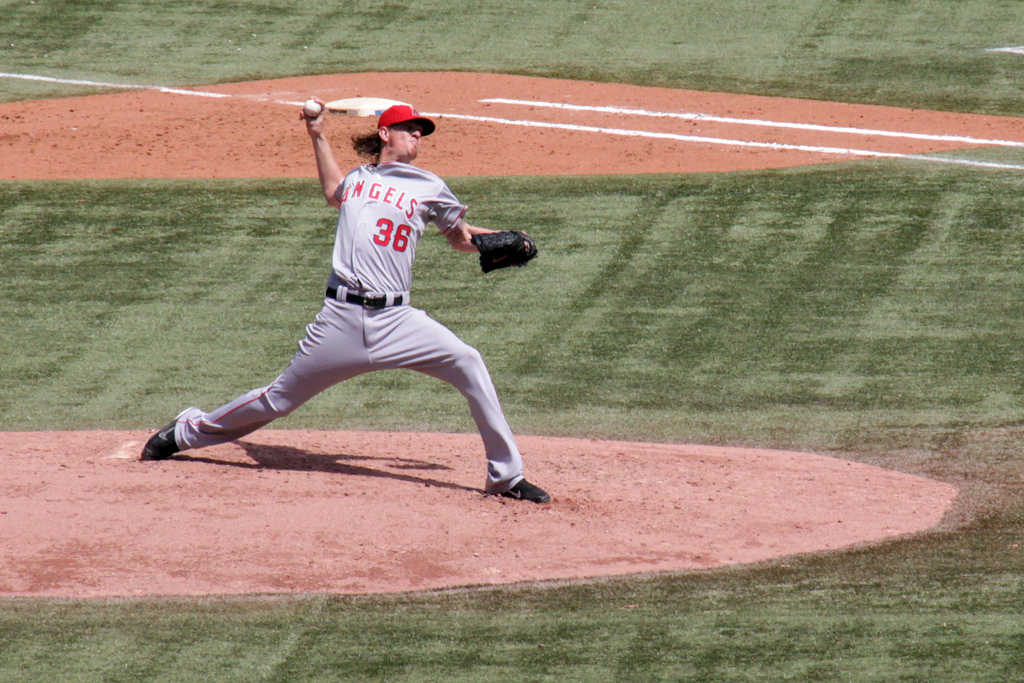
Weaver Tosses 2012’s Second No-Hitter … and a bit of history

 Jered Weaver yesterday tossed a no-hitter against the Minnesota Twins, which raises the question – Which is more surprising?

 1) That the Angels’ ace no-hit the 6-18 Twins (who were shut out on 3-hits by Jerome Williams the day before and now haven’t had a hit in 15 innings);

2) That the Angels remain in last place despite the three-game sweep of the Twins;

3) That Albert Pujols (of the 11 consecutive 30+ homer seasons) is hitting .208 with no home runs and only 5 RBIs after 25 games in the American League?  

We’ll go with “3” and send our congratulations out to Weaver, who walked one and struck out nine in his 9-0 win.   

BBRT likes to provide a little history in each post, so here some factoids for today – which, as you will see later, are only one degree of separation from Jered Weaver. 

While Weaver’s no-no was the classic complete game, there have been 9 “combined” no-hitters in MLB history, including 2 in 1991 (when there were a total of 7 no-hitters).  1991’s seven no-hitters is the record for a single season, tied with 1990, when there were also 7 no-hitters, including one combined effort.   For historic reference, 1990-91 saw as many no-hitters as 1927-44. 

The most pitchers used in a combined no hitter was six, on June 11, 2003, when a parade of Houston Astros’ hurlers shutdown the Yankees 8-0 at Yankee Stadium.  It all started out normally enough as the Astros’ Roy Oswalt sent the Yankees down 1-2-3 in the first (Alfonso Soriano-fly out, Jeter- strikeout swinging, Jason Giambi-strikeout swinging). Things took a turn toward baseball history two pitches into the Yankee second, as Oswalt aggravated a groin injury and the Astros were forced to go to the bullpen.  In succession, Pete Munro tossed 2.2 innings; Kirk Saarloos 1.1; Brad Lidge 2.0 (for the win); Octavio Dotel (1.0); and Billy Wagner 1.0.   When it was over 13 Yankees had gone down on strikes, there Bombers had no hits and had put only 5 runners on base (3 walks, an error and on a wild pitch strikeout.)

And, the game was both unusual and meaningful.  The Yankees came into the game with a 36-27 record, just ½ game ahead of the Red Sox, while the Astros were 36-28 and tied for first place with the Cubs.  Oh, and that one degree of separation?  The Yankees’ starting (and losing) pitcher was Jered Weaver’s brother Jeff, whose major league pitching career spanned 1999-2010.  Jeff went 6.1 innings, giving up 5 runs on ten hits in the loss.  

How did the Yankees take the unusual no-hitter?

“We should be embarrassed,” Jeter said after the contest. “If you’re not embarrassed something’s wrong with you.”

The Yankees did take the loss with class. When they got to the clubhouse after the game, each of the six participating pitchers found a bottle of champagne, courtesy of the Yankees, at his locker.
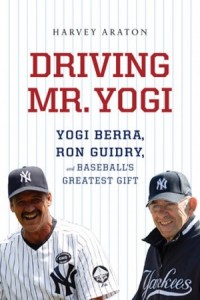
Book Review – Crossing Generations and DRIVING MR. YOGI

Driving Mr. Yogi:  Yogi Berra, Ron Guidry and Baseballs’ Greatest Gift

By Harvey Araton

Published (2012) by Houghton Mifflin Harcourt  ($26.00)


Take a first look at the cover of Driving Mr. Yogi and you’ll see two major league ballplayers, two Yankee all-stars and two sports celebrities.  Take another look after you’ve begun your passage through the book and you’ll see much more.  You’ll see two friends from different backgrounds and even different generations, brought together by a shared passion for baseball in general and Yankee baseball in particular –  but even more closely bonded  by mutual respect and genuine caring.

The book – a light (240-page), fun and feel-good summer read – ultimately is as much about friendship and loyalty as it is about baseball.

The tale begins in Yankee spring training 1999, when Yogi Berra returns to the Yankee-fold after a 14-year feud with team owner George Steinbrenner over the circumstances of Berra’s firing as Yankee manager.   Guidry is asked to pick up Berra at the airport and, despite the age difference – at 74 Berra was 15 years Guidry’s senior – the two hit it off.  The Berra/ Guidry camaraderie (including the annual airport pickup) becomes a true “right of spring.”

From 1999 forward, Guidry, a star in his own right, (14-year career with 170 wins and 91 losses, including 25-3 in 1978) picks up Berra at the airport in his Ford pick-up, on-time and ready to carry Berra’s luggage. During spring training, Guidry pretty much serves as Berra’s chauffer and not just from the hotel to the ballpark and back – to dinners (at Berra’s favorites), shopping malls, and the golf course.  The book, however, is not about the excursions themselves, but about what Berra and Guidry learn about and from each other as their friendship grows.  And, as Berra ages, Guidry’s role expands from chauffeur to protector (and always best friend.)

Driving Mr. Yogi is not always an easy task.  Berra is a stickler for punctuality – on time means early and he is quick to voice his displeasure at being late.  Yogi is also a creature of habit and routine, as Guidry puts it, no matter what the activity “Everything’s got to be just the way it was last time and the time before that.”

Guidry, however, knows just how to deal with Yogi – mixing the correct amounts of reverence and irreverence, in a way only true friends can.  He knows when to cajole, when to tease, when and how fast to give in, how to get a smile from Berra (who when it came to grins was known for not wasting any) and, most important, when and how to say no to Berra when he wants to push himself a little too far.   He also understands that Berra is a man who cares deeply about the others, who wants to earn his way and is committed to doing the right things the right way – all the time.

Oh, there’s plenty of baseball in this book as well.   The drama of Yogi Berra Day (July 18, 1999) at Yankee Stadium, when all of fandom became aware that Yogi’s feud with Yankee owner George Steinbrenner was officially over.   Araton takes us there as Yankee old-timer Don Larsen (who, in 1956, pitched the only perfect game in World Series history) throws out the first pitch to his battery mate for the masterpiece, Berra.  Then,  Araton takes us along for the tension-filled ride as Yankee pitcher David Cone tosses a perfect game of his own on this oh-so-perfect day for the Yankee faithful.

Araton alsp gives insight into other giants of Yankee lore, like Joe DiMaggio who wanted to be the last Yankee introduced at Yankee celebrations and “demanded reverence from everyone within a 200-mile radius.”

Sprinkled through the book, you’ll also find gifts for fans of Yogi’s renowned malapropisms (Yogi once described his reason for avoiding a certain St. Louis restaurant with the observation, ”Nobody ever goes there any more, it’s too crowded.”) Araton shares gems like Yogi’s comment during ceremonies at a Yankees’ Old-Timers game when the names of former Yankees who were deceased scrolled across the scoreboard – “I hope I never see my name up there.”

But mostly, this is a book about friendship, integrity, compassion, loyalty, humility and humanity.  At one point in the book, Berra – who could be stubborn and set in his ways – is described as an individual who could “charm the melancholy out of anyone.”  This book and its very real leading characters can do the same.

BBRT sees Driving Mr. Yogi as a good read about a couple of really good people.  The baseball tie is just the icing on the cake.

Best and Worst One Game ML Careers

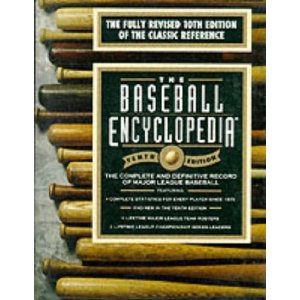
We wouldn’t we all like that one chance to put our names into the Encyclopedia of Baseball.  Here are two players whose one-game careers were polar opposites in terms of outcome – but were no doubt equal in terms of thrills. 


RON WRIGHT.  Three at bats – six outs – and done.

Attitude is everything – and we could all learn a lot from Ron Wright, a one-time MLB prospect who calls his one-game major league career “the best day of my professional life,” despite the fact that he accounted for an amazing 6 outs in only three at bats. Starting his first – and only – game after being called up in April 2002 by the Mariners, Wright began his ML career by striking out with two on in the second inning – and it was all downhill from there. But, I’m getting ahead of myself.

First, the 6’ 1”, 230-pound first baseman was a legitimate prospect, and a three-time minor league all-star.  Selected by the Braves (right out of high school) in the seventh round of the 1994 draft, Wright hit 32 home runs for the Macon Braves as a 19-year-old. He added another 36 minor league dingers for the Durham Bulls and Greenville Braves the next year. Wright was traded to the Pirates in 1996, and would later play in the Cincinnati, Tampa Bay and Seattle systems.  Injuries, however, took him off track in short order.  Wright missed most of the 1998 and 1999 seasons with a back injury, but worked hard to regain his prospect status.  In 2001, playing for the Durham Bills, he hit .262 with 20 homeruns and was considered the International League’s top fielding first-sacker.  The following season, an injury to Seattle DH Edgar Martinez led to an April call-up to the Seattle Mariners. On April 14 he started (and ended) his ML experience in a game won (at Texas) by Seattle 9-7, with Seattle getting 18 hits.  Wright’s day  went like this.

  • Second Inning: With Ruben Sierra on second and John Olerud on first, Wright took a called third strike from Rangers’ starter Kenny Rogers
  • Fourth Inning: With Sierra on third and Olerud on first, Wright hit a grounder to Rogers, who threw to SS Alex Rodriguez at second for the force. Sierra, who had broken for home, was caught in a SS-C-3B-P rundown for a second out, and Wright who tried to take second during the run down was thrown out P-2B.  An unusual triple play.
  • Sixth inning: Again up with both Sierra and Olerud on base (second and first, respectively), Wright hit into a more traditional short-to-second-to first double play.
  • Seventh Inning: Up again with Sierra and Olerud on base (first and third) with one out, Mike McLemore pinch hit for Wright (ending Wright’s ML stat line).  McLemore, by the way, struck out.

Wright went back down to the minors before getting another ML at bat and never made it back. (He did hit .273 with 15 HRs for Tacoma in 2002).  So, his major league career consisted of three at bats and six outs – strikeout, triple play, double play.  And, as for that fielding expertise, Wright’s spent his short ML career as a DH.  Still, in all his interviews since then, Wright had indicated he cherishes the game and the fact that he is one of the rare few who did make it to the major leagues.

JOHN PACIOREK.  Career On Base Percentage 1.000 – and done.

On the other side of the coin, we have John Paciorek, who enjoyed a banner day in his only major league appearance.  A 6’ 1”, 200-pound outfielder, Paciorek was called up by the Houston Colt .45s (yes, that was their original name) in September of 1963.  The 18-year-old got into his only major league game on September 29, starting the last game of the season (at home against the Mets) in right field and hitting seventh.  It was a 13-4 Houston victory and Paciorek ended up with three hits and two walks in five plate appearances, with 2 runs scored and three runs batted in.  It was a rather surprising ML debut for Paciorek, who was hitting just .219 for Modesto when he was called up (and who went on to hit over .250 in only one of his 6 minor league seasons.)  Like Wright, back surgery played a role in Paciorek’s brief career.  The surgery came in 1964; Paciorek missed all of 1965 and ended his playing career in 1969 without ever getting back to the “bigs.”  His one game went like this:

Second Inning:  With Houston 3B Bobby Aspromonte on first with two out, Paciorek walked and later scored on a triple by C John Batemen.

Fourth Inning: With the based loaded (1B Rusty Staub on third, Aspromonte on second, CF Ivan Murrell on first), Paciorek singled, driving in two.  Later he scored on a sacrifice fly by pinch hitter Pete Runnels.

Fifth Inning:  With Aspromonte and third with one out, Paciorek singled for another RBI.  Later, he scored on a single by SS Bob Lillis.

Sixth Inning:  Paciorek walked with one out, later scored on another Lillis’ single.

Eighth Inning:  Paciorek led off with a single.

Short, but spectacular ML career.  Oh, and another factoid, Paciorek is the brother of Tom Paciorek, who enjoyed a solid 18-year major league career.

Happy 40th Chipper – A 4-Bagger Celebration

Happy 40th Chipper!

Yesterday, when Chipper Jones celebrated his 40th birthday with a home run during the Braves 4-3 win over the Dodgers, he joined an elite club – only four other players have hit a home run on their 40th birthday:

Bob Thurman, Reds, on May 14, 1957 … an unusual case, since Thurman didn’t make the major leagues until he was 37 and then played until he was 42 (1955-59).

Joe Morgan, Phillies, on September 19, 1983 … Morgan played from 1963-84.

Wade Boggs, Devil Rays, on June 15, 1998 … Boggs played from 1982-99.

Tony Phillips, As, on April 25, 1999 … Phillips played from 1982-99.

Jones, retiring after this season, will not have the chance to move to the next level … a homer on his 41st birthday. That birthday club has two members:

Darrell Evans, Tigers, May 26, 1988 … Evans played from 1969-89.

Jim Thome, Indians, August 27, 2011 … Thome, still playing for the Phillies, began his ML career in 1991. He rejoined the Indians (from the Twins) the day before his birthday blast.

And, of course, there is also the Mets’ Julio Franco. Maybe not a birthday bash but, on May 4, 2007, at 48-years-old (and 254 days), Franco established the current mark for the oldest major leaguer to hit a round-tripper. Note: Franco is also the oldest player to have a multi-homer game, hit a grand slam and hit a pinch-hit home run. Franco’s career stretched from 1982-2007.

Apps You’ll Find on the BBRT IPhone

Here’s a look at the baseball apps you’ll find on BBRT’s IPhone – for baseballs news, statistical analysis, history or just plain fun.   Most of these run from free to $1.99, except for MLB At Bat 12 at $14.99, but worth it for a true baseball geek.

 Baseball News

MLB At Bat 12 … BBRT’s number one source of in-season info.  Lots of baseball news, schedules, box scores, Game Day pitch-by-pitch coverage, standings, stats leaders and good, timely video.   Free live video stream of one game a day, and you can listen to any game through your phone – just like the days of the good-old transistor radio, only with infinite range.  Pricey at $14.99, but well worth it.

EvriThing Baseball … Pulls baseball news from literally thousands of sources and organizes them for easy access (in what the app terms “channels”).  There’s Scoreboard and Standings channels, as well as channels for General BB news, Trade Talk, Roster Moves, Injury Reports and one for each ML team.  And, to top it all off, it’s free.  If you’re looking for a no-cost baseball news app, this is for you.

Sporting News Pro Baseball … Baseball info organized by News (general news), Scores, Stats and Fantasy News.  Identify your favorite team and have quick access to the latest developments.   Another  free source of baseball news.

 Analysis

Bill James Baseball IQ … For true BB stats geeks, in depth analysis of player strengths, weaknesses and trends – based on every pitch thrown over the past four seasons.  Goes way beyond traditional stats like batting average, RBIs, ERA, etc.  and into such areas as where, when and how a player gets his hits or makes his outs – or what pitch a hurler is likely to toss, in what location and on what count.    “Some” of the categories:  Hit Locators (where the batter is likely to hit the ball in a specific situation); Hit Zone (where the batter gets his hits); Pitch Location (where the pitcher is likely to spot the ball); Match-Ups (batter/pitcher lifetime results) – and MUCH more.  How detailed can you get?  I just looked up what pitch location Jered Weaver had used to strikeout Danny Valencia on two and two counts over the past four seasons.  Basically, as you learn to use this app, it will take you to statistical levels (depths and heights) you never reached before.    Again, free.  Ain’t life sweet?

History

Baseball Memories … This app makes more than 200,000 games played between 1871-2009 available to you (depending on records kept at the time).  You can access the final line score (with line-up), the box score, a text play-by-play or a play-by-play on-screen simulation.  You can pull up games by year, date and / or team.   A bit addicting for a baseball geek like me, but a treasure trove of history for $1.99.

Fun

Baseball Legends … More than 1,000 baseball trivia questions offered up in regular mode (ten seconds per question) or time trials (answer as many as you can in 90 seconds).   Degree of difficulty ranges from “gimmees” to “You’ve got to be kidding!”   No one gets shut out, but there are few four-for-fours either.  The points you earn for correct answers enable you to unlock video, photos and audio from baseball history –  such “fan treats” as Abbott and Costello’s famous “Who’s  on first?” routine, Babe Ruth’s speech announcing he is leaving the Yankees, Roger Clemens talking about his fifth Cy Young.  A fun pick-up for 99 cents.

Flick Home Run … Hitting homers with a flick of the finger (you can also swing and miss, foul one off or pop up).  Fun diversion when things are going slow, as you work to get the appropriate “flick” on an array of fast balls and floaters the move across your screen.  Points for distance – and you can “leave the park and hit buildings, automobiles, etc.   A free and 99-cent version – and you can purchase advanced skills.

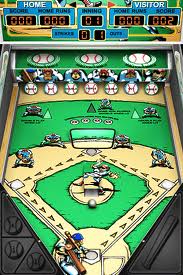
Hit the Deck Baseball … Electronic version of the old classic mechanical baseball pinball game, with flippers, lights bells and all the excitement of being in an old-style arcade.   Had a little trouble with tracking all-time high score, but still loads of  retro fun for “geezers” like BBRT.    (99 cents)

ESPN Fantasy Baseball … Let’s me run my ESPN Fantasy Baseball team from the IPhone.  (Free)

Congrats Phil Humber – Light Up A “Perfecto”

On April 21, Phil Humber tossed a perfect game in a 4-0 victory over the Seattle Mariners in Seattle.  Humber finished off the Mariners in 95 pitches, 67 for strikes, going to a three-ball count on only three batters.  In his gem, Humber struck out nine (including the final batter) and there were only six outfield putouts.

While BBRT raves about Humber’s masterpiece, we register a bit of a rant at the Mariners’ shortstop Munenori Kawasaki’s sixth-inning bunt attempt.  The first hit, after 17 batters have been retired in a no-hitter, should be legitimate.

The 4-0 score is the second most popular perfect game final count.  Six of MLB’s 21 perfect games have resulted in the narrowest of victories, ending by the score of 1-0.  Five perfect games have ended at 4-0 and four at 2-0.  The highest score in a perfect game?  6-0, twice: In Yankee David Cone’s July 18, 1999, perfect game against the Expos – and in Phillie Jim Bunning’s June 21, 1964, masterpiece against the Mets.

Another perfecto fact.  The largest attendance for a perfect game was 65,519 for Don Larsen’s 1956 World Series perfect game (the only ever in a World Series).  The smallest – 6,298, when Catfish Hunter shut down the Twins in Oakland on May 8, 1968, although tens of thousands claim to have been there.  The announced attendance for Humber’s perfecto was 22,472.  Final piece of trivia:  Of the 21 perfect games, 15 were at home.

Looking back to Larsen’s game, probably the most famous perfecto:  It came on October 8, 1956, at Yankee Stadium as the Bronx Bombers bested the rival Brooklyn Dodgers 2-0.  Larsen struck out 7 (including, like Humber, the last out), went to a three-ball count only once and saw 9 outfield putouts.

Perhaps the most dominant perfect game performance (if such a distinction can be brought to perfection) belongs to Dodger lefty Sandy Koufax, who tossed his perfect game against the Cubs in LA – winning 1-0 on September 9, 1965.  Koufax struck out 14 Cubbies in that outing, including the last six batters.

Addie Joss of the Cleveland Naps used the fewest pitches to log a perfect nine-innings – 74 pitches – just three strikeouts – as he beat the White Sox (in Cleveland) on October 2, 1908.  The most pitches in a perfecto?  120 by Yankee David Wells, as he shut down the Minnesota Twins 4-0 at Yankee Stadium on May 17, 1998.

Perfect game record least likely to be broken?  When Jim “Catfish” Hunter tossed his perfect game against the Twins (May 8, 1968, at Oakland), he not only notched 11 strikeouts (including the last batter) – he added insult to injury by collecting three hits in four at bats (a double and two singles) and driving in three of Oakland’s four runs.  The best offensive performance ever by a perfect hurler.


BBRT Declares Unofficial Record – 38 straight strikes.

Talk about being in the groove.  On April 18, while beating the Angels 4-0, Oakland A’s  pitcher Bartolo Colon threw 76 percent of his pitches for strikes, including one streak of 38 strikes in a row (second pitch of the fifth inning to the seventh pitch of the eighth inning).  BBRT is going to declare the 38 straight strikes an “unofficial” record until someone proves it wrong.  Colon pitched 8 scoreless innings in the game, with 4 hits, no runs and 5 strikeouts.  The win brought the 2005 Cy Young winner’s 2012 record to 3-1, 2.63 ERA, with 2 walks in 27.1 innings pitched.

Pretty much everything Bartolo Colon threw was over the plate Wednesday.

In an understatement, A’s catcher Kurt Suzuki said after the game, “Bartolo knows where the ball is going and he knows what he wants to do.”

BBRT likes to reminisce, so here’s the look backward.  In 1962, Kansas City Athletics hurler Bill Fischer put together a record streak of 84.1 innings pitched without a base on balls (August  4- September 30).  Fischer, who ended the year 4-12 with a 3.95 ERA, tossed 127 innings with only 8 walks that season.   Ironically, Fischer – in his later coaching career – became known as “Walking Wisdom.”

2012 Early Season Surprise – Albert Who-Jols? And a bit of history … the last .300 hitting team.

Eleven games into the season, the now Pujols-less Cardinals are riding high (8-3, first place) and leading the National League in Batting Average (.293), Hits (114), Runs (59), HRs (16) and RBI (59), as well as On Base and Slugging Percentage.  Pujols, meanwhile, is hitting .267 with no HRs and 4 RBI in 45 at bats (his longest streak of season-opening at bats without a long ball).  BBRT thinks this puts Pujols on a pace for 37 HRs – realistic math versus actual math.

Among the key Cardinal contributors:  Matt Carpenter (.409-1-11); David Freese (.371-3-11); Carlos Beltran (.351-4-5); and Yadier Molina (.324-3-10).  Clearly these Redbirds have picked up the slack.

A little bit of history from the BBRT “Baseball Geezer.”

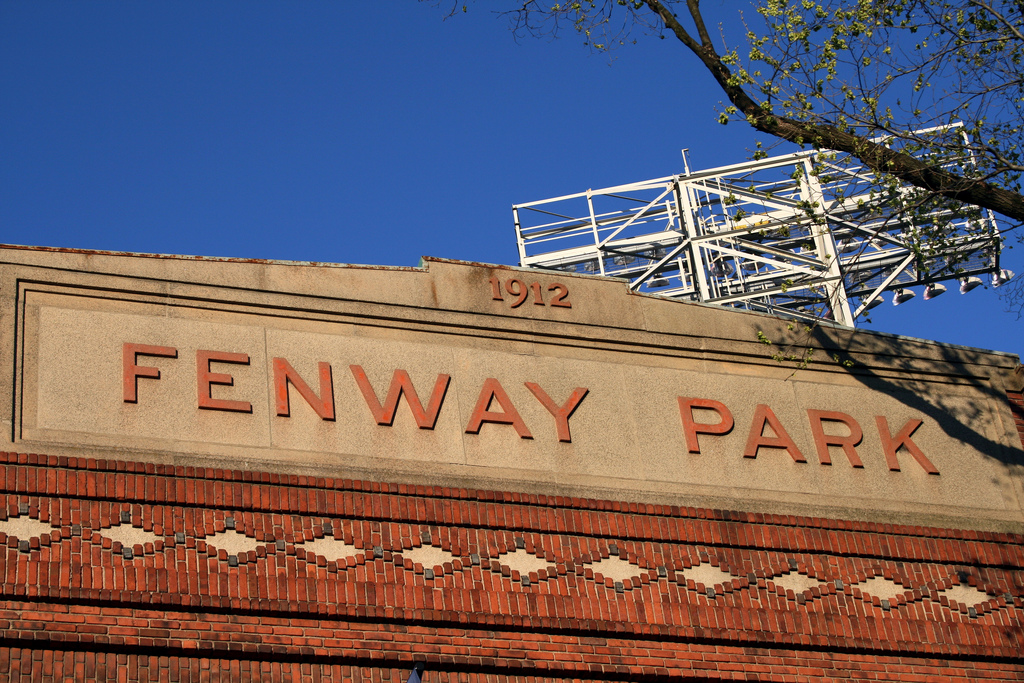
Even a .300-hitting team couldn't bring a pennant to Fenway.

Hot hitting does not always bring pennants.  Consider the 1950 Boston Red Sox – the last major league team to average .300 for a season (.302).  On any given day, that line-up featured 7 or 8 .300 hitters, and the lowest average among regulars was .294.   And there was Billy Goodman, who won the league batting title with a .354 average, but did not have a “regular” spot in the field.  In the course of the season, Goodman played OF, 1B, 2B, 3B and SS.   The Sox finished first in Batting Average, led the league in Runs Scored, finished second in HRs and finished third (behind the Yankees and Tigers) at 94-60.

The hard-hitting line-up:

C             Birdie Tebbets                   .310

1B           Walt Dropo                        .322

2B           Bobby Doerr                      .294

3B           Johnny Pesky                    .312

SS           Vern Stephens                  .295

LF            Ted Williams                     .317

CF           Dom DiMaggio                  .328

RF           Al Zarilla                           .325

UT          Billy Goodman                   .354


The team closest to .300 in the .2000s?  Only 3 teams have reached the .290 mark – the 2000 Rockies (.294); 2001 Rockies (.292); and the 2007 Yankees (.290).

Tom Cheney’s 21 Strikeouts – What Pitch Count?

With the Washington Nationals pitching staff leading the NL in ERA (see post of April 15) and putting the Nats in first place, it seems a good time to reflect on Washington Senators’ Tom Cheney’s record-setting performance of September 12, 1962.  On that day, Cheney set the major league’s single game record for strikeouts, with 21 Ks in a 16-inning complete game 2-1 win over the Orioles.

Cheney’s line included just the one run, on 10 hits, with 4 walks and 21 punch outs.  Notably, Cheney – who threw 228 pitches – seemed to get stronger as the game progressed, holding the Orioles hitless (with 10 Ks) over the final eight innings.

Cheney’s inning-by-inning strikeouts:

1st-0; 2cnd-1; 3rd-3; 4th-1; 5th-3; 6th-1; 7th-0; 8th-2; 9th-2; 10th-2; 11th-2; 12th-0; 13th-0; 14th-2; 15th-1; 16th-1.

Cheney was 5-8 going into the game, with 3 complete game shutouts.  He  finished the year 7-9, with a 3.17 ERA and 147 Ks in 173 innings.

Cheney’s 21 Ks, by the way, are  not the “professional” record.  The record for strikeouts in a professional game belongs to Mario Picone. On June 15, 1944, the 18-year-old right-hander went 19 innings for the Bristol (Virginia) Twins (Class D, Appalachian League) in a 3-2 complete game win over the Johnson City Cardinals – whiffing 28 batters in the process. While Picone had a successful minor league career (13 seasons, 129-98, 3.95), in three MLB campaigns, he went 0-2, 6.30.

BBRT Note: Bristol may, indeed be the strikeout capitol of baseball. On May 13, 1952, the Bristol Twins’ Ron Necciai tossed a no-hitter, and set the record for whiffs in a nine-inning game with 27 punch outs. He followed that performance with a 24-strikeout, 2-hitter in his next start.  Later that season, Necciai was called up to the Pirates, where he went 1-6 with a 7.08 earned run average – before his career fell victim to stomach ulcers and a torn rotator cuff.

2012 Early Surprise – The Nationals

“First in war, first in peace, last in the American League”used to describe the American League cellar-dwelling Washington Senators.  In 2012,Washington D.C.’s team is no longer the Senators, no longer in the American League and no longer in last place.

Stephen Strasburg leads the much-improved - league leading - Nationals' pitching staff.

The early 2012 surprises (emphasis on “early,” too small a sample to make any real projections) are the first-place Nationals (7-2) and Dodgers (8-1) and, to a lesser extent, the last-place Angels and Red Sox (each at 3-5).

Let’s look at the Nationals. (Note:  In BBRT’s 2012 NL projections, we predicted a .500+ season and a stake in the Wild Card race for the Nats.)   The Nationals are doing it with pitching.  Through April 15, the Nationals have the NL’s lowest earned run average at 1.82, and have held opposing batters to a .170 average while striking out 88 in 84 innings pitched.  The starting staff, led by Stephen Strasburg, Geo Gonzalez, Jordan Zimmerman and Edwin Jackson has led the charge to the top of the standings.  Even fifth starter Ross Detwiler tossed 5 innings with only two hits, no runs, 1 walk and 6 Ks in his start.

Ultimately, it looks like Washington will be in the race to stay – and may even surprise some people in the playoffs.