BBRT Looks at the Hall of Fame Ballot

With the Baseball Writers’ Association’s 2013 Hall of Fame ballot now officially in the hands of more than 600 voters (who can each vote for up to ten nominees), we can expect plenty of debate as we move toward the January 9th announcement date.  Unfortunately, that debate will focus as much on chemicals (Performance-Enhancing-Drugs, PEDs) as on credentials (those all-important statistics) and character (contributions to the game).  How important can the PED spector be?  Consider that Mark McGwire, with 583 home runs, four HR titles and twelve All Star selections has never reached 25 percent of the vote and Rafael Palmeiro, with 3,020 hits, 569 home runs, 1,613 runs and 1,835 RBI has never reached 15 percent of votes cast.

If you just want the executive summary of BBRT’s opinions on the ballot, here’s what BBRT predicts from the BBWA – and how BBRT would fill out its ballot (if I had one).

Predictions for BBWA vote:  Going into the Hall of Fame in 2013 – Craig Biggio, Mike Piazza, Jack Morris.

If BBRT had a ballot:  Biggio, Piazza, Morris, Lee Smith and (for sentimental reasons) Julio Franco.

HOF BALLOT FIRST-TIMERS

This year’s ballot includes 24 first-timers, led by controversial (PED-suspect) candidates Barry Bonds, Roger Clemens and Sammy Sosa.   All three have the credentials to be first-ballot inductees.  Bonds is the all-time single season and career home run king, with a record seven Most Valuable Player Awards, as well as 14 All Star selections and eight Gold Gloves. Clemens, an 11-time All Star, recorded 354 wins and 4,672 strikeouts in a 24-year career that saw him capture a record seven Cy Young Awards.  Sosa is a one-time MVP and seven-time All Star, who hit 609 career homers and is the only player to top 60 round trippers in a season three times.  Credentials aside, all three are tainted by the PED controversy and BBRT expects them all to fall short of 50 percent of the vote, as the baseball writers continue to make a statement on the validity of steroid-era accomplishments.  While BBRT (if I had a vote) would eventually support HOF consideration for this trio, I would not cast a first-time ballot vote for any of the three.

Also on the ballot for the first time are Sandy Alomar Jr., Craig Biggio, Jeff Cirillo, Royce Clayton, Jeff Conine, Steve Finley, Julio Franco, Shawn Green, Roberto Hernandez, Ryan Klesko, Kenny Lofton, Jose Mesa, Mike Piazza, Reggie Sanders, Curt Schilling, Aaron Sele, Mike Stanton, Todd Walker, David Wells, Rondell White and Woody Williams.  The top candidates among this group are Biggio, Franco, Piazza, and Schilling.

BBRT’s vote would go to Piazza and Biggio – and I’d also toss one in for Franco for sentimental reasons.
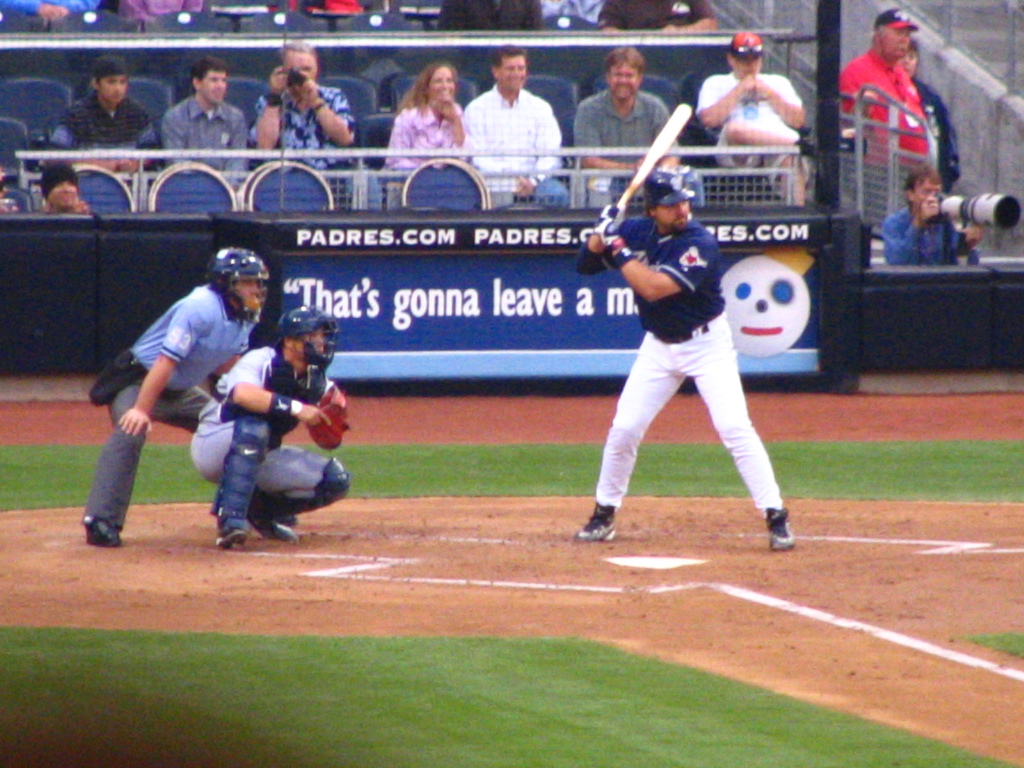
Mike Piazza

BBRT likes Mike Piazza as a first-ballot inductee, a catcher with a .308 career average, 427 home runs (a MLB record 396 as a catcher) and 12 All Star Selections. There are some PED rumblings surrounding Piazza’s candidacy that may cost him some votes, but BBRT believes he will earn election with about 80 percent of the vote, with the BBWA making its statement and stand by denying votes to the big three of Bonds, Clemens and Sosa.  If BBRT had a vote, Piazza would be named on my ballot.

Piazza’s best year: 1997, Dodgers – .362 avg., 201 hits, 104 runs, 40 HR, 124 RBI.

Craig Biggio

BBRT would also vote for Craig Biggio, who (in 20 seasons) collected 3,060 hits, scored 1,884 runs and hit 291 home runs, while also stealing 414 bases.  Biggio was a seven-time All Star and a four-time Gold Glove winner, who spent notable time at second base, catcher and in the outfield.  His 668 doubles are the most ever by a right-handed hitter (and fifth all time) and he is one of only two players to collect 50 doubles and 50 stolen bases in the same season.  His .281 career average may hurt his chances, but he gets BBRT’s vote not for being “great,” but for being “very, very good” for “very, very long” – not to mention a nod for Biggio’s NL record 285 times being hit by a pitch.    BBRT thinks the BBWA voters will go along, recognizing the significance of the 3,000-hit mark and also wanting to make a statement by electing the non-PED-tainted Biggio on his first ballot. BBRT looks for Biggio, like Piazza, to be named on 75-85 percent of the ballots.

Biggio’s best year:  1998, Astros – .325, 210 hits, 123 runs, 20 HRs, 88 RBI, 50 stolen bases.

BBRT would also cast a sentimental vote for Julio Franco, who gave hope to all of us oldsters when he was still in the Major Leagues at age 48 (becoming the oldest player ever to hit a home run).  Julio was good enough to last 23 years in the Majors, collecting 2,586 hits (a .298 average), 173 home runs and 281 stolen bases, three All Star Selections and one batting title. (He also hit .309 in 125 games for the Braves in 2004 – at age 45.) It’s also notable that Franco played in the DH-less NL from ages 42 to 48.     BBRT doesn’t expect Franco to top 15 percent in terms of vote totals, but my sentimental ballot would include a vote for the ageless wonder.

Franco’s top season: 1991, Rangers – .341 average (led AL), 201 hits, 108 runs, 15 home runs, 78 RBI, 36 stolen bases.

Curt Schilling’s 216 wins, 3,116 strikeouts and six All Star selections make him a legitimate candidate for consideration, but far from a first-ballot selection (look how long it took Bert Blyleven to get in with even stronger numbers).  Still, he will garner votes on the basis of 200+ wins and some anti-Clemens sentiment.

Schilling’s best season:  2001, Diamondbacks – 22-6 (led NL in wins), 2.93 ERA, 256 2/3 innings pitched and 293 strikeouts versus just 39 walks.

RETURNING CANDIDATES

(Note:  You become eligible after five years of retirement, must get at least 5 percent of the vote to remain on the ballot and can remain on the ballot for fifteen years.)

The 13 candidates returning from one year ago include:

Jack Morris (Fourteenth time on ballot, 66.7 percent last year)

Jeff Bagwell (Third ballot, 56.0 percent)

Lee Smith (Eleventh, 50.6 percent)

Tim Raines (Sixth, 48.7 percent)

Alan Trammell (Twelfth, 36.8 percent)

Edgar Martinez (Fourth, 36.5 percent)

Fred McGriff (Fourth, 23.9 percent)

Larry Walker (Third, 22.9 percent)

Mark McGwire (Seventh, 19.5 percent)

Don Mattingly (Thirteenth, 17.8 percent)

Dale Murphy (Fifteenth, 14.5 percent)

Rafael Palmeiro (Third, 12.6 percent)

Bernie Williams (Second, 9.6 percent)

Clearly, Rafael Palmeiro is at the top of this class, but the PED controversy is still following him.  Despite 3,000+ hits and 500+ home runs, his vote total seems unlikely to climb as high as 20 percent this year.  Mark McGwire has some impressive numbers as well, but again the perception of chemicals and character likely will outweigh credentials.

Then we get to the best of the rest – Jack Morris, Jeff Bagwell, Lee Smith.

BBRT anticipates that Jack Morris will get the nod.  In his 18-year career, he earned a reputation as a big-game pitcher (and the pitcher with the most victories in the 1980s), as well as a 254-186 record with a 3.90 ERA, 2,478 strikeouts and five All Star selections.  Working in Morris’ favor this year are Bert Blyleven’s selection last year (although BBRT sees Blyleven’s credentials as notably stronger than Morris’), the fact that Morris earned 2/3 of the vote last year, and the opportunity for voters to make a further “statement” about PEDs by putting Morris in over Clemens.  (This would seem to be an important ballot for Morris, with mound craftsmen Greg Maddux, Tom Glavine and Mike Mussina soon to join the pitching candidates.)  BBRT agrees that 250+ wins is enough, that Morris has waited long enough, that his big-game-grit is enough to put him over the top. Plus, I was at Game Seven in 1991 to witness his ten-inning shutout performance, so BBRT’s endorsement comes from the heart as well as the head.

Morris’ best season: 1986, Tigers – 21-8, 3.27 ERA, 15 complete games, six shutouts, 267 innings pitched, 223 strikeouts.


HOFers soon, but probably not this year.

Jeff Bagwell with a 15-year career that included 2,314 hits, 449 home runs, 202 stolen bases and a .297 average – along with a Rookie of the Year Award, a Most Valuable Player Award, one gold Glove and four All Star selections.  Bagwell continues to move up in the vote tally and BBRT thinks he will eventually earn entrance to the Hall, but not this year.

Bagwell’s best season:  2000, Astros – .310 average, 183 hits, 152 runs, 132 RBI, 47 home runs. 

Lee Smith’s 478 saves put him third on the all-time list (he was number one when he retired after the 1997 season).  He also recorded 13 consecutive seasons (in an 18-year career) of 25 or more saves, a 3.03 lifetime ERA and 1,251 strikeouts in 1,289 innings pitched; led the league in saves four times; and made seven All Star teams.  He garnered 50.6 percent of the vote last year and BBRT sees him falling short of election again this year.  However, if BBRT had a vote Smith would get it.

Smith’s best season:  1991, Cardinals – 6-3, 2.34 ERA, 47 saves, 73 innings pitched, 67 strikeouts. 

BBRT’s Favorite World Series – 1960

Baseball … memories count!

My favorite World Series?  1960.

To understand why this is my favorite, it helps to set the stage.

The year was 1960. There were only 16 major league teams.  If you didn’t finish with ‘the best  record in your league, you didn’t go to the World Series.  No one had ever heard of the designated hitter, the wild card, WAR or even WHIP.   Home Run Derby was on TV – in black and white, with power hitters pairing off at Wrigley Field in Los Angeles.

Ted Williams finished his career with a home run in his last at bat and Brooks Robinson won his first Gold Glove. MLB held two All Star Games. The White Sox became the first team to put players’ names on uniforms.  Warren Spahn threw his first no-hitter at age 39 (and won a league-leading 21 games) and Juan Marichal threw a one-hitter in his major league debut at age 22.   Roger Maris won his first MVP Award in his first year as a Yankee (after being traded from the Kansas City Athletics).  The Pirates’ Dick Groat won the NL batting title and MVP Award.

Mickey Mantle led the AL in home runs, Roger Maris in RBIs, Pete Runnels led the league in hitting, and Minnie Minoso collected the most hits.   In the NL, Ernie Banks won the home run crown, Hank Aaron the RBI title and Willie Mays topped the senior circuit in hits.   Don Drysdale and Sandy Koufax finished one-two in the NL strikeout race, while Jim Bunning topped the AL.  Lindy McDaniel of the Cardinals set a new record with 26 saves, while the Tigers’ Frank Lary’s 15 complete games were the lowest ever to lead either league.

I was thirteen and an avid baseball fan.  The Game of the Week (in black and white), the radio – especially the radio – and an occasional trip to the ball park were my tickets to the national past time.

At the time, the Yankees were baseball’s dynasty.  Since my birth in 1947, the Bronx Bombers had been to 11 World Series (including the 1960 Series, yet to be played) and had won eight World Championships.  Fans from pretty much everywhere but New York had made Yankee-hating a tradition.  I was no exception.  Milwaukee-born, I was a steadfast Braves fan, still smarting from the Yankees’ 1958 World Series comeback, when they downed my Braves after trailing three games to one. The Yankees were in the 1960 Series – and I had an emotional interest  in seeing them lose.

Being of Polish descent,  I also took pride in the fact the great Stan Musial was Polish and wondered why Milwaukee-born Hall of Famer Al Simmons had changed his name from Al Symanski.  I was a fan of the sleeveless power hitter Ted Kluszewski, regretted that Tony Kubek (also of Polish descent) played for the Yankees, was rooting for the Pirates Bill Mazeroski, and wished that my heroes Eddie Mathews and Hank Aaron could boast of a little Polish ancestry.  I also was firm in my belief that Steve Dalkowski threw that fastest fastball ever … you can look it up.

Put all of this together and you can see why I looked to the 1960 World Series with excitement – and why I was rooting for the underdog Pirates.  The fact is, very few expected much of a Series and, instead, they got a great seesaw battle and a major upset.

The prognosticators predicted a Yankee win in five or six games.  They pointed out that the Yankees, with a 97-57 record (the Pirates were 95-59-1) came into the Series with the momentum of a 15-game, season-closing winning streak, while the Pirates lost four of their final seven.  They also lauded the Yankees’ post-season experience (in the decade of the 1950s, the Yankees played in eight World Series, winning six, while the Pirates hadn’t seen postseason play since 1927.) And, they heralded the Yankees power (the Yankees led the AL with a record 193 home runs and 746 runs scored, while the Pirates led the NL with 734 runs scored, but only 120 round trippers) – the Yankees’ game one starting lineup had belted 152 regular season homers to 98 for the Pirates’ starters.  When it came to mound work, things appeared more  balanced, maybe even a shade in favor of the Pirates.  While the Yankees’ 3.52 ERA was the lowest in the AL, the Pirates’ NL third-best ERA (at 3.49) slightly bettered the Bomber mark.  The Pirates did have the clear advantage in strikeouts (811-712) and fewest walks allowed (an NL low of 386 to an AL worst 609 for the Yankees). They also boasted the Cy Young Award winner in Vernon Law (20-9, 3.08), backed up by Bob Friend (18-12, 3.00), while no Yankee starter had topped 15 wins.  The top relievers for the two teams were Elroy Face, with 24 saves for Pittsburgh and Bobby Shantz, who saved 11 for the Yanks.

When the Series was over, Pirate pitching made the difference, but you could never tell from the stats line:

  • The Yankees scored a Series’ record 55 runs to 27 for the Pirates,
  • The Yankees collected a Series’ record 91 hits to 60 for the Pirates.
  • The Yankees hit a Series record .338 to .256 for the Pirates
  • The Yankees collected a Series’ record 27 extra base hits to 15 for the Pirates.
  • The Yankees out-homered the Pirates 10-4.
  • The Yankees’ pitchers put up a 3.54 ERA to 7.11 for the Pirates.
  • Bobby Richardson of the Yankees won the Series MVP award,  hitting .367 with a Series’ record 12 RBI.
  • The Yankees’ Whitey Ford was the Series’ most effective pitcher, throwing two complete game shutout in two starts.

Couple all of this with the fact that the Pirates won the series with a 10-9 victory in Game Seven – highlighted by a bottom of the ninth walk-off  home run by Bill Mazeroski – and you can see why this is BBRT’s favorite World Series.

Let’s look at it, game by game.

Game One (October 5, at Pittsburgh)

The Yankees’ power made itself felt in the first inning, as right-fielder Roger Maris punctuated his first-ever World Series at bat with a towering upper deck home run off  Pirate ace and 20-game winner Vernon Law.  The Pirates woke up the home crowd by coming right back with three runs in the bottom of the inning off Yankee starter (15-game winner) Art Ditmar, a Casey Stengel choice that surprised fans and sportswriters alike (Whitey Ford was the presumed Game One choice.)  Pirate center-fielder Bill Virdon led off with a walk, stole second and then went to third when nobody covered the base and Yogi Berra’s throw sailed into center field (error, shortstop Tony Kubek).  Then, NL batting champ Dick Groat (shortstop) doubled home Virdon, left fielder Bob Skinner singled home Groat (and promptly stole second, as the Pirates had decided to try and counter the Yankees’ power with speed and aggressive base running). First baseman Dick Stuart lined out to right and right fielder Roberto Clemente singled in Skinner – sending Ditmar to an early shower.  Jim Coates came in and got out of the inning with no more damage.

The Yanks seemed ready to bounce back in second, as Yogi Berra and first baseman Moose Skowron singled to open the inning.  Then Stengel made a managerial move that some saw as early-game panic.  He lifted (and embarrassed) starting third baseman Clete Boyer for pinch hitter Dale Long (who flied out to right).  Next, second sacker Bobby Richardson lined out to left and Berra was double off second (Bob Skinner to Bill Mazeroski) – threat and game pretty much over.

As the game went on, Law pitched in and out of trouble, giving up ten hits and a walk, but only two runs over seven innings.  The Yanks did scratch out a run in the top of the fourth (Maris scoring on a Skowron single), but the Pirates bounced right back with a two-run homer over the left field scoreboard by Mazeroski.   The Pirate second baseman scored another run in the bottom of the sixth (on a Bill Virdon double), and the 6-2 lead held until the top of the ninth, when the Yankees got a two-run pinch-hit homer from Elston Howard.  FINAL:  Pirates 6 – Yankees 4


Game 2 (October 2, at Pittsburgh)

The Pittsburgh “high” from Game One was matched – and then some – by the “low” of Game  Two, which opened with 18-game winner Bob Friend on the mound for the Pirates and nine-game winner Bob Turley hurling for the Yankees.  Given the match up and the first game results, hopes were high at Forbes Field.  The Pirates, however, were without starting left fielder (and perhaps their best left-handed hitter) Bob Skinner, who had injured his left hand in game one.  Pirate Manager Danny Murtaugh put right-handed hitting Geno Cimoli in left and, in an effort to add a left-handed bat, benched the Pirates’ leading home run hitter, first baseman Dick Stuart, in favor of Rocky Nelson. The line-up changes were pretty much forgotten by the end of the game.

The Yanks scored first, with two runs in the top of the third and one in the top of the fourth, with the Pirates getting one back in the bottom of the fourth to make it 3-1 Yanks. Then the roof fell in.  Murtaugh had pinch-hit for Friend in the fourth, so Freddie Green took the mound for the Pirates in the fifth.  The hard-throwing lefty walked the first batter he faced (shortstop Gil McDougald) and got right fielder Roger Maris to hit  into a fielder’s choice  before center fielder Mickey Mantle crushed a two-run homer to  right-center.  The Yankees added seven runs off three Pirate hurlers in the sixth in an inning that went:  Elston Howard – triple; Bobby Richardson – run-scoring double; Bob Turley – ground out to pitcher; Tony Kubek safe on an error; Gil McDougald – run-scoring single; Roger Maris – walk; Mickey Mantle – strikeout; Yogi Berra – two-run single; Moose Skowron – run-scoring single; Elston Howard – run-scoring single; Bobby Richardson – run-scoring single; Bob Turley – fly out (his second out of the inning).  It was quiet in Pittsburgh and got even quieter in the top of the seventh when Mantle made up for his sixth-inning strikeout with a 475-foot, three-run homer to right-center.  The Yanks added a meaningless tally in the top of the ninth, while the Pirates put up two runs in the bottom of the inning, finally getting to Turley.  Overall, the Yankees collected 19 hits and five walks off six Pittsburgh hurlers, while Turley managed to scatter 13 hits and three walks, giving up just three runs (two earned) in 8 1/3  innings (with Bobby Shantz getting the last two outs).

FINAL:  Yankees 16 – Pirates 3


Game Three ( October 3, at New York)

If the Pirates were shell-shocked in Game Two, they got no relief in Game Three.  After the Bucs went down quietly against Whitey Ford (12-9 in the regular season), Pirates’ starter Vinegar Bend Mizell (13-5) lasted only 1/3 of an inning, as the Yankees posted six runs in the bottom of the first, highlighted by a grand slam off the bat of Bobby Richardson, who had hit only one home run all season.  The only other Yankee scoring came in the four-run fourth, which included Mantle’s third homer of the series (a two-run shot) and a two-run single for Richardson, giving him Series’ record six RBI in the game.  Overall, the Yankees picked up 16 hits and four walks off six Pirate pitchers – while Ford threw a complete-game, four-hit, shutout.  The prognosticators saw all as once again right with the baseball world and the Yankee juggernaut.  Clouds, however, loomed on the horizon.

FINAL:  Yankees 10 – Pirates 0


Game Four (October 4, at New York)

Game Four featured Pirates’ Ace Vernon Law (winner of Game One) against Ralph Terry, who had gone 10-8 for the Yankees.  Another Bomber rout seemed possible as Terry started the game with a one-two-three first, including strikeouts of center fielder Bill Virdon and right fielder Roberto Clemente.  The Yankees opened the bottom of the first with a single by left fielder Bob Cerv and a double by shortstop Tony Kubek.  Runners on second and third, no outs and the big three of Roger Maris, Mickey Mantle and Yogi Berra slated to hit.  Law, however, got Maris on a fly out to short right, intentionally walked Mantle and got the usually clutch-hitting Berra to hit into a double play.  The Pirates had new life – and new spirit.

The Yankee power did emerge in the fourth, as the Bombers took a one-run lead on first baseman Moose Skowron’s homer to right.  The Pirates, however, came back with three in the top of the fifth as left fielder Geno Cimoli led off with a single; catcher Smoky Burgess was safe at first as Skowron threw too late to second trying for a force of Cimoli; third baseman Don Hoak popped out on an attempted sacrifice;  second baseman Bill Mazeroski popped out to first;  Law doubled in Cimoli; center fielder Bill Virdon singled home Burgess and Law; and shortstop Dick Groat popped out.  The three runs were all Law would need, as the Yankees managed only one more run off Law and reliever Elroy Face.

Final:  Pirates 3 – Yankees 2  … GAME ON!


Game 5 (October 10, at New York)

The experts already considered this an upset, the Pirates had guaranteed at least a six-game series.  Now Stengel, already criticized for not using World Series-seasoned Whitey Ford in Game One – enabling Game One, Four and Seven starts for the “Chairman of the Board” – faced another decision.  Should he stick with his original rotation and start Ditmar, who failed to make it out of the first inning in Game One?  Or go with impressive rookie Bill Stafford, who had gone 3-1 with a 2.25 in 11 games?  Stengel stuck with Ditmar, who faced off against 11-game winner Harvey Haddix (most famous for his record 12 2/3 perfect innings against the powerful Milwaukee Braves in a May 1959 loss).

Ditmar improved on his Game One performance, but only slightly, lasting 1 1/3 innings this time –  as the Pirates pushed across three runs in the top of the second.  It was all they would need as the Yankees scored only two runs (one in the second on a Tony Kubek ground out and another in the third on a towering homer into the right field upper deck by Roger Maris).  The Pirates scored one in the top of the third (on a double by Dick Groat and an RBI-single by Roberto Clemente and added an insurance run in the top of the ninth – a Don Hoak single plating Smoky Burgess.  Then it was back to Pittsburgh with the underdog Pirates  leading three games to two.  Bill Stafford, by the way, tossed 5 scoreless  innings (3 hits) in relief, resulting in even more criticism of Stengel’s pitching choices.

FINAL:  Pirates 5 – Yankees 2


Game 6 (October 12, at Pittsburgh)

Game Six created more pitching problems for Stengel, who it was reported had hoped to go into the game with a one-game lead and toss Bob Turley, saving Whitey Ford for a Game Seven if necessary.  Facing elimination,  however, Stengel handed the ball to Ford (on only three days rest).   Opposing Ford would be well-rested Bob Friend, the Game Two loser.

After Friend tossed a 1-2-3 first, Ford gave up a lead-off single to Bill Virdon, who was quickly erased on a double play.  Clemente followed with a sharp single to right, and a nervous Stengel got Bob Turley up in the bull pen. Ford, however, struck out first baseman/cleanup hitter Dick Stuart to end the inning.

As Ford set the Pirates down with just one hit in the second and third, the Yankee hitters went to work.  They scored one in the top of the second, as a Ford infield single plated Yogi Berra (who beat the throw to the plate) and added five runs in the top of the third, when they batched five hits and a hit batsman (highlighted by Bobby Richardson’s  two-run triple off the left-field scoreboard, which gave the Yankee second baseman a World Series’ record 11 RBI).

The Bronx Bombers added two more runs in the sixth, seventh and eighth innings, as they opened a commanding  lead.  Richardson was again at the center of the action, hitting his second triple of the game in the seventh (scoring catcher Johnny Blanchard and extending Richardson’s new RBI record).

Ford, meanwhile, was masterful – despite developing a blister on his pitching hand in the fifth inning.  He pitched his second complete-game shutout, allowing only seven singles and one walk, while striking out five. The Yanks tallied 12 runs, on 17 hits off six Pittsburgh hurlers.  With Ford’s second shutout came the outcry of second-guessers – who were now even more dissatisfied with Stengel’s pitching choices.  The Pirates would now get a third start out of ace Vernon Law, while Ford was on the bench with two shutouts.  Not surprisingly, the upcoming 1960 World Series Game Seven would be Stengel’s final contest as Yankee manager.

Final:  Yankees 12 – Pirates 0


Game 7 (October 13, at Pittsburgh)

Despite being outscored 46 to 17, out hit 78 to 49 and out homered 8 to 1 in the first six games, the Pirates were looking forward to a Game Seven and a chance to win the Series at home behind Vernon Law (winner of Games One and Four.)  The Yankees countered with Bob Turley, who, despite winning Game Two, had given up 13 hits and three walks in 8 1/3 innings.  The Pirates also had their top left-handed hitter, Bob Skinner (injured in Game One), back at the number-three spot  in the order, while the Yankees were missing Elston Howard (broken finger, Game Six).

This was the game that made took this World Series from good to great, so BBRT will look at it in more detail.

The Yanks went meekly in the top of the first inning (liner, popup, foul out), and the Pirates, homerless since Mazeroski’s blast in Game One, got a two-run homer from Rocky Nelson (whom Murtaugh chose to start at first base over regular Dick Stuart).

In second, Law set the heart of the Yankees down in order – Mantle, fly to center; Berra, grounder to third; Skowron, grounder to short.  In the bottom of the inning, Stengel appeared to put his managerial position in further jeopardy.  Smoky Burgess started the inning with a single and Stengel immediately pulled Turley in favor of the rookie Bill Stafford (who had stifled the Pirates for five innings in Game Five).  The move did not pay off.  Stafford walked third baseman Don Hoak and Mazeroski beat out a bunt single.  Law was now at the plate (the Pirates’s pitcher was two for four, with a double, run scored and RBI in Games One and Four).  Law hit back to Stafford for a pitcher-to home-to first double play, but center-fielder/lead-off hitter Bill Virdon followed with a two-run single and a 4-0 Pirates lead.

Law handcuffed the Yankees through four innings, giving up only two singles.  In the fifth,  Yankee first sacker Moose Skowron made the score 3-1 with a  lead-off homer just inside the right field foul pole.  Law did not let the roundtripper upset him, retiring Johnny Blanchard, Clete Boyer and Bobby Shantz (who came on to pitch for New York in the third) in order.

The Yankees closed the gap – and then some – in the top of the sixth.  The pesky Bobby Richardson (who already had nine hits in the series) led off with a single to center, and Tony Kubek followed with a walk.  With the Bombers appearing on the verge of a rally,  Murtaugh replaced Law (who, it turns out had been pitching on a sore ankle throughout the Series) with his top reliever Elroy Face.   Face got Roger Maris on a foul pop to Don Hoak at third base, but Mickey Mantle followed with a “seeing eye” single up the middle, scoring Richardson. Yogi Berra followed with a upper deck home run (like Skowron’s just inside the right field foul pole) to give New York a 5-4 lead in what was shaping up to be a Game Seven nail biter.

The veteran Bobby Shantz, meanwhile, was baffling the Pirates – giving up only a single and a walk from the third to the seventh innings.

In the top of the eighth, the Yankees seemed to dash the Pirates’ hopes – using a walk, two  singles and a double to produce two more runs and a 7-4 lead.   Notably, Stengel’s  pitching decisions again came into play.  He let Shantz bat with two out and runners at second and third (Boyer and Skowron) and a chance to extend the Yankee lead.  Shantz flied out and the living-room and press-box managers were quick to point out:  1) the lost scoring opportunity; 2) the fact that Stengel left Shantz in for a sixth inning of work, despite the fact that Shantz had not gone more than four innings in the regular season.

So, that was the situation as the game went into the bottom of the eighth – when the Pirates (and Forbes Field) proved they still has some life left in them.  Gino Cimoli pinch hit for Face and stroked a single to right-center field.  Shantz, who had already induced two double plays appeared to have worked his magic again, as Bill Virdon hit a hard ground ball right at shortstop Tony Kubek.  Just as Kubek was ready to field the ball and begin the sure double play, it appeared to hit a pebble (the Yankees had already been critical of the condition of the Forbes Field infield) and ricocheted into Kubek’s throat.  Kubek went down, gasping for air and spitting up blood, with his windpipe rapidly swelling (doctors on the scene at first thought an emergency tracheotomy might be necessary).  The end result?  Kubek sent to the hospital and replaced by Joe DeMaestri and the Pirates with two on and no outs, instead of none on and two outs.

Pirates’ shortstop Dick Groat took advantage of Kubek’s mishap and lined singled to left, scoring Cimoli.  Stengel came to the mound and replaced Shantz with right-hander Jim Coates (despite the fact that lefty Bill Skinner was coming to the plate).  The righty-lefty matchup made little difference, as Skinner sacrificed the runners up one base.  Next was Rocky Nelson, who flied out to medium right, with the Pirates choosing not to test Roger Maris’ arm.   So, two outs, two on and the Yankees still in front 7-5.   That brought up the Pirates’ best hitter, right-fielder Roberto Clemente, who had been held hitless in his first three at-bats. Coates made a good pitch, getting Clemente to hit a weak ground ball toward first.   A hustling Clemente beat both Coates and Skowron’s throw to the bag, while Virdon scored and Groat moved to third.  Now, 7-6 and the Pirates still had life.

That brought up backup catcher Hall Smith (who had come into the game in the eighth after Joe Christopher ran for starting catcher Smoky Burgess in the bottom of the seventh).   Smith took a 2-2 Coates’ pitch over the left-field wall for a 9-7 Pittsburgh lead.  The Pirates, with only one roundtripper in the first six games had homered twice for five runs in Game Seven.

To protect the lead  in the ninth (and with Elroy Face already out of the game), Pirate Manager Danny Murtaugh called on starter Bob Friend, who had lost Games Two and Six, giving up seven earned runs in six innings (and had pitched in relief only once all season).  Yankee lead off hitter Bobby Richardson started off the ninth with a single to left.  Veteran and former-Pirate Dale Long, pinch hitting for Joe DeMaestri (who had replaced the injured Kubek) singled to right and Friend was gone, replaced by Game Five starter Harvey Haddix.  Haddix got Roger Maris on a foul out, but Mickey Mantle drove in Richardson with a single to right center.   Yogi Berra followed with a ground ball down the first base line.  Rocky Nelson made a nice backhanded stop, but was out of position for a first-to second-to first, game-ending double play.   Nelson took the sure out, stepping on the first base bag and retiring Berra, while Gil McDougald (pinch running for Long) headed toward home.  It was at this point that Nelson realized Mantle had not run to second.  Mantle, sizing up the situation, was returning to first (with the force at second now off). It was an unorthodox base-running move, but as Mantle dove head first back to the bag (avoiding Nelson’s desperate attempt to tag him), McDougald scored the tying run.  Skowron then grounded out to Mazeroski (forcing Mantle) to end the inning in a 9-9 tie.

Mazeroski’s 1960 home run trot immortalized at PNC Park.

Stengel, like Murtaugh, was now using starters in relief, bringing Game Four-loser Ralph Terry in to pitch the ninth.  Number-eight hitter Bill Mazeroski led off the inning.  Terry’s first pitch was a high and inside fastball.  The second pitch, another fastball, was in the strike zone and Mazeroski deposited it over the 406-foot marker in left center.  Not sure the ball would carry out in the deep part of the park, Mazeroski ran full speed with his head down to first and toward second, before seeing the umpire making the circular home run signal.  Mazeroski removed his helmet, waving his way to home plate where his team mates awaited  the first player in major league history to end the World Series with a walk-off home run.

Trivia Tidbit:  The seventh game of the 1960 Series is the only World Series game in which neither team recorded a strikeout.

FINAL: Pirates 10 – Yankees 9; Pirates 4 games – Yankees 3 Games; MLB and its 1960 fans, the ultimate winners in BBRT’s favorite World Series.  

A Great Opportunity for One of Baseball’s Good Guys

Mike Redmond, 2011 Midwest League Manager of the Year … now leading the Miami Marlins.

BBRT says congratulations to one of its favorite “grinders,”  Mike Redmond, who was recently named manager of the Miami Marlins.    Redmond’s 13-year major league career – primarily as a backup catcher, included time with the Marlins, Twins and Indians.  His best season came with the Twins in 2007, when he hit .294. with 1 home run and 38 RBI in 82 games.  His career batting average was .287, with 13 homers and 243 RBI in 764 games.

As a player, Redmond enjoyed a well-earned reputation as a hard worker who got the most from his talents, was respected for his commitment to and knowledge of the game, and was appreciated for his clubhouse presence – knowing when to get fired up and when to loosen up.   He was also known for clutch hits, playing through pain, “smelling the RBIs” and taking naked batting practice (actually, he was wearing spikes and batting gloves.)

And, while his managing experience is brief, it’s pretty impressive.  The 41-year-old Redmond, who retired as a player after the 2010 season, managed the past two seasons in the Blue Jays’ minor league system.  In 2011, he started his managerial career by leading the Lansing Lugnuts to their best record ever (77-60), winning Midwest League Manager of the Year honors.   In 2012, he moved to the Florida State League, leading Dunedin to a 78-55 record and first-place divisional finish.

Redmond has plenty of work to do with the Marlins, who finished 69-93 under veteran manager Ozzie Guillen in 2012.  BBRT applauds the Marlins’ choice and wishes Mike Redmond the best – we know he will, as always, give the job his best.

Sandoval KOs Verlander – Game On!

Kung Fu Panda changes the tone of the World Series.

Now that the Panda-Monium surrounding Pablo Sandoval’s record-tying three homers in a single World Series game has waned (at least a little bit), BBRT would like to add its perspective on Kung Fu Panda’s historic game.

Sandoval may have already earned the World Series MVP award for changing the whole “tone” of the Series in three swings of the bat.  Remember, just a few days ago, Detroit was supposed to “over power” the Giants on the strength of big bats and strong arms. San Francisco, which had hit the fewest home runs in major league baseball over the course of the season (103) seemingly couldn’t match the power of the Miguel Cabrera / Prince Fielder-led Tigers (the Tigers hit 163 regular-season homers).  In addition, the power pitching of the Tigers, led by Justin Verlander and Max Scherzer – the first teammates to finish 1&2 in strikeouts since Mark Prior and Kerry Wood in 2003) – was supposed to be too much for the Giants peck-and-scratch lineup.  After all, the Tigers starters had the second-best ERA (3.76) in the AL and, going into game one of the Series, had a 2012 post-seasons ERA of 1.02.  And, besides, mound king Justin Verlander was starting game one.

So, what did Sandoval’s big game do?

  • Dispelled the notion that the Giants couldn’t generate series-winning power.
  • Dispelled the notion that Justin Verlander was the “invincible difference” in the Series.
  • Dispelled the notion that the Tigers starters would overpower the Giants hitters.

As Verlander mouthed after Sandoval’s second-dinger “Wow!”  It now appears to be a whole new ballgame.

BBRT would also like to congratulate the (in the past, much-maligned) Barry Zito – who despite his 85-mph fastball, outpitched Verlander (95-mph heater).  Zito joined the  Giants in 2007 with a $126-million contract after seven seasons with the Oakland A’s, where he never finished under .500 (102-63 overall), won the 2002 Cy Young, led the league in wins once (23-5 in 2002) and starts four times, and had an ERA over 4.00 only once.  In his first five years with the Giants, Zito went 43-61, never had an ERA under 4.00 (and topped 5.00 twice), led the league in only one category (17 losses in 2008) and was left off the 2010 post season roster.  It appears all is now forgiven,. Zito went 15-8, 4.15 in the regular season and delivered important wins in game five of the National League Championship Series and, of course, yesterday’s World Series game one.  BBRT congratulates a hurler who worked hard, persevered and is now proving to be a post-season difference maker.

So, as we move to game two – it’s “game on.”  The Tigers still have the advantage when it comes to starting pitching (although less so with Verlander’s loss) and home run power, with Giants having the edge in the bullpen (Valverde seems totally lost) and defense.  It should be a fun ride.

Why I Love Baseball … Guest Post from sportswriter/author Larry LaRue

BBRT presents a guest post from journalist/author Larry LaRue.

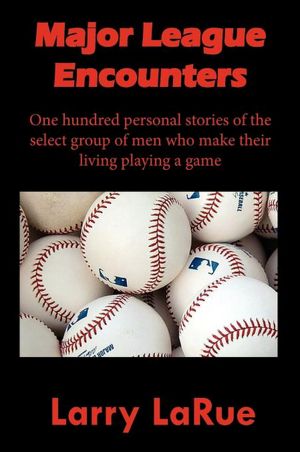
BBRT is pleased to bring you a guest post from veteran journalist/sportswriter Larry LaRue, author of the entertaining book Major League Encounters,  a compilation of 100 vignettes over 255 pages that gives readers a behind-the-scenes look at what drives the men – and boys – who earn the rare opportunity to play our national past time  at its highest level.  (See BBRT’s review, posted August 30, for more detail.   Major League Encounters is available at Amazon.com and BarnesandNoble.com.  BBRT thanks LaRue for his contribution – especially the very appropriate tale (since this is a post for BBRT’s Why I Love Baseball section) on how he witnessed the no-hitter on which the Kevin Costner’s film “For the Love of the Game” is based.


Why I Love Baseball

By Larry LaRue

For BaseBallRoundTable.com

I’ve loved the game my entire life and 33 years ago was given the opportunity to cover it professionally. What I learned from and about the men who play, manage and coach the game only deepened my affection for baseball.  All of us who played the game learned somewhere along the line how difficult it was to be as good as the best on our teams. It was no different in the majors.

In the spring of 1988, Ken Griffey Jr. was in camp with the Seattle Mariners and his natural ability was astonishing.  He was having a great spring until he faced Oakland’s Dave Stewart, and Stewart made him look foolish at the plate.  After a second strike out, Griffey went to hitting coach Gene Clines.

“What is that pitch?” he asked.
“That’s a split-fingered fastball,” Clines said.
“Why does he keep throwing it in the dirt?”
“Because you keep swinging at it.”

Griffey considered that, took it to heart. He committed the pitch to memory, swore he would make Stewart throw it for a strike. When the regular season opened, rookie Griffey faced veteran Stewart in the Kingdome for the Mariners home opener.  Stewart got ahead in the count, threw Junior a splittie.  Griffey hit it off the left field fence for a double.

For many of the 33 years I covered the game, I was in the press box of one ball park or another most nights all season. It was impossible not to see the physical toll a 162-game season took on the men who played it.  By the All-Star break, every pitcher was at less than 100 per cent.  So were most hitters. There are strains, aches and minor injuries that are largely ignored day after day after day.

The game isn’t played by supermen. Those who succeed, however, do so because – like all of us growing up playing once or twice a week – they love to be on a diamond.

Being around players meant appreciating their devotion to a game, and understanding it was for the most selfish of reasons. They could not imagine enjoying any thing in life more than playing baseball well.

Cal Ripken Jr. considered his consecutive games streak little more than a man showing up for work every day. He did it because he loved the game, yes, but he also did it because he felt an obligation to teammates and the franchise.  He’d signed on to play baseball. Unless there was someone on the team better than he was at what he did, the team was at its best when he played.

The more I learned about the game – and I often learned it from old-school managers like Gene Mauch and Dick Williams, who didn’t mind pointing out what I didn’t know – the better it got.

Seeing a pitcher set up a hitter in the first inning for what he might need to do late in the game, knowing what hitters looked for in certain counts … the complexity of the game was fascinating.

More than anything, though, knowing the men who played the game made watching it all the more gripping.

On May 14, 1996, I watched Dwight Gooden throw a no-hitter for a New York Yankees team he’d barely made. Starting because someone else couldn’t, he was a shell of the pitcher he’d been when he burst upon the game.

That night, however, Gooden pitched on heart and grit and the desire players never lose no matter what their ability. By the seventh inning, he had nothing left but a curveball. By the eighth inning, he’d thrown 110 pitches. In the ninth, he passed 120 pitches, then 130.  On the 135th pitch of the game, Gooden completed a no-hitter. Kevin Costner’s film, ‘For Love of the Game,’ was based on Gooden’s performance.

For Gooden that night, the game was about redemption.

Baseball has never been only about athletic ability. The drama each season provides goes beyond wins and losses and gives those who follow it comedy and melodrama, delight and torment.

The best players fail, not just at the plate or in the field, but occasionally in life. Unknowns fill in and become stars.  Bodies break down, teams that are great in May flounder in July.  The game is never scripted and as a writer, I couldn’t have created more moving stories.

I watched Nolan Ryan throw his last big-league pitch, a ball with nothing on it, and walk off the mound and the field for the final time as a pitcher.  He’d thrown a million fastballs by then, set records and left his mark, but Ryan knew his right arm. What hurt that night was, he knew, the end.

“I’ve thrown my last pitch,” he said afterward, without tears.

I consider myself fortunate to have known men like Ryan, Reggie Jackson, Bret Boone, Griffey, Fred Lynn, Ripken, Bruce Kison, Jay Buhner … and countless others who gave me their time, shared their stories.

Professionally, I’ve now covered my last baseball game.  I’ve been shifted back to news, where my career began, as a columnist.

Yes, I love the game of baseball, and the young players like Mike Trout, Kyle Seager, Chris Sales. I will miss covering the sport and the men who keep it alive.  Players like Ryan and Ripken, however, showed how to walk away with dignity that reflected well on them and their game.  No tears here.

I still love the game.

Harmon Killebrew Ultimate Slugger – You Couldn’t Make This Up

Harmon Killebrew  Ultimate Slugger


By Steve Aschburner

Triumph Books, 2012

$25.95


Fact or fiction – a story about a strapping, 17-year-old country boy being signed by the Washington Senators after being discovered playing baseball by a U.S. Senator?  The Senators’ scout goes west to watch this teenager play a trio of games for the – Oh, let’s call them the Payette Packers – and all the kid does is go 11 for 13 with four home runs, two triples and a double.

But wait, the story gets better.  The phenom goes on to a 22-year career in which he is an 11-time All Star (the first player selected an All Star at three positions); hits 573 home runs (leading the league six times); drives in more than 1,500 runs (leading the league three times); and wins an AL MVP award.

But there’s more.  While his prestigious power earns him the nickname “Killer,” this ultimate slugger celebrates victories with milkshakes, has a humble and quiet disposition and spends time schooling teammates on how to sign a legible autograph for the deserving fans.

Had enough yet?  How about he visits a young burn victim in the hospital and tells him he’ll try to hit “a couple” of home runs for him (against the then vaunted Yankees no less) – and goes out and does it?  Oh, and for good measure, let’s say that, in addition to the Baseball Hall of Fame, he also earns a spot in the World Sports Humanitarian Hall of Fame

As movie, it would probably be considered a baseball fantasy.  As a book – Harmon Killebrew Ultimate Slugger – it is the real life story of the late Harmon Killebrew (as told by long-time journalist/sportswriter Steve Aschburner.)

I was seven-years-old when Harmon first came to the big leagues with the Senators in 1954, and was privileged to live in Minnesota and see him play for much of his career with the Twins.  I can confirm what the late Twins’ owner Calvin Griffith said about the excitement generated by this quiet star:  “If our fans knew Killebrew was coming up in the ninth inning, they never left the ball game, no matter what the score was.”  The fact is, we all knew the Killer was always a towering tape-measure drive waiting to happen.

All of this makes Ultimate Slugger a great read for anyone who had the fortunate opportunity to see Killebrew play.  Yet, in some ways, it may make the story less compelling for others.  Many of the stories about Killebrew are as modest as the man himself – no late-night carousing, no braggadocio, no feuds with pitchers or umpires.  Yet, the book is a good, and even inspiring, read.

Aschburner, in sparse journalistic style, captures the spirit, dignity and quiet strength of the Killer –  from his Idaho youth, across his HOF career, and finally through a series of family, financial and health issues.  He brings Killebrew to life not only with statistics and biographical information, but with stories and comments from those who played with him and against him.  He also gives readers a look at baseball in the 1950s and 1960s, referred to by many as the sport’s “golden years.”

But maybe more important, he gives us a look at a player who behaved in real life like the heroes we imagined in our youth.  Harmon Killebrew was the kind of man, the kind of role model, we’d all like to know (and have our kids get to know).  This book opens the door to that opportunity – and it is a BBRT recommended read for baseball fans of all ages.

It’s a good story, about a good man, who happened to be a great ballplayer.  For BBRT, there is one quote in the book that tells it all.  Asked to comment on the best day in his life (or career), Killebrew answered, “What’s the best day in my life?  I try to make every day in my life the best day.”  You couldn’t make that up.

Move Over Reggie – For the Real Mr. October

Carlos “Big Game” Beltran – this guy can play the game.

Great players need great nicknames – like Mr. October, Big Train or the Baby Bull. Well, perhaps Carlos Beltran should be Carlos “Big Game” Beltran.  With his home run in game one of the 2012 NL Championship Series, Beltran added to his already spectacular post-season statistics.

In 29 post-season games, Beltran is hitting .370 with 14 home runs, 25 RBI., 38 runs scored and 9 stolen bases.  Not that he’s a regular season slouch.  In 15 seasons, the 1999 AL Rookie of the Year and nine-time All Star has rung up a .282 average, with 2,064 hits, 1,243 RBI and 1,267 runs scored.  He’s also a member of the 300-300 club, with 334 home runs and 306 stolen bases.  And, he tops it off with 3 Gold Gloves.  And, he’s done it all consistently and quietly, never leading the league in any of the key offensive categories.

BBRT Looks at 2012 Rookie and Manager of the Year Awards

In recent posts (Oct. 6/7), BBRT has shared its opinion on the AL & NL Most Valuable Player and Cy Young Awards.  In this post, we’ll take a look at two more major regular season recognitions – Rookie of the Year and Manager of the Year.   We’ll start with the easiest to guage, American League Rookie of the Year.


Mike Trout – likely unanimous AL ROY.

AL Rookie of the Year – Mike Trout (Angels)

If you don’t know the AL ROY is going to be the Angels’ Mike Trout, go back to Monday Night Football, you’re reading the wrong blog.

The (now) 21-year-old Trout, called up in late April, finished the season with a .326 average, 30 HRs, 83 RBI (from the lead-off spot) – while also leading the AL in runs scored (129) and stolen bases  (49) and likely earning Gold Glove consideration. In the process,  he became the youngest player to reach the “30-30 Club” (HRs and SBs), one of only 19 players to reach 30-40, and came within one stolen base of joining Eric Davis (1987) and Barry Bonds (1990) in the 30 HR-50 SB fraternity.   In fact, as BBRT completes this post, Trout is not only being talked about as a shoe-in Rookie of the Year, but as a leading AL Most Valuable Player candidate (see BBRT post of Oct. 7).

Honorable Mention would go out to the Rangers’ right-hander Yu Darvish, who posted a 16-9 record, with a 3.90 ERA, striking out 222 batters in 191 1/3 innings pitched.  The contest, however, is not even close.

NL Rookie of the Year – Wade Miley (Diamondbacks)

Wade Miley – stats on next year’s card will show why BBRT likes him as NL ROY.

BBRT sees a three-way battle here – one that could have been avoided except for a kink in the ROY eligibility rules (more on that later).  BBRT takes Arizona hurler Wade Miley over Bryce Harper of the Nationals and Norichika Aoki of the Brewers.

First, why Miley?  For the year, he posted a 16-11 record (leading the Diamondbacks in wins), with the league’s tenth-best ERA among qualifiers (3.33).  He took on a strong workload for a rookie (194 2/3) innings pitched – showing poise, control and power (only 37 walks against 144 strikeouts).

Second, why not Harper or Aoki (especially Harper, who was touted all year as the league’s top and most exciting rookie)?  For BBRT these two players, who took widely different paths to the NL (Harper a teenage sensation and Aoki a 30-year-old Japanese import), stole votes from each other.   Here’s the proverbial “tale of the tape.”

Games Played:  Aoki leads 151 to 139.

Hits:  Aoki tops Harper 150 to 144.

Batting Average:  Aoki bests Harper – .288 to .270.

Runs Scored:  Harper tops Aoki – 98 to 81.

Home Runs:  Harper well ahead of Aoki 22 to 10.

Doubles:  Aoki makes up for some of Harper’s HR-power, leading in two-baggers 37-26.

Triples:  Harper is more explosive, with 9 triples to Aoki’s 4.

RBI:  Despite the “overpowering” HR lead, the RBI race was closer than you would expect, with Harper leading 59 to 50.

Stolen Bases: Like Harper in HRs, Aoki has a big lead here, 30 to 18.  Also, Oaki was safe 89.5% of the time to 75.0% for Harper.

Walks:  Harper leads Aoki 56 to 43.

Strikeouts:  BBRT hates these wasted at-bats.  Aoki fanned only 55 times to Harper’s 120.

Excitement quotient:  Have to give the edge to Harper, who went all-out, all-the-time.

Harper had a fantastic season for a teenager, but just not enough to offset Wiley’s presence in the Diamondbacks’ rotation – and really not that far ahead of Aoki’s 2012 performance.

Honorable Mention:  BBRT regrets that Cardinal Lance Lynn did not qualify for ROY consideration (there was some debate early in the season).  He was well under the 50 innings pitched limit (getting in 18 games with 34 2/3 innings in 2011), but his early June  2011 call-up gave him more than the allowable 45 days of ML service (during the 25-man roster period – yes, it’s a technical rule).  Without that hitch, and time on the bench, Lynn would get BBRT’s vote hands down for his 18-7, 3.78, 176 innings pitched, 64-walk, 180-strikeout effort.

Notably, over in the AL, Mike Trout faced a pre-season ROY-eligibility dilemma himself.  According to reports last December, Trout was initially credited with 55 days on the Angels’ active roster (during the 25-player time period) in 2011. However, Trout was on the 25-man roster for just 38 days, with the remaining additional 17 days being credited after a short-term demotion to the minors.  MLB, in that case, ruled that while Trout retains 55 days of service time for accounting purposes, only the time he spent on the active roster will count against his rookie status.  Wow, I’m getting a headache, Mr. Commissioner.

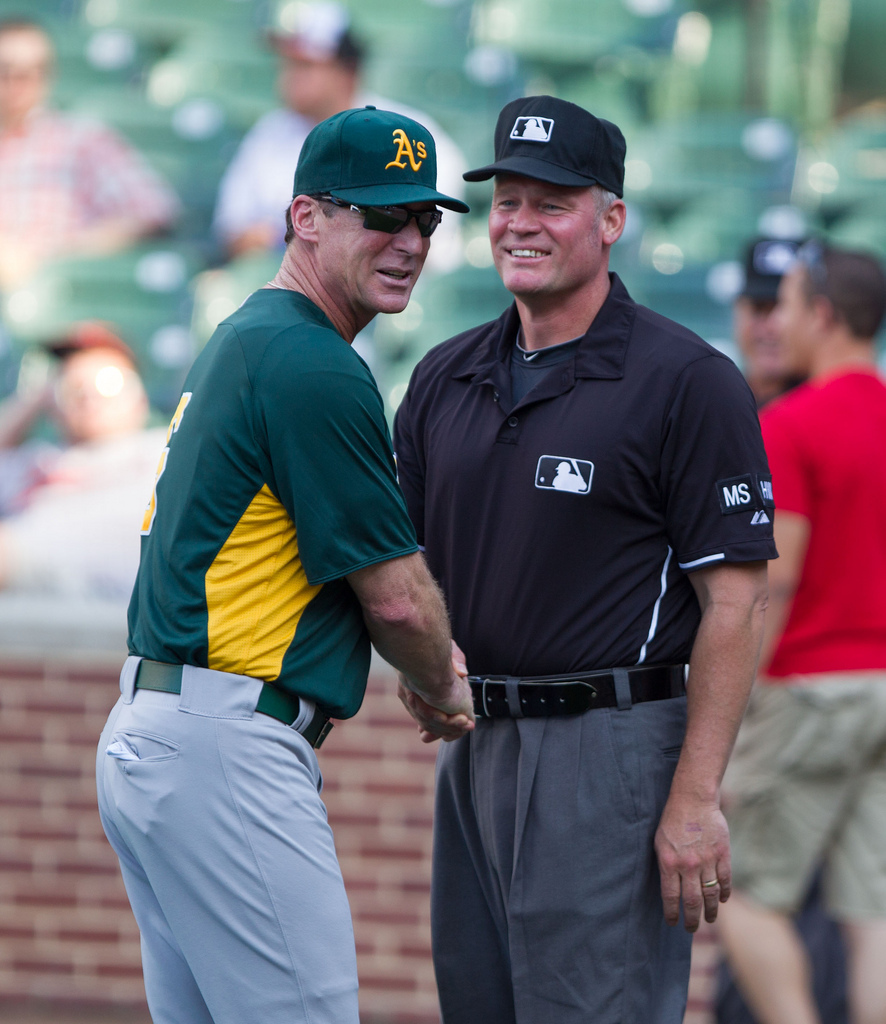
AL Manager of the Year – Bob Melvin (A’s)

The A’s Bob Melvin – BBRT choice for AL Manager of the Year.

BBRT’s choice, Bob Melvin, brought a no-name, no-payroll club (picked for last place by many analysts) to the West Division Championship with a 94-68 record (second-best in the AL).  Along the way, his A’s overcame a 13-game deficit as of June 30; were nine games out at the All-Star Break, four back with eight to go; and two behind with three to go.  They had to sweep the first-place and favored Rangers in the last series of the year and needed to overcome a 5-1 deficit in game 162 to capture the Division title.  They did it all – and with the lowest payroll in the league.

They also did it with no 100-RBI men; no .300 hitters; only one player with 30 or more homers; no-pitcher with more than 13 victories; only one pitcher with 30+ starts; and no pitcher with 200 innings pitched. They had 54 wins from rookie pitchers, and started a rookie hurler in each of the last 14 games of the season.

Runner-up?  That would be Buck Showalter of the equally “disrespected-in-the-preseason” Orioles.  Showalter kept his Orioles in the race with the vaunted Yankees until the final weekend, finishing two games out of the Division title – winning a Wild Card spot with a 93-69 record.  Had Melvin’s A’s not captured the West, BBRT would have split its vote between the A’s and Orioles’ skippers.

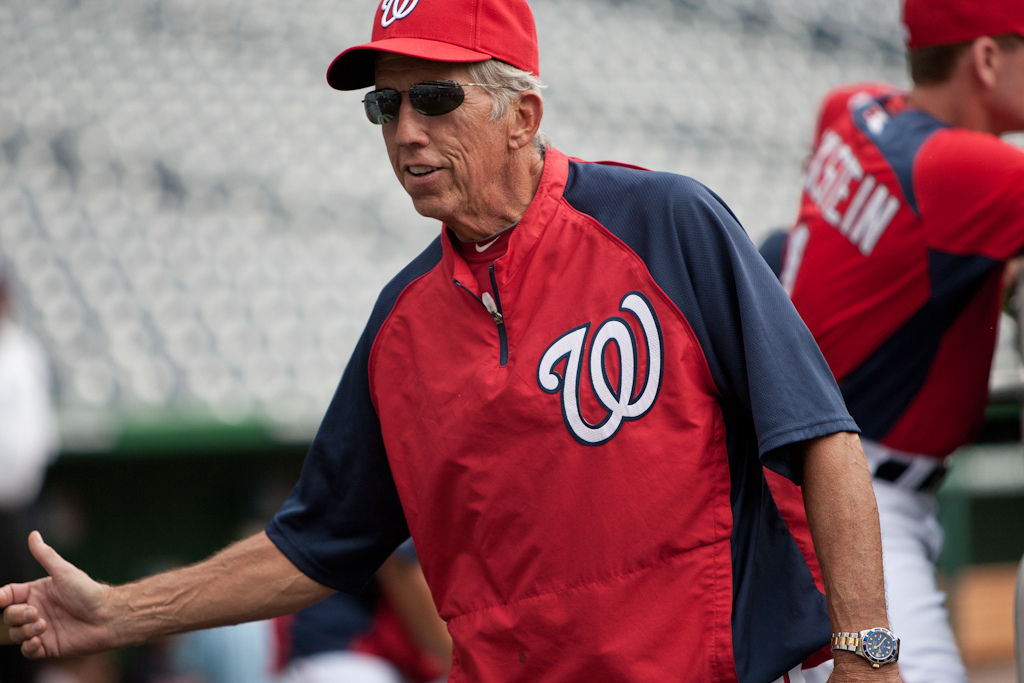
NL Manager of the Year – Davey Johnson (Nationals)

Davey Johnson – BBRT choice for NL Manager of the Year.

This was a close one for BBRT, with the Nationals’ Davey Johnson barely edging out Bruce Bochy of the Giants and Dusty Baker of the Reds not far behind.  All three managers brought 2011 non-playoff teams to Division Championships.  Johnson ends up with a slight edge for bringing his Nationals’ squad in at 98-64, MLB’s best record in 2012.

Here’s what BBRT saw over the season.  We’ll start with Johnson.  His Nationals improved from 2011’s third-place finish (80-81, 21 ½ games out) to 98-64 and an AL East Crown.  In the process, Johnson had to deal with injuries to key players like Michael Morse,  Jayson Werth and Ryan Zimmerman.  He also had to keep enthusiastic (can you be overly enthusiastic?) 19-year-old rookie Bryce Harper on as even a keel as possible and handle the Stephen Strasburg shut-down controversy.  Finally, he boosted the confidence and performance of middle-infielders Ian Desmond and Danny Espinosa, who came into the season with a combined 515 total games of MLB experience.  Those challenges, plus his deft handling of the pitching staff and MLB’s best record earn Johnson BBRT’s vote.

Close behind is the Giants’ Bruce Bochy.  The Giants didn’t have as far to come as the Nationals (which played a role in BBRT’s preference for Johnson), going from 2011’s second-place finish (86-76, eight games out) to 94-68.  Bochy, however, faced plenty of challenge along the way.  He lost his leading offensive player to a PED-related suspension, suffered through an off-year by staff ace Tim Lincecum (whose ERA went from 2011’s 2.74 to 5.18), dealt with injuries to key players like Pablo Sandoval, and faced the threat of the high-spending Dodgers.   Outside of the spectacular year from Buster Posey (.336, 24 HR, 103 RBI), the Giants’ HR and RBI leader would have been Sandoval, with only 12 HRs and 63 RBI.  Like the Nats, the Giants could count on a strong starting staff (Matt Cain, Ryan Vogelsong, Madison Baumgardner and a resurgent Barry Zito), which helped compensate for Lincecum’s 10-15 record. A key to the Giant’s strong season, however, was Bochy’s handling of the bullpen, consistently getting the “hot hand” in at the “right time.”  As a result, the bulk of the saves went to:  Santiago Casilla (25), Sergio Romo (14) and Javier Lopez (7).

BBRT gives third place in the Manager of the Year race to Dusty Baker of the Reds.  Baker brought the Reds from 2011’s third-place finish (79-83, 17 games back) to 97-65.  Over the course of the season, he had to deal with injuries to key players like Joey Votto (the center of the Reds’ offense) and Scott Rolen.  Baker, known as a player’s manager and motivator, responded by getting the best out of players like Jay Bruce and Ryan Ludwick.  Not blessed with a particularly strong bench, Baker proved a master (though an oft-criticized one) at juggling his line-up to keep the Reds on track.  Baker also has to be credited for the Mid-May decision to move hard-throwing Aroldis Chapman into the closer role.  Chapman responded with 38 saves, a 1.51 ERA and 122 K’s in 71 2/3 innings pitched.

Like Johnson and Bochy, Baker did benefit from a solid and stable (perhaps the most stable) starting rotation.  Baker’s five-man rotation (Johnny Cueto, Matt Latos, Homer Bailey, Bronson Arroyo and Mike Leake) accounted for 161 of the Reds’ 162 starts.  For you trivia buffs, the starter in that one “outlier” – the second game of an August 18 day/night doubleheader – was rookie Todd Redmond (his only ML appearance to date).

Overall, a great – maybe even award-worthy – managerial season for Baker.  However, both Johnson and Bochy had to deal with more “distractions” in bringing their squads home in first.

BBRT invites your comments on 2012 regular-season awards.

2012 Awards – NL MVP & the Cy Young(s)

With BBRT’s pick for the AL MVP out of the way – see the previous post on the very debatable junior circuit Most Valuable Player award – let’s move on to BBRT’s look at the remaining regular-season recognitions.  Not as much controversy here, but still plenty of good competition.

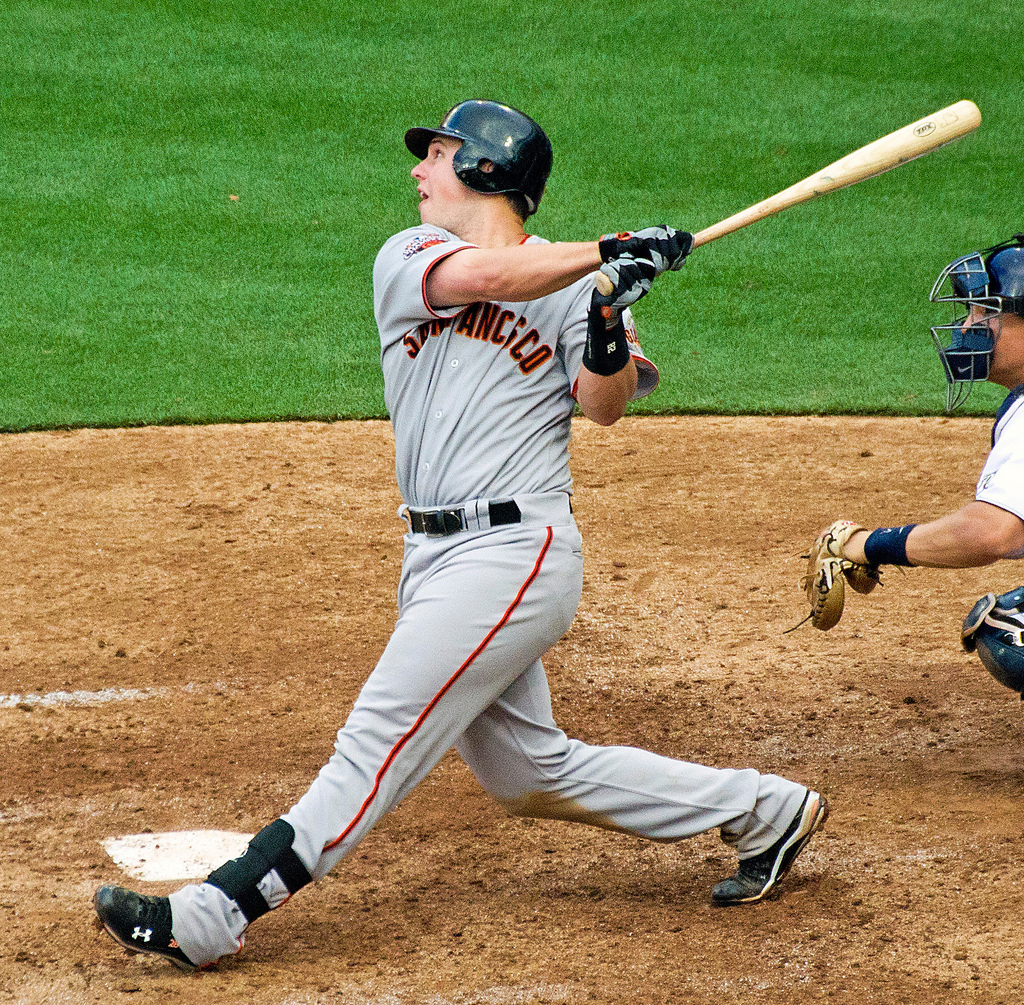
Buster Posey – BBRT choice for NL MVP.

NL MVP – Buster Posey (Giants)

BBRT sees a two-player race here and, surprisingly, both contenders make at least half their living in foul territory.  BBRT’s top candidates for NL MVP are catchers Buster Posey (SF) and Yadier Molina (St.L.).  BBRT is going with Posey, based on a combination of timing and circumstance.

Let’s look at Molina first.  A Gold Glove performer (who tosses out about half of the opponents’ potential base stealers), Molina put up some pretty gaudy offensive numbers for a backstop – .315, 22 HRs and 76 RBI.   His season was one of consistency:  .304, 13, 45 before the All-Star break, .328-9-31 in the second half.  Further, he called a great game and was a leader on the field.  Clearly, he made strong contributions to St. Louis run to a Wild Card spot.

BBRT’s MVP choice, however, contributed even more to his team’s results, helping lead the Giants to the West Division title (by 8 games over the Dodgers) despite the team’s on-field injuries and off-field difficulties.    Not only did Posey (like Molina) play the game’s most mentally and physically demanding position, he put up a line of .336, 24 HRs and 103 RBI.  In addition, Posey picked up the slack following Melky Cabrera’s PED-related suspension.  After a .289, 10 HR, 43 RBI first half, Posey delivered a .385 average with 14 HRs and 60 RBI after the break.  Further, Melky C.’s unfortunate (self-inflicted) circumstances, paved the way for Posey to become only the fourth catcher to win a league batting crown.   Ultimately, that strong (and much-needed) second-half push moves Posey ahead of Molina.

AL Cy Young – David Price

David Price – Edges Out Verlander for BBRT’s AL Cy Young.

Three starters dominated here – David Price, Justin Verlander and Jered Weaver.  BBRT goes with Price, barely over Verlander (due primarily to Price’s three extra wins) with Weaver dropping to third.  Let’s examine the competition.

Weaver, despite his 20-5 record, drops off due to having the fewest starts, fewest innings pitched, fewest strikeouts and highest ERA of the three.  Still he deserved consideration based on a 20-5 record, and 2.86 ERA.  It was the sub-200 innings pitched (188 2/3) and the less than dominating 142 strikeouts that put him third in this race.

Now to the top two contenders.  Verlander did lead the league in innings pitched and strikeouts (238 1/3 IP, 239 Ks). Price was not far behind at 211 IP and 205 Ks.  Verlander also led Price in starts, 33-31.  Price, on the other hand, led the league in ERA at 2.56, with Verlander second at 2.64 and Weaver third at 2.86.  Verlander also topped the AL in complete games with 6, to only 2 for Price (but today’s game really is not about going nine innings anymore).  Both pitchers logged 25 quality starts.  Ultimately, this could go either way, but for BBRT it comes down to Price’s three extra victories (20-5 versus 17-8) and the fact that Price edged Verlander by winning 22% of TB’s games, while Verlander picked up 19% of the Tigers’ victories.  BBRT can support either Price or Verlander, we just give the edge to tradition and the 20-game winner.

R.A. Dickey – Should Walk Off with NL Cy Young.

NL Cy Young – R.A. Dickey

This was a no-brainer for BBRT.  Yes, we love Braves’ closer Craig Kimbrel, 3-1 with 42 saves, a sparkling 1.01 ERA and a spectacular 116 strikeouts (and only 14 walks) in only 62 2/3 innings.   And there’s Gio Gonzalez of the Nationals, who was often buried in the Strasburg publicity and shut-down controversy, while quietly turning in a 21-8, 2.89 season with 207 K’s in 199 innings pitched.  A lesser case could also be made for the Reds’ Johnny Cueto (19-9, 2.78) and the Dodgers’ Clayton Kershaw (14-9, 2.53), who came on strong; just too late.

Hands down, however, the Cy Young has to go to the Mets’ R.A. Dickey – who went 20 – 6, 2.73 with a Mets’ team that had a faltering bullpen and finished 14 games under .500.  Dickey led the NL in:  Starts (33, tie); Innings Pitched (233 2/3); Strikeouts (230, one more than Kershaw); Quality Starts (27); and Complete Games (5).  He finished second in wins to Gonzalez’ 21 and second in ERA (at 2.73) to Kershaw’s 2.53.  And, Dickey walked only 54 against his 230 K’s – unusual control for a knuckleballer.  A great season, deserving of the Cy Young for a pitcher who came into 2012 with a career 41-50 record and a 4.34 ERA.

Watch soon for BBRT’s Rookie and Manager of the Year picks – and we invite your comments on the MVP and Cy Young. 

BBRT Weighs In On Post Season Awards – Starting with AL MVP

Miguel Cabrera – BBRT’s AL MVP.

In the next few posts, BBRT will be taking a look at the upcoming MLB 2012 Regular Season Awards – MVP, Cy Young, Rookie of the Year, Manager of the Year.  We’re starting with the most controversial award of 2012 – American League MVP.  The Tigers’ Triple Crown winner Miguel Cabrera and the Angels’ spectacular rookie Mike Trout each have plenty of supporters and statistics – from Batting Average to On Base Percentage to Wins Above Replacement – are being tossed around like hand grenades.

In a tight contest, BBRT would give the AL MVP to Cabrera over sure-thing Rookie of the Year Mike Trout – and not just on the basis of Cabrera’s rare Triple Crown achievement.  Let’s look at the logic.

First, of course, we all know that Cabrera won the first Triple Crown in 45 years.  How much an edge is that in the race for MVP?   For BBRT, the three legs of the Triple Crown are weighed equally with a host of other stats.  Let’s look.


Batting Average

This is close, Cabrera leads the league at .330, but Trout is right behind, second in the league, at .326.  Very slight edge to Cabrera.

Home Runs

Cabrera enjoys a big lead in total HRs with his AL best 44, but Trout showed solid power as well. His 30 round trippers ranked 13th in the AL.  BBRT gives a moderate edge to Cabrera. (Some might argue that Trout spent most of April in the minors, but for the season he had only 63 fewer at-bats.)

RBI

Big edge to Cabrera, a league-leading 139, to Trout’s 83 (13th in the league).  But we need to take into account that Trout is a lead-off hitter and Cabrera is a middle of the line-up guy.

With the big three out of the way, Cabrera has a bit of an edge.  Now, let’s look deeper.

Runs Scored

Trout led the AL at 129 (despite a late-April call-up).  Cabrera, however, was no slouch.  His 109 runs scored were second only to Trout.  And, here again, for different reasons, we must keep in mind that Trout was leading off.  Still, slight advantage Trout.

Hits

Cabrera’s 205 were second in the league, but Trout’s 182 placed him tenth (and, again, he was called up in late April.)  Call this one a draw.

Doubles/Triples

Cabrera had a large lead in doubles 40 to 27, but that was offset by Trout’s 8 to 0 lead in triples.  Another toss-up.

Stolen Bases

Trout by far, a league-leading 49 to Cabrera’s four – making Trout a unique power-speed threat.

On Base and Slugging Percentage

Trout’s .399 OBP was third in the league, just besting Cabrera’s .393 (AL 4th) – while Cabrera’s .606 league-leading Slugging Percentage topped Trout’s .564 (third).  Six of one, half-dozen of another here.

So, now we’re through most offensive stats – and it’s very close.  BBRT sees a slight edge to Cabrera, but it’s still debatable.

Now, some offensive stats not too many are talking about.

Bases on Balls

Surprisingly, not a lot of free passes for either of these offensive stars.  Trout’s 67 walks were one more than Cabrera.  Toss up.

Strikeouts

Let’s face it, K’s are pretty much wasted at-bats.  A surprise here, Trout fanned 139 times (not expected from your lead-off man) to 98 for Cabrera (a more respectable number for the middle of the line-up).  Trout fanned 41 more times – in 63 fewer at bats.  Edge – Cabrera.

Defense

Trout takes the lead here, a potential Gold Glove candidate.  But, we have to keep in mind that Cabrera moved over the third base to enable the acquisition of Prince Fielder – a valuable concession from a team point of view.   Ultimate advantage, still a healthy one for Trout, but not weighted as heavily here as in some other quarters.

Other factors

Remember, this is not a Best Player or even Best All-Around Player award; this is Most Valuable Player – what you mean to your team.

BBRT give Cabrera an edge here, with Detroit coming back to win the Division

Mike Trout – spectacular rookie a close second in BBRT’s book.

and the Angels at home watching the post season after finishing third in their Division and four games behind in the Wild Card race. The fact is, without Cabrera, the Tigers, like the Angels, would already be home.  Without Trout, the Angels would probably still have finished third – just a little closer to Seattle.  BBRT agrees that Trout did spark the Angels, just not enough to make a difference in the final division standings. 

And what about the impact as the pennant race unfolded?  Consider what the two accomplished through the “Dog Days” of August, and the critical September/October time frame.  As Bill Madden of the NY Daily News noted: from August 1 on, Cabrera .344, 19 HRs and 54 RBI – Trout .287, 12 HRs and 28 RBI.  As the race heated up, Cabrera got hotter, while Trout seemed to fade a bit.

Further, Cabrera went through the season with the expectations placed on a veteran leader – to inspire, mentor and motivate – to be a clubhouse leader.  Trout was a rookie, expected to learn from team leaders like Albert Pujols and Torii Hunter.

So yes,  Trout, at 21, became the first rookie and youngest member of the 30-40 club (30 homers and 40 stolen bases) – and, to BBRT even more impressive, was only one stolen base from joining the elite 30-50 club, which includes only Eric Davis and Barry Bonds. An argument may, in fact, be made for Trout being very close to – if not the – best all-around, five-tool player of 2012.

But, again, this award does not recognize the “best” player, but rather the “most valuable.”   When you add it all up, BBRT’s MVP vote goes to Miguel Cabrera (WAR not withstanding) – not just for for his full-season performance on the field (all those stats being tossed around), but also for his contributions down the stretch, his willingness to cross the diamond from first base to third base for the good of the team, and the expectations placed on him as a veteran and team leader.  

Watch BBRT for a soon-to-come (and briefer) look at the other 2012 Awards:  NL MVP; AL & NL Cy Young; AL & NL Rookie of the Year; and AL & NL Manager of the Year.  There’s some spirited competition, but far less controversy.