First Complete-Game No-Hitters, Getting A Bit Less Rare

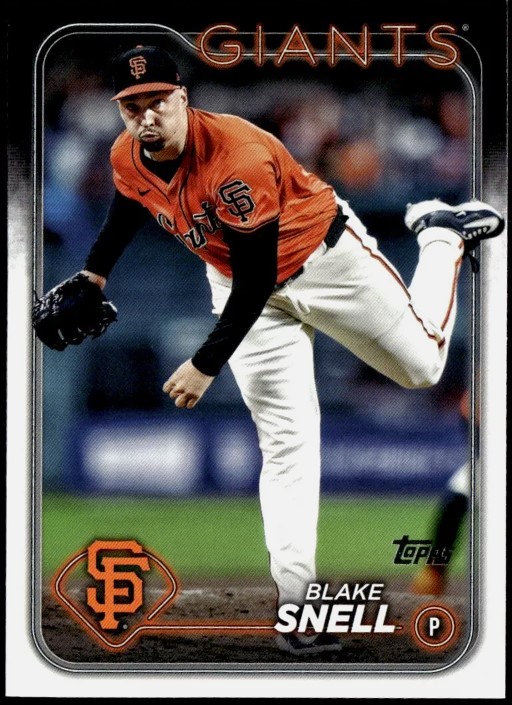
In the 2024 MLB season there were three one-pitcher no hitters – Ronel Blanco, Dylan Cease and Blake Snell.  For two of those pitchers, the no-hitter was their first – and still only – MLB complete game. Snell’s no-no was of special interest to Baseball Roundtable because Snell is already a two-time Cy Young Award winner and this first career complete outing came in his ninth MLB season and 202nd MLB start.  As usual with The Roundtable, one thing led to another and I took a deep dive into Modern Era (post-1900) MLB pitchers whose first MLB complete game was a no-hitter. I came across 29 such instances and, as you might expect, most of them were relatively recent.  (Complete games themselves, of course, are considerably rarer these days and a pitcher practically has to be working on a no-hitter – or at least a shutout – to be extended beyond the acceptable “pitch count.”)  Of the 29 first-complete game no-hitters I found, 23 came after the year 2000 and ten of those since 2020. Note: Negro League stats, particularly game-by game, from 1920-48 are not complete.

For a further point of comparison, I went back to 1953, the year the Braves moved to Milwaukee and my love of everything baseball (and everything Eddie Mathews) was born. That season there were 864 complete games in Major League Baseball – that is 111 more complete games than in the last 12 seasons combined (and remember back in 1953, there were fewer teams, playing a shorter season).

A Diversion – Before the Statistical Meat of this Post 

I still remember vividly (but not fondly) my feelings on April 13, 2002, when I was attending a Dodgers/Twins matchup at Target Field. After 7 1/2 innings, the Dodgers were up 6-0 – but, more significantly, Clayton Kershaw was pitching a perfect game. Nary a twin had reached base and 13 had gone down on strikes. My scorecard was looking like a real keeper – and perhaps I would be among 17,101 fans witnessing a bit of MLB history.  Not meant to happen. Dodgers’ manager Dave Roberts brought in reliever Alex Vesia to open the eighth frame, despite the fact that Kershaw had thrown just 80 pitches.  Just another look at how hard it is to get a complete game these days.

Now, let’s look at first-complete game no-hitters, prioritized by:

  • First complete-game perfect games;
  • First – and only – MLB career complete-game no hitters; and
  • Simply first complete-game no hitters.  Note: an * indicates the pitcher was still active in MLB in 2024.

FIRST COMPLETE GAME A PERFECT GAME

Philip Humber, RHP, White Sox … April 21, 2012
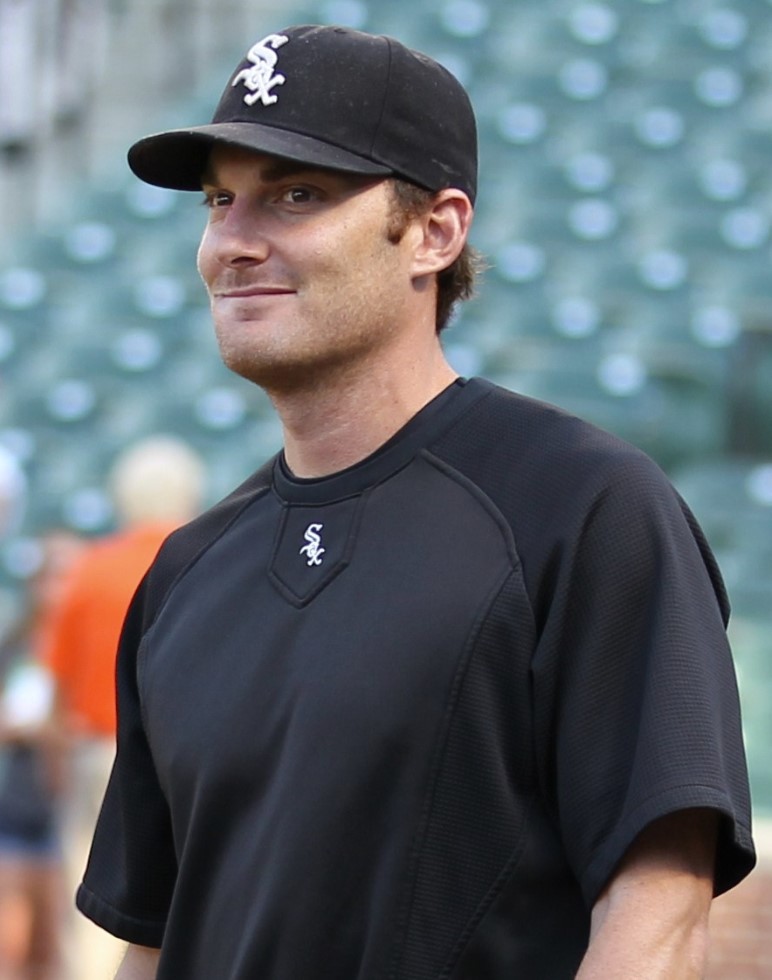
Photo: Keith Allison on Flickr derivative work: Muboshgu, CC BY-SA 2.0 <https://creativecommons.org/licenses/by-sa/2.0>, via Wikimedia Commons

Philip Humber tossed his perfect game (his only career complete game) in his seventh MLB season, 56th appearance, 30th start. He was on the mound for the White Sox, facing the Mariners (in Seattle). He threw 96 pitches in his 27-up/27-down performance – fanning nine Mariner hitters – as the White Sox prevailed 4-0. It was just his second start of the season and he had given up just one run (six hits) in 5 1/3 innings in his first outing. After the perfect game, things seemed to go awry. His next time out, Humber gave up nine earned runs in five innings and, in the three starts following the perfecto, he surrendered 20 earned runs in 13 1/3 frames.  He finished the 2012 season – in which he lost about a month due to an elbow issue – at 5-5, 6.44.  The following season (Humber’s last in the major leagues), the righthander went 0-8, 7.90 with the Astros. Humber pitched in eight MLB seasons (2006-2013 … Mets, Twins, Royals, White Sox, Astros).  His career record was 16-23, 5.31 in 97 appearances (51 starts), with, of course, that one very memorable complete game.

Humber was the third overall pick (Mets) in the 2004 MLB draft (out of Rice University, where he had gone 35-8, 2.80, with six complete games in 49 starts, over three seasons).

Dallas Braden, LHP, A’s … May 9, 2010
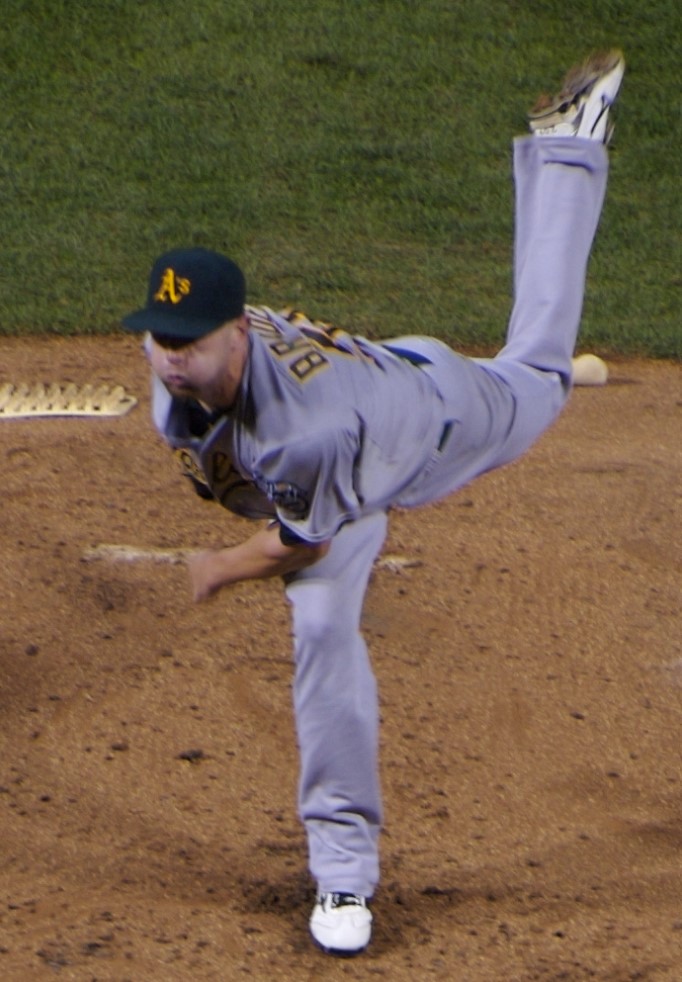
Photo: Jeff Kubina on Flickr (Original version)  UCinternational (Crop), CC BY 2.0 <https://creativecommons.org/licenses/by/2.0>, via Wikimedia Commons

Dallas Braden’s first MLB complete game was not only a no-hitter, but like Humber’s it was a perfect game.  It was not, however, his only MLB complete game.  The perfect outing came on May 9, 2010, as his A’s bested the Rays 4-0 in Oakland.  This first career complete game came in his fourth MLB season (68th appearance/53rd start). Braden fanned six batters in his 109-pitch perfecto and reached ball three on only four of the 27 hitters he faced. Braden threw four more complete games that season, when he finished at 11-15, 3.50.

Braden pitched in five MLB seasons (2007-11), all for the A’s.  He went 26-36, 4.16 for his MLB career – with five complete games (two shutouts).

Braden was signed by the A’s (out of Texas Tech University) in the 24th round of the 2004 MLB Draft.


Domingo German*, RHP, Yankees … June 28, 2023
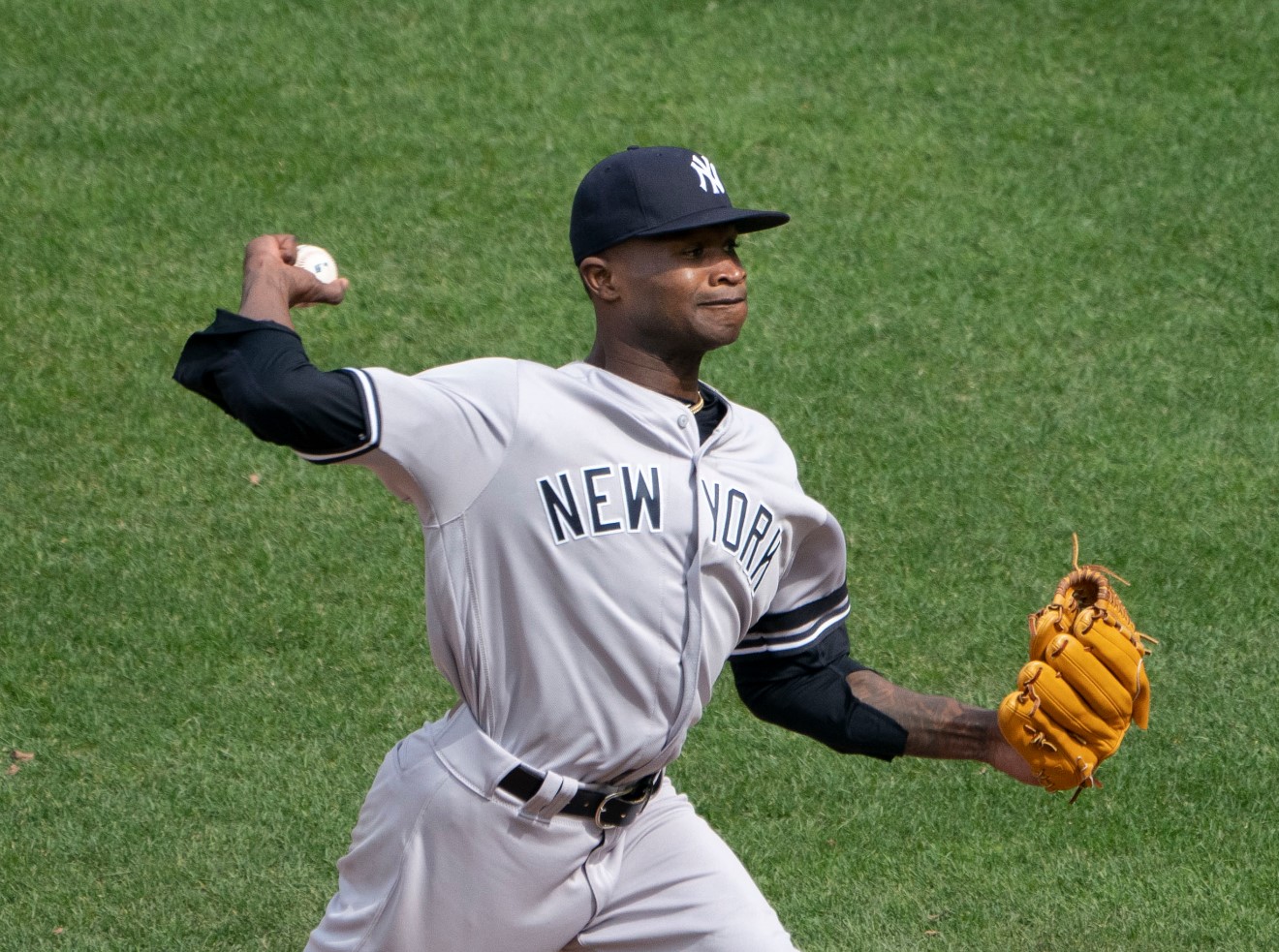
Photo: Keith Allison from Hanover, MD, USA, CC BY-SA 2.0 <https://creativecommons.org/licenses/by-sa/2.0>, via Wikimedia Commons

Domingo German was 30-years-old and in his sixth MLB season when he threw his perfect game, which was also his first (and still only) MLB complete game. It came in his 85th MLB start (107th appearance) and was part of an 11-0 Yankees win over the A’s (in Oakland). German fanned nine in his 99-pitch (72-strike) outing. He went to a three-ball count on only two of the 27 batters. Interestingly (to me), in the outing that preceded his perfecto, German lasted just 3 1/3 innings, giving up eight hits, two walks and ten runs (eight earned) and, in the outing after his perfect game, German lasted just 4 1/3 frames, giving up nine hits and three runs (two earned).  He finished the 2023 season at 5-7, 4.56.

Domingo German pitched the first perfect game by a player from the Dominican Republic.

German was signed by the Marlins as an international free agent in 2009. He has pitched in seven MLB seasons (2017-19, 2021-24 … Yankees, Pirates). He record stands at 31-29, 4.54. His best season was 2019, when he went 18-4, 4.03 for the Yankees. To date, German has just the one complete game in 91 MLB starts.

FIRST AND ONLY CAREER COMPLETE GAME A NO-HITTER

Bobo Holloman, RHP, Browns … May 6, 1953

Bobo Holloman was the first Modern Era pitcher to throw no-hitter in his first-ever MLB start.  (Tyler Gilbert matched that feat in 2021).  It was a start Holloman “earned” by going 0-1, 8.44 in his first five career MLB appearances (five earned runs in 5 1/3 relief innings). In nis no-hitter, the thirty-year-old rookie shutdown the Athletics (in St. Louis) in a 6-0 win – walking five and fanning three. He made hard work of the final inning, walking the first two batters (PH Elmer Valo and SS Eddie Joost) before inducing a double play grounder (CF Dave Philley). He then walked his third batter of the inning (3B Loren Babe) before getting 1B and cleanup hitter Eddie Robinson on a flyout to right. Holloman finished the 1953 season, his only big-league campaign, 3-7, 5.23 in 22 appearances (10 starts).

Bud Smith, LHP, Cardinals … September 3, 2001

Bud Smith no-hit the Padres 4-0 in San Diego in his lucky 13 MLB appearance (11th start). He walked four and fanned seven in the 134-pitch outing, which ran his rookie season record to 4-2, 3.75. He would finish the campaign at 6-3, 3.83. The following season, Smith would go 1-5, 6.94 – and he ended his MLB career with a 7-8, 4.95 record. (He did pitch in the minors through 2005.)

Smith was signed (by the Cardinals) out of the fourth round of the 1998 Major League Draft. In 2000, he went 17-2. 2.26 at Double-A and Triple-A. Before his 2001 callup, he was 8-5, 2.75 at Triple-A.

Jonathan Sanchez, LHP, Giants … July 10, 2009

Jonathan Sanchez’ no-hitter (and only MLB complete game) came in his fourth MLB season (106th appearance/51st start) – and almost vaulted him into the perfect game portion of this post. Sanchez retired the first 22 batters he faced, fanning nine.  Then, with one out in the eighth, Padres’ LF Chase Headley reached on an error by Giants’ 3B Pablo Sandoval. Sanchez then retired the next five Padres’ batters to complete the 110-pitch no-no with just that one blemish. Sanchez went 8-12, 4.26 in 2009 and 39-58, 4.70 for his eight MLB seasons (2006-2013 … Giants, Royals, Rockies, Pirates). He made 194 appearances – 137 starts.

Sanchez waw a 27th-round pick (Giants) in the 2004 MLB Draft. His best MLB season was 2010, when he went 13-9, 3.07 for the Giants.

Hisashi Iwakuma, RHP, Mariners …. August 12, 2015

Hisashi Iwakuma’s no-hitter (and only complete game) came in his fourth MLB season (his age-34 season), 102nd MLB appearance and 88th start. Iwakuma threw 116 pitches (three walks, seven strikeouts) in topping the Orioles 3-0 in Seattle. The game ran his record to 3-0, 3.86 in a season which would see him go 9-5, 3.54. Prior to joining the Mariners, Iwakuma had pitched 11 seasons in Japan, going 107-69, 3.25, with 48 complete games in 225 starts.  In MLB, he pitched six seasons (2012-17), all for the Mariners – going 63-39, 3.42, with that one complete game in 136 starts (150 appearances). He was an All Star in 2013, when he went 14-6, 2.66. He won 15 or more games in three of his six MLB campaigns.   Iwakuma was just the second Japanese player to pitch an MLB no-no (after Hideo Nomo).

Alec Mills, RHP, Cubs … September 13, 2020

Alec Mills was in his fourth MLB season when he tossed his no-hitter and only compete game. It came in his 28th MLB appearance and 15th start.  Mills was up-and-down (majors-and-minors) over the previous three seasons (from 2016-19, he appeared in 73 minor-league games and 19 MLB games). In 2020, he made his first start for the Cubs in late July. His no-hitter came on lucky September 13, as his Cubs trounced the Brewers 12-0 in Milwaukee. Coming into the game Mills was 4-3, 4.74 on the season. In his no-no, he walked three and struck out five (114 pitches).

Miller finished the season at 5-5, 4.48.  He pitched in seven MLB campaigns (2016, 2018-23), going 12-14, 5.00 in 70 games (39 starts).

Miller was originally signed by the Royals (out of University of Tennessee-Martin) in the 22nd round of the 2012 MLB draft. In 11 minor-league seasons, he threw one complete game in 131 starts.

John Means*, LHP, Orioles … May 5, 2021

John Means threw a no-hitter in Seattle, as the Orioles beat the Mariners 6-0. He walked none and fanned a dozen in his 114-pitch outing and one errant pitch cost him a perfect game – despite the fact that he faced the minimum 27 batters.  In the bottom of the third inning, with none on and one out, Means got ahead of Seattle LF Sam Haggerty 1-2, who then swung and missed (for strike three) a curveball in the dirt (scored a wild pitch) that got past catcher Pedro Severino enabling Haggerty to reach first.  On the first pitch to the next batter Haggerty was thrown out trying to steal and Means retired the next 19 batters in order – for an almost perfect outing for his first career complete game. The no-no came in Means’ fourth MLB season, 39th career MLB appearance and 44th start. He finished the 2012 season at 6-9, 3.62.

Still active in 2024 (2018-24, all for the Orioles) Means has an MLB career record of 23-26, 3.68.  He was 2-0, 2.61 in 2024 before undergoing season-ending surgery. Means was an All Star as a rookie in 2019, when he went 12-11, 3.60 for the Orioles.

Means was selected by the Orioles in the 11th round of the 2014 MLB draft (out of West Virginia University).

Spencer Turnbull*, RHP, Tigers … May 18, 2021

Spencer Turnbull no-hit the Mariners in a 5-0 Tigers’ win in Seattle – walking two and fanning nine in a 117-pitch outing. The gem came in his fourth MLB season, 51st appearance, 50th start. Turnbull, still active in 2024, has a career stat line of 15-29, 4.26 (78 appearances/67 starts). His career was interrupted by Tommy John surgery in 2021.  He has pitched in the major leagues for the Tigers and Phillies.

Turnbull was drafted by the Tigers in the second round of the 2014 MLB draft (out of the University of Alabama, where he went 11-16, 3.54 in three seasons).

Tyler Gilbert*, LHP, Diamondbacks … August 14, 2021

Tyler Gilbert’s no-hitter/only career complete game came in his first MLB start (fourth MLB appearance) – on August 14, 2021, as his Diamondbacks topped the Padres 7-0 in Arizona.  He walked three and fanned five in the 102-pitch outing. Gilbert finished the 2021 season at 2-2-, 2.15 in nine appearances (six starts). He has been up-and down (Triple-A/Majors) since that time, and his career MLB record is 2-7, 4.23. In nine minor-league seasons, he has made 242 appearances (62 starts) with no complete games, compiling a 41-34, 4.06 record.

Gilbert was a Phillies’ sixth-round pick in the 2015 MLB draft – out of the University of Southern California, where he went 5-2, 2.79 in 2015. He also pitched two years at Santa Barbara City College (15-7, 3.11).

Reid Detmers*, LHP, Angels … May 10, 2022

Reid Detmers no-hitter came in his second MLB season (11th MLB appearance/11th start), as his Angels beat the Rays 12-0 in Anaheim. Detmers walked one and struck out two in his 108-pitch outing.  He went on to finish the season at 7-6, 3.77 in 25 starts. Still active (major leagues 2021-24 … Angels), he has a career mark of 16-28, with just the one complete game in 75 starts. Side note:  His one complete game in 2022 was enough to tie for the AL lead in shutouts that season.

Detmers was an Angels’ first-round draft pick (tenth overall) in 2020 – out of the University of Louisville, where he went 20-6, 3.20 over three seasons.

Mike Lorenzen*, RHP, Phillies … August 9, 2023

Mike Lorenzen’s no-no came in his ninth MLB season (333rd career appearance/64th start). It was Lorenzen’s second appearance for the Phillies (following an August 1 trade from the Tigers). In the 124-pitch outing, he walked four and fanned five, while his Phillies topped the Nationals 7-0 in Washington D.C.  (Seven may have been a lucky number, the 7-0 win moved Lorenzen’s record to 7-7 on the season.) Lorenzen finished the 2023 season at 9-9, 4.18. Still active in 2024, Lorenzen has a career record of 47-44, 3.99 (15 saves) in 368 appearances (93 starts). He still has just the one complete game. Since his MLB debut in 2015, Lorenzen has pitched for the Reds, Angels, Tigers, Phillies, Rangers and Royals. In 2024, the 32-year-old Lorenzen went 7-6, 3.31 for the Rangers and Royals.

Lorenzon was a first-round pick (Reds, 38th overall) in the 2013 MLB draft – out of California State University Fullerton, where he pitched and played outfield. At CSU, he went 5-0, 1.61, with 35 saves (42 appearances, all in relief) and hit .322-11-128 in 167 games.

Let Me Take My Cuts

Mike Lorenzen is a pretty good hitter for a pitcher. In fact, over his MLB career, he has played 34 games in outfield and has been used 29 times as a pinch hitter. He has a .233 career batting average (1-for-133) with seven home runs and 24 RBI.

Ronel Blanco*, RHP, Astros … April 1, 2024

On April 1 of the 2024 season, 30-year-old Astros’ righty Ronel Blanco tossed a no hitter in a 10-0 Houston win over the Blue Jays (in Houston).  Blanco fanned seven and walked two in the whitewashing.  It was his first-ever complete game and only complete game to date. The 105-pitch no-no came in Blanco’s third MLB season, 25th MLB appearance and just his eighth MLB start.  Blanco went 13-6, 2.80 in 2024 and has a career mark of 15-7, 3.31 (2022-24, Astros).

Blanco signed with the Astros in 2016 as an international free agent.(Dominican Republic).

Blake Snell, LHP, Giants … August 2, 2024

On August 2 of the most recent MLB season, Giants’ southpaw Blake Snell no-hit the Reds in a 3-0 win in Cincinnati. – picking up his first victory of the season (running his record on the season to 1-3, 4.29.)  It was the two-time Cy Yong Award winners first (and still only) MLB complete game – coming in his ninth MLB season and 202nd MLB start. In the game, Snell threw 114 pitches, walking three and fanning 11. He fanned the side (three up/three down) in the first and fourth innings and not a single runner reached second base.

The no-hitter remains the only time in his MLB career (211 starts) that that Snell pitched at least eight innings (he has logged seven or more innings in 33 starts).

Snell finished the 2024 season at 5-3, 3.12 in 20 starts – and now had a career mark of 76-58, 3.19 over nine seasons (2016-2024 … Rays, Padres Giants).

Snell was selected by the Rays in the first round of the 2011 draft (out of Shorewood, WA, High School). In his senior year, Snell went 9-0, with a 1.00 ERA and 128 strikeouts in 69 innings pitched.

FIRST (BUT NOT ONLY) COMPLETE GAME A NO-HITTER

Bill Stoneman, RHP, Expos … April 17, 1979

Bill Stoneman no-hit the Phillies in 7-0 Expos win in Philadelphia – walking five and fanning eight.  It came in his third MLB season, 60th game and, 22nd start.  It was the first no-hitter for the expansion Expo’s (they had taken Stoneman (from the Cubs) with their ninth selection in the 1968 expansion draft. Stoneman, a 31st round Cubs’ selection in the 1966 MLB draft (out of the University of Idaho) had a 2-5, 4.00 MLB record for the Cubs in 1967-68. In 1969, Stoneman went 11-19, 4.39 for the 52-110 Expos, with eight complete games. He led the Expos in wins, starts (36), complete games (8), shutouts (5), innings pitched (235 2/3) and strikeouts (185).

Stoneman pitched in eight MLB seasons (1967-74 … Cubs, Expos, Angles), going 54-85, 4.08. He threw 45 complete games in 169 starts, including 15 shutouts.

Charlie Lea, RHP, Expos … May 10., 1981

Charlie Lea’s no-hitter came in his second MLB season (27th appearances/233rd start.)  It was part of a 4-0 win over the Giants in Montreal. In a game tied at zero through six frames, Lea walked four and fanned eight.  He threw his second career complete game in his very next start (May 16), a four-hit, 5-0 shutout over the Giants.

Lea pitched in seven MLB seasons (1980-84, 1987-88 … Expos, Twins). He went 62-48, 3.54 in 152 games (144 starts) and tossed 22 complete games. His best season was 1988, when he went 15-10, 2.89. Note: Lea’s career was interrupted by a shoulder injury.

Lea was selected by the Expos in the ninth round of the 1978 MLB Draft – out of the University of Memphis, where he went 9-2, 3.78 in 1978.

Wilson Alvarez, LHP, White Sox … August 11, 1991

In August 11, 22-year-old White Sox southpaw Wilson Alvarez won 7-0 game over the Orioles in Baltimore. It was just his second MLB appearance (he had one start in 1989), first complete game and first MLB victory. Alvarez walked five and fanned seven in his no-no. Side note: In his first MLB appearance (for the Texas Rangers on July 24, 1989), Alvarez started and faced just five batters.  It went single, home run, home run, walk, walk. Although his second MLB start didn’t come until two seasons later, the wait was clearly worth it.

Alvarez pitched in 14 MLB seasons (1989, 1991-99, 2002-05 … Rangers, White Sox, Giants, Devil Rays, Dodgers), going 102-92, 3.96 in 355 appearances (263 starts, 12 complete games). He was an All Star in 1994, when he went 12-8, 3.45 for the ChiSox. His best season was 1993, when he went 15-8, 2.95 for the White Sox.

Kent Mercker, LHP, Braves … April 8, 1994

Kent Mercker was in his sixth MLB season (185th appearances/12th start) when he threw his first complete game – a no-hitter in a 6-0 win over the Dodgers (in LA). It was his first start of the 1994 season. In the game, he walked four and fanned ten, throwing 131 pitches (85 strikes). Mercker pitched a second complete game in 1994 (a July 18, two-hit, 3-2 win over the Pirates in Pittsburgh). He finished the 1994 season at 9-4, 3.45 (20 games/17 starts). Moving between starter and reliever during his career (542 relief appearances/150 starts), his nine 1994 wins would be his second-highest career total (he was 11-11, 5.07 for the Cardinals in 1998).

After his two complete games in 1994, Mercker would pitch another 11 years in the major leagues (492 appearances/122 more starts) without notching another complete game. Overall, Mercker pitched in 18 MLB seasons (1989-2000, 2002-2006, 2008 … Braves, Orioles, Reds, Indians, Cardinals, Red Sox, Angels, Rockies, Cubs), going 74-67, 4.16, with 25 saves.

Mercker was drafted by the Braves in the first round (fifth overall) of the 1986 MLB Draft out of Dublin (Ohio) Coffman High School (where he had a 32-3 record over four seasons).

Jose Jimenez, RHP, Cardinals … July 5, 1999

Jose Jimenez’ no-no came in his second MLB season (19th game/18th start).  It was a bit of a surprise (he came into the game – against the Diamondbacks – with a 3-7 record and a 6.69 earned run average). Jimenez had given up five or more runs in five of his previous seven starts. He used 101 pitches (two walks and eight strikeouts) to no-hit down the Diamondbacks in a 1-0 Cardinals win (the opposing hurler was Randy Johnson, who pitched a four-hitter and fanned 12.)

Jimenez went 5-14, 5.85 that season, his last as a full-time starter. (In his first two MLB seasons, Jimenez made 31 starts in 33 appearances.  Then, from 2000 through 2004, he made just seven starts in 296 appearances.)  He pitched in seven MLB seasons (1998-2004 … Cardinals, Rockies, Indians) and went 24-44, 4.92 with 110 saves (329 games, 38 starts, two complete games.)

Jimenez signed with the Cardinals as a free agent (out of the Dominican Republic) in 1991.

A.J. Burnett, RHP, Marlins … May 12, 2001

A.J. Burnet threw an unusual no-hitter in his second start of the 2001 season.  As his Marlins topped the Padres 3-0 in San Diego, Burnett saw lots of opposing jerseys in his infield – as he gave up nine walks (seven strikeouts) and one hit batsman in his 129-pitch outing. In fact, over the first four innings, he threw 70 pitches –  walking six, hitting one batter and tossing one wild pitch – and still his Marlins led 2-0.  Burnett finished the 2001 season at 11-12, 4.05 for the 76-86 Marlins.

Burnett enjoyed a 17-season MLB career (1999-2015 …Marlins, Blue Jays, Yankees, Pirates, Phillies), going 164-157, 3.99, with 24 complete games in 435 starts). His best season was 2008, when he went 18-10, 4.07 for the Blue Jays. He was an All Star once – in his final season – for the 2015 Pirates.  In that campaign, he was 7-3, 3.18 at the break, but 2-4, 6.04 in the second half.

He was drafted by the Mets in the eighth round of the 1995 MLB Draft (out of Central Arkansas Christian High School.)

Derek Lowe, RHP, Red Sox … April 27, 2002

Derek Lowe’s first complete game came in his sixth MLB season, 303rd appearance and 27th start (2002 was his first season as a full-time starter). He went on to pitch through the 2013 season – 378 more appearances, 350 more starts, nine more complete games.

In his 97-pitch no-hitter, a 10-0 Red Sox win over the Rays, Lowe walked one and fanned six. In the game, the Rays hit just five fair balls out of the infield.

An All Star in Two Roles

Derek Lowe made the AL All Star team as a reliever in 2000, when he went 4-4, 2.56 with a league-leading 42 saves for the Red Sox. He later (2006) made the All Star team as a starter (21-8, 2.58, also for the Red Sox).

Lowe pitched in 17 MLB seasons (1997-2013 … Mariners, Red Sox, Dodgers, Braves, Indians, Yankees, Rangers), making 681 appearances (377 starts). He went 176-157, 4.03 (86 saves). Lowe won 15 or more games in five seasons.

Lowe was signed by the Mariners after being drafted in the eighth round of the 1991 MLB Draft out of Edsel Ford High School (where he lettered in baseball, basketball, soccer and gol).

Anibel Sanchez, RHP, Marlins … September 6, 2006

Anibel Sanchez’ no-hitter came early in his career – in his rookie season (at age 22). He would go on to pitch in 16 MLB seasons and record eight more complete games.  But I’m getting ahead of myself.  Sanchez’ no-no came in his 14th MLB appearance and lucky 13th start.  He walked four and fanned six in the 103-pitch outing – a 2-0 win over the Diamondbacks. (Just two starts later, he pitched his second MLB complete game – in a 2-1 loss to the Braves in Atlanta). Sanchez pitched in 16 MLB seasons (2007-2020. 2022 … Marlins, Tigers, Braves, Nationals). He went 116-199, 4.28 in 364 appearances (361 starts). His best season was 2013, when he went 14-8 for the Tigers and won the AL earned run average crown at 2.57.

Sanchez signed with the Red Sox as an International Free Agent in 2001.

Clay Bucholz, RHP, Red Sox … September 1, 2007

Clay Bucholz no-hit the Orioles (10-0) in Baltimore in just his second MLB appearance (also his second MLB start). In the 115-pitrh outing, he walked three and fanned nine. He made just four appearances in the majors that season, going 3-1, 1.59.  (Bucholz was 8-5, 2.44 at Double-A and Triple-A that year.)

Bucholz went on to a 13-season MLB career (2007-2019 … Red Sox, Phillies, Diamondbacks, Blue Jays) – with ten of those seasons with Boston. His final MLB stat line was 90-69, 3.98, with ten complete games (six shutouts) in 218 starts (236 appearances).  He was a two-time All Star and his best season was 2010, when he went 17-7, 2.33 for the Red Sox,

Now, that a Pain the Neck (and a spoiled season)

In 2013, Clay Bucholz was 9-0, 1.71 when he was place on the DL (neck strain) in mid-June. He was out until September 10 and finished the season 12-1, 1.74.

 Bucholz was selected by the Red Sox on the first round of the 2005 MLB Draft.   

 Jon Lester, LHP, Red Sox … May 19, 2008

Jon Lester’s first complete game came in his third MLB season, 38th appearance/37th start) – in a 7-0 Red Sox win over the Royals at Fenway. He threw 130 pitches in his no-hitter, walking two and fanning nine. Forty-five days (and eight starts) later he threw another complete game – this one a five-hitter in another 7-0 win over the Yankees. Those two shutouts would lead the AL in whitewashings.

Lester pitched in 16 MLB seasons (2006-2012 … Red Sox, A’s, Cubs, Nationals, Cardinals), going 200-117, 3.66 in 452 appearances (451 starts), He would record 15 complete games. A five-time All Star, Lester won 15 or more games in eight seasons and led the NL with 18 wins for the Cubs in 2018.

Lester was selected by the Red Sox in the second round of the 2002 MLB Draft – out of Bellarmine Preparatory School (Washington), where he was Washington’s 2000 Gatorade Player of the Year.

Francisco Liriano, LHP, Twins … May 3, 2011

Francisco Liriano’s no-hitter (and first complete game) came in his sixth MLB season (114th appearance/95th start). It was part of a tight pitching duel – won by the Twins 1-0 – with the White Sox Edwin Jackson. Liriano walked six and fanned two in his 123-pitch outing (just 66 strikes). It wasn’t a stellar season for Liriano, despite the no hitter.  He went 9-10, 5.09. (His ERA coming into the no-no was 9.13 in five starts.)  In the starts immediately before and after the no-hitter, Liriano last three innings each time, giving up seven and four runs, respectively.

Liriano pitched in 14 MLB seasons (2005-06, 2008-2019 … Twins, White Sox, Pirates, Blue Jays, Astros, Tigers).  He went 112-114, 4.14 in 419 games (300 starts and three complete games). His best season was 2013, when he went 16-8, 3.02 in 26 starts for the Pirates.

Liriano was signed by the Giants in 2000 as an International Free Agent.

Francisco Liriano won the AL Comeback Player of the Year Award in 2010 and the NL Comeback Player of the Year Award with the Pirates in 2013.  He’s the only player to win the award in both leagues.

 Mike Fiers, RHP, Astros …. August 21, 2015

Mike Fiers started the 2015 season with the Brewers and was 5-9, 3.89 when traded to the Astros (July 30). In his third start (fourth appearance) for Houston, Fiers threw a three-walk, ten-whiff, no-hitter versus the Dodgers for his first-ever MLB complete game. It came in his 60th start (75th appearance).  He threw 134 pitches in the no-no (88 strikes).

Fiers pitched one additional complete game in his career (219 appearances/99 starts). He pitched in 11 MLB seasons (2011-2021 … Brewers, Astros, Tigers, A.s) going 75-64, 4.07. His best season as 2018, when he went 12-8, 3.56 for the Tigers and A’s.

Fiers was selected by the Brewers in the 22nd round of the 2009 MLB Draft.

Sean Manaea*, LHP, A’s … April 21, 2018

Sean Manaea threw his first MLB complete game in his third season, 59th appearance and 58th start.  He walked two and fanned ten in that April 21, 2018, 3-0, no-hit win over the Red Sox. Manaea finished 2021 at 12-9, 3.59.  Still active, he has a career 77-62, 4.00 record in nine seasons (2016-24 … A’s, Padres, Giants, Mets). He has thrown two more complete games (both in 2021 and both shutouts). In 2024, he was 12-6, 3.47 in 32 starts for the Mets.

James Paxton*, LHP, Mariners … May 8, 2018

James Paxton’s no-hitter came in his sixth MLB season (82nd appearance, all starts). Pitching for the Mariners, he shut down the Blue Jays 5-0 in Toronto. Paxton walked three and fanned seven in the 99- pitch outing. Just 11 days later (May 19), in a 7-2 win over the Tigers, he threw his second (and to date only other) career complete game. Since that time, he has had 114 MLB starts.  Still active in 2024 (9-3, 4.40 for the Dodgers and Red Sox), Paxton has pitched in 11 MLB seasons (2013-21, 2023-24 … Mariners, Yankees, Red Sox, Dodgers) and has a 73-41, 3.77 career record.  His best season was 2019, when he went 15-6, 3.82 for the Yankees.

Paxton was a fourth-round draft choice (Mariners) in 2010 – out of the University of Kentucky, where he went 11-5, 4.91 over three seasons.

Joe Musgrove*, RHP, Padres … April 9, 2021

Another still-active pitcher, Joe Musgrove tossed his no-hitter in his sixth MLB season, 110th appearances, and 85th starting assignment – as his Padres topped the Rangers 3-0 in Texas. Musgrove didn’t walk a batter and fanned ten in his near-perfect outing. A fourth-inning pitch that hit Rangers’ RF Joey Gallo was all that stood between Musgrove and a perfect game. Later that season, he threw a second complete game – a three-hit shutout, as the Padres beat the Angels 5-0 in Anaheim. To date, he still has just the two complete games.  Musgrove went 11-9, 3.18 in the season of his no-no and ended 2024 with a career record of 66-62, 3.73 (206 games, 180 starts).  He has pitched in nine MLB seasons (2016-224 … Astros, Pirates, Padres.)

Musgrove was the 46th pick (Mariners) in the first round of the 2011 MLB Draft (out of Grossmount High School).

Two the Road

While pre-1900 first-complete game no-hitter records are more difficult to document, and were often thrown under different rules (shorter pitching distances, nine-ball walks, for example),  Ted Breitenstein and Charles “Bumpus” Jones deserve some mention here. Each threw a no-hitter in their first MLB start.  Breitenstein for the American Association St. Louis Browns on October 4, 1891 – in a 6-0 win over the Louisville Colonels.  Jones for the Reds on October 15, 1892 in a 7-1 win over the Pirates.

Breitenstein pitched in 11 MLB seasons (1891-1901 … Browns, Reds) and went 160-170, 4.03, with 301 complete games in 342 stats. Jones only pitched in two MLB seasons (1892-93 … Reds, Giants), going 2-4, 7.99, with three complete games in seven starts. His 1993 no-hitter came on the final day of the season.  


Primary Resources: Baaseball-Reference.com; Baseball-Almanac.com; TheBaseballCube.com

Baseball Roundtable – Blogging Baseball Since 2012.

100Baseball Roundtable is on the Feedspot list of the Top 100 Baseball Blogs.  To see the full list, click here.

Baseball Roundtable is also on the Anytime Baseball Supply Top 66 Baseball Sites list.  For the full list, click here

I tweet (on X) baseball @DavidBaseballRT

Follow Baseball Roundtable’s Facebook Page here.  More baseball commentary; blog post notifications; PRIZES.

Member: Society for American Baseball Research (SABR); Negro Leagues Baseball Museum; The Baseball Reliquary.

P 1073

Trivia(l) Tidbit Tuesday – Getting Into The Record Books – The Painful Way

Time for another edition of Trivia(l) Tidbit Tuesday. I hope you are enjoying weekly presentation of baseball occurrences that for some reason caught The Roundtable’s eye.  (I’m particularly fond of unexpected performances or statistical coincidences.) These won’t necessarily be momentous occurrences, just events, statistics or coincidences that grabbed my attention.

This Tuesday, we’ll focus on a pair of record-setting pitching performances – made possible by unusual circumstances that offered the hurlers no escape from the mound.

Special note:  The records presented here are for the Modern Era (post-1900).

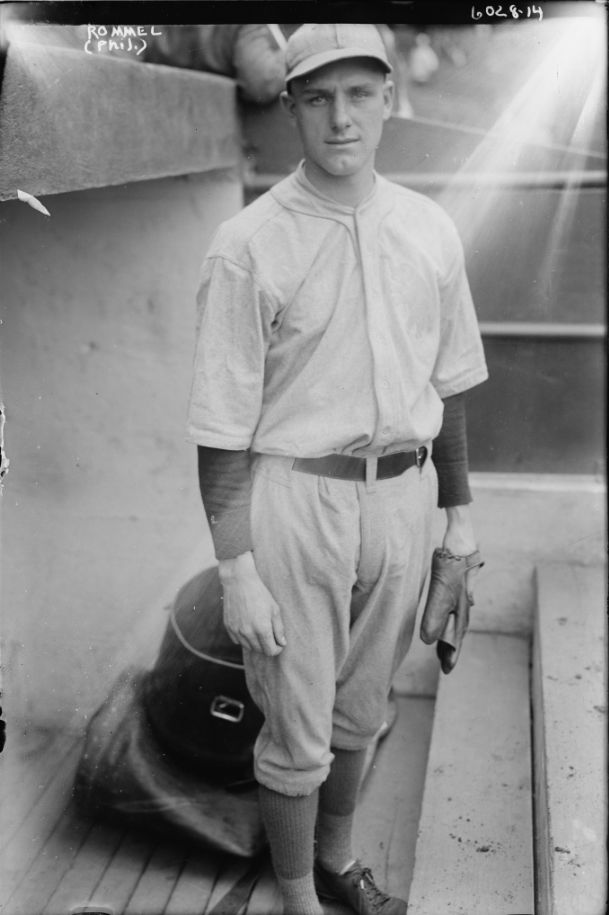
Eddie Rommel … 29 Hits Surrendered In One Game

Photo: Bain News Service, publisher, Public domain, via Wikimedia Commons

On July 10, 1932, Philadelphia Athletics’ righty Edwin Americus (Eddie) Rommel (often termed the “father of the knuckleball”) earned his 171st and final major league victory – and it was hard-earned to be sure.  (On election day, it seemed like a post with a player named Americus was appropriate.) In the contest, winning-pitcher Rommell set or tied the MLB records for:

  • Most hits given up by an MLB pitcher in a game (starter or reliever, regardless of innings) – 29;
  • Most runs allowed in a relief win – 14 (The most runs allowed in any relief appearance is 18, by the Athletics’ Bill Bernhard in a 23-12 loss to the Boston Americans on May 2, 1901. Bernard pitched eight innings to a no-decision.);
  • Most earned runs allowed in a relief win – 13 (The most earned runs allowed in any relief appearance is 15, by the Brooklyn Robins’ Nelson Greene in a 21-5 loss to the Pirates on June 20, 1925. Greene gave up 15 earned runs over 6 2/3 innings in a no-decision.);
  • Most walks in a relief win – 9, tied (The most walks in any relief appearance belong to the Athletics’ Carl Ray at 12 on May 9, 1916 in a 16-2 loss to the Tigers. Ray pitched seven innings and got a no-decision.)

Rommel pitched 17 innings in relief that day, the second-longest relief appearance in the Modern Era.  Zip Zabel, gotta love that name, pitched 18 1/3 innings of relief in a 4-3, 19-inning Cubs’ win over the Dodgers on June 17, 1915. Over his 18 1/3 frames, Zabel gave up just nine hits and two runs (walking one and fanning six).

So, how did Rommel’s 17-inning, 29-hit outing come about?

Rommel, at age 34 and in his 13th season with the Athletics, came on in relief of starter Lew Krausse in the bottom of the second, with the Athletics trailing 3-2.  Seventeen innings later, Rommel had his final MLB win, as the Athletic prevailed 18-17.   That win came after Rommel had surrendered 14 runs (13 earned) on nine walks, again while also giving up a single-game recorded 29 hits.

Why the long relief stint?  The Athletics had just finished a series in Philadelphia (against the White Sox) and were traveling to Cleveland for a one-game (make-up game) stand before playing in Philadelphia again on July 11.  In an apparent cost-saving move, they brought only two pitchers (Krausse and Rommel) to Cleveland. Once Krause was out, Rommel was “all in.”

Rommel pitched in only five more MLB games (all in 1932) – going 0-2, 3.86 in those games and 1-2, 5.51 on the season.  He finished his MLB pitching career with a 171-119, 3.54 record in 501 appearances (249 starts – 145 complete games.)

If Rommel’s name sounds familiar, not only did he win 171 MLB games, he also spent 22 years (1938-59) as a major-league umpire – working a half dozen All Star games and two World Series.

And The Hits Just Keep On Coming

In Eddie Rommel’s 29-hit final victory, Indians’ shortstop and number-two hitter Johnny Burnett collected a single-game MLB record nine hits (11 at bats), with eight of those safeties coming off Rommel.  Burnett had seven singles and two doubles, with four runs scored and two RBI.

The 29-hit outing was not indicative of Rommel’s skills on the mound.  In 1922, he led the American League in victories, despite pitching for an under-performing (or under-talented) Athletics team.  That season, Rommel went 27-13, 3.29, while the Athletics went 65-89.  Then, in 1925, Rommel again led the AL in wins with a 21-10, 3.69 record – pitching for an improved Athletics squad (88-64).

Okay, Walter, What Ya’ Got?

On Opening Day in 1926, Eddie Rommel was involved in what has become a legendary Opening Day match up. It came on April 13, with Rommel and his Athletics facing future Hall of Famer Walter Johnson and the Senators. The game ended in a 15-inning, 1-0 Senators’ win, with both Rommel and Johnson going the distance. Johnson’s effort – his final Opening Day start (at age 38) – gave him the longest Opening Day shutout ever. 


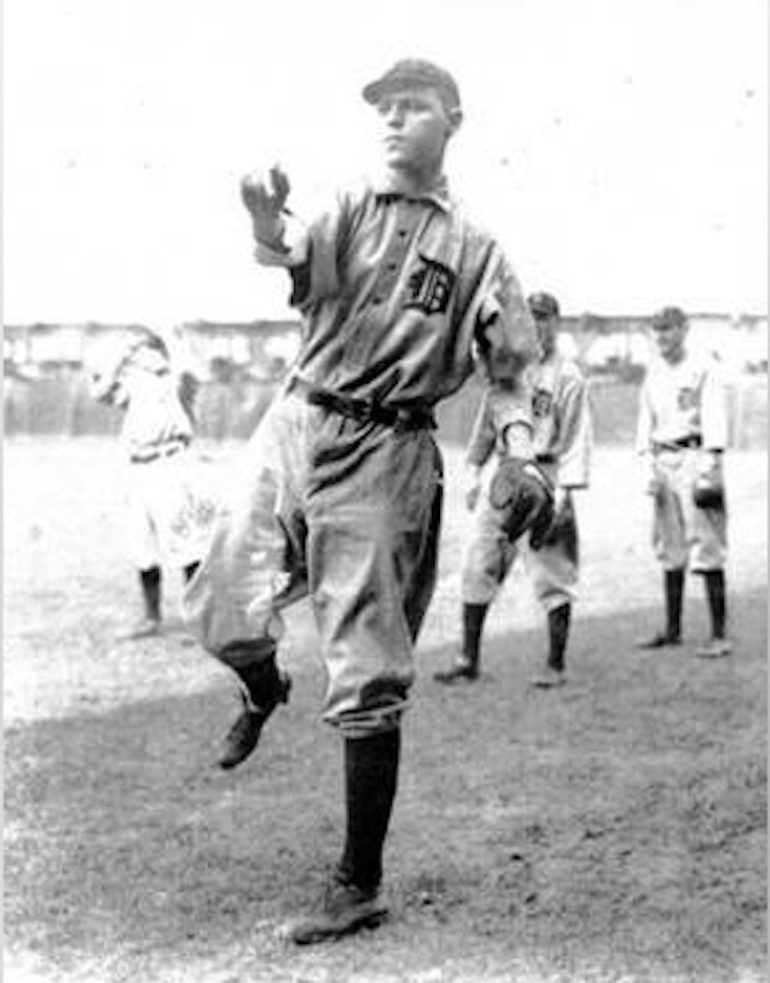
Allan Travers … 24 Runs for Heaven’s Sake

Photo: Public Domain, via Wikimedia Commons

Rommel’s numbers in his final win pale a bit by comparison with those of Allan Travers in his first (and also final) MLB appearance.  (Although Travers had a pretty good excuse for his performance.) It came on May 18, 1912 – with Travis on the mound for the Tigers, facing the Athletics in Philadelphia. Just three days (and two games) earlier, with the Tigers facing the Highlanders in New York, Ty Cobb had gone into the stands and physically accosted a very persistent and offensive heckling (and handicapped) fan named Claude Lucker. Lucker, apparently not lucky that day, suffered a pretty solid beating.   As a result, Cobb had been suspended indefinitely by AL President Ban Johnson. After one game without Cobb, a majority of the Tigers players voted to strike until Cobb was reinstated.  Johnson did not back down. In fact, he doubled down, announcing that the Tigers would be fined $5,000 for each game they forfeited for not fielding a team. Long story short, Tigers’ manager Hugh Jennings turned to Philadelphia sportswriter Joe Nolan for help in quickly rounding up a squad.  Nolan, in turn, contacted Travers, whom he knew as the St. Joseph College Assistant (student) Manager for the varsity baseball squad.

A replacement team – sandlot players, former Georgetown College players, a couple of amateur boxers and two Tigers’ coaches ended up taking the field.  The amateurs were signed to one-day contracts ($25), but no one apparently wanted to take the mound.  For an extra $25, Travers – who had never thrown a pitch in competition, agreed to take on the task.

Travers, in what would be his only professional baseball appearance, threw an eight-inning complete game, giving up a:

  • record setting number of runs (24); and
  • record-tying (for a starters) 26 hits in a 24-2 loss.

He walked seven and fanned one (Athletics/ relief pitcher Carroll Brown.)

Just Keep on Running

In Allan Travers May 18, 1912 start, the Athletics collected an AL record-tying six triples.  They also had four doubles and 16 singles (five bunt singles), as well as ten stolen bases.

After the fiasco, Ban Johnson doubled down again, cancelling the following game and informing the players if the strike continued, they would be banned for life. Game. Set. Match. Cobb urged his teammate to end the walkout. (Although there may have been some behind the scene negotiations, as Johnson reduced Cobb’s suspension to ten days.)

Travers went on to graduate from St. Joseph in 1913, further study at St. Andrew on the Hudson (New York) and Woodstock College (Maryland) before being ordained a priest in 1926.

Primary Resources; Stathead.com; Baseball-Almanac.com; “Father Allan Travers: The one-game pitcher who might have saved the Detroit Tigers,  The Detroit Catholic, July 14, 2013 by Daniel Meloy.

Baseball Roundtable – Blogging Baseball Since 2012.

100Baseball Roundtable is on the Feedspot list of the Top 100 Baseball Blogs.  To see the full list, click here.

Baseball Roundtable is also on the Anytime Baseball Supply Top 66 Baseball Sites list.  For the full list, click here

I tweet (on X) baseball @DavidBaseballRT

Follow Baseball Roundtable’s Facebook Page here.  More baseball commentary; blog post notifications; PRIZES.

Member: Society for American Baseball Research (SABR); Negro Leagues Baseball Museum; The Baseball Reliquary.

P 1072

Guest Post: John Paciorek Looks at Kirk Gibson’s Iconic World Series Home Run… And More

With the World Series behind us and Freddie Freeman‘s heroics fresh in our minds, Baseball Roundtable is pleased to present this guest post from former major leaguer John Paciorek. The post focused on an iconic (as well as unexpected and inspiring) World Series roundtripper from another Dodger hero – a walk-off blast by a hobbled Kirk Gibson to win Game One of the 1988 World Series. It’s a tale that has been told many times, but (in The Roundtable’s opinion) never as well as by Paciorek in this post. He describe the passion, tension,  determination, strategy and ultimate impact of the Gibson at bat in a way that only someone who has both been in the batter’s box and studied the physics and psychology of hitting a baseball could. I think of it as a must read for fans who witnessed and  remember Gibson’s heroics, as well as for those less familiar with the circumstances.

Before getting to the post, just a bit on why J0hn Paciorek is such a perfect author to present it.

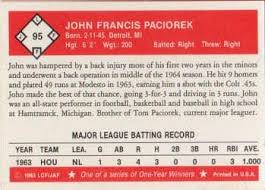
John Paciorek – signed out of Saint Ladislaus High School in Hamtramck, Michigan (where he had starred in football, basketball and baseball) – appeared in his first major-league game on the final day of the 1963 season (September 29) at the age of 18.  The 6’ 1”, 200-pound outfielder had spent the 1963 season with Class-A Modesto Colts. The Colts’ parent club, the Houston Colt .45s (that was the current Astros’ franchise name back then), was suffering through a difficult season. The team was 65-96 going into that final game.  Looking to the future, Houston had, in fact, fielded an all-rookie lineup (average age 19) on September 27. Youth was still being served two days later when John Paciorek started his first MLB game. The results were surprising – and worthy of recognition.

Playing right field and batting seventh in a 13-4 win over the NY Mets, Paciorek ended up with three hits and two walks in five plate appearances, with four runs scored and three runs batted in.  Perhaps equally surprising is that it was not only Paciorek’s first major-league appearance, it was to be his only MLB appearance.  Back pain the following spring, followed by surgery (he played 49 minor league games in 1964 and missed all of the 1965 season), put an end to his MLB playing days. (Paciorek did play in four more minor-league seasons.)  Still, you will find John Paciorek in the Baseball Encyclopedia and his is arguably the greatest one-game MLB career ever.

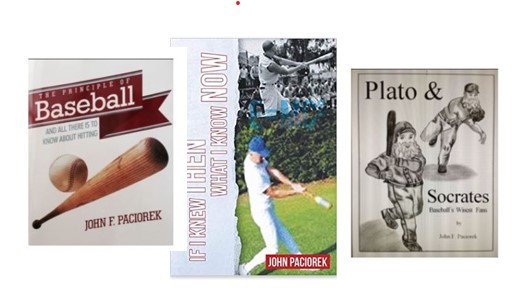
Paciorek went on to teach at Clairbourn Jr. High for 40 years and  serve as a multi-sport coach. He is the author of the books (Plato and Socrates – Baseball’s Wisest Fans;  The Principles of Baseball: And All There Is To Know About Hitting; and If I Knew Then What I Know Now. You also can enjoy Paciorek’s prose (and expertise) at his blog “Paciorek’s Principles of Perfect Practice” at JohnPaciorek.com. You can find out even more about Paciorek in Steven Wagner’s 2015 book Perfect: The Rise and Fall of John Paciorek, Baseball’s Greatest One-Game Wonder.

A final note. John Paciorek’s insight into the national pastime should come as no surprise. Paciorek comes from a true “baseball family.”  He was the first born of eight siblings and was followed to the big leagues by younger brothers Jim and Tom Paciorek.  (Like John, Jim’s MLB career was short – 48 games for the Brewers in 1987. (Jim also enjoyed a solid six seasons in Japan’s Centraal League.) Brother Tom, however, achieved a .282 average over an 18-season MLB career.

Now to the guest post.

1988/2024 – DEJA VU Reminder of Kirk Gibson with

Freddie Freeman and the Timeless Dodgers

Guest Post

By John Paciorek

(originally published on johnpaciorek.com On October 6, 2013; republished on October 19, 2024.)

All photos from John Paciorek.com

In honor of Kirk Gibson’s Immortal “stroke of genius,” I wish to applaud once again an individual feat in sports history that I don’t think will ever be duplicated, although some renowned sports writers would evaluate it as merely second or third on the list of memorable home runs ever hit.

As Gibson has been experiencing some physical difficulties since 2015, I would hope the man who performed the miracle at the 1988 World Series could somehow disentangle himself from the “interlaced ambiguities of his being” and realize that it is natural for him only to feel good, to be well, and to experience perfect bodily conditions.

Baseball Roundtable Editor’s Note:  Gibson was diagnosed with Parkinson’s Disease in 2015. After his diagnosis, he expanded the work of the Kirk Gibson Foundation (established in 1996 to provide college scholarships) to include efforts to improve the quality of life for people with Parkinson’s.

In his honor, I am pleased to repost my account of Gibson’s historic, monumental achievement from that first game of the 1988 World Series for your reading pleasure. And, perhaps, to inspire someone on the 2024 Dodgers squad to do the same. ENJOY! (Note: Again, this was posted on Paciorek;s website October 19.)

When classifying the “Greatest Home Runs” in Baseball history, the closest that Kirk Gibson’s 1988 World Series “Bomb” ranks to the top of the analysts’ charts, even by MLB Productions, is second or third, behind Bill Mazeroski’s 1960 “Walk-off” World Series winner, and/or Bobby Thompson’s 1951 “Shot Heard Round the World,” that gave the Giants the pennant.

Of course, the main criteria for evaluating these enduring historical footnotes are still the reminiscence of “that” notorious “City-Team” rivalry and a purely “Under-Dog” sentimentality (the Giants’ 15-game deficit before tying the Dodgers, then winning the pennant; and Pirates’ monstrous negative run-differential with the overwhelmingly favored Yankees).

Now, if that criterion cannot be upgraded eventually by time and logistics, then a new category must be conceived in order to pay proper respect for what Kirk Gibson did in 1988 when (single-handedly, but surreptitiously) leading the Dodgers to the World Series title. (Space in this category would also have to be reserved for the NFL’s 1972 “Immaculate-Reception,” which would probably rank second as the “penultimate” contributor to those “amazing” performances.)

In order to hit a single home run, so many aspects of a batter’s swing must be aligned to satisfy the anatomical, physiological, and psychological constituencies composing each player, as afforded haphazardly by the “Gods of Baseball.” Most athletes, professional and amateur alike, who have legitimately tasted both the “thrill and agony” of most major sports activities will usually attest to the validity of Ted Williams’ famous, yet arguable, statement that, “Hitting a baseball is the single-most difficult skill to master in all of sports.”

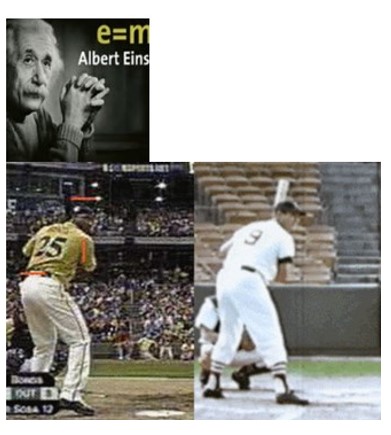
In an essay I wrote entitled, “Einstein and the Home-Run Principle,” my Einstein supersedes the Williams’ statement when he parenthetically observes, “Hitting a home run is the most difficult thing to do in all of sports.” To hit a home run, a batter has to be almost perfect in his application of the “the laws of physics” with regard to the mechanics of swinging a baseball bat with precision and power. To be a consistent home-run hitter the batter must also have an understanding of all the elements that are included in the dynamics of hitting a baseball effectively.

Theoretically, it is possible to hit a home run every time a batter swings at a baseball. However, Einstein and others have found through Quantum Mechanics, when trying to establish the essence of matter, that “at the fundamental levels, causation is a matter of statistical probabilities, not certainties.” Therefore, with all the elements and combinations of variables with which a batter has to deal, from within and from without himself, the “uncertainty principle” gives compelling testimony that mastering the “Rubik’s Cube” of hitting a homerun every time is highly improbable. However, the knowledge itself, of such feasibility, enhances the statistical probability of success.

Not even Albert Einstein and all the renowned physicists of his time, and “sabermetricians” of this modern-era, could have approximated the statistical improbability of what Gibson did on October 15, 1988.

The resounding joy that New Yorkers experienced in 1951 and preserved for decades was not altogether incalculable, since Bobby Thompson had not more than three days earlier lit up Ralph Branca with a home run that presented, as an ominous note, a precursor of what was to come. And Bill Mazeroski’s feat that ended the 1960 World Series, although dramatic, cannot have been totally unexpected. Pinch hitter Hal Smith, had earlier hit a three-run homer to stake the Pirates to a two-run lead until the Yankees tied the game in the top of the ninth, thus extending the heart-pounding “see-saw” battle.

“Maz” was 1-for-3 as he led off the bottom of the ninth. Yankee pitcher, Ralph Terry, made the huge mistake of getting the pitch up to the short, but powerfully built, Pirate second baseman, who took advantage and slugged the ball over the brick wall 408 feet from home plate. It was truly a magnificent and endearing moment for the Pittsburgh community and all baseball fans outside of the Bronx – worthy indeed of memorial status.

All that being said, encomiums to those two distinct episodes in baseball lore should pale in comparison to the near “mythical” grandeur that highlighted the glorified instant of Gibson’s exalted “blast,” as well as propagated the ecstatic drama that preceded his culminating heroics.

Gibson’s advent into professional baseball is as mysterious as that of the legendary “Roy Hobbs,” without the tragic prelude. Upon completing a successful college football career, it was suggested that he not waste his athletic talent in the “off-season,” and play “a little” baseball for his Spartan baseball team at Michigan State University. In that first and only year of college baseball, he played so well (.390 batting average, 16 HRs and 52 RBI in 48 games) as to warrant being picked in the first round of the 1978 MLB Draft by the Detroit Tigers. He was with the Tigers for nine years and was a key figure in attaining a World Series title in 1984.

After being determined as one of the ballplayers being “black-balled” by MLB franchises in the notorious “Collusion Scandal” of 1987, Gibson left the Tigers and, in January, joined the hapless Dodgers of the National League, whose dismal ‘87 season needed something of a “Hobbsian” spark to generate new life into a ball club in disarray.

Early in Spring Training, a few opportunities to set the stage for an immediate change of direction in team attitude and focus presented themselves. This would eventually lead the march to a much-improved status and uncontested standing in the National League West to win the Division by seven games.  Frivolity and practical jokes took a back seat to Kirk’s ultra-professional and business-like mentality, and the team flourished from beginning until the season’s end. Gibson’s season-ending stats earned him National League MVP honors, while helping the Dodgers win 21 more games than the season before.

But it was his uncommon “personal leadership” and otherwise intangible, undaunted presence that invoked the “mythical hero” image his teammates and adversaries had learned to admire and would attempt to emulate. In the NLCS, although injured, Kirk still performed heroically in clutch situations, and his timely home runs in the fourth and fifth games clinched the National League Pennant and advanced the Dodgers into an improbable World Series entitlement.

Kirk purportedly had done all he could to get the Dodgers to that World Series, but “they” were presumably going to have to get to the “Promised Land” without “him,” for the injuries he incurred along the way were too severe for any “mortal” to overcome. All the world would have accredited the Dodgers with a valiant effort for just making it to the “Final” Series. Everyone knew that, even with Gibson, there was slim  (if any) chance for them to beat the powerful Oakland Athletics, whose superior arsenal of player personnel had amassed an incredible record of 104 wins to 58 losses. And even with Gibson’s premier status with the “Baseball Gods,” the “Arrogant- A’s” knew that “one player does not a team make.”

With Gibson being an “absolute” scratch from the line-up (he wasn’t even at the pre-game introductions ceremony), the first game of the Series began unexpectedly with a first inning two-run homer by Dodger Mickey Hatcher. The “A’s” came back with four runs in the top of the second and held a two-run lead until the Dodgers scored again in the sixth. The game stood at 4-to-3 (Oakland leading)  in the bottom of the ninth.

Throughout the game, there were brief TV glimpses of Kirk Gibson hobbling around in the dug-out as he was traversing the distance from the training room and back, trying to massage and loosen his painful joints and hamstrings. Ever-optimistic, Tommy Lasorda seemed to be coaxing his beleaguered star, to see if any type of “miracle” was in the offing.

Vince Scully repeatedly commented that there was “absolutely” no chance of Gibson making an official appearance. With TV and radio broadcasts coming into the locker room, Gibson heard one of Scully’s commentaries – and it was as if providence were beckoning for him to consider an alternative thought. In sudden contemplation of all that was transpiring before him, Gibson realized an inexplicable surge of unwarranted confidence streaming through his consciousness. As in a biblical reference to Jacob wrestling with the “man” inside, Kirk’s vision of princely accommodation could not be suppressed.

The decision was made; his mind was determined; “the die was cast”; but only the portentous action itself was forestalled. “Will I look like and be a fool? What in hell could I possibly do? I can’t even walk! What or who do I think I am?” would have been the common queries instigated by mortal fear that must be wrested away from that mind intent on fulfilling a noble purpose.

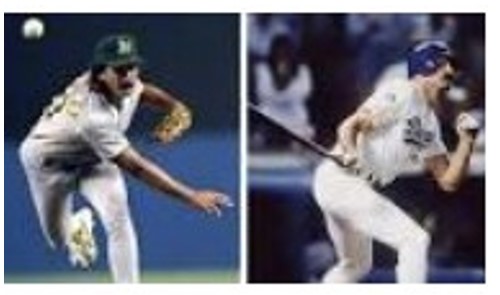
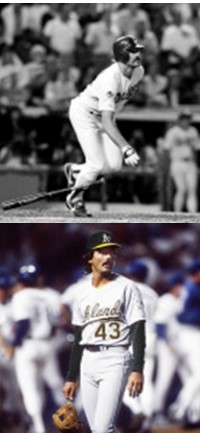
After Dodger pitching blanked the Athletics in the top of the ninth, the otherwise stalwart performance of Oakland pitcher Dave Stewart ended when statistically prudent “A’s” manager Tony LaRussa replaced his starter with the league’s premier “closer,” Dennis Eckersley. (Eckersley had led MLB with 45 saves – in 45 save opportunities –  during the regular season.)

It looked like a sure win for Oakland, since “Eck” was destined to face the bottom of the Dodger line-up (though somewhat of an ominous sign, in hindsight). Eckersley got the first two outs in rapid succession, and was about to face a formidable former teammate who was set to pinch-hit for the number-eight batter in the line-up.

Meanwhile, in the Dodger dugout, Lasorda learned that Gibson had begun a personalized mental and physical rehabilitation process, which immediately spurred Lasorda’s ever-percolating mind to envision a preemptive scenario of his own. After appointing Mike Davis to pinch hit for Alfredo Griffin, he surreptitiously placed Dave Anderson in the on-deck circle, to make Eckersley and LaRussa think that they could afford to be a little cautious with Davis (a potential threat) and contemplate the “end” by pitching to the weak-hitting Anderson.

All potentially constructive Dodger strategy lay in the proposition that Gibson regain a semblance of his former self. Yet, even if he could overcome the acute pain and obvious debility, what could he hope to achieve in this debilitative condition?  Bob Costas would later remark that while he was in the stairwell of the Dodger dugout, he could hear the groaning, anguishing strokes of a batter desperately trying to ready himself for one last at bat, even “one last swing,” while teammate Orel Hershiser was feeding baseballs onto the tee for Gibson’s convenience.

Although most of his teammates must have sensed the futility of Gibson’s somewhat contrived heroism, they probably also could not have expected anything less from “The Man” – who had proven himself so many times before. They all must have thought the “good prospect” all but impossible. However, their past experience would at least warrant a “statistically” derived-at chance of success. “YOU’VE GOT TO BELIEVE” would have been the genuine inspirational sentiment pouring into the ears of the players from the mouth and heart of Tommy Lasorda and the Great Dodger in the Sky.

Gibson is now sitting at the end of the dugout bench, fully dressed, and armed with helmet and “hickory,” speculating the purview the situation has presented. “I have inspiration and commitment to do something, but what, and how far can my own determination carry me? Will Davis get on base to set up my ‘grand entrance,’ and what emotion will the fans exude? And will it give me that final burst of adrenaline to be propelled to heights previously unknown?”

Gibson was afforded no additional time to mentally peruse the circumstances of the present situation, for Eckersley had just walked Mike Davis. Taking a deep yet unstrained breath, Kirk’s electrifying and confident image popped onto the top step, then out of the dugout to the thunderous roar of the now ecstatic and frenzied crowd.

“That’s what I wanted to hear,” thought Gibson, as he must have restrained the urge to shed at least a tributary tear of ineffable joy he and his patrons could feel in this present moment of triumphal hope.  Lasorda’s unending chants of “new promise” inspired his team and the Dodger Faithful to loftier heights of exaltation, as Gibson finished his preliminary swings. His slow, deliberate, but majestic walk to the plate must have been a nerve-wrenching ordeal for the Oakland pitcher, even though he exuded a confidence, rather than impatience, to get the game over.

One could only speculate as to what order of thoughts must have been aligning themselves in Gibson’s mind as his footsteps proceeded into that rarefied cubicle of variable distinction. Before assuming his characteristically “Spartan” batting-stance, his back cleat scratched the hardened dirt for a foothold to secure a base from which his afflicted body might launch its purposeful attack.

He was finally ready, and none too soon for the exasperated Eckersley, who let his arm commence with the business at hand, firing a blazing, side-arm, tailing fastball, for which Gibson must have felt a tad unprepared. All observers couldn’t help but notice the constrained, oblique wrenching, late response Gibson’s off-balanced body and bat conveyed as it almost completely missed the ball. The second pitch gave the same explicit message, and the fans as well as Eckersley himself must have sensed thathe “Gibber” was no match for the “Eck.” Gibson was behind 0-and-2 in what seemed like a “heartbeat,” and Eckersley was determined to finish him off on the next pitch.

Eckersley’s disdain for Gibson’s futile attempts was obvious as he was about to throw another fast ball, same speed, to the same spot (away). The fact that Gibson looked bad, but progressively better on each swing did not escape Eckersley’s discerning eye. Gibson knew that his body needed only a short quick turn, but even that was too slow to get his arms activated.

On that third fast-ball, Kirk was prepared to shorten the turn and throw his arms and hands more quickly. The result was a swing with little power, as his arms and hands were too far out in front, and his wrists rolled over way too soon. He was grateful that he even made contact for an otherwise worthless dribbler that forced him to run (hobble) toward first before the ball fortuitously struck the edge of the infield grass and abruptly darted foul, thus extending his at-bat. (That had to hurt!)

After his first pitch to Gibson, it became obvious to Eckersley, as well as the “brain-trusts” in both dugouts, that Kirk was not the optimum threat for which everyone fancifully hoped or cautiously suspected. But he was quickly portending to be a formidable adversary, even in his seemingly “powerless” condition. “Eck” recognized that with all the pitches Gibson was subtly calculating, making superficial contact with every one, it might only be a matter of time before he can put one in play, perhaps to the detriment of Oakland.

Therefore, he can’t let Davis steal second base. Before his second and third pitches he made three throws to keep Davis close. With two strikes on Gibson, the Dodgers might be desperate. Eckersley’s fourth pitch was a ball outside, going a little farther to see if Gibson would bite beyond the fringe. He didn’t. Since “Eck” didn’t throw over before the fourth pitch, Davis attempted a steal on the fifth. Gibson had his best swing yet, but fouled it back. Eckersley didn’t think Davis would steal on consecutive pitches, and he was correct, but threw “Ball Two” in the process.  Before his seventh pitch, he threw to first base again. But on the following pitch to Gibson, the ball was further outside, and Davis successfully stole second base, much to the consternation of LaRussa, Eckersley and the “A’s” dugout as the count rose to 3-and-2.

The situation had not developed the way Eckersley intended. Gibson’s impotent, yet “frisky,” at bat posed a conundrum whose immediate solution never materialized. So, there was only one direction in which to go!

As Dennis Eckersley was truly an adroit “student of the game,” he (like the many who had come before him) usually observed Warren Spahn’s masterful advice when administering to their trade: “It is the batter’s duty to have good timing and rhythm to perform effectively, while it is the pitcher’s duty to off-set that rhythm and timing with variable speeds and placement of pitches.”

As for Gibson the batter, he had neither rhythm nor timing when he first came to the plate. But through the course of his gauntlet-like “trial-by-pitch” he had developed both to a rather insignificant level. Now, it was thought by “Eck,” to end this dilemma. He knew what he had to do. He’d done it before, with great success. And he will do it, NOW!

The game wasn’t necessarily on the line, if his strategy failed. Gibson would walk, and the Dodgers would still have a runner in scoring position, presenting merely a secondary condition that would quickly be dismissed. But “Eck” was confident, he could not fail. “This is absolutely the ‘last hand’.”

All the “cards” being dealt, Eckersley landed (in Poker parlance) a fourth “Ace,” while Kirk had a pair of Jacks and the 7, 8, 9 of Clubs. Kirk could have kept the pair and thrown the other three away, but instead threw the Jack of Hearts, keeping its “Brother-in-Clubs.” The statistical probability for Eckersley’s success was astronomical! Kirk Gibson seemed to have been abandoned by the “Gods” and his mythological legend was about to become irreparable.  The most he could hope for was simply a mimesis of that “Luis Gonzalez” swing and flare a base hit that might tie the game. But in Eckersley’s mind, a game-ending out was all Gibson was “gunna” get!

There’s the tying run on second base. Eckersley is in his “stretch.” The count is 3-and-2. “Eck” is about to deliver the most potent pitch in his repertoire. The Dodger dugout is ecstatic. Now, with the fleet-footed Davis in scoring position, a base-hit would tie the game, and that is all and the best they could expect from their forlorn hero. But Eckersley had other plans! And what was Gibson himself thinking?

Just before Eckersley was to deliver his “secret” pitch, Kirk abruptly stepped out of the batter’s box, as if to regain his composure under this momentous circumstance. But, in that instant, a higher source seemed to beckon him to recall an otherwise innocuous fact that Gibson had read in a report prepared by an astute and meticulous “scout” (Mel Didier) before the playoffs began. After pondering the present situation, all statistical possibilities seemed to be aligned in a favorable position. And the curtain was about to fall with a dramatic conclusion on one of these conquering heroes, each with his own weapon of invincibility in hand (reminiscent of the final poker-hand in the movie, “The Cincinnati Kid”). But which will project the image of “The Man?”

Kirk looked toward the mound, then stepped into the “Box,” knowing he had all the information he needed (his final card was dealt). But is his faith in his belief strong enough and will his mind’s commitment to act unflinchingly, in spite of his apparent bodily condition, enable his warrior-heart? 55,000 spectators are about to find out as well.

Neither antagonist is smiling but each exudes an indefinable confidence, even while knowing well that “one will die today.”

Eckersley takes his stretch and prepares his “Load” for delivery. Gibson makes a final, but ominous, mental query designating his unquestioning tact as “the die is cast” once more, “Sure as I’m standing here, partner, you’re going to throw me that ‘back-door’ slider, aren’t you?”

As the pitch leaves his hand, Eckersley recognizes the ball’s trajectory to be perfect, right where he wanted it. With all the pitches he had thrown, he knew Gibson would see the ball moving directly toward the outside. He also thought Gibson’s quick sense would assume that, since his side-armed fast ball “tails,” the pitch’s destination would obviously move farther outside for a ball. He was expecting Gibson to momentarily relax, and not have enough time to respond to the pitch’s abrupt deviation of speed and direction, until it was too late – the “Aces” were “face-up!”

“Sure enough,” realized Gibson, upon first glance! His “absolute faith,” and patience allowed him to wait. He’d not yet lifted his front foot as he did previously while expecting Eckersley’s fast ball. An extra nano-second of time was in his favor. “Now, all I have to do is get my timing right, to be able to explode at the precise moment!” In his extremely “closed stance,” as he discerned the ball’s outside trajectory, he waited until he could detect its subtle and abrupt turn toward him. Then his front foot exaggerated its deliberate stride toward third base, as his body was “gathering” its forces to uncoil as his foot planted into the ground.

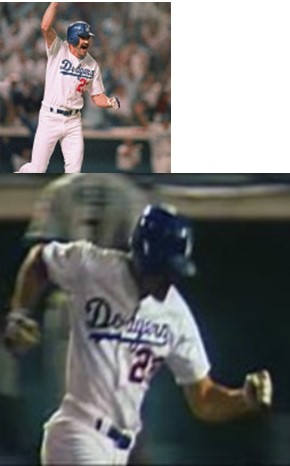
Eckersley couldn’t help but notice that Gibson’s physical demeanor was uncommonly composed as he unobtrusively glided in the direction from which the ball was finally descending (as if he knew what was coming). “Eck” saw Gibson’s foot plant, his body uncoil, his arms extend and – in a final explosive lunge of shoulders, hands, and wrists – observed the bat contact the ball with an uncanny perfect synergy that launched the round projectile with improbable force in the direction from which it came.

With all spectators and both dugouts watching in apparent disbelief, the ball kept rising and carrying farther and farther in its ellipticity until it finally disappeared over the right-field wall, as Kirk’s final card resoundingly struck the table as a Ten of Clubs – and a “Straight Flush.”

Throughout the day not a hint of joy was expressive on the face of Kirk Gibson, only a stoic-facade hiding pain, disappointment, resentment, and disdain for his helpless and impotent condition. As the abrupt follow-through of his celestial swing of bat was completed, and he cautiously embarked on an unrehearsed, and as yet undefined, trek, an observer could detect a gradual change in facial disposition. The remorseful look of indifference was suddenly transformed into a heavily distinguishable canvas of ecstatic jubilation.

And in a moment of triumphant glory, he pumped his bent right arm in successive punches along the side of his beleaguered body after the subjugated leather-bound projectile did indeed traverse the height of the outfield fence for an uncontested, historic “masterstroke” (Tour De Force) of amazing ramifications, the conclusion of which would be directly revealed.

The instant of evidentiary proof of Gibson’s success immediately transformed the hopeful, yet solemnly cautious, dispositions of Dodger fans and teammates (who hadn’t really believed in “Santa Claus”) into genuinely faith-filled followers who, at that “holy instant,” probably could have moved a mountain or two.

From the dugout, Dodgers were streaming out onto the field, arms flaying and voices shouting “Hallelujah” (from the roof-tops) to their resurrected “messiah,” as he buoyantly circumnavigated the bases in all but reconstructed, glorified form.

His amazing feat did provide a home run of incomparable distinction. And it did win that Game One of the “Series,” in abrupt and miraculous fashion. But the intangible essence of that single act of unfathomable “heroism” also unlocked a momentarily imprisoned spirit of team unity that suddenly “empowered” the Dodgers to claim the 1988 World Series title, even without Gibson playing another moment of any of the remaining four games. Kirk Gibson’s home run was truly the “single-most amazing performance piece in sports history.”

Postscript:

As unlikely as Kirk Gibson’s conquest was, at that momentous October event, what more climactic expression of exaltation could be spontaneously delivered than that spoken by Baseball’s “immortal bard,” Vin Scully, when he exclaimed, as Kirk was rounding the bases, “In a year that has been so ‘Improbable,’ the ‘Impossible’ has occurred.” Truer words were never spoken. No one in the world could have expected Gibson’s humble yet triumphal salute, “I came; I saw; I conquered!” And for the last 36 years, legions of followers have echoed the words of another prominent and renowned sportscaster (Joe Buck) as he commented repeatedly, in breathless exuberance, “I DON’T BELIEVE WHAT I JUST SAW! I DON’T BELIEVE… WHAT I JUST SAW”! Nothing in sports history can equate to Kirk Gibson’s “improbable” and “impossible” act of courage and accomplishment. The only historical event that would have shared in equipollence would have been “The Battle of Thermopylae,” if this Spartan warrior had been there to defeat the Persians.

Post – Postscript:

2024 World Series – Freddie Freeman:

As a suggested prospect for historical recognition, at the beginning of this post, I proposed a Gibsonian corollary to that 1988 masterpiece, “And perhaps for the inspiration to someone on the 2024 team to do the same.” I am overjoyed by the TEAM response during the first three games of this year’s World Series, with hopes that the fourth, fifth, (sixth or seventh) games will prove as successful as its providential past. The Yankees won Game Four, and would their new momentum subvert destiny’s call for a “De Ja Vu” Experience?

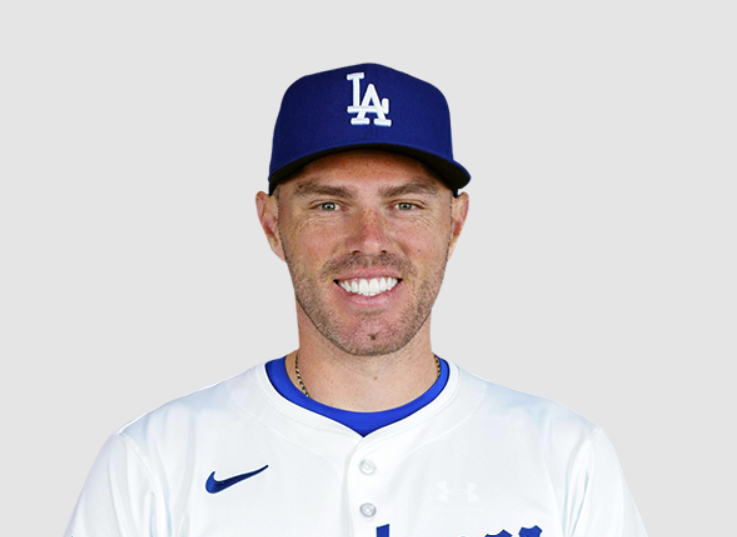
Particularly impressive and somewhat reminiscent of singular glorification is the prophetic expression of grandeur by one Freddie Freeman who, in some familiar fashion, shared a similar Heroic Effort of his Prototypical Predecessor. During a week of convalescence for a severely sprained ankle between Championship Series, it was questionable whether Freddie would participate in the World Series. But because of his solid determination, dedication, and discipline, he worked his way back to a playable physical condition.

And, as destiny would be assured by the “Great Dodger in the Sky,” with two outs in the bottom of the last inning of Game One, with the bases loaded and the Yankees ahead 3-to-2, the previously physically afflicted Dodger first baseman hit the pitcher’s first pitch into the Right Field Pavilion (near where Gibson hit his historic blast) for a history-making, never before seen ‘World Series Walk-Off” Grand-Slam” – and another “Game One World Series victory” for the “Indomitable Los Angeles Dodgers.”

As with the inevitable despair felt by Dennis Eckersley, Tony LaRussa, and the Oakland Athletics in 1988, the Yankees were experiencing the same in 2024 as Freeman also hit home runs in the second, third and fourth games, while the Dodger pitching successfully stymied its rivals (except in Game Four). The Dodgers eventually won Game Five in equally dramatic form as 1988, while Walker Buehler captured the spirit of Orel Hershiser in winding up the Dodger pitching duties by mowing down the Yankee offense in the bottom of the ninth to secure a 7-to-6 Dodger World Series Victory and World Championship.

The likely MVP candidate was realized in the person of Freddie Freeman whose 12 RBI performance tied the MLB World Series record – in silent commemoration of the fact that Kirk Gibson didn’t receive that Award in 1988 because he was physically unable to play again after Game One. Even though Orel Hershiser certainly deserved the Award, he acknowledged the spirit of Gibson energized his own heroic effort. And how many of the 2024 Dodgers were unofficially cognizant and imbued with that Indomitable Spirit of the 1988 Dodger Team?

Baseball Roundtable – Blogging Baseball Since 2012.

100Baseball Roundtable is on the Feedspot list of the Top 100 Baseball Blogs.  To see the full list, click here.

Baseball Roundtable is also on the Anytime Baseball Supply Top 66 Baseball Sites list.  For the full list, click here

I tweet (on X) baseball @DavidBaseballRT

Follow Baseball Roundtable’s Facebook Page here.  More baseball commentary; blog post notifications; PRIZES.

Member: Society for American Baseball Research (SABR); Negro Leagues Baseball Museum; The Baseball Reliquary.

P 1071

Baseball Roundtable Trivia(l) Tidbit Tuesday – Coming Back from a Dozen Down

Time for another edition of Baseball Roundtable Trivia(l) Tidbit Tuesday. I hope you are enjoying this weekly presentation of baseball occurrences that for some reason caught The Roundtable’s eye.  (I’m particularly fond of unexpected performances or statistical coincidences.) These won’t necessarily be momentous occurrences, just events, statistics or coincidences that grabbed my attention.

This Tuesday, the focus is comebacks – specifically by teams facing deficits of a dozen runs.

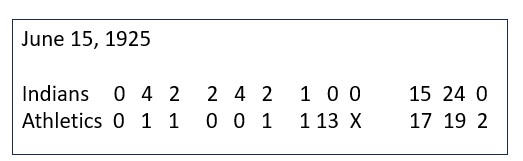
Right-handed pitcher Tom Glass had a very short MLB career – one season, two appearances, five innings pitched and a 1-0, 5.40 stat line.  Despite his minimal major-leaguer tenure, Glass was the winning pitcher in an historic MLB contest.  It came on June 15, 1925 in Glass’ second (and final) MLB appearance. Glass’ Athletics were facing the Indians (in Philadelphia). Veteran righty Eddie Rommel (9-4, 4.83) started for the Athletics, while southpaw Jake Miller (3-3, 2.25) was on the hill for the Indians.

Cleveland got out of the gate fast and, by the time Glass came on to pitch in the top of the sixth, the Indians led the Athletics 12-2.  In that sixth inning, Glass gave up two more tallies, bringing the Indians lead to 14-2 (a 12-run gap that will be significant as we go on). The Athletics scored one off Miller in the bottom of the inning on a triple by 1B Jim Poole and a sacrifice fly by Glass (his only career RBI). In the top of the seventh, the Indians got the run back as C Glenn Myatt stole home – and the lead was back to 12 (15-3).  The Athletics responded with one tally in the bottom of the inning and Glass pitched a scoreless top of the eighth, setting up a bit of MLB history.

In the bottom of the eighth the Athletics used four walks, seven singles, one triple and a three-run home run by CF Al Simmons to take a 17-15 lead (the Indians used four pitchers in the frame.)  At one point in the inning, ten consecutive athletics’ hitters reached base. Glass had been pinch hit for during the inning, so Rube Walberg came in to pitch a scoreless ninth and save the win for Glass.

As it turned out, that comeback from a 12-run deficit is tied for the largest comeback in Modern Era MLB history – and, of course, Glass closed out his MLB career with the win. By the way, five future Hall of Famers appeared in the game:  for the Athletics, Al Simmons, Mickey Cochrane and Jimmie Foxx; for the Indians, Tris Speaker and Joe Sewell.

For those who like to know such things here are MLB’s other two comeback from 12-run deficits.

On June 18, 1911, the Tigers trailed the White Sox 13-1 going into the bottom of the fifth. From that point on, Detroit held Chicago to two runs, while scoring 15 of their own (including three in the bottom of the ninth) for a 16-15 victory. The Tigers’ hitting star was Ty Cobb, who went five-for-six, with five RBI and three runs scored.

The winning pitcher was southpaw Clarence Mitchell. Now, regular readers know how I like a coincidence.  Turns out Mitchell, like Tom Glass (above) was also a rookie, also making just his second MLB mound appearance and also picking up his first MLB win.  Mitchell threw the last two innings (giving up no runs). He would go on to a 125-188, 4.12 record in 18 MLB seasons (P/1B). In addition to 390 mound appearances, Mitchell appeared in 76 games at first base, 20 in the outfield and 171 as a pinch hitter.  In 1,287 at bats, he hit .252-7-133.

On August 5, 2001, the Indians trailed the Mariners 12-0 going into the bottom of the fourth – and trailed 14-2 after six. Cleveland then held Seattle scoreless over innings 7-8-9, while the Tribe scored three in the seventh, four in the eighth and five in the ninth to tie the game. They then won 15-14 on an RBI single by 2B Jolbert Cabrera (who had replaced Roberto Alomar in the sixth inning) scoring CF Kenny Lofton, in the bottom of the eleventh,

The win went to southpaw John Rocker, who had pitched a clean top of the ninth – fanning Carlos Guillen, David Bell and Bret Boone on 18 pitches. Rocker was in his fourth of six MLB seasons.  His final career line was 13-22, 3.42, with 88 saves. Indians’ SS Omar Vizquel drove in four runs (four hits, including a double and a triple), while Cleveland 1B Jim Thome had three RBI on a pair of homer runs.

Primary Resources:  Baseball-Reference.com; Baseball-Almanac.com; “When Yogi Says It’s Not Over:  The Biggest Comebacks in Major League Baseball History, Craig Haley, theanaylyst.com.

Baseball Roundtable – Blogging Baseball Since 2012.

100Baseball Roundtable is on the Feedspot list of the Top 100 Baseball Blogs.  To see the full list, click here.

Baseball Roundtable is also on the Anytime Baseball Supply Top 66 Baseball Sites list.  For the full list, click here

I tweet (on X) baseball @DavidBaseballRT

Follow Baseball Roundtable’s Facebook Page here.  More baseball commentary; blog post notifications; PRIZES.

Member: Society for American Baseball Research (SABR); Negro Leagues Baseball Museum; The Baseball Reliquary.

P 1069

Fernando Valenzuela – A Free and Awesome Spirit

NOV. 1, 1960 – OCt.  22, 2024.Photo: Tony Barnard, Los Angeles Times, CC BY 4.0 <https://creativecommons.org/licenses/by/4.0>, via Wikimedia Commons

In honor of the late Fernando Valenzuela, who we lost much too soon (October 22), Baseball Roundtable is reposting this tribute to Valenezula which was posed here late April.

On this date (April 27) in 1981, a 20-year-old rookie southpaw for the Dodgers named Fernando Valenzuela threw his third consecutive shutout (and fourth in five starts), as his Dodgers topped the Giants 5-0 in LA before a raucous crowd of 49,478.

With that event in mind, I’d like to use this post to allow “geezers” like me to look back with nostalgia on the phenomenon that was “Fernandomania” and to let a new generation of fans get a better idea of the “wonder” that was Fernando Valenzuela’s  screwball.

Fernando Valenzuela is the only MLB player to win Rookie of the Year and the Cy Young Award in the same season.

In July of 1979, Valenzuela, then 18-years-old, was purchased by the Dodgers from the Yucatan Leones of the Mexican League.  Early on, teammate Bobby Castillo taught the youngster (who did not have an overpowering fastball) how to throw a screwball. It was a stroke of good fortune for Valenzuela and the Dodgers. Valenzuela quickly perfected the pitch and took it to new heights.  That screwball, in fact,  would earn Valenzuela a call up to the Dodgers by September of 1980.  As the 1980 MLB season closed out, Valenzuela made ten relief appearances for the Dodgers –  pitching  17 2/3 innings without giving up an earned run (walking five and fanning 16).

In 1981, as a 20-year-old with his rookie status still intact, Valenzuela not only made the season-opening Dodgers’ roster, but when the slated Opening Day starting pitcher Jerry Reuss suffered an injury warming up, manager Tommy Lasorda chose Valenzuela to start the opener.   He didn’t disappoint.  In his first MLB start, the Dodger rookie pitched a complete-game shutout (topping the Astros 2-0), with five hits, two walks and five strikeouts – and thus the foundation of Fernandomania was born.

Over his first five MLB starts, using his devastating screwball and unorthodox lineup, the likable youngster pitched  five complete games, four of them shutouts, while  walking 11 and fanning 43 in 45 innings. In his only non-shutout, Valenzuela gave up one run on four hits and two walks, while fanning ten. After five games, the 20-year-old was 5-0, with a 0.20 ERA and 43 whiffs in 45 innings.  In the process, the free-spirited Valenzuela captured not only the hearts and passion of the California Latino community, but the attention of fans across baseball.

At home, Valenzuela’s 1981 starts drew 48,431 fans, as compared to 40,912 for games he didn’t start  – an 18 percent increase.  Valenzuela’s road starts drew an average of 33,273 fans, while the Dodger road games he did not start drew 19,456.  I’ll do the math again.  That’s a 71 percent jump.

Eleven of Valenzuela’s 12 Dodger Stadium 1981 starts were sellouts.

Valenzuela brokered his devastating screwball into a 13-7, 2.48 record (in a strike-shortened 100-game season), finishing second in the NL in wins (13), first in innings pitched (192 1/3); first in strikeouts (180); first in games started (25); first in complete games (11); and first in shutouts (eight).  Valenzuela also won a Silver Slugger Award in 1981 (hitting .250 over 64 at bats).

Not only did the 20-year-old rookie make the 1981 NL All Star team, he was chosen to start the game.  Then he topped off the season by winning not only the NL Rookie of the Year Award, but also the league’s Cy Young Award.  He helped lead the Dodgers to the World Series and won Game Three, as the Dodger stopped the Yankees four games-to-two.

From 1981 through 1987, Valenzuela went 111-82, 3.11 for the Dodgers in the regular season and 5-1, 2.00 in the post season,  His career marks  (1980-91, 1993-97 … Dodgers, Angels, Orioles, Phillies, Padres, Cardinals) were: 173-153, 3.54 in the regular season and 5-1, 1.98 in the post season.

A few other Valenzuela tidbits:

  • On June 29, 1990, Valenzuela threw a no-hitter, as the Dodgers topped the Cardinals 6-0 in LA;
  • He won two Silver Slugger Awards and one Gold Glove;
  • He was a career .200 hitter, with ten home runs and 84 RBI in 936 at bats;
  • In 1990, he hit .304-1-11 in 69 at bats;
  • In 19 place appearances as a pinch hitter, Valenzuela hit .368;
  • He led the NL in wins once (21 in 1986);
  • He also led the league in complete games three times, and shutouts, innings pitched and strikeouts once each;
  • He was a six time All Star – consecutive years 1981-1986.

In the 1986 All Star Game, Fernando Valenzuela tied the record (set by Carl Hubbell) for consecutive strikeouts with five. Valenzuela’s victims were: Don Mattingly; Cal Ripken, Jr.; Jesse Barfield; Lou Whitaker; and Teddy Higuera.


Primary Resources: Baseball-Reference.com; Baseball-Almanac.com; How Fernando Drew Thousands of Extra Fans, by Mike Petriello, MLB.com, August 15, 2012; When 20-year-old Rookie Fernando Valenzuela Captivated LA and Major League Baseball, by Phil Sheridan, History Channel, September 8, 2021.


Baseball Roundtable – Blogging Baseball Since 2012.

100Baseball Roundtable is on the Feedspot list of the Top 100 Baseball Blogs.  To see the full list, click here.

Baseball Roundtable is also on the Anytime Baseball Supply Top 66 Baseball Sites list.  For the full list, click here

I tweet (on X) baseball @DavidBaseballRT

Follow Baseball Roundtable’s Facebook Page here.  More baseball commentary; blog post notifications; PRIZES.

Member: Society for American Baseball Research (SABR); Negro Leagues Baseball Museum; The Baseball Reliquary.

P 1068

BASEBALL ROUNDTABLE REVISITS WORLD SERIES TARGETS

With the  Dodgers and Yankees renewing an historic rivalry in the 2024 World Series, Baseball Roundtable will present its traditional post on World Series targets to shoot for (or to avoid).  I’ve worked to incorporate Negro League World Series records ( 1924-27, 1942-48) whenever possible (relying heavily on retrosheet.org and statehead.com).  You should keep in mind, those records are still  incomplete or, in some cases, not thoroughly documented. Note:  For a past post on World Series that Baseball Roundtable is particularly  of, click here. 

Albert Pujols – Possibly the Best World Series Game at the Plate … Ever

Photo by Dirk DBQ

On October 22, 2011 – in Game Three of the Cardinals/Rangers World Series matchup – Redbirds’ 1B Albert Pujols went five-for-six with four runs scored and six RBI.  In the process, he established a new (and still-standing) record for total bases in a World Series game (14) and also earned, and still holds, a share of the World Series’ single-game records for hits (5), runs scored (4), RBI (6) and home runs (3). Ironically, in the other six games, he went one-for-nineteen, with six walks, four runs scored and no RBI.

Now, let’s look at the Fall Classic record book.

SOME SINGLE-GAME WORLD SERIES MARKS TO SHOOT FOR (or avoid)

Home Runs in a World Series Game – Three

Babe Ruth, Reggie Jackson, Albert Pujols, Pablo Sandoval

Babe Ruth … While three players have hit three home runs in a World Series game, the Yankees’ Babe Ruth is the only player to accomplish the feat twice – October 6, 1926 and October 9, 1928. In Game Four of the 1926 Series, as the Yankees topped the Cardinals 10-5, Ruth went three-for-four, with three home runs, two walks, four runs scored, four RBI and, of course, three dingers. The long-ball victims were Redbirds’ starter Flint Rhem (twice) and reliever Herman Bell. In Game Four of the 1928 World Series (a Yankees’ sweep over the Cardinals), Ruth went three-for-five with three solo home runs – two off Bill Sherdel and one off Grover ClevelandPete” Alexander.

—–

Reggie Jackson … The Yankees’ Reggie Jackson’s feat was unique in that he hit his three long balls (October 18, 1977) off three consecutive pitches offered up by three different pitchers. After drawing a walk to lead off the bottom of the second inning of Game Six (versus Dodgers’ starter Burt Hooton), Jackson hit the first pitch he saw from Hooton in the fourth inning for a two-run home run. He came up again in the fifth, facing Elias Sosa, and hit the first pitch in that at bat for another two-run homer. In his next at bat, leading off the eighth frame, Jackson hit the first pitch from Charlie Hough for a solo home run. A three-for-three day with four runs scored and five RBI.

—–

Albert Pujols … Albert Pujols hit his three home runs in Game Three of the 2011 World Series (versus the Rangers) in Texas – as part of a five-for-six day. He hit a three-run homer on a 1-1 pitch from Alexi Ogando in the top of the sixth; a two-run shot on the first pitch he saw from Mike Gonzalez in the seventh; and a solo shot homer on a 2-2 pitch from Darren Oliver in the ninth. Those six RBI – which tie for the World Series single-game record – were the only runs driven in by Pujols in the seven-game Series – won by the Redbirds four games-to-three.

—–

Pablo Sandoval … In Game One of the 2012 World Series (October 24), the Giants’ Pablo Sandoval  went four-for-four, with three home runs, three runs scored and four RBI. He homered in the first and third innings off the Tigers’ Justin Verlander and in the fifth off Al Alburquerque before adding a single off Jose Valverde in the seventh – as the Giants triumphed 8-3.

Pablo Sandoval hit just 12 home runs in 108 games during the 2012 season and only 153 in 14 MLB seasons. In the 2012 post-season, however, he hit six home runs in 18 games.

________________________________________________

Home Runs in a Single World Series – Five

Reggie Jackson, Chase Utley, George Springer

Hostess via tradingcarddb.com, Public domain, via Wikimedia Commonshoto:

Reggie Jackson … As noted above, Yankee RF Reggie Jackson had a three-home run game  in the sixth and final matchup of the 1977 World Series.  The Yankees won the game 8-4 and the Series four games-to-two. Jackson also went deep in the Yankees’ Game Four 4-2 win over the Dodgers (a solo shot off Rick Rhoden) and in  the Yankees’ 10-4 loss in Game Five (a solo homer off Don Sutton).   Over the final three games of the Series, Jackson went   seven-for-eleven, with a double, five home runs, eight runs scores and eight RBI.

Chase Utley … Utley’s Phillies lost the 2009 World Series (four games-to-two), but it wasn’t Utley’s fault, The Philly 2B led all players with five homers and tied the Yankees’ Hideki Matsui for the Series RBI lead with eight. He hit two solo homers in the Phillies’ Game One 6-1 win, had a home run and a double in a 7-4 Game Four loss; and had a second two-homer game as the Phillies took Game Five 8-6. (Utley drove in four of the eight runs).

George Springer … Astros’ CF and leadoff hitter George Springer hit .379, with five home runs and seven RBI as the Astros topped the Dodgers four games-to-three in the 2017 World Series. This was after a Game One in which he  came to the plate four times and fanned four times (on a total of 19 pitches). He went on to homer in Games Two, Four, Five, Six and Seven.

Bases – Just Add ‘Em Up

George Springer holds the record for total bases in a single World Series at 29.  In the 2017 World Series – as his Astros topped the Dodgers four games-to-three, Springer collected 11 nits in 29 at bats,  including three doubles and five home runs. 

___________

Base Hits in a World Series Game – Five

Paul Molitor, Albert Pujols

Paul Molitor … Brewers’ third baseman and leadoff hitter Paul Molitor – who hit .302 with 201 hits in the 1982 regular season – grounded out to second base leading off the 1982 World Series (Inning One, Game One, in St. Louis on October 12). It would be the only time he was retired in the game, as the Brewers triumphed 10-0. Molitor followed with a single in the second inning; an RBI-single in the fourth; a single in the sixth; a single in the eighth; and an RBI single in the ninth.

Taking It One Base at a Time

When the Brewers’ Paul Molitor hit .355 (11-for-31) in the 1982 World Series, every one his safeties was a single. The Brew Crew  lost the Series to the Cardinals four games-to-three.

—–

Albert Pujols … Cardinals’ first baseman Albert Pujols had his five-hit World-Series contest in Game Three (October 22) of the 2011 Series (in Texas). Like Molitor (above), Pujols grounded out in his first at bat – and then went on to record five straight hits. Unlike Molitor, his safeties were not all singles. He led off the fourth inning with a single (off Matt Harrison); led off the fifth with a single off Scott Feldman; popped a three-run home run off Alexi Ogando in the sixth; homered off Mike Gonzalez in the seventh; and homered off Darren Oliver (solo) in the ninth.  The Cardinals won the contest 16-7 and won the Series four game-to-three.

_______________________________

Base Hits in a Single World Series – Fifteen

Judy Johnson

Judy Johnson … The Hilldale Club’s 3B Judy Johnson rapped 15 hits in 44 at bats in the best-of-nine 1924 Negro Leagues World Series. (The Hilldale Club topped the Kansas City Monarchs five games -to-four (with one tie).  Johnson hit .341 for the Series with  five doubles, one triple, one home run and seven runs scored.

Side Note:  The record for base hits in a best-of-seven World Series is 13, shard by Bobby Richardson, Yankees (1964); Lou Brock, Cardinals (1968); and Marty Barrett , Red Sox, 1986). Each of those Series went the full seven games. 

___________________________________________________

Runs Batted in a World Series Game – Six

Bobby Richardson, Hideki Matsui, Albert Pujols, Addison Russell

Bobby Richardson – added a surprising bat to a polished glove in the post season.

Bobby Richardson … In Game Three of the 1960 World Series (October 8), the Yankees trounced the Pirates 10-0. Despite a lineup that included the big bats of Mickey Mantle, Roger Maris, Yogi Berra, Bill Skowron and Elston Howard, little  5’9” second baseman Bobby Richardson  (a .252 hitter with just one home run and 26 RBI in 150 1960 regular-season games) did the most damage to the Pirates’ pitching staff.  His day included a Grand Slam home run in the first frame and a tw0-run single in the fourth (part of a two-for-five day). Richardson’s six RBI set a new MLB single-game World Series RBI record (since tied). How unlikely was the Richardson Grand Slam? In 12 MLB seasons (1,412 regular-season games), he had  just 34 home runs and one regular-season Grand Slam. Despite the Yankees losing the Series four games-to-three, Richardson, who drove in a World Series’ record 12 RBI in the seven games, was named the Series MVP – the only player from the l0sing team ever granted that honor.

——–

Hideki Matsui … In the final game of the 2009 World Series (Game Six on November 4), Yankee DH Hideki Matsui filled the DH role well – driving in six runs in the Yankees’ 7-3 win over the Phillies. His three-for-four day included a two-run home run (off Pedro Martinez) in the second inning; a two-run single off Martinez in the third; and a two-run double off J.A. Happ in the fifth. Matsui had quite a series, leading the Bronx Bombers in average (.615); home runs (3); and RBI (8) – and winning World Series MVP Honors. Matsui was coming off a .274-28-90 regular season.

Put Me In, Coach

In Hideki Matsui’s first  three seasons with the Yankees (2003-05), he played in every Yankee Game – going .297-70-330. Matsui joined the Yankees (and MLB) after playing ten seasons in Japan, where he hit .304-332-889.

—–

Albert Pujols … Yep, Albert Pujols is here again – thanks to his three-home run, six-RBI game in the 2011 World Series (Game Three, October 22). As noted earlier, in that 16-7 win, Pujols set the World Series single-game record for total bases and tied the World Series single-game records for hits (5), home runs (3), RBI (6) and runs scored (4).

—–

Addison Russell … The Cubs faced elimination for the second game in a row as they came into Game Six of the 2016 World  Series. (The opposing  Indians had won three of the first four games.) Cubs’ SS Addison Russell lashed a two-run double in the top of the first to put the Cubbies ahead 3-0 and, two innings later, smacked a Grand Slam to push the edge to 7-0. The Cubs eventually won 9-3 and ended  up taking the Series four games-to-three, with a ten-inning, 8-7 win in Game Seven. Russell hit just .222 for the Series, but drove in a Series-leading nine runs. Over a five-season MLB career, Russell hit .242-60-253 in 615 games. 2016 was his only All Star year and he reached career highs in runs (67), home runs (21) and RBI (95).

____________________________________________

RBI in a Single World Series – 12

Bobby Richardson … Yankees’ 2B Bobby Richardson drove in a record 12 runs (.367-1-12 for the Series), as the Yankees lost to the underdog Pittsburgh Pirates four games -to- three.  The Yankees lost the Series despite outscoring the Pirates 54-26 over the seven games. Again, (this deserves repeating), during the 1960 regular season, Richardson had driven in 26 runs in 150 games.

__________________________________

Runs Scored in a World Series Game – Four

Babe Ruth, Earle Combs, Frankie Crosetti, Enos Slaughter, Reggie Jackson, Kirby Puckett, Carney Lansford, Lenny Dykstra, Jeff Kent, Albert Pujols, Lance Berkman

This is a mark, I ‘d like to see broken, if only to end an 11-player tie.

______________________________________

Runs Scored in a Single World Series – Ten

Monte Irvin, Reggie Jackson, Paul Molitor

Monte Irvin … Newark Eagles’ SS Monte Irvin scored ten runs as his Newark Eagles topped the Kansas City Monarchs four games-to-three in the 1946 Negro League World Series. Irvin was pretty much unstoppable in the Series, going 12-for-26 (.462), with two, doubles, three homers, the ten runs scored and eight RBI.  Oh, and he also stole two bases.

—–

Reggie Jackson … Yankees’ RF Reggie Jackson Jackson  went .450-5-8 with ten runs scored as the Yankees bested the Dodgers four games-to-three in the 1977 World Series. Six of Jackson’s nine hits went for extra bases (five homers, one double).

—–

Paul Molitor … Blue Jays’ DH/1B Paul Molitor went 11-for-24 (.458) in the 1993 Worlds Series, won by the Blue Jays over the Phillies four games-to-two.    Molitor had one double, two triples, two homers and seven RBI in the six games.

_____________________________________________

Stolen Bases in a World Series Game – Three

Honus Wagner, Willie Davis, Lou Brock, B.J. Upton, Rajai Davis

Lou Brock … Lets’ just note here, that Lou Brock remains the only player to steal three bases in a World Series game twice in his career. The fleet Cardinals’ outfielder accomplished the feat against the Red Sox in Game Seven of the 1967 World Series (October 12) and in Game Three of the 1968 World Series (October 5) against the Tigers.

___________________________________________

Stolen Bases in a Single World  Series – Seven

Lou Brock

Lou Brock … Lou Brock, who stole 938 bases in his career (regular-season), is not just the only player to steal seven bases in a single World Series, he did it twice. In 1967, as his Cardinals lost to the Red Sox 4-3, and in 1968, as St. Louis topped the Tigers 4-3. Brock was seven-for-seven in steal attempts in 1967 and seven-for-nine in 1968. Notably, in those two World Series, Brock hit .414 (1967) and .464 (1968).

_____________________________________________

Intentional Walks in  World Series Game – Three

Rudy York, Barry Bonds, Albert Pujols, David Ortiz

Rudy York, Red Sox … October 11, 1946 –  Game Five of the Red Sox/Cardinals World Series.

Barry Bonds, Giants …   On October 23, 2002 – Game Four of the Angels/Giants World Series.

Albert Pujols, Cardinals … On October 24, 2011 – in Game Five of the Cardinals/Rangers World Series.

David Ortiz, Red Sox … On October 30, in Game Six of the Cardinals/Red Sox World Series.

__________________________________

Grounded into Double Plays in a World Series Game – Three

Willie Mays

PHOTO: New York World-Telegram and the Sun staff photographer, William C. Greene, Public domain, via Wikimedia Commons

Willie Mays … On October 8, 1951 – in Game Four of the Yankees/Giants World Series – Giants’ rookie CF Willie Mays came to bat four times and not only was held hitless, but grounded into a Series single-game record three double plays.

Baseball Roundtable Extra – Whiff and Poof

While 19 players have fanned four times in a World Series Game – including position players Josh Devore, Mickey Mantle, Joe Collins, Wayne Garrett, Devon White, Brad Hawpe, Ryan Howard, Pat Burrell, Mike Napoli, George Springer and Cody Bellinger:

  • Only pitcher George Pipgras has fanned five times in a World Series Game. The Yankee righthander did it in Game Three of the 1932 Cubs/Yankees World Series – whiffing in all five of his plate appearances. Pipgras, a career .163 hitter, did get the win in a 7-5 Yankee triumph.
  • Only Cody Bellinger has fanned four times in a World Series Game twice – and he did it in a span of five days. The Dodgers’ rookie 1B did it in Game Three of the 2017 Dodger/Astros World Series (October 27) – fanning four times in four at bats on fourteen pitches. He repeated the “feat” in Game Six (October 31) fanning four times in four plate appearances – this time on 24 pitches. The 21-year-old Bellinger was coming off an All Star and Rookie of the Year season in which he hit .267-39-97. In the Series he fanned World Series record 17 times in 29 plate appearances. 

______________________________________________

Doubles in a World Series Game – Four

Frank Isbell

Frank Isbell … In Game Five of the 1906 World Series (Cubs/White Sox), White Sox’ 2B Frank Isbell went four-for-five, rapping four doubles, as the White Sox topped the Cubs 8-6. Isbell scored three times and drove in two.  Isbell was not exactly a doubles machine.  In the 1906 regular season he hit just 18 doubles in 617 plate appearances.

________________________________________

Doubles in a Single World Series – Seven

Newt Allen

Newt Allen … Kansas City Monarchs’ 2B Newt Allen rapped seven doubles in the best-of-nine 1924 Negro League World Series, as his Monarchs topped the Hilldale Club five games-to- our (one tie). Allen collected 11 hits (39 at bats) in the Series and seven of them were doubles.  During the 1924 regular season, Allen hit just eight doubles in 73 games (298 at bats).

Side Note:  The most doubles in a best-of-seven World Series is six, by Tigers’ RF Pete Fox in the 1934 World Series. For the Series (Cardinals over Tigers four games-to-three), Fox went 8-for-28 (.286). 

___________________________________________

Triples in a World Series Game – Two

Tommy Leach, Patsy Dougherty, Dutch Reuther, Bobby Richardson, Tommy Davis, Mark Lemke

Tommy Leach, Pirates … Game One 1903 World Series (Pirates/Boston Americans). Notably, both three-baggers were hit off Cy Young.  Part of a four-for-five day.

—–

Patsy Dougherty, Boston Americans … Game Five 1903 World Series, part of a three-for-six, three-RBI day.

——

Dutch Reuther, Reds … Game One, 1919 World Series (Reds/White Sox). Reuther gets special mention as the only pitcher on the list. He collected two triples, a single and a walk in four plate appearances – and also pitched a one-run, six-hit, complete game as his Reds triumphed 9-1. Reuther was a solid-hitting pitcher, putting up a .258 average, with seven home runs and 111 RBI over 11 MLB seasons.

—–

Bobby Richardson, Yankees … Game Six 1960 World Series (Pirates/Yankees). The Yankee second-sacker went two-for-three with one run and three RBI in the game.

—–

Tommy Davis, Dodgers – Game Two, 1963 World Series (Dodgers/Yankees). The Dodgers’  CF went two-for-four, with one run and two RBI.

—–

Mark Lemke, Braves … Game Six, 1991 World Series (Braves/Twins). A two-for-three day with two runs and three RBI for the Braves’ 2B.

_______________________________

Triples in a Single World Series – Four

Tommy Leach

Tommy Leach … Pirates’ 3B Tommy Leach had four triples among his nine hits (in 33 at bats) in the 1903 best-of-nine World Series, won by the Boston Americans five games-to-three.

Now Let switch to the moundsmen.

Perfect Games in the World Series – One

Don Larsen

Don Larsen, Yankees …. Game 6 1960 World Series (October 8). Don Larsen, coming off a 11-5, 2.36 season, pitched the World Series’ only Perfect Game – retiring all 27 Dodger batters on a total of 97 pitchers as the Yankees won 2-0. Larsen, who fanned seven, reached ball three on only one Dodger hitter (Dodgers’ shortstop Pee Wee Reese in the first inning). Dodgers’ pitcher Sal Maglie had the longest at bat versus Larsen – a seven-pitch at bat before fanning on a 2-2 pitch to end the sixth inning.

_______________________________

No-Hitter (not a Perfect Game) in a World Series – Two

Red Grier

Red Grier … Claude “Red”  Grier of the Atlantic City Bacharach Giants (Eastern Colored League) tossed a no-hitter versus the Chicago American Giants (Negro National League) in a 10-0 win in Game Three of the 1926 Negro League World Series. Grier walked six and fanned eight in the outing – and also collected three hits (a double and two singles) and a walk.

Red Farrell

Red Farrell …. Luther “Red’ Farrell of the Atlantic City Bacharach Giants tossed a seven-inning (game called on account of darkness) no-hitter in Game Four of the 1927 Negro League World Series – as Atlantic City topped the Chicago American Giants 3-2.  Luther gave up two unearned runs, walked five and fanned three.  (Atlantic City made four errors.)

____________________________________


There have been more than 90 single-pitcher shutouts in World Series play, so let’s just look at the two narrower categories: Extra-Inning, Single-Pitcher Shutouts &  Multiple Shutouts in a Single World Series.

Extra-Inning World Series Shutouts

Johnny Markham Homestead Grays … In Game Seven of the 1943 Negro League World Series (the Series went eight games – one tie), Markham threw an eight-hit, 11-inning shutout (one walk and zero – yes, zero – strikeouts), as his Homestead Grays topped the Birmingham Black Barons 1-0. His mound opponent, Roy Partlow gave up ten hits (two walks/two whiffs) and one run in 10 2/3 innings.  Markham’s is the longest single-pitcher shutout in World Series history.

—–

Christy Mathewson, Giants … In Game Two of the 1913 World Series (Giants/Athletics), Christy Mathewson pitched a ten-inning, eight-hit, one-walk, five-strikeout shutout as his Giants won 3-0.  Mathewson himself drove in the game’s first run with a single off Athletics’ starter Eddie Plank. (The Giants scored three times in the top of the tenth.)

_____

Clem Labine, Dodgers … In Game Five of the 1956 World Series (Dodgers/Yankees), Clem Labine went ten innings and shutout the Yankees on four hits, two walks and five strikeouts. Bob Turley went the distance for the Yankees, giving up just one run on four hits, with eight walks and 11 whiffs.  Jackie Robinson drove in the only run of the game plating Jim Gilliam with a single with two outs in the bottom of the tenth.

_____

Jack Morris, Twins …  Jack Morris tossed a ten-inning, complete-game shutout as the Twins won Game Seven of the 1991 Series 1-0. Ironman Morris tossed 126 pitches in shutting out the Braves on seven hits, with two walks and eight whiffs.

Rest?  I’ve Got All Winter to Rest.

When Christy Mathewson threw three shutouts in the five-game 1905 World Series, he did it in a span of six days.  On October 9 (Game One), the New Y0rk Giants’ mounds giant shutout the Athletics 3-0 on four-hits. On October 12, still in Philadelphia, he whitewashed the A’s 9-0 on another four-hitter; Then, on October 14, he tossed a six-hit shutout in a 2-0 win that gave the Giants the Series four games to one. Notably, every game in the Series saw the winning pitcher go the distance in a shutout. 

A few tidbits for trivia buffs:

  • Lew Burette, at one point in the 1957 World Series, threw 24 straight scoreless innings versus a powerful (and favored) Yankee squad;
  • Sandy Koufax threw his second 1965 World Series shutouts on just two days rest;
  • In the 1960 World Series, the Pirates scored zero runs in Whitey Ford‘s two starts and 27 runs in the other five games.  The Yankees scored 22 runs in Ford’s two starts and 33 runs in the other five games;
  • Bill Dineen started four games in the best-of-nine 1903 World Series (which went eight games), completed them all and went and went 3-1, 2.06;
  • The Pirates’ Deacon Phillippe pitched a World Series record five complete games in the Series, going 3-2, 3.07.

Starting To Become Rare Air

The most recent single-pitcher World Series shutout was in Game Five of the 2014 World Series.  The Giants’ Madison Bumgarner  tossed a four-hitter as his Giants topped the Royals 5-0. He threw 117 pitches, walking none and fanning eight.  To illustrate how times have change:, the 1960’s saw 15 single-pitcher World Series shutouts. 

____________________________________________

Lowest Earned Run Average – Single World Series (minimum 18 innings pitched)  – 0.00

Christy Mathewson, Waite H0yte, Carl Hubbell, Whitey Ford

Photo by trialsanderrors

Christy Mathewson … Okay, this is a little repetitive, but it bears repeating. In the 1905 World Series, Giants’ righty Christy Mathewson put up a 0.00 earned run average over 27 innings . In fact, he threw three shutouts in six days.   So, three starts, 27 innings pitched, no runs, 13 hits, one walk and 18 whiffs.  (Keep in mind, in 1905, MLB pitchers average just 3.9 strikeouts per nine frames.)  That season, by the way, Mathewson went 31-9, 1.28 with 32 complete games and eight shutouts in 43 appearances (37 starts).

—–

Waite Hoyte … In 1921, 21-year-old Waite Hoyt  (after a 19-13, 3.09 season for the Yankees) was pegged to start Game Two of the World Series (on October 6 versus the rival Giants). Hoyte responded with a two-hit shutout (five walks and five strikeouts) in a 3-0 Yankee win.  Four days later (October 10), with the Series tied at two games apiece), he started again and threw a gutsy ten-hitter giving  up just one unearned run as the Yankees won 3-1. In that game, the Giants had runners on base in seven of the nine innings. Hoyte next pitched on October 13 – in the winner-take-all Game Seven and, despite giving up just one unearned run, took the loss in a 1-0 Giants win. In that one, Hoyte gave up six hits and four walks, while fanning seven. The only run scored in the top of the first inning, on an error by shortstop Roger Peckinpaugh.

——-

Carl Hubbell … Hubbell started two games for  the Giants, as they topped the Nationals in the 1933 World Series.  He put up a 0.00 ERA over 20 innings.  his efforts included  a complete game in a Giants’ 5-2 win in Game One (two unearned runs, five hits, two walks, ten strikeouts) and an 11-inning complete game in Game Four – one unearned run, eight hits, four walks, five strikeouts.

—–

Whitey Ford …  In the 1960 World Series (won by the Pirates over the Yankees in seven games), Whitey Ford pitched in two of the most lopsided shutouts in Series’ history, In Game Three, Ford pitched a four-hit (one walk/three strikeouts) shutout as New York prevailed 10-0. In Game Six, he again blanked the Pirates (seven hits, one walk, five whiffs), as the Yankees won 12-0.

In the 1960 World Series, the Yankees outhit the Pirates .338 to .256, outhomered them 10-4 4, and outscored them 55-27. The Pirates, however, won the Series four games to three. 

__________________________________________

Most Innings pitched in a World Series Game -14

Babe Ruth

Babe Ruth … Babe Ruth pitched 14 innings for the Red Sox in a World Series complete-game, six-hit, 2-1 win ( over the Brooklyn Robins) on October 9, 1916. Ruth gave up just six hits (three walks/four strikeouts) over the 14 frames. He also picked up an RBI on a third-inning ground out.

________________________________________

The Deacon Phillippe Standard Setter

In the 1903 World Series (best-of-nine between the Boston Americans and Pittsburgh Pirates), the Pirates Deacon Phillippe set a host of World Series records – most games started (5), most complete games (5), most innings pitched (44). (The Series went eight games.)

——-

Most Strikeouts in a World Series Game – 17

Bob Gibson

Bob Gibson … In the Opening Game of the 1968 World Series (October 8), the Cardinals’ Bob Gibson (facing the Tigers) struck out a World Series’ single-game record 17 hitters – getting each of the nine players in the Tigers’ starting lineup at least once. Gibson threw a five-hit shutout, as St. Louis won 4-0.

_____________________________

Most Strikeouts in a Single World Series

Bob Gibson

Bob Gibson ... As you might expect, Gibson holds the record for strikeouts in a single World Series (35 in 27 innings pitched in 1968). Gibson also holds the second spot on this list with 31 strikeouts in the 1964 Series (27 innings pitched) and is tied for the number-five spot  with 26 strikeouts in the 1967 World Series. At number-three is the Dodgers’ Sandy Koufax, with 29 strikeouts in 24 innings in 1965. Number four is the Boston Americans’ Bill Dineen, with 28 strikeouts in 35 innings in 1903.  Tied with Gibson for the five spot are the Atlantic City Bacharach Giants’ Claude “Red” Grier (26 strikeouts in 27 2/3 innings in the 1926 Negro league World Series) and the Diamondbacks’  Curt Schilling (26 strikeouts in 21 1/3 innings in 200).

_______________________________

Batters Hit-by-Pitch in a World Series Game   – Four

Lance McCullers,  Jr.

Lance McCullers, Jr.  … in Game Seven of the 2017 World Series (November 1), Lance McCullers of the Astros plunked four Dodgers in 2 1/3 innings. Surprisingly, despite giving up three hits and hitting four batters in 2 1/3 innings, McCullers did not surrender a run.

It went like this:

  • Bottom of the first – Astros up 2-0. Dodgers’ CF Chris Taylor opens with a double; McCullers fans SS Corey Seager on a 3-2 pitch; 3B Justin Turner is hit by a 1-2 pitch; 1B Cody Bellinger fans on a 1-2 pitch; RF Yasiel Puig is hit by a 3-1 pitch loading the bases. LF Joc Pederson grounds out on an 0-2 pitch to end the inning.
  • Second Inning – 2B Logan Forsythe leads off with a single to left (on a 1-0 pitch); C Austin Barnes grounds out, Forsythe moving to second; PH Enrique Hernandez is it by a 3-1 pitch; Taylor lines into a double play.
  • Third Inning – Seager singles to center on a 1-2 pitch; Turner is hit by an 0-0 pitch; Bellinger strikes out on a 2-2 pitch. Brad Peacock relieves McCullers and retires Puig and Pederson with no damage., The Astros go on to win the Game 5-1 and the Series four games-to-three.

________________________________

Strikeouts by A Reliever in a  World Series Game  – 11

Moe Drabowsky

Moe Drabowsky … In the Opening Game of the 1966 World Series (October 5) between the Orioles and Dodgers, Drabowsky came on in the bottom of the third inning with the Orioles up 4-1.  The Dodgers, however, had the bases loaded with one out (starter Dave McNally had walked RF Lou Johnson, LF Tommy Davis and 2B Jim Lefebvre in succession). Drabowsky got 1B Wes Parker on a strikeout; walked 2B Jim Gilliam to force in a run; and retired got C Johnny Roseboro on a foul pop up.

Drabowsky went on to fan the side in order in the fourth and fifth innings. Ultimately, he finished the game, pitching 6 2/3 frames – giving  up one hit and two walks and fanning 11, as the Orioles won 5-2. Those two runs would be the Dodgers only tallies in the four-game Series.  They lost the final three games by scores of 6-0, 1-0 and 1-0.

_____________________________________

Most Mound Appearances in a Single World Series

The record for pitching appearances in a single World Series in seven, shared by Darold Knowles (1973 A’s) – seven appearances, 6 1/3 innings, two saves and a o.oo ERA  – and Brandon Morrow (2017 Dodgers) – seven appearances, 5 1/3 innings pitched, and an 8.44 ERA. 

_____________________________________

Most Hits Allowed in a World Series Game – 16

Ray Brown

Ray Brown – The Homestead Grays’ Ray Brown  threw a complete-game in the 1942 Negro League World Series Game Three matchup with the Kansas City Monarchs.  The Monarch won the contest 9-6, with Brown giving up a Series-record 16 hits.

______________________________________

Most Home Runs Allowed in a World Series Game – 5

Lance McCullers, Jr.

In Game Three of the 2022 World Series, Astros’ starter Lance McCullers, Jr. gave up six hits in 4 1/3 innings pitched – and five of those hits ended up in the stands.  (He also fanned five batters.)  McCullers gave up a two-run shot to the Phillie’s DH Bryce Harper in the first; solo homers to both 3B Alec Bohm and CF Brandon Marsh in the second; and a two -run homer to LF Kyle Schwarber, as well as a solo shot to 1B Rhys Hoskins in the fifth.

____

Most Walks Allowed in a Word Series Game – Ten

Bill Bevens

Bill Bevens … On October 3, 1947, the Yankees’ Bill Bevens gave up just one hit (8 2/3 innings) in a 3-2 World Series loss to the Dodgers. Bevens, unfortunately, walked a World Series single-game record ten batters (one intentional), and free passes contributed to all the scoring.

____________________________________________

Most Runs Given Up in a World Series Game  – Ten

Brickyard Kennedy

Bill “Brickyard” Kennedy … Bill Kennedy gave up a World Series single-game record ten runs on October 7, 1903, as his Pirates lost to the Boston Americans (AL) 11-2. Kennedy was matched up in a scoreless duel with Cy Young through five innings, before giving up six runs – all unearned – on three hits and three errors in the sixth and another four runs (all earned) in the seventh.

_______________________________

Earned Runs Given Up – Eight

Grover Cleveland (Pete) Alexander, Ray Brown, Cotton Williams, Jay Witasick

Grover Cleveland Alexander … On October 5, 1928, Grover Cleveland  (Pete) Alexander (16-9, 3.36 in the regular season) lasted only 2 1/3 innings against the Yankees – giving up eight runs on six hits (one home run) and four walks, in a game the Yankees won 9-3. The 41-year-old Alexander, with 364 regular-season wins under his belt, pitched just five innings in the Series (a Yankee sweep), giving up 11 runs.

—–

Ray Brown … A little repetition here. The Homestead Grays’ Ray Brown  threw a complete-game  in the 1942 Negro League World Series Game Three matchup with the Kansas City Monarchs.  The Monarch won the contest 9-6, with Brown giving up a Series-record 16 hits, a total of nine runs of which eight were earned tying another Series record.

—–

Cotton Williams … In Game Three of the 1946 Negro League World Series (Newark Eagles versus Kansas City Monarchs), the Eagles’ Cotton Williams came on in relief to open the fifth inning (with the Eagles trailing 6-2).  Over the next 3 2/3 innings, he gave up 11 hits and nine runs – including a Series record-tying eight earned runs.

—–

Jay Witasick … On November 3, 2001 – in Game Six of the World Series –  Yankees’ reliever Jay Witasick came on in the third inning against the Diamondbacks, who already had roughed up starter Andy Pettitte for six runs (on seven hits and two walks) in just two innings. Witasick gave up a record-tying eight earned runs (plus one unearned) in 1 1/3 innings. While he gave up ten hits, Witasick walked none and recorded all four of his outs on strikeouts. Eight of the first nine batters Witasick faced collected base hits (six single and two doubles).

Most Saves in a Single World Series

John Wetteland

The Yankees’ John Wetteland appeared in five Game in the 1996 World Series – won by the Yankees (over the Braves) four games-to-two. Wetteland picked up four saves in 4 1/3 innings of work (four hits, one run, one walk, six strikeouts).

Primary Resources: Baseball-Reference.com; Retrosheet.org; Baseball-Almanac.com; The World Series (Dial Press/Sports Products, Inc.)

Baseball Roundtable – Blogging Baseball Since 2012.

100Baseball Roundtable is on the Feedspot list of the Top 100 Baseball Blogs.  To see the full list, click here.

Baseball Roundtable is also on the Anytime Baseball Supply Top 66 Baseball Sites list.  For the full list, click here

I tweet (on X) baseball @DavidBaseballRT

Follow/Like Baseball Roundtable’s Facebook Page here.  Find More baseball commentary; blog post notifications; PRIZES.

Member: Society for American Baseball Research (SABR); Negro Leagues Baseball Museum; The Baseball Reliquary.

P1067


Baseball Roundtable Trivia(l) Tidbit Tuesday … Making Contact in the Post Season

Time for another edition of Trivia(l) Tidbit Tuesday. I hope you are enjoying this weekly presentation of baseball occurrences that for some reason caught The Roundtable’s eye.  (I’m particularly fond of unexpected performances or statistical coincidences.) These won’t necessarily be momentous occurrences, just events, statistics or coincidences that grabbed my attention.  At times (for longer posts), I will redirect you to the Baseball Roundtable blog.

Now, much has been written about last Friday’s (October 18) Mets 12-6 National League Championship Series (NLCS) win over the Dodgers (in New York), with a lot of emphasis on the fact that not a single Mets’ batter struck out (in 44 plate appearances).  Overall, 14 Mets batters reached two strikes in their plate appearances, with four putting an 0-2 pitch in play and three putting a 1-2 pitch in play.  Note:  The attention does seem justified.  In the entire 2024 regular season, there was only one game in which a team did not suffer a single strikeout. That was the April 29 Dodgers versus Diamondbacks game – won by the Dodgers 8-4 and in which the Dodgers went strikeout-free.

The Mets 12 runs scored are the most in a post-season game by a team that didn’t strike out a single time. The fewest runs scored by a team that didn’t fan at least once in a postseason game is one – by the Yankees in Game One of the 1940 World Series – a game they won 1-0, as Vic Raschi outdueled Jim Konstanty.


As you have probably surmised, for this Edition of Trivia(l) Tidbit Tuesday, I have chosen to focus on post-season, no-strikeout contests. Turns out, there have been 11 no-strikeout games in the Modern Era post-season: Nine in the World Series and two in the National League Championship Series. The teams whose batters managed to avoid striking out won seven of those contests.  One of those contests really grabbed my attention.

Game Seven of the 1960 World Series (October 13, 1960) – one of the most iconic post-season games of all time (remembered historically for Bill Mazeroski’s walk-off homer in a a10-9 Pirates win) – is the only post-season contest in which neither team struck out even a single time. That game featured 24 hits, 19 runs, five homers, five walks, 77 plate appearances and zero strikeouts. Further:

  • 28 batters reached two strikes before putting the ball in play, 12 of those on an 0-2, or 1-2 count;
  • 10 batters hit the first pitch of their at bats, and another 23 put the ball in play on the second pitch of their at bats;
  • The average plate appearance in the game lasted 3.3 pitches.

Notably, the Pirates had also “enjoyed” a strikeout-free game versus the Yankees in Game Two.   Enjoyed is probably not a good word.  Despite not striking out a single time, in that game, the Pirates fell 16-3 to the Yankees.  The Bronx Bombers fanned 11 times, but also put up 19 hits including three doubles, a triple and two home runs (both by Mickey Mantle). The only other team to have two strikeout-free games on offense in a single post-season series was the 1918 Cubs (versus the Red Sox) – and like the Pirates they split those two games winning 3-1 in Game 2 and losing 3-2 in Game Four.

In the 1960 World Series, the Yankees outhit the Pirates .338 to .256; outhomered them 10 to 4;  outslugged them .528 to 355;  and outscored them 55 to 27.  (The Pirates fanned 26 times to the Yankees 40.) The Yankees won games by scores of 16-3, 10-0 and 12-0; the Pirates by scores of 6-4, 3-2, 5-2, 10-9.

Primary Resource:  Stathead.com.

Baseball Roundtable – Blogging Baseball Since 2012.

100Baseball Roundtable is on the Feedspot list of the Top 100 Baseball Blogs.  To see the full list, click here.

Baseball Roundtable is also on the Anytime Baseball Supply Top 66 Baseball Sites list.  For the full list, click here

I tweet (on X) baseball @DavidBaseballRT

Follow Baseball Roundtable’s Facebook Page here.  More baseball commentary; blog post notifications.

Member: Society for American Baseball Research (SABR); Negro Leagues Baseball Museum; The Baseball Reliquary. 

P1066

BASEBALL ROUNDTABLE TRIVIA(l) TIDBIT TUESDAY – Brother Versus Brother … A Fall Classic Tale

Time for another edition of Trivia(l) Tidbit Tuesday. I hope you are enjoying this weekly presentation of baseball occurrences that for some reason caught The Roundtable’s eye.  (I’m particularly fond of unexpected performances or statistical coincidences.) These won’t necessarily be momentous occurrences, just events, statistics or coincidences that grabbed my attention.  At times (for longer posts), I will redirect you to the full Baseball Roundtable blog.

With the post-season in full swing, I was drawn to a Words Series “coincidence” from Game Seven of the 1964 Fall Classic.  The opponents were two storied franchises – the Yankees and Cardinals. Scrolling through the starting lineups, I found a pair of brothers (one on each team): Clete Boyer (batting eighth for the Yankees) and Ken Boyer (at cleanup for the Cardinals).  Now, for what drew The Roundtable’s attention.

A First and Still Only – One of the Roundtable Unicorns

Clete Boyer (Yankees) and Ken Boyer (Cardinals) both homered in Game Seven of the 1964 World Series.  They are the first, and still only, brothers to go deep in the same World Series game.

The above distinction is a pretty good starter, but there is more:

  • Clete and Ken both started at third base for their respective teams;
  • They each homered in their final at bat of the game (Ken in the bottom of the seventh inning, Clete in the top of the ninth);
  • Both were solo home runs;
  • For both, it was their second career World Series home run; and, finally,
  • For both, the home run would mark their final career World Series plate appearance – it was a last chance coincidence.

A little more on the Boyers; Ken was the older of the pair (33-years-old to Clete’s 27.).  (Note: A third, older, brother, Cloyd Boyer also made it to the major-leagues, logging five MLB seasons (1949-52, 1955 … Cardinals, Athletics) as a pitcher.

Ken was a the most talented of the Boyers. He was All Star in seven seasons and five-time Gold Glover in his 15-season MLB career (1955-69 … Cardinals, Mets, White Sox, Dodgers). He was the 1964 NL Most Valuable Player, when he hit .295, with 24 home runs and a league-topping 119 RBI.  He hit 20 or more home runs in eight seasons (a high of 32 in 1960). His final stat line was a .287-282-1,141 (2,034 games).   His played his only World Series in 1964 (.222-2-6 in seven games).

Clete played in 16 MLB seasons (1955-57, 1959-71 … Athletics, Yankees, Braves). His final stat line was .242-162-654 (1,725 games) He won a Gold Glove with the Braves in 1969.  Clete played in five World Series (1960-64, all for the Yankees. In WS play, he went .233-2-11 in 27 games.

Cloyd, by the way, went 20-23, 4.73 in is five MLB campaigns.

Now, of course, with The Roundtable “one thing always seems to lead to another.” So, here are the other sets of brothers to both homer in a World Series games (just not in the same game or even same Series.).

Bob and Emil “Irish” Meusel

Bob Meusel, primarily an outfielder, played in six World Series (1921-23, 1926-28) all for the Yankees. He hit .225-1-17 in 34 WS games, his lone home run coming in Game Three of the 1928 World Series. Bob played in 11 MLB seasons (1920-30 … 1920-29 for the Yankees, 1930 for the Reds). He hit .309-156-1,071 in 1,407 games. In 1925, he hit .290 with a league-leading 33 home runs and a league-topping 134 RBI. He dove 100+ runs in five seasons.

Irish Meusel, also primarily an outfielder, played in four World Series (1921-24 … all for the Giants). He hit home runs in the 1921, 1922 and 1923 Fall Classics and finished with a career World Series stat line of .276-3-17 in 23 games. Like his brother, he played in 11 MLB seasons (1914 Nationals, 1918-26 Giants, 1927 Robins). He hit .310-106-819 in 1,289 MLB games – hitting over .300 in eight seasons and driving in 100+ runs in four (leading the league with 125 RBI in 1923).

Yuli Gurriel and Lourdes Gurriel, Jr.

Yuli Gurriel, primarily a first baseman, played in four World Series (2017, 2019, 2021-22 … all for the Astros). He homered in the 2017 World Series (twice) and the 2019 Fall Classic. His World Series stat line reads: .276-3-12 in 26 games. Still active in 2024, Yuli has played in nine MLB seasons (2016-2024 … Astros). His career stat line is .280-98-468 in 927 games. He won the 2021 AL batting title with a.319 average. His best season was 2019, when he  it .298 with a career-high 31 homers and a career-best 104 RBI.

Lourdes Gurriel, Jr., primarily an outfielder, has played in just one World series to date – for the Diamondbacks in 2023. He hit .333-1-5 in five games. Still active in 2024, Lourdes has played in seven MLB seasons (2018-24 … Blue Jays, Diamondbacks). His career line is .279-110-411 in 746 games. He was an All Star in 2023, when he it .261-24-82 for Arizona. He has hit 20 or more home runs in three seasons.

COMING SOON: World Series Targets Revisited.

Primary Resource:  Statehead.com


Baseball Roundtable – Blogging Baseball Since 2012.

100Baseball Roundtable is on the Feedspot list of the Top 100 Baseball Blogs.  To see the full list, click here.

Baseball Roundtable is also on the Anytime Baseball Supply Top 66 Baseball Sites list.  For the full list, click here

I tweet (on X) baseball @DavidBaseballRT

Follow Baseball Roundtable’s Facebook Page here.  More baseball commentary; blog post notifications.

Member: Society for American Baseball Research (SABR); Negro Leagues Baseball Museum; The Baseball Reliquary. 

P1065

Trivia(l) Tidbit Tuesday – Starting Your Career with a Bang … or a Home Run Triple Header

Time for another edition of Trivia(l) Tidbit Tuesday. I hope you are enjoying weekly presentation of baseball occurrences that for some reason caught The Roundtable’s eye.  (I’m particularly fond of unexpected performances or statistical coincidences.) These won’t necessarily be momentous occurrences, just events, statistics or coincidences that grabbed my attention.  This Tuesday, we’ll be looking a a few players who started their MLB careers by lining  a baseball over the fence and into the record books.

Hit ‘Em Where They Ain’t – Except the  Fans, Of Course

mCdLet’s start with Keith McDonald, who had a very short, but pretty sweet and unicorn designation-worthy MLB career.  McDonald’s MLB career stat line would include just eight games, 11 plate appearances (two walks), three hits in nine at bats (.333 average), three home runs, three runs scored and five RBI.
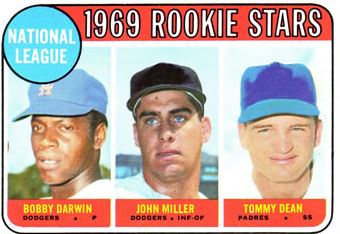
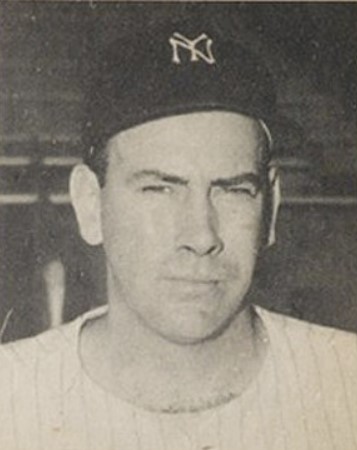
In the process of those eight games, McDonald became the only player with more than one MLB career hit, who can look back on major league career in which his every hit was a home run. He also became one of only two players – and the only National Leaguer – to homer in his first TWO major-league plate appearances.  

The Cardinals selected 21-year-old McDonald (out of Pepperdine University) in the 24th round of the 1994 draft. From 1994 to 1999, McDonald (a catcher, this will be important in a bit) worked his way up from Rookie ball to Triple-A.

He started the 2000 season at Triple-A (Memphis Redbirds). He was hitting .246, with one home run and 17 RBI in early July, when he was called up to replace Cardinals’ injured backup catcher Eli Marrero.

McDonald got his first taste of MLB action on July 4 (in St. Louis), pinch-hitting (for SS Edgar Renteria) in the bottom of the eighth inning – with the Cardinals ahead by a 13-3 score. After hitting just one home run in 177 at bats at Triple-A that season, McDonald sent a 2-2 pitch out of the park to left-center.

McDonald did not play in the Reds/Cardinals July 5 tilt, but On July 6, he started at catcher against the Reds, batting in the number-eight spot.  He got his first at bat in the bottom of the second, with the Cardinals trailing 3-2. He tied the game with a home run on a 1-0 pitch – becoming just the second MLB player ever to homer in their FIRST TWO plate appearances. (The other was St. Louis Browns’ LF Bob Nieman, who homered in his first two at MLB at plate appearances in his debut game – against the Red Sox in Fenway – on September 14, 1951.) By the way, McDonald went one-for-three in the July 6 game, adding a walk and another RBI.

McDonald’s next MLB appearance came on July 8. With the Cardinals hosting the Giants, McDonald replaced Matheny at catcher in the top of the ninth, with the Giants up 7-6. McDonald came to the plate in the bottom of the inning and drew a walk. He didn’t take the field again until July 13, when he again entered the game as a pinch hitter (this time in the top of the ninth with the Cardinals up 13-3 on the White Sox in Chicago).  He grounded out to second.  Two days later (July 15), still in Chicago, McDonald pinch hit again. This time, it came in the top of the ninth of a game in which the Cardinals trailed 15-5. McDonald popped a 3-1 pitch for a two-run home run. At this stage of his MLB career, he was three-for-six – with all three his hits leaving the yard.  McDonald got only one more major-league at bat that season, a ninth-inning, pinch-hit fly out against the Twins on July 15.

Then, as suddenly as it began, it was over. On July 21, McDonald was sent back down to Memphis, where he finished the season .263-5-30 in 83 games.  He appeared in just two more major-league games – in September of 2001 – going hitless in two at bats.   McDonald then spent the next five seasons at AAA; playing in the Cardinals’, Cubs’, Pirates’, Rangers’ and Yankees’ systems.  So, his final MLB stat line was .333-3-5 in eight games. His .333 average was result of three hits in nine careers at bats – again, all home runs.  For more on Keith McDonald, click here.

It’s Miller time

Little did Yankee rookie leftfielder John Miller know (when he made his debut on September 11, 1966) that his entire MLB career would include as many at bats as Yankee Roger Maris had home runs in 1961.  He also probably didn’t know he would bat his way into Yankee history in a way that could never be erased – becoming the first Yankee to homer in his first MLB at bat – as well as one of just two MLB players to homer in their first and last MLB at bats.

Miller made his MLB debut on September 11, 1966 – his fifth professional season – playing LF and batting seventh against Lee Stange and the Red Sox in Fenway.  Miller had gone  .294-16-59 at Double-A/Triple-A that season. In his first MLB at bat, in the bottom of the second inning, with a runner on first and two out, he hit a two-run home run to left.

That made Miller the first Yankee in history to go deep in his first MLB at bat.  He would hold the distinction of being the only Bronx Bomber to go deep in his first MLB at bat for four decades – 36 seasons, actually. (Marcus Thames would be next on June 10, 2002).

It would be a while before Miller went deep again – but it would be another historic long ball. Miller, in fact, would not get another home run or RBI until September 23, 1969 – in the final at bat of his MLB career.

In 1966, Miller would play in six games for the Yankees, going 2-for-23 with nine strikeouts (and, of course, that one home run and two RBI).   The following April, Miller was traded to the Dodgers. He spent 1967 and 1968 at Triple-A Spokane – putting up respectable numbers.  In 1969, he made it back to the big leagues, getting in 26 games (just 38 at bats) for the Dodgers. In the first 37 of those at bats, Miller collected seven hits (one double and six singles), scored twice, but did not collect an RBI.   Miller’s last at bat of the season (and what turn out to be the last at bat of his MLB career) came as a pinch hitter (September 23) in the eighth inning of a game at Cincinnati.  The Dodgers, trailing 6-2 sent Miller to the plate for pitcher Al McBean.  In that final MLB at bat, Miller stroked a solo home run off Reds’ starting pitcher Jim Merritt.

Just Aside

In the spirit of  “with Baseball Roundtable one thing always seems to lead to another,”  Al (Alvin O’Neal)  McBean (see paragraph immediately above)  was the winning pitcher in MLB’s only All-Hispanic All Star Game (played on October 12, 1963.  For more on that historic game, click here

That second homer made Miler one of two players in MLB history to homer in their first and final at bats. The other is Paul Gillespie – whose MLB career spanned three seasons during World War II (1942, 1944, 1945), all with the Cubs. Gillespie, a catcher, appeared in 89 games – hitting .283, with six home runs and 31 RBI; and went zero-for-six in the 1945 World Series.

Miller played in a total of just 32 major-league games, getting 61 at bats and just ten hits (.164 career average), two home runs and three RBI.  With that output, however, Miller earned a special place in the MLB record books

Miller did go on to play three seasons (1970-72) in Japan, hitting .249 with 72 home runs and 222 RBI in 382 games for the Chunichi Dragons.

The Long and Short of It

As noted earlier,  above three were 36 seasons between John Miller becoming the first Yankee to homer in his first at bat and Marcus Thames becoming the second.  That’s the “long” of it.  Now for the “short” of it.

On April 13, 2016, 24-year-old Tyler Austin made his MLB degut at 1B, batting seventh for the Yankees.  In his first MLB at bat (bottom of the second), he popped a 2-2 pitch from the Rays’ Matt Andriese to deep right for a two-run home run. How long did it take for the next Yankees rookie to hit a dinger in his first MLB at bat?  Just one hitter and four pitchers.  Next up was a rookie RF named Aaron Judge, who hit a 1-2 pitch from Andriese to deep center for a home run in his first MLB at bat.  Two rookies hitting first at bat home runs back-to-back – that’s still an MLB first and only.

Primary Resources:  Baseball-Reference.com and Baseball-Almanac.com

Baseball Roundtable – Blogging Baseball Since 2012.

100Baseball Roundtable is on the Feedspot list of the Top 100 Baseball Blogs.  To see the full list, click here.

Baseball Roundtable is also on the Anytime Baseball Supply Top 66 Baseball Sites list.  For the full list, click here

I tweet (on X) baseball @DavidBaseballRT

Follow Baseball Roundtable’s Facebook Page here.  More baseball commentary; blog post notifications.

Member: Society for American Baseball Research (SABR); Negro Leagues Baseball Museum; The Baseball Reliquary. 

P1064

Trivia(l) Tidbit Tuesday (rescheduled for Thursday) – Walking Your Way into the Record Books

Time for another edition of Trivia(l) Tidbit Tuesday (on Thursday this week because of the September Wrap Up post on Tuesday).  I hope you are enjoying weekly presentation of baseball occurrences that for some reason caught The Roundtable’s eye.  (I’m particularly fond of unexpected performances or statistical coincidences.) These won’t necessarily be momentous occurrences, just events, statistics or coincidences that grabbed my attention. This week – since it’s October 3 – we’ll look at the events of October 3, 1947.

Note: For the September wrap, click here.

Now, today’s Tidbit.

When Floyd Clifford (Bill) Bevens took the mound for the Yankees in Game Four of the 1948 World Series (October 3), it was not a World Series matchup for the ages.   Bevens was coming off a 7-13, 3.82 season for the Bronx Bombers, while his mound opponent was a rookie (Harry Taylor who had gone 10-5, 3.11). Both, however, would find their way into the record books – if in a negative fashion.

Let’s start with Taylor, since the 28-year-old righty wrote his name into MLB annals the fastest – in the top of the first inning.  Yankee 2B Stuffy Stirnweiss greeted Taylor abruptly, lacing his first pitch to left for a single.   RF Tommy Heinrich followed with a groundball single up the middle, sending Stirnweiss to second. C Yogi Berra reached on a fielder’s choice (with all runners safe due to an error by Dodgers’ SS Pee Wee Reese). CF Joe DiMaggio next drew a four-pitch walk, forcing in a run – and Taylor’s day was done. (Hal Gregg replaced him on the mound).  Fortunately for Taylor, Gregg retied 1B George McQuinn on a pop out the infield (runners holding) and then got Trivia(l) Tidbit Tuesday (rescheduled for Thursday) – Walking Your Way into the Record Books Billy Johnson to hit into a short-to second-to first double play ending the inning.

Taylor’s spot in the record book?  He became one of just four pitchers to start a World Series Game and not record a single out – joining the White Sox’ Reb Russell (Game Five, 1917); Cubs’ Charlie Root (Game Two, 1935); and Cubs’ Hank Borowy (Game Seven, 1945). The Dodgers’ Bob Welch (Game Four, 1981 World Series) has since “earned” a share of this record.

Taylor, by the way, pitched in six MLB seasons (1946-48, 1950-52 … Dodgers, Red Sox), going 19021, 4.10. 1947 was his best season.

Ouch!

For those who like to know such things, the Cubs’ Charlie Root holds the record for the most runs given up as a World Series starter without recording a single out. Notably, his outing also took place on October 3 (1935). In the bottom of the first inning of Game Two against the Tigers, Root gave up a single to CF Jo-Jo White; an RBI double to C Mickey Cochrane; an RBI single to 2B Charlie Gehringer; and a two-run home to 1B Hank Greenberg. Four hits, four runs on 18 pitches without recording an out. (Of course, three of the four batters he faced ended up in the Hall of Fame.)

Now let’s move on to Bevens’ record-setting and record-tying World Series’ performance of October 3, 1947. At the time, the record for walks surrendered by a pitcher in a World Series game was nine: Athletics’ Jack Coombs versus the Cubs in Game Two of the 1910 Series.  Coombs went the distance (eight hits, nine walks in a 9-3 win).

The record for the fewest hits given up by a starting pitcher in a complete game in a World Series was one: Cubs’ Ed Reulbach (Game Two, 1910, in a 7-1 win over the White Sox) and Cubs’ Claude Passeau (Game Three, 1945 in a 3-0 win over the Tigers).

On October 3, 1947, Bevens would set a new (still standing) mark for walks surrendered in a World Series game and also tie the record (which stood until Don Larsen’s 1956 perfect game) for fewest hits allowed in a World Series complete game.

In a sign of things to come, Bevens walked Dodgers’ 2B Eddie Stanky to open the game and, two outs later issued a free pass to RF Dixie Walker.  Bevens then walked one in the second inning; one in the third; two in the fifth; one in the sixth; one in the seventh. As they entered the bottom of the ninth, Bevens had issues free passes, but had given up just one run and had not yet surrendered a hit.

The ninth stared out just fine, as C Bruce Edwards lined out to left on a 2-0 pitch. Then, Bevens tied the World Series record, issuing his ninth walk, on a 3-1 pitch to CF Carl Furillo.  Bevens then retired 3B Spider Jorgenson on a foul pop out to first. Now, he was one out away from victory and one out away from MLB’s first World Series no-hitter. It was, however, not to be.  The managerial machines starting whirring as Dodger skipper Burt Shotton used a pair of pinch hitters and a pair of pinch runners to close out the frame.

Al Gionfriddo came in to run for Furillo and an injured and gimpy Pete Reiser pinch hit for Dodgers’ pitcher Hugh Casey.  Gionfriddo stole second on a 2-1 pitch to Reiser and, when Bevens went to 3-I on the always dangerous Reiser, Yankee manager Bucky Harris called for an intentional walk (giving Bevens sole possession of the World Series Walk record, which he still has). Eddie Miksis then was put in to pinch run for Reiser and Cookie Lavagetto pinch hit for Stanky. Lavagetto hit Bevens’ second offering for a two-run double – ending the no-hitter, winning the game and tagging Bevens with the loss.

Sidenote: Bevens’ ten-walk performance spared Dodger Rex Barney a spot in the record books.  The very next day, Barney started against the Yankees and walked nine batters in just 4 2/3 innings, in a Brooklyn 2-1 loss.

Bevens pitched in four MLB seasons (1944-48), all for the Yankees. He went 40-36, 3.08.

Primary Resource: Baseball-Reference.com

Baseball Roundtable – Blogging Baseball Since 2012.

100Baseball Roundtable is on the Feedspot list of the Top 100 Baseball Blogs.  To see the full list, click here.

Baseball Roundtable is also on the Anytime Baseball Supply Top 66 Baseball Sites list.  For the full list, click here

I tweet (on X) baseball @DavidBaseballRT

Follow Baseball Roundtable’s Facebook Page here.  More baseball commentary; blog post notifications.

Member: Society for American Baseball Research (SABR); Negro Leagues Baseball Museum; The Baseball Reliquary. 

P1063