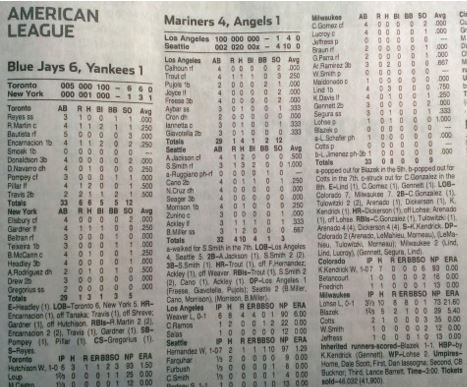
The box score – a thing of beauty.
Consistent with Baseball Roundtable’s reputation as being at least a bit “old school” (Hey, I’m 71, cut me a little slack), I start each day with the scent of hot coffee and newsprint. Yes, each day during the baseball season, I start my morning with the newspaper box scores. I look not only to see the standings and who turned in the best pitching or hitting performances, but also any anomalies that grab my attention (and demand further research). For example, if you look at the box score for the 1968 MLB All Star Game (That was, of course, known as “The Year of the Pitcher.”), you will see that not a single run batted in was recorded. (More on that in a bit, but let’s look at something more current, a box score item from yesterday that caught my eye.)
Yesterday, September 3, the Brewers topped the Cubs 4-3 with a bottom-of-the-ninth run that scored in an inning in which there were no base hits and no fielder’s errors. The baseball, in fact, never left the infield. BBRT classifies this inning as one of those “Glad It Happened on the Road” frames. Had it happened in Chicago, I would have put it in the “You Just Can’t Un-See That” category.
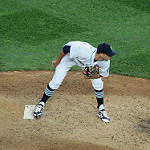
Steve Cishek Photo by THE Laura Smith 
Here’s how it went. The Brewers had tied it up in the bottom of the eighth on a bases-loaded walk (Carl Edwards pitching to Brewers’ pinch hitter Mike Moustakas.) Edwards had sandwiched two singles and two walks around a pair of strikeouts and Cubs’ manager Joe Maddon had seen enough. He went to the pen for right-hander Steve Cishek and Brewers’ manager Craig Counsell countered with left-handed pinch hitter Travis Shaw. (It was, by the way, Cishek’s line in the box score that caught my eye. He got the loss, gave up an earned run – but allowed no hits. But, I’m getting ahead of myself.) It seemed like a pretty solid move. On the season, Cishek had appeared in 65 games, going 4-2 (three saves) with a 1.90 earned run average and 69 strikeouts in 61 2/3 innings pitched. The move worked out well in the eighth. Cishek went to 2-0 on Shaw and then ended the inning (and the bases-loaded jam) on a groundball back to the mound.
Now, we go to the bottom of the ninth – the inning most responsible for the box score line that got BBRT’s attention. Cishek opened the inning with a four-pitch walk to the number-seven hitter, Eric Kratz. On his fifth pitch, he hit Brewers’ shortstop Orlando Arcia. Cishek then settled down and fanned LF Curtis Granderson – with both runners moving up on a passed ball (on the fourth pitch of the six-pitch at bat). The next hitter was CF and leadoff man Lorenzo Cain and Cishek again lost the plate – hitting Cain with a 2-0 pitch. So, at this point, the ninth inning had seen Cishek throw 14 pitches (just three strikes, all to Granderson) – loading the bases with one out, without a single ball leaving the infield.
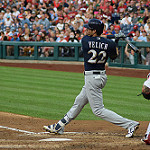
Christian Yelich’s round out plated the winning run. Photo by DandreaPhotography
Maddon then brought in Jesse Chavez to face one of the hottest hitters in baseball, Brewers RF Christian Yelich. Chavez got ahead in the count (1-2) and induced a grounder to third baseman Kris Bryant. Bryant stepped on third for the force, but Yelich beat the throw to first and the winning run scored on the fielder’s choice – and the ball had still not left the infield. Cishek’s total “day?” Two-thirds of an inning pitched, 17 pitches (four strikes), one earned run, zero hits, one walk, two hit batsman.
In that September 3 Cubs/Brewers game, Steve Cishek realized the satisfaction of pitching out of someone else’s bases-loaded jam in the eighth and the disappointment of creating his own sacks-juiced jam in the ninth.
So, anyway, that’s the story behind a box score anomaly that caught BBRT’s eye this morning.
____________________________________________________
The 1968 MLB All Star Game – The One Without an RBI
Now, back to that 1968 All Star Game. It was, indeed, The Year of the Pitcher. Denny McLain went 31-6, Bob Gibson put up an MLB-best 1.12 earned run average (seven qualifying pitchers were under 2.00), Juan Marichal tossed 30 complete games, Bob Gibson threw 13 complete-game shutouts, the AL had only one qualifying .300 hitter (Carl Yastrzemski won the batting title at .301), and the Most Valuable Player Award went to a pitcher in both leagues (Denny McLain in the AL and Bob Gibson in the NL). How dominant were the pitchers? Before the opening of the 1969 season, the pitchers’ mound was lowered from 15 inches to ten inches and the strike zone was shrunk to the distance between the batter’s armpits and his knees (from the distance between the batter’s shoulders and his knees.)
That season’s All Star Game, played on July 9 at the Astrodome, reflected the pitchers’ dominance over the season – ending 1-0, with a total of just eight hits and (here’s that anomaly) not a single run batted in. The only run (and, ironically, even without an RBI, the run was earned) scored off the American League’s Luis Tiant in the bottom of the first.
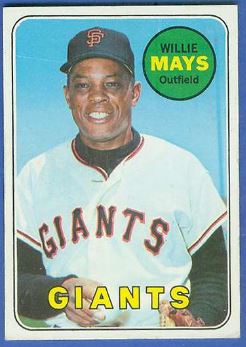
Willie Mays scored the only run of the 1968 All Star game – as Willie McCovey hit into a 4-6-3 double play.
It went like this, NL CF Willie Mays started the inning with a single to left. It appeared that Tiant had Willie picked off first, but the throw went awry and Mays went to second. A wild pitch sent Mays to third – before LF Curt Flood walked. 1B Willie McCovey hit into a 4-6-3 (Rod Carew-Jim Fregosi-Harmon Killebrew) double play, with Mays scoring. (No RBI awarded on a double play.) After a walk to RF Hank Aaron, Tiant got 3B Ron Santo on a short-to-first ground out. And that was all the scoring for the 1968 All Star contest. The game featured just eight total hits (four doubles), six walks (all given up by AL pitchers) and 20 strikeouts (nine by AL pitchers, 11 by NL hurlers).
Primary Resource: Baseball-Reference.com.
I tweet baseball @DavidBBRT
Follow/Like the Baseball Roundtable Facebook page here.
Member: Society for American Baseball Research; The Baseball Reliquary; The Negro Leagues Baseball Museum.