BASEBALL ROUNDTABLE TRIVIA TEASER (Just to get you in the mood for this post.)
Only two MLB rookies have ever won the Most Valuable Player Award. And. while both were selected Rookie(s) of the Year, neither was a unanimous choice. Your question is not who were those rookies (1975, Fred Lynn, Rex Sox … 2001, Ichiro Suzuki, Mariners), but who were the two players who got the first-place votes that denied Lynn and Suzuki “unanimous status.”
YOUR ANSWER.
In 1975, the Red Sox’ Fred Lynn went .331-21-105, won a Gold Glove and led the American League in doubles (47) and runs scored (103). His efforts earned him MVP honors and 23 1/2 of 24 possible first-place votes for Rookie of the Year. That other one-half vote went to Lynn’s teammate and outfield partner Jim Rice, who went .309-22-102.
In 2001, The Mariners’ Ichiro Suzuki led that American Leaguer with a .350 average, 242 hits and 56 stolen bases. He also hit eight home runs, drove in 69 runners, scored 127 times and won a Gold Glove. That performance earned him league MVP honors and twenty-three of twenty-four possible first-place votes for Rookie of the Year. The remaining vote went to Indians’ rookie C.C. Sabathia, who 17-5, 4.39 in 33 starts.
___________________________________________________________________________
Now for BBRT’s post on unanimous Rookies of the Year.
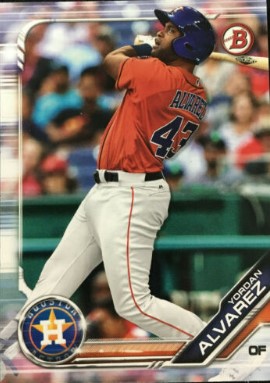 The Astros Yordan Álvarez – the 2019 American League Rookie of the Year – was the first-ever primarily Designated Hitter to capture that honor. (Of Álvarez’ 83 starts – in 87 games played – 74 were as a DH.) He also became the 22nd unanimous ROY selection, capturing all thirty first place votes and far outdistancing runner-up Orioles’ pitcher John Means.
Álvarez, who made his MLB debut June (18 days before his 22nd birthday) hit .313, with 27 home runs and 78 RBI in 87 games. This was after going .343-23-71 in 56 games for the Triple A Round Rock Express. Runner-up Means, a 27-year-old southpaw starter, went 12-11, 3.62 for an Orioles team that finished 54 games under .500.
From BBRT’s perspective, had I been asked to predict who would be a unanimous Rookie of the Year choice, I would probably have gone with Mets’ 24-year-old first baseman Pete Alonso. The 6’3”, 235-pound Alonso played in 161 games and went .263-53-120 (with 103 runs scored) – setting a new MLB record for rookie-season round trippers and leading all major leaguers in 2019 long balls. Alonso got 29 of 30 possible first-place votes, with the remaining top tallies going to Braves’ RHP Mike Soroka – who went 13-4, 2,68. The lone first-place vote for Soroka, by the way, did not come from a Braves’ beat writer, but rather from a Giants’ beat writer, who was impressed with Soroka’s rookie-season performance in a year in which baseball’s were flying out of the park in record numbers. The 6’-5”, 22-year-old starter allowed just 14 long balls in 173 2/3 innings. (Soroka also collected 25 second-place votes and two third-place votes.)
Pete Alonso is the first player (since the Rookie of the Year Award was established in 1947) to break or tie the rookie home run record and not be a unanimous Rookie of the Year selection. The Reds’ Frank Robinson tied the record (set by Braves’ Wally Berger in 1930) with 38 home runs as a rookie in 1956; the A’s Mark McGwire set a new rookie record with 48 home runs in 1987; and the Yankees’ Aaron Judge set a new rookie record with 52 round rippers in 2017. All three were unanimous ROY selections.
In this post, BBRT will take a look at all of MLB’s unanimous Rookie of the year selections.
Jackie Robinson, the first-ever Rookie of the Year Award winner (and the award now bears his name), was not a unanimous selection. In fact, he barely edged out Giants’ right-handed pitcher Larry Jansen for the honor. Robinson hit .296-12-48, with 125 runs and league-topping 29 steals – in a season in which he faced the pressure of breaking MLB’s color line. Jansen went 21-5,3.16 in his rookie season (his .808 winning percentage leading the league), with 20 complete games in 30 starts.
—-UNANIMOUS ROOKIE OF THE YEAR SELECTIONS—-
1956 …. Frank Robinson, OF, Reds (HOF)
Frank Robinson started his Hall of Fame career with a bang. The unanimous choice for 1956 National League Rookie of the Year played in 152 games and hit .290, with 38 home runs (tying the MLB rookie record) and 83 RBI. The 20-year-old also led the NL in runs scored with 122 and hit-by-pitch with 20 (ouch). He went on to 21-season MLB career; was an All Star in 14 campaigns. He finished with a career .294 average, 586 home runs, 1,812 RBI, 1,829 runs scored and 204 stolen bases. He also was a Triple Crown winner, a two-time league MVP, a World Series MVP, an All-Star Game MVP and, after retiring as a player, honored as the American League Manager of the Year (1989, Orioles).
Frank Robinson is the only player to win the Most Valuable Player Award in both the National; (Reds, 1961) and American (Orioles, 1966) Leagues.
———————————————————————
1959 …. Willie McCovey, 1B, Giants (HOF)
Willie McCovey is a bit of a surprise on this list, as he was a unanimous selection for 1959 National League Rookie of the Year despite not making his MLB debut until July 30 of that season – and playing in just 52 Games for the Giants. Still, he made the most of those games – hitting .354, with 13 home runs and 38 RBI. I also find it surprising the Giants waited until July to call him up to the “show.” He was already in his fifth professional season and was hitting .372-29-92 in 95 games) at Triple-A Phoenix at the time.
Willie McCovey was named the National League Player of the Month in his first full month in the major leagues – playing in 27 games in August of 1959 and going 38-for-102 (.373), with eight home runs and 22 RBI.
McCovey went on to a 22-season Hall of Fame MLB career. He was a six-time All Star and the 1969 NL MVP. The three-time NL home run leader finished with a .270 average, 521 home runs and 1,555 RBI. He also went .310-2-6 in eight post-season games.
————————————————————
1972 … Carlton Fisk, C, Red Sox (HOF)
Carlton Fish was the unanimous choice for the American League Rookie of the Year in 1972 (the first-ever AL unanimous ROY). The 24-year-old backstop played in 131 games for the Red Sox hitting .293, with 22 home runs and 61 RBI, 74 runs scored and five stolen bases – while also capturing the AL Gold Glove at catcher.
In his rookie season, Carlton Fisk led the American League in triples (tied with Joe Rudi) with nine.
Fisk’s MLB career stretched for 24 seasons. He was an All Star in 11 of those seasons and finished with a .269 average, 376 home runs, 1,330 RBI, 1,276 runs scored and 128 stolen bases.
——————————————————-
*Note a change in All Star voting allowed each voter three votes (first, second third), so BBRT will not the runner-up in each of the season that saw a unanimous number-one choice.
———————————————————-
1985 … Vince Coleman, OF, Cardinals
Vince Coleman came up to the Cardinals as a 23-year-old, in his fourth professional season. Over 328 minor-league games he had hit .286 – and swiped 289 bases. He continued to show that speed as an MLB rookie, leading the National League with 110 steals in his 1986 ROY season. Coleman remains the only player to steal 100+ bases in his rookie season. He played in 151 games, hitting .267, with just one home run and 40 RBI – but scored 107 runs.
Vince Coleman led that National League in steals in each of his first six MLB seasons (tying the NL record for consecutive seasons leading the league in that category.) He also pilfered 100+ bases in each of his first three seasons, becoming the only MLB player to record three straight seasons of triple-digit steals.
Coleman played 13 MLB seasons, hitting .264, with 28 home runs, 346 RBI, 849 runs and 752 steals. He was a two-time All Star.
The runner up to Coleman for 1985 NL ROY was Reds’ LHP Tom Browning, who went 20-9, 3.55 in 38 starts.
——————————————————-
1987 …. Mark McGwire, 1B, A’s
Mark McGwire got the proverbial “cup of coffee” in the big leagues in 1986, hitting just .189 with three home runs in 18 games. This experience came after a late season call up from Triple a Tacoma, where he hit .318-13-59 in 78 games (he had also gone .303-10-53 in 55 games at Double A).
Then, the following season, with his rookie status still intact, the 23-year-old hit .289, mashed a then MLB rookie-record (and league-leading) 49 home runs and drove in 188 tallies. It was good start to a 16-season MLB career that would see him his .263, with 583 home runs, 1,414 RBI and 1,167 runs scored. Over that career, McGwire was an All Star in 12 seasons, a four-time home run champion – and even won a Gold Glove (A’s – 1990). In 1998, McGwire broke Roger Maris’ single-season home run record (61), basing 70 round trippers. (Barry Bonds broke McGwire’s record in 2001, with 73 long balls.
Mark McGwire holds the career record for the best at bats-per-home run ratio (among player with at least 3,000 plate appearances) at 10.61. Babe Ruth is second at 11.76.
Runner up to McGwire was the Royals’ INF/OF Kevin Seitzer, who hit .323-15-83, with 105 runs scored and a league-leading 207 hits in 161 games.
——————————————————————–
1987 … Benito Santiago, C, Padres
Twenty-three-year-old Padres’ backstop Benito Santiago got off to a good start as the unanimous NL Rookie of the Year choice in 1987 – batting .300, with 18 home runs, 79 RBI and 12 stolen bases.
The 22-year-old went on to a 20-season MLB career, hitting .263, with 217 home runs and 91 steals. He was a five-time All Star and a three-time Gold Glover.
From August 25 through October 2, 1987, Benito Santiago hit safely in 34 games – the longest hitting streak ever by an MLB rookie.
Pirates’ RHP Mike Dunn was runner up to Santiago, after going 13-6, 3.03 in 23 starts.
———————————————–
1990 …. Sandy Alomar, C, Indians
Like Benito Santiago (see above bio), Sandy Alomar started out as a catcher in the Padres’ system. Alomar, however, was blocked by 1987 unanimous Rookie of the Year and 1989 All Star catcher Benito Santiago (Alomar played in just eight games for the padres in 1988-89). In December of 1989, the Padres traded Alomar (along with Carlos Baerga and Chris James) to the Indians for power-hitting Joe Carter. Alomar got an opportunity to stick with Cleveland in 1990 – and he made the most of it. Like Santiago, he was a unanimous Rookie of the Year selection – hitting .290-9-66 in 132 games, making the All-Star team and winning a Gold Glove. (Carter, by the way, hit .232-24-115 for the Padres in 1990 and was traded to the Blue Jays after the 1990 season.)
Sandy Alomar was named as the Baseball America Minor League Player of the year in 1988 and 1989 – hitting .297-16-71 at Double A in 1988 and .306-13-101 at Triple A in 1989.
Alomar played 20 MLB seasons, hitting .273-112-588. He was a six-time All Star.
Yankees’ 1B Kevin Maas was the runner up to Alomar, going .252-21-41 in 79 games.
—————————————————————
1993 … Mike Piazza, C, Dodgers (HOF)
Over his first three minor league seasons, Mike Piazza hit .245, with 43 home runs and 150 RBI over 262 games. Then, in 1991, the 23-year-old, put it all together – hitting .350-23-90 in 125 games at Double-A and Triple-A and earning a late season call up (.232-1-7 in 21 games) with the Dodgers.
In 1992, still considered a rookie, he was behind the plate for the Dodgers full time – and went .318-35-112 (making the NL All Star squad in the process).
Mike Piazza was the 1390th pick of the 1989 MLB draft.
Mike Piazza went on to a 16-season Hall of Fame career – hitting .308, with 427 home runs and 1,335 RBI – and making an even dozen All Star teams. He topped 30 home runs in a season in nine seasons (reaching 40 twice) and had 100 or more RBI in six campaigns.
Runner up to Piazza was Braves relieve Greg McMichael, who went 2-3, 2.06 with 19 saves in 74 appearances.
————————————————-
1993 … Tim Salmon, OF, Angels
While he did get a late season call up (August) in 1992, Tim Salmon still had his rookie status when he took a full-time spot in the Angels’ outfield in 1993. In his full-season rookie campaign, the 24-year-old hit .283, with 31 home runs, 95 RBI and 93 runs scored. He enjoyed a 14-season MLB career, hitting .282, with 299 home runs and 1,016 RBI. Salmon – although never an All-Star Selection – hit 30 or more home runs in five seasons and drove in 100+ runs in three. In 1995, he went .330-34-105 in 143 games.
Tim Salmon was the 1992 Baseball America Minor League Player of the Year after hitting .347, with 23 home runs, 94 RBI and 12 steals in 118 games for the Triple A Edmonton Trappers.
The runner up to Salmon was White Sox RHP Jason Bere who went 12-5, 3.47 in 22 starts.
—————————————————–
1994 … Raul Mondesi, OF, Dodgers
Raul Mondesi made a major-league impression before his 1994 season (when he was the unanimous selection for NL Rookie of the year). Called up to the Dodgers the previous July, the then 22-year-old had hit .291 in 42 games and showed plus defense in the outfield. In his 1994 ROY season, Mondesi played in 112 games for the Dodgers, hitting .306, with 16 home runs, 56 RBI, 63 runs scored and 11 steals.
Raul Mondesi is on of only 13 players to have multiple 30-30 (30 home runs/30 stolen bases) seasons. In 1997, Mondesi hit .310, with 30 home runs and 32 steals for the Dodgers. In 1999, he hit .253, with 33 home runs and 36 steals, again for the Dodgers.
Mondesi played 13-seasons in the major leagues, hitting .273, with 271 home runs, 860 RBI and 229 stolen bases. He was a one-time All Star and two-time Gold Glover. He hit 30 or more home runs in three seasons and stole at least 30 bases in three seasons.
The runner up to Mondesi for the Rookie of the Year, was Astros reliever John Hudek, who went 0-2, 2.97 with 16 saves in 42 appearances.
————————————————-
1996 … Derek Jeter, SS, Yankees
Derek Jeter was a first-round (sixth-overall) Yankee draft pick right out of high school (1992). He saw his first MLB action in 1995 (15 games as a September call up), before his unanimous selection as Rookie of the Year (as a 22-year-old) in 1996. In that 1996 season, Jeter played in 157 games, hitting .314, with ten home runs, 78 RBI, 104 runs scored and 14 stolen bases. He went on to a 20-season MLB career, during which he hit .310 (3,465 hits), with 269 round trippers, 1,311 RBI, 1,923 runs scored and 358 steals. He topped 200 hits in eight campaigns (leading the league twice), scored 100+ runs in 13 seasons (leading the league once), won five Gold Gloves and was an All Star 14 times. He was also the 2000 World Series MVP (hitting .409 in five games) and 2000 All Star Game MVP.
Derek Jeter holds the record for post-season games played (158), hits (200), total bases (302), runs scored (111), doubles (32); triples (five, tied). His total post-season appearances (158 games) make up a solid single-season stat line (.308-20-61, with 200 hits, 111 runs scored, 61 RBI and 18 steals.)
White Sox’ pitcher James Baldwin was the runner-up to Jeter for ROY, after going 11-6, 4.42 in 28 starts for the Pale Hose.
——————————————————-
1997 … Nomar Garciaparra, SS, Red Sox
Garciaparra, at age 23, was in his fourth pro season when he captured 1997 AL Rookie of the Year honors. (Garciaparra had earned a late-season – 24 games played – call up in 1996). In 1997, the 23-year-old played in 153 games for the BoSox, hitting .306, knocking 30 home runs, 44 doubles and a league-leading eleven triples. He drove in 98 runs, scored 122 and earned his way onto the 1997 AL All Star squad.
Garciaparra went on to a 14-season MLB career in which he hit .313-229-936; was a six-time All Star; and won a pair of batting titles. He hit .300+ in nine seasons, scored 100+ runs six times, and hit 30 or more homes runs twice and 50 or more doubles twice.
Nomar Garciaparra is one of just 13 players to hit two Grand Slams in a single game (May 10, 1999) – and the only player to achieve this feat in his home ball park.
The runner up to Garciaparra for Rookie of the Year was outfielder Jose Cruz, who split his season between Toronto and Seattle, playing in 104 games and hitting .248-26-68.
—————————————————-
1997 … Scott Rolen, 3B, Phillies
Scott Rolen made his debut with the Phillies (at age 21) on August 1, 1996. He got in 37 games with the Phils that season (preserving his rookie status for 1997), hitting .254, with four home runs and 18 RBI. Much better things were on the horizon. In his 1997, ROY season, Rolen played in 156 games, hitting .283, with 21 home runs, 92 RBI – and 16 stolen bases.
He went on to a 17-season MLB career, hitting .281, with 316 home runs, 1.287 RBI and 118 steals. He was s seven-time All Star and eight-time Gold Glover at the hot corner. Rolen hit 20 or more home runs in 10 seasons (topping 30 three times) and drove in 100+ runs in five campaigns.
Who knows what could have been? In 1993, as a high school senior, Scott Rolen as was named Mr. Indiana (high school) baseball and was the runner up for Mr. Indiana Basketball. He earned a basketball scholarship to Georgia, but the Phillies offered an attractive bonus to secure his services on the diamond.
The runner up to Rolen for ROY was Marlins pitcher Livan Hernandez, who went 9-3, 3.18 in 17 starts. Side note: Hernandez was also the MVP of the 1997 National League Championship Series and the MVP of the 1997 World Series.
——————————————————————
2001 … Albert Pujols, OF/1B/3B, Cardinals
Drafted by the Cardinals in 1999 (at age 19), after just one year of college ball (Maple Woods Community College), Albert Pujols played just one minor-league season (.314-19-96 in 133 games at three levels) before earning a unanimous National League Rookie of the Year selection.
In his first-ever college baseball game, Albert Pujols hit a Grand Slam and turned an unassisted Triple Play. He finished that freshman season with a .461 average and 22 home runs and 80 RBI.
Pujols, still active, has now played in 19 MLB seasons, hitting .300 (3,202 hits, 15th all-time) with 656 home runs (sixth all-time) and 2,075 RBI (fourth all-time). He is a ten-time All Star, two-Gold Glover and three-time National League MVP. He has led his league in runs scored five times (topping 100 ten times), home runs twice (reaching forty or more seven times) and RBI once (exceeding 100 in 14 times) and batting average once (topping .300 in ten seasons). A sign of respect, his 311 intentional walks are second only to Barry Bonds He topped .300, 30 home runs, 100 RBI in each of his first ten seasons. (Over those first ten campaigns, his season average was .331-41-123). In the post-season, has hit .323 (77 games), with 19 home runs and 54 RBI.
The runner up to Pujols for 2001 NL ROY was Astros’ pitcher Roy Oswalt (14-3, 2.73 in 28 appearances).
————————————————————
2011 …. Craig Kimbrel, Reliever, Braves
Craig Kimbrel, still active was a 33rd-round draft pick (Braves) in 2007. He earned a look at the major-league level in 2010, going 4-0, 0.44 with one save in 21 games (40 strikeouts in 20 2/3 innings). In 2011, he was the Braves’ full-time closer, leading the NL with 46 saves – the first in a string of four consecutive seasons as the NL saves leader.
Craig Kimbrel holds the rookie record for saves – at 46.
In his ten MLB seasons, Kimbrel has gone 31-23, 2.08 with 346 saves (13th all-time) and 898 strikeouts in 553 1/3 innings pitched. He is a seven-time All Star and has led his league in saves four times (topping 30 saves in eight seasons, reaching 40 or more five times, with a high of 50 saves in 2013).
The runner up for ROY in 2011 was Kimbrel’s teammate Freddie Freeman, who hit .282, with 21 home runs and 76 RBI in 157 games.
——————————————————
2012 …. Mike Trout, OF, Angels
While Mike Trout saw 40 games of MLB action as a 19-year-old in 2011 (.220-5-16), he retained his rookie status for the 2012 season. He earned his unanimous selection as AL Rookie of the Year by going .326-30-83 in 139 games. He also led the AL in runs scored (129) and stolen bases (49).
In his rookie season, Mike Trout became the youngest MLB player ever to have a 30-30 season (30 home runs/30 stolen bases) – accomplishing it at age 20. He hit 30 home runs and stole 49 bags.
Still active, in nine MLB seasons, Trout has hit .305, with 285 home runs, 752 RBI, 903 runs scored and 200 stolen bases. He is an eight-time All Star and has won the AL Most Valuable Player Award three times (finishing second four times). He’s led the AL in runs scored four times (topping 100 in seven seasons) and RBI once (topping 100 three times). He’s also topped the junior circuit in walks three times and on-base percentage four times.
Finishing second in the 2013 AL Rookie of the Year voting was Oakland’s Yeonis Cespedes, who went .292-23-82 with 16 steals.
————————————————————————-
2014 …. Jose Abreu, 1B, White Sox
Jose Abreu signed with the White Sox in October 2013 after (defecting from Cuba that August). He had already established himself as a star in Cuba – where he had played ten seasons. As a 27-year-old rookie with the White Sox in 2014, Abreu hit .317, with 36 home runs and 107 RBI – earning an All-Star selection and leading the league in slugging percentage.
Jose Abreu was the Most Valuable Player in the Cuban Serie Nacional in the 2010-11 season – after hitting .453, with 33 home runs and 93 RBI in 66 games.
Still Active, Abreu’s six-season MLB stat line is .293-179-611. He is a three-time All Star and, last season, led the AL with 123 RBI. Abreu has driven in 100 or more runs in five of his six MLB seasons and punched 30 or more home runs in four campaigns.
Angels’ pitcher Matt Shoemaker was the runner up to Abreu in the 2014 AL ROY voting, after going 16-4, 3.04 n 27 games (20 starts).
———————————————————–
2015 … Kris Bryant, 3B/OF, Cubs
As a 23-year-old rookie in 2015, Kris Bryant played in 151 games for the Cubs (he saw action in seven Cubs games in 2014), hitting .275, with 26 home runs and 99 RBI in 151 games – not only earning unanimous ROY honors, but also an All-Star selection. But there was more to come. The following season, Bryant earned NL Most Valuable Player recognition, with a .292-39-102 season.
Kris Bryant picked up a lot of hardware/accolades before making his Cubs debut. He was a USA Today (High School) All American in 2010; a College All-American in 2012 and 2013; winner of the Dick Howser Trophy and Golden Spikes Award in 2013; and the USA Today and Baseball America Minor League Player of the Year in 2014. (In 2014, Bryant, then 22-years-old, hit .325, with 43 home runs and 110 RBI in 138 games at Double-A and Triple-A.)
In five MLB seasons, the still active Bryant has a.284-138-403 stat line. He is a three-time All Star and has topped 100 runs scored in three seasons, 100 RBI once and 30 home runs twice.
The Giants’ Matt Duffy finished second in the 2015 NL ROY balloting, after a .295-12-77 season.
———————————————————————————————
A BRIEF INTERMISSION
There is still time to vote in Baseball Roundtable’s Hall of Fame Fan Ballot. Just click on the ballot image below to go directly to the ballot. Voting open until January 1
——————————————————————————————————–
2016 … Corey Seager, SS, Dodgers
A first-round draft pick in the 2012 draft, Seager made his MLB debut in 2015 and was the unanimous choice for NL Rookie of the Year in 2016. As an 18-year-old, Seager hit .309, with eight home runs in 46 Rookie-League (2012) games. And, Seager just kept getting better. When he got his first call up (September 2015), he was in the midst of a .293-18-76 season at Double-A/Triple-A. He acquitted himself well at the MLB-level, going .337-4-17 in 27 games for the Dodgers.
In his 2016 ROY campaign, Seager hit .308, with 26 home runs and 72 RBI, making the All-Star squad and finishing third in NL MVP balloting.
Corey Seager and his brother Kyle Seager were the first siblings to hit 25 or more home runs in the same season. Corey was .308-26-72 in 2016, while Kyle was .278-30-99 for the Mariners.
Seager has now played in five MLB season and has a .294-73-266 stat line, with a pair of All-Star sections.
The runner up in the 2016 NL ROY voting was the Nationals’ Trea Turner, who went .342-13-40 in 73 games.
————————————————–
2017 … Cody Bellinger, OF/1B, Dodgers
Cody Bellinger joined the Dodgers as a 21-year-old rookie in 2017 and immediately went to work. That season, Bellinger hit .267, with 39 home runs and 97 RBI in 132 games. His 39 home runs were a new National League rookie record (broken by Pete Alonso of the Mets last season) and help earn him a unanimous Rookie of the Year selection. And, like many of our unanimous selections, Bellinger had plenty left in the tank. In 2019, he was the NL Most Valuable Player (at age 23), putting up a .305-47-115 line, with 84 runs scored and 15 steals.
On July 15, 2017, Cody Bellinger hit for the cycle as the Dodgers topped the Marlins 7-1 in Miami.
In three MLB seasons (thus far), Bellinger has hit .278, with 111 home runs, 288 RBI and 39 stolen bases. He was the 2019 NL MVP and is a two-time All Star and one-time Gold Glover.
Finishing second in the 2017 NL ROY voting was the Cardinals’ Paul DeJong, who went .285-25-65 in 108 games.
———————————————————-
2017 …. Aaron Judge, OF, Yankees
In 2017, Aaron Judge became the first rookie ever to hit 50 or more home runs (52) – setting a rookie record (broken by Pete Alonso last season) 52 dingers to go with a .284 average, 114 RBI, a league-topping 128 runs scored and an AL-highest 127 walks. (He also led the league in whiffs with 208).
Aaron Judge made his MLB debut on August 13th, 2016. In his first at bat, he homered off Tampa Bay Rays’ pitcher Matt Andriese. Notably, Yankee Tyler Austin – who hit one spot before Judge and was also getting his first MLB at bat – had also homered. This made Judge and Austin the first MLB teammates to hit home runs in their first at bat in the same game (much less in their first at bats back-to back.)
Four years seasons into his MLB career, Judge has a .273-110-246 stat line (396 games). He is a two-tie All-star.
The runner up in the 2017 AL Rookie of the Year race was the Red Sox’ Andrew Benintendi, who went .271-20-90 (with 20 steals (in 151 games).
——————————————————–
2019 …. Yordan Álvarez, DH. Astros
See the opening paragraphs of this post.
Primary Resources: Baseball-Reference.com; Baseball-Almanac.com; MLB.com
BASEBALL ROUNDTABLE ON THE TOP 100 BASEBALL BLOG LIST
 Baseball Roundtable is on the Feedspot list of the Top 100 Baseball Blogs. To see the full list, click here.
I tweet baseball @DavidBBRT
Follow/Like Baseball Roundtable’s Facebook Page here. More baseball commentary; blog post notifications; PRIZES.
Member: Society for American Baseball Research (SABR); The Baseball Reliquary; The Negro Leagues Baseball Museum.