The results are in and congratulations go out to the 2019 Baseball Hall of Fame Class – beginning with Mariano Rivera, the first-ever unanimous selection (Let the debates begin.) Well-deserved congratulations also go to 2019 inductees Edgar Martinez, Roy Halladay and Mike Mussina. In addition, BBRT would like to congratulate Today’s Game Era Committee electees Lee Smith and Harold Baines. The bios of these deserving new Hall of Famers can be found at the end of this post. But first, some BBRT observations on both the election (BBWAA and Era Committee) and the differences between the BBWAA official balloting and BBRT’s unofficial fan vote.
BBRT’s BALLOT (If I had one.)
BBRT would have voted for Rivera, Martinez, Halladay and Mussina – as well as Jeff Kent, Todd Helton, Larry Walker, Fred McGriff, Omar Vizquel and Andy Pettitte. For BBRT’s comments on each of those candidates, see my November 19, 2018 post (click here). At that time, I predicted Rivera and Martinez would get in and had Halladay and Mussina as dark horse candidates with a good chance at election. Looking at the Today’s Game Era Committee candidates, BBRT would have voted for Smith and Lou Piniella. Back on November 7, I predicted their election and had Harold Baines and George Steinbrenner as dark horse candidates. For that post, click here.
OBSERVATIONS ON BBWAA BALLOT
Here are just a few thoughts on the BBWAA balloting.
- Mariano Rivera’s unanimous election may pave the way for higher vote totals in the future. In the past, we have seen voters making a distinction between first-ballot electees and those elected on subsequent ballots (demanding more of first-timers on the ballot). That distinction may be blurring.
- The induction of Mariano Rivera (unanimous and first-ballot) and Lee Smith indicate a past bias related to relief pitchers may behind us.
- The induction of Edgar Martinez (with about 70 percent of his MLB starts at DH) and Harold Baines (with about 60 percent of his MLB starts at DH) may indicate the relaxing of a perceived bias against players who were primarily designated hitters (good news for David Ortiz). However, since Martinez got in on his tenth and final year on the ballot and Baines was elected by the Today’s Game ERA Committee, this one observation demands further proof.
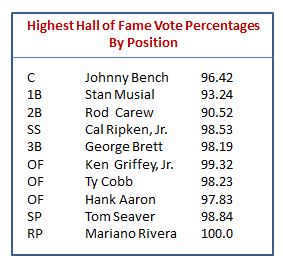
Others with 95 percent or higher: Nolan Ryan (98.79%); Tony Gwynn (97.61); Randy Johnson (97.27); Greg Maddux (97.20); Chipper Jones (97.16); Mike Schmidt (96.52); Steve Carlton (95.82); Babe Ruth (95.13); Honus Wagner (95.13).
POST ELECTION QUESTION
On BBRT’s mind is whether Mike Mussina goes into the Hall of Fame as an Oriole or a Yankee. Moose went 147-81, 3.53 in ten seasons for Baltimore and 123-72, 3.88 in eight seasons in New York. I’m rooting for the O’s – with whom Mussina has more wins and a lower earned run average, as well as more complete games (45 to 12) and more shutouts (15 to eight). Then again, his strikeouts per nine innings were better with the Yankees (7.4 to 6.9) and his walks per nine were also better (1.8 to 2.1). Mussina also had more post-season appearances with the Yankees (17 games to six), but his post-season record with Baltimore was 2-1, 2.53 versus 4-7, 3.80 with the New Yorkers.
BIGGEST SURPRISE OF 2019 BBWAA BALLOTING – LANCE BERKMAN
I admit I was surprised by Mariano Rivera’s unanimous election, I anticipated there would be a holdout or two based on a feeling that if Babe Ruth (or Ty Cobb, Hank Aaron, Cy Young, etc.) weren’t unanimous, no one should be. Credit to the BBWAA for setting aside that thinking. That aside, BBRT was very surprised to see Lance Berkman as a “one and done” on the ballot – with just 1.2 percent of the vote. I didn’t anticipate his election, but I did expect him to get enough support (five percent) to stay on the ballot.
Berkman – one of Houston’s “Killer B’s” – provided dependable power for the Astros (1999-2010). He also played for the Yankees (2010), Cardinals (2011-12) and Rangers (2013). Berkman was a five-time All Star, whose career line was .293-366-1,234. He also hit 422 doubles (leading his league twice) and scored 1,146 runs. Berkman hit 30 or more home runs five times (a high of 42 in 2002); drove in 100+ runs in six seasons; scored 100+ runs in five campaigns; and hit over .300 five times. Berkman is also one of only 21 major leagues to hit 55 or more doubles in a season and put up a .317-9-41 stat line in 52 post-season contests.
THE BBWAA OFFICIAL BALLOT VERSUS BBRT’S UNOFFICIAL FAN BALLOT
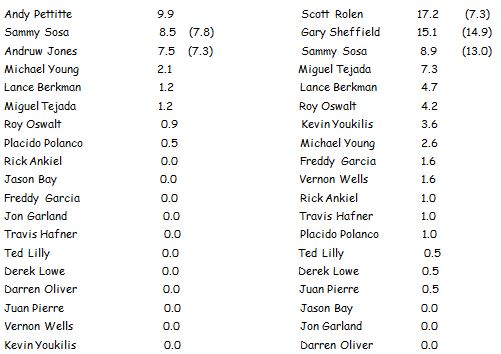
Here are a few comparison between the BBWAA Balloting and BBRT’s fan voting.
- While the top four players were the same on both sets of ballots, the fan balloting seemed more demanding. In the fan ballot only Mariano Rivera and Edgar Martinez got the necessary 75 percent. Halladay and Mussina were in the 55-60 percent range.
- Fans voting in the BBRT ballot were also a tougher sell on Rivera, who got 86.5 percent of the fan vote.
- Players selected per ballot were fairly even,with fans casting votes for 7.7 players per ballot and the writers voting for 8.0 per ballot.
- Fans seemed less forgiving than the writers when it came to PED suspicions. For example, in the BBWAA balloting, Roger Clemens and Barry Bonds got 59.5 and 59.1 percent of the vote, respectively. In the BBRT fan balloting, Clemens got 44.9 percent and Bonds 43.2.
- Fans spread their votes around a bit more. In BBRT’s fan balloting only three players received zero votes, while in the BBWAA official ballot eleven players were shutout.
- Sixteen players were “one and done” on the BBWAA ballot (less than five percent support), while fifteen received less than five percent on the BBRT fan ballot. The names on the “one and done” lists were identical except that Miguel Tejada received 7.3 on BBRT’s unofficial fan ballot, but only 1.2 percent on the BBWAA ballot.
A half dozen other notable differences between the BBWAA ballot and BBRT’s unofficial fan balloting:
- Curt Schilling finished fifth in the BBWAA ballot at 60.9 percent – and 13th in BBRT ballot at 27.6 percent.
- Fred McGriff (in his tenth and final year on the ballot) finished tenth on the BBWAA ballot (39.8 percent, up 16.6 points from the previous year). He finished fifth in the fan balloting at 49.5 percent (up 11.6 points).
- Jeff Kent got 18.1 percent of the BBWAA vote and 34.9 percent in the fan vote.
- Scott Rolen got 17.2 percent support in both tallies.
- Todd Helton received 16.5 percent support from the writers, 36.5 percent in the fan balloting.
- Andruw Jones got just 7.5 percent in the writers’ balloting, 21.4 percent in the BBRT fan vote.
Here’s the full comparison.


_________________________________________________________
BIGGEST HOF SNUBS
The BBRT Fan Ballot asked for comments on which players represent the most significant Hall of Fame Snubs. Here are the leaders (in terms of mentions.
Barry Bonds – 11 mentions
Roger Clemens – 8
Jim Kaat – 7
Fred McGriff – 4
Dale Murphy – 4
From BBRT’s perspective: I’d go with Jim Kaat (283 wins/16 Gold Gloves); Jeff Kent (Most HR’s in MLB history/MVP Award/1,500+ RBI); and Larry Walker (.313 career average/three batting titles/MVP Award/seven Gold Gloves).
_________________________________________
2019 BASEBALL HALL OF FAME INDUCTEES
Now a look at the 2019 inductees.
Mariano Rivera – 100 Percent … (RHP/Closer, 1995-2013) … First year on the ballot.
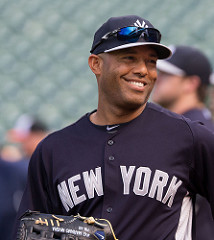
Photo by Keith Allison 
Rivera is at the top of the 2019 HOF class, no matter how you look at it – and we finally have our first unanimous selection. (Although I did always like the speculation.)
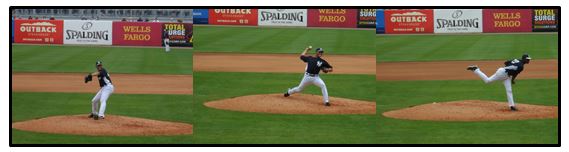
Rivera spent nineteen years with the Yankees and racked up an MLB-best 652 career saves. He was an All-star in 13 seasons, led the AL in games saved three times and finished in the top three in Cy Young voting four times. He saved 30 or more games in a season 15 times (including nine seasons of 40 or more saves, two of fifty or more) and put up an overall won-lost record of 80-52, with a 2.21 earned run average in 1,114 games. In 11 of his 19 seasons, Rivera’s earned run average was under 2.00 – which included a four-season span (2003-06), in which he saved 170 games, won 21 (13 losses) and put up a 1.69 ERA in 302 2/3 innings pitched. In his final season – at age 43 – Rivera went 6-2, with a 2.11 ERA and 44 saves. Rivera was the American League Rolaids Relief Man of the Year in five seasons and the MLB Delivery Man of the Year in three campaigns.
In 96 post-season appearances, Rivera went 8-1, with 42 saves and a minuscule 0.70 ERA. Rivera was named the World Series MVP in 1999 and the ALCS MVP in 2003. In 58 of his 96 post-season appearances, Rivera pitched more than one inning. In the 2003 post-season, he appeared in eight games, pitching 16 innings (more than one frame in seven of the eight appearances), earning a win and five saves, giving up just one earned run (0.56 ERA).
Mariano Rivera’s Best Season: Lots to choose from here – like 43 saves and a 1.38 ERA in 2005; or 44 saves and a 1.91 ERA in 2011 (at age 41). BBRT will go with 2004, when Rivera saved a career-high 53 games, won four (lost two) and posted a 1.94 ERA
_________________________________________________
Edgar Martinez – 85.4 Percent … (Designated Hitter/Third Base, 1987-2004) … Tenth/Final year on the ballot, 70.4 percent on the BBWAA ballot in 2018.
Photo by clare_and_ben
We’ve seen some bias against designated hitters in past voting, but Edgar Martinez’ election indicates this may be subsiding. Martinez clearly, and expertly, defined the DH role. In an 18-season MLB career (all with the Mariners), Martinez was named to seven All Star teams; won a pair of batting titles (hitting a high of .356 in 1995); earned five Silver Slugger Awards; topped 100 RBI in six seasons (leading the league with 145 in 2000); and scored 100 or more runs five times (leading the league with 121 in 1995). He finished his career with a .312 average; 2,247 hits; 1,219 runs; 1,261 RBI; 309 home runs; and 514 doubles.
Martinez hit .571 in the 1995 AL Championship Series (12-for-21), with two home runs, six walks and 10 RBI in five games. In 34 post-season games, he hit .266, with eight home runs and 24 RBI.
Edgar Martinez’ Best Season: One of two … In 1995, Martinez led the league in batting average (.356), runs scored (121) and doubles (52), adding 29 home runs and 113 RBI. In 2005, Martinez put up a .324 average, 37 home runs, a league-leading 145 RBI and 100 runs scored.
_____________________________
Roy Halladay – 85.4 percent …. (RHP/Starter, 1998-2013) … First year on the ballot.
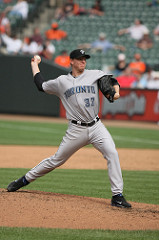
Photo by Keith Allison
Roy Halladay had one of the best-ever ten-year runs on the mound (2002-2011). In those ten seasons, he went 170-75, with a 2.97 earned run average and 1,699 strikeouts in 2,194 2/3 innings. He was an All Star eight times during that span and won a pair of Cy Young Awards (2003 and 2010). Halladay also recorded three seasons of 20 or more wins during those ten seasons, leading his league twice. Between 2002 and 2011, he also led his league in complete games seven times, shutouts four times and innings pitched four times.
And, there is more to support Halladay’s candidacy. On May 10, 2010, he pitched a perfect game – striking out 11 – as his Phillies topped the Marlins 1-0 in Miami. Then, on October 6, 2010, Halladay tossed a no-hitter against the Reds in Game One of the National League Division Series – walking one and fanning eight as the Phillies won 4-0. It was just the second no-hitter in post-season history. Halladay was also one of just six pitchers to win the Cy Young Award in both the American and National Leagues.
Halladay finished his career at 203-105, 3.38 with 2,117 strikeouts in 2,749 1/3 innings pitched. He pitched for the Blue Jays (1998-2009) and Phillies (2010-13).
Roy Halladay’s Best Season: In his 2010 Cy Young Award season – after being traded from the Blue Jays to the Phillies in December of 2009 – Halladay led the NL in wins (21-10); complete games (nine), shutouts (four), and innings pitched (250 2/3), while putting up a 2.35 ERA (third in the league), fanning 219 batters (second in the NL) and walking just 30. His 7.3 strikeouts to walks ratio was the NL’s best.
________________________________________
Mike Mussina – 76.7 Percent … (RHP/Starter, 1991-2008) – Sixth year on the ballot 63.5 percent on the BBWAA 2018 ballot.
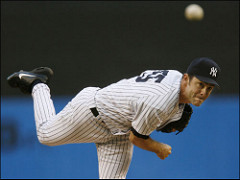
Photo by Willie Zhang
Mussina built a 270-153 record, with a career 3.68 ERA and 2,813 strikeouts over 18 seasons. While only once a 20-game winner (in his final season, at age 39), Mussina won 18 or 19 games five times, leading the AL with 19 wins in 1995. In his first three full seasons in the major leagues (1992-94), Mussina put up a .700 or better winning percentage each year (.783, .700, .762). His record over that span – for the Orioles – was 48-16.
Mussina was a five-time All Star and a seven-time Gold Glove winner. He recorded a .650 or better winning percentage in nine seasons, with a career (and league-leading) high of .783 in 1992. Mussina ranks among the top 25 pitchers all-time in strikeouts (20th) and strikeout-to-walk ratio (24th among pitchers with 1,000 or more innings pitched). He’s also in the top fifty all-time in games started, wins and winning percentage. Mussina pitched for the Orioles (1991-2000) and Yankees (2000-2008). Mussina appeared in 23 post-season games, with a 7-8 record and a 3.42 ERA.
Mike Mussina’s Best Season: Mussina may have saved his best for last. In his final season (as a Yankee), at age 39, he recorded his first twenty-win campaign. That year, Mussina went 20-9, 3.37 – and proved his durability by leading the AL in starts with 34, logging his 11th season of 200 or more innings pitched and earning his seventh Gold Glove
_________________________________________________
— Today’s Game Era Committee Electees—-
Lee Smith (RHP) … 1980-97
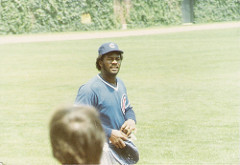
Photo by terren in Virginia
From Baseball Roundtable’s perspective, Lee Smith should have been in the Hall of Fame years ago. However, in his 15 years on the traditional ballot, he never garnered more than 50.6 percent support – and never less than 29.9 percent.
Why does BBRT feel strongly about Lee Smith spot in the Hall? Smith’s 478 career saves put him third on the all-time list (he was number-one when he retired after the 1997 season). He recorded 13 consecutive seasons (in an 18-year career) of 25 or more saves, a 3.03 lifetime ERA and 1,251 strikeouts in 1,289 innings pitched; led his league in saves four times; made seven All Star teams; and was the Rolaids Relief Man of the Year in three seasons. Smith also is one of just 16 pitchers to appear in 1,000 or more MLB games. His 1,022 appearances put him at number 13.
Smith pitched for the Chicago Cubs (1980-87); Boston Red Sox (1988-90); St. Louis Cardinals (1990-93); New York Yankees (1993); Baltimore Orioles (1994); California Angels (1995-96); Cincinnati Reds (1996); Montreal Expos (1997).
Lee Smith’s best season: 1991, Cardinals … 6-3, 2.34 ERA, 47 saves, 73 innings pitched, 67 strikeouts.
_____________________________________________
Harold Baines (OF/DH) … 1980-2001
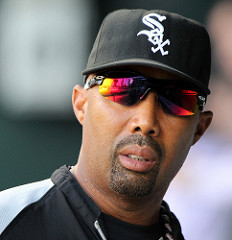
Photo by Keith Allison
Harold Baines had a 22-season MLB career. He was a six-time All Star and two-time winner of the Designated Hitter of the Year Award. He is in the top 50 players all-time in hits with 2,866 (46th) and RBI with 1,628 (34th). Baines, with a .289 career average, hit .300 or better in nine seasons. He was a steady source of power with 384 home runs, never reaching 30 in a season, but hitting 20 or more home runs in ten campaigns. He drove in 100+ runs in three seasons and scored 1,299 runs in his career. Baines hit .324, with five home runs, 16 RBI and 14 runs scored in 31 post-season contests. Harold Baines played for the White Sox (1980-1989, 1996-1997, 2000-2001); Rangers (1989-1990); A’s (1990-1992); Orioles (1993-1995, 1997-2000); and Indians (1999).
Harold Baines’ best season: Baines’ best MLB campaign may have been 1999, when – at age 40 – he made his final All Star team and hit .312, with 25 home runs and 103 RBI, playing for the Orioles and Indians. That season, Baines also hit .357 (5-for-16), with one home run and four RBI in four post-season (ALDS) games.
Primary Resources: Baseball-Reference.com; MLB.com; Society for American Baseball Research.
BASEBALL ROUNDTABLE MAKES TOP 100 BASEBALL BLOG LIST
 Baseball Roundtable has made the Feedspot list of the Top 1oo Baseball Blogs. To see the full list, click here.
I tweet baseball @DavidBBRT
Follow/Like Baseball Roundtable’s Facebook Page here. More baseball commentary; blog post notifications; PRIZES.
Member: Society for American Baseball Research (SABR); The Baseball Reliquary; The Negro Leagues Baseball Museum.