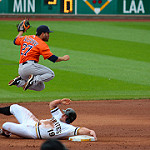
The ballet of the double play … a beautiful thing.
Photo by roy.luck 
Regular readers of Baseball Roundtable know a few things about this hardball observer. I like tense, low-scoring games, I prefer action on the base paths and in the field (home runs, strikeouts, walks, HBP and catcher’s interference … all part of the BBRT Trot Index … not so much) and I am enamored of the baseball ballet that is the ground ball double play.
Side note: When it comes to twin-killings, my favorite is the short – to second – to first variety. The shortstop makes the stop and flips to the second baseman, who is moving away from first base toward the second base bag. After taking the ball, the second sacker has to reverse momentum and make the pivot to throw back toward first. That pivot is often a thing of beauty.
Why bring this up in this post? Yesterday, in topping the Pirates 1-0 in Pittsburgh, the Cubbies turned seven double plays – which, Elias Sports reports, tied the record for a nine-inning game. This was BBRT’s kind of game. (For those who like the long ball, the only run scored in a home run by Cubs’ LF Kyle Schwarber in the second inning.) A BBRT takeaway, all those double plays mean that the Cubs pitchers (and fielders … and fans) were continually under stress – and that more than half of the Pirates’ total outs came on double plays. I should also note here, that six of the double plays came on ground balls and one on an infield line drive. Of some note, the first and last innings for the Pirates ended in the same way, with Pirates’ 3B David Freese – up with runners on first and second and one out – hitting into a third-to-first double play.
Here’s how the twin killings went:
First inning: With runners on first and second and one out, Pirates’ David Freese grounds to Cubs’ third baseman Javier Baez, who tags third for the first out and throws across the diamond to first (Anthony Rizzo) to complete the DP.
Second inning: With a runner on first and one out, Pittsburgh 1B Josh Bell hits into a third (Baez) to second (Ben Zobrist) to first (Rizzo) double play. 2B Josh Harrison then grounds out short to first to end the frame.
Third inning: With a runner on first and one down, Pirates’ LF Corey Dickerson hits into a second (Zobrist) to short (Addison Russell) to first (Rizzo) double play.
Sixth inning: With a runner on first and one out, Buccos’ RF Gregory Polanco hits into an inning-ending double play – second (Zobrist) to short (Russell) to first (Rizzo).
Seventh inning: With a runner on first and one out, Josh Bell hits into his second double play of the game – this one from short (Russell) to second (Zobrist) to first (Rizzo).
Eighth inning: With a runner first and one out, Pirates’ pinch hitter Adam Frazier lines out to Cubs’ second baseman Javier Baez (who had moved from third to second to start the inning). Baez doubles the runner (pinch runner Kevin Newman) off first.
Ninth inning: With runners on first and second and one out, Freese grounds into his second third (David Bote, who had come on in the eighth) to first (Rizzo) double play.
The winning pitcher, by the way, was Cole Hamels, who gave up five hits and two walks, while fanning three, in seven scoreless frames. Jesse Chavez got the final two outs for the save, and the Cubs used a total of five pitchers.
How about those other two seven-double play, nine-inning games?
On August 14 1942, the Yankees turned seven double plays in a nine-inning 11-2 pounding of the Athletics in Philadelphia.
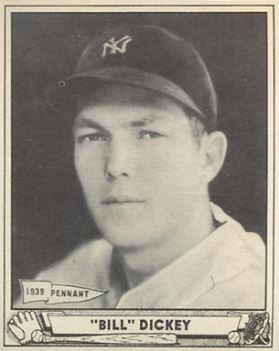
Yankee catcher Bill Dickey initiated two “strike ’em out/throw ’em out” double plays – as the Yankees wrapped up seven twin killings against the Athletics.
The Yankee game was a bit unique in the first two double plays were of the “strike ‘em out – throw ‘em out” variety. In the first inning, with runners on first and second and no one out, Yankee starter Lefty Gomez fanned Athletics’ 3B Pete Suder, with the base runner on second (CF/leadoff hitter Mike Kreevich) attempting to steal third. Kreevich was gunned down catcher (Bill Dickey) to third (Red Rolfe). Then in the third frame, with Kreevich on first and one out, Gomez fanned RF Elmer Valo, with Kreevich attempting to take second. Kreevich was again gunned down, this time Dickey to shortstop (Phil Rizzuto).
The remaining five double players were all of the more traditional groundball variety: 6-4-3 (2); 4-6-3; 5-4-3; and 1-6-3. Side note: One reason for so many twin killings? Winning pitcher Lefty Gomez, while giving up just two runs, walked seven in six innings – and three of those walking batters were erased as part of double plays.
A flawless, almost magical, double play pivot helped Pirates’ second baseman (and eight-time Gold Glove winner) Bill Mazeroski earn a spot in the baseball Hall of Fame. Mazeroski holds the MLB record for double plays by a second baseman at 1,706. Second on the list is Nellie Fox at 1,619.
On May 4, 1969, the Astros nipped the Giants 3-1 at the Astrodome – despite the fact that Giants’ starter Juan Marichal went the distance and Houston starter Denny Lemaster lasted just 1/3 of an inning.

1B Curt Blefary handled the ball on all seven of the Astros’ May 4, 1969 double plays. He had 13 putouts and an assist in the contest.
Lemaster started strong, striking out Giants RF/leadoff hitter Frank Johnson. Then things went off the rails: 2B Ron Hunt singled; CF Willie Mays singled; 1B Jack Hiatt walked; C Dick Dietz walked (forcing in a run); and Dooley Womack replaced Lemaster. Womack induced San Francisco LF Jim Ray Hart to hit into a short (Denis Menke ) to second (Joe Morgan) to first (Curt Blefary) double play to get out of the inning – and an additional six twin killings later the Astros had a 3-1 victory.
Lots of different players initiated ground ball, double play action in the game (all seven were ground ball double plays). There were two that went 6-4-3 and one each at 5-4-3; 4-6-3; 4-3; 6-3; and 3-6. A total of six Giants hit into double plays during the game: 3B Bobby Etheridge (2); 2B Ron Hunt; RF Frank Johnson; C Dick Dietz; LF Jim Ray Hart; and P Juan Marichal.
Primary Resources: MLB.com; Baseball-Reference.com
I tweet baseball @DavidBBRT
Follow/Like the Baseball Roundtable Facebook page here.
Member: Society for American Baseball Research; The Baseball Reliquary; The Negro Leagues Baseball Museum.