In 2011, Peter Gorton (baseball fan, researcher and writer) showed a group of veteran major league scouts a 39-second film of a rangy, African-American southpaw. The verdict was unanimous, an electrifying talent, referred to by one scout as “a left-handed Bob Gibson.”

Courtesty of W.T. Oxley and the Donaldson Network.
That cinematic audition did not, however, lead to a professional contract. The fact is, the film was shot in 1925 and featured John Wesley Donaldson – a pitcher who ultimately amassed more than 400 wins, 5,000-plus strikeouts and was hailed by Hall of Fame manager John McGraw (and others) as “the greatest I have ever seen.”
That film clip has, however, been part of the force behind a documentary film project (appropriately titled 39 Seconds) detailing the life (and, importantly, the times) of left-handed hurler John Wesley Donaldson.
A FEW OF JOHN DONALDSON’S DOCUMENTED ACCOMPLISHMENTS*
- 404 victories
- 5,034 strikeouts
- 13 no-hitters; two perfect games
- A 31-strikeout game (18 innings)
- 33 games of 20 or more strikeouts
- Three consecutive 500-strikeout seasons
- A winning percentage of more than .700
*You can put an “at least” in front of all these statistics. These are just the victories and strikeouts documented thus far by The Donaldson Network.
The discovery of that 39 seconds of historic footage was part of the work of Peter Gorton and The Donaldson Network – an organization dedicated to generating the recognition (and someday the Baseball Hall of Fame plaque) that Donaldson deserves. Gorton (in an effort involving more than 500 researchers) has spent 17 years documenting and bringing John Donaldson’s achievements to light and is now working with Tru Ruts Films, 612IM and the Negro Leagues Baseball Museum to bring Donaldson’s career to life on the big screen. (The project begins shooting this summer).
Baseball Roundtable will take a closer look at Donaldson’s career a few paragraphs down the page, but first a bit of background on this historic film project – and a look at how you can be part of it.
THE FILM
 39 Seconds will tell the Donaldson story with a combination of interviews with those who knew (or knew of) Donaldson and scenes from the times recreated by actors, historic film and still images. It will not only look at Donaldson’s achievements on the ball field, but also put his life in the context of the times – giving viewers a look at how baseball and American society changed over Donaldson’s lifetime. For more on the project and the story it will tell (including comments from Negro Leagues Baseball Museum President Bob Kendrick), click here and scroll down.
Gorton, who has written numerous articles and made presentations on Donaldson across the country, said the film was a next step that made a lot of sense.
“I could have written a book” he explained, “but – in these times – telling the story in film seemed like the most effective way to get people to sit down and literally open their eyes to his (Donaldson’s) greatness.”
Gorton added that the timing of 39 Seconds also seemed right, citing the verification of Donaldson’s statistics, the Donaldson Network’s success in getting the player into the Missouri Sports Hall of Fame and even the movie “42.”
“We’ve reached the point where we have thoroughly documented his legacy,” Gorton said, noting that The Donaldson Network has collected more than 6,000 newspaper articles on Donaldson alone.
“Ten years ago, we weren’t ready to prove that the Donaldson story was not just myth or legend,” he said, adding that he spent May of 2012 through Thanksgiving of 2016 digging through those thousands of articles and other resources – verifying the stories and the statistics.
The Center for Negro Leagues Baseball Research has called the Donaldson Networks’ efforts “The most extensive research project that has ever been undertaken related to Black baseball.
“We now know that, if anything, his achievements are underrepresented,” Gorton added. “We do have gaps, when we know Donaldson was pitching pretty much every Sunday, but we can’t find acceptable documentation. But every one of those 400-plus wins and 5,000 plus strikeouts is backed but solid evidence.”
The movie “42” also showed that a film focusing on the trials faced by African-American baseball players could both make a statement and draw an audience, Gorton continued.
In addition, Donaldson’s election to the Missouri Sports Hall of Fame last year provided both validation and energy to the project.
The documentary will look at more than Donaldson’s on-field accomplishments, Gorton said.
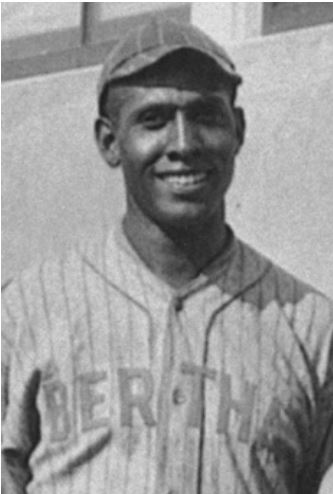
John Wesley Donaldson
Photo: Courtesy of The Donaldson Network.
“John Donaldson knew, from a very early age, what it took for a Black man to survive in the segregated world,” he said. “He was a great ballplayer, but his life is an extraordinary example of what it was like to be Black in America. He endured his father being murdered by a railroad cop in 1923. His ability to navigate the miles and play baseball in at least 25 states and over 550 cities meant he showed exceptional courage to merely survive. That’s another part of his story that needs to be told.”
WANT TO BE PART OF 30 SECONDS?
“39 Seconds” is running a Kickstarter fundraising effort through the end of March. If you are interested in being part (big or small) of this effort – and helping to move this project forward and shining more light on the Donaldson legacy. – you can get more information by clicking here.
__________________________
NOW HOW ABOUT A LOOK AT JOHN DONALDSON’S BASEBALL CAREER
NOTE: The historic background here is updated from an ealier BBRT post promoting Donaldson’s inclusion in the the Basebal Hall of fame.
John Donaldson’s playing career touched four decades (1908-1941) and he wore the uniforms of at least 25 teams and took the mound on more than 550 ball fields. Donaldson’s collection of home jerseys stretched from coast-to-coast and in between – Brooklyn Royal Giants, Chicago American Giants, Kansas City Monarchs, Los Angeles White Sox. In BBRT’s home state of Minnesota, Donaldson twirled his mound magic for teams in Bertha, Lismore, Madison, Melrose, Arlington and St. Cloud. He also starred internationally, pitching for several Canadian squads.
Over his 34-year career, Donaldson pitched pretty much wherever he could draw a crowd and a paycheck and against pretty much anyone willing to step in the batter’s box and face him. But, I’m getting ahead of myself.
John Wesley Donaldson was born February 20, 1891 in Glasgow, Missouri. It’s reported that he was a good student and a superb athlete. He began pitching in grade school and, as a sixth-grader, led his school’s team to the regional championship.
As a teenager, Donaldson pitched for the Missouri Black Tigers (Higbee, MO) in 1908 and the Hannaca Blues (Glasgow) in 1909-1910. Donaldson, however, really began building his reputation as the “greatest colored pitcher of his time” when he left college and joined the Black barnstorming Brown’s Tennessee Rats in 1911. During that season, Donaldson won 41 games against just three losses – foreshadowing a long and successful career on the mound.
JOHN DONALDSON GOES 18 INNINGS – FANS 31
On September 14, 1911, John Donaldson took the mound for the barnstorming Brown’s Tennessee Rats versus a team from Humboldt, Iowa. The Rats won 4-3 in 18 innings, with Donaldson tossing a complete game and fanning 31 batters.
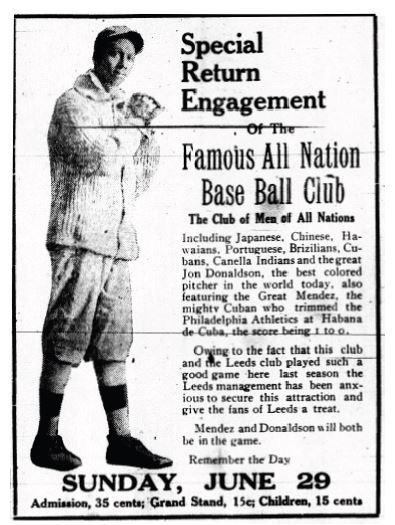 In 1912, Donaldson moved to the All Nations multi-racial team operated by future Hall of Fame baseball executive J.L. Wilkinson. The All Nations team – composed of Black, White, Native American, Latino, Hawaiian and Asian players – was one of the country’s most successful barnstorming clubs. Donaldson proved one of the most dominant pitchers in the game while with the All Nations squad. In his first two seasons, he won eighty games, while losing only five – consistently racking up double-digit strikeout totals.
The National Baseball Hall of Fame (enshrined in 2006) executive/entrepreneur J.L. Wilkinson termed John Donaldson, “One of the greatest pitchers that ever lived – white or black.”
The year 1917 was a notable one for Donaldson. It was the year the major leagues came calling. Reports show that Donaldson was offered $10,000 to travel to Cuba, change his name and return to the U.S. to play big league ball as a Cuban. The major league offer required him to renounce his family and all association with “colored” people in order to maintain his “Cuban” identity. Donaldson flatly refused the offer and, with that refusal, lost his only shot at the all-white hallowed fields of the major leagues. That same year, the impact of World War I reached America. The baseball season closed and the All Nations team was dissolved. Pressure from the looming Railway Control Act grounded the ability of barnstorming clubs to travel. For the next few years, Donaldson’s career “settled” and he enjoyed “home field advantage” for the first time since his teenage years (although with a number of different established clubs.)
Just as Donaldson’s on-field life settled in 1917, he settled in off the field as well – marrying Eleanor Watson of Minneapolis, Minnesota. Donaldson’s marriage lasted until his death in 1970 and had an impact on both his baseball career and Minnesota’s baseball history.
Donaldson’s next contracts were signed with a series of top-notch All-Black teams including the Brooklyn Royal Giants, New York Lincoln Giants, Indianapolis ABC’s and Detroit Stars. When the Negro League was officially formed in 1920, Donaldson was again paired with his old boss, J.L. Wilkinson, who signed him for the Kansas City Monarchs. Donaldson would become one of the best centerfielders in the league. He anchored the Monarchs with his five-tool ability, pitching less and presiding over a club that would become the most successful franchise in the history of Negro League baseball. During his tenure with the Monarchs (1920-23), Donaldson also played for and managed the revived All Nations barnstorming team, now traveling by automobile.
In 1924, Donaldson returned to his wife Eleanor’s home state of Minnesota – signing a contract with the semi-pro Bertha Fisherman for the princely sum of $325 per month. (BBRT note: It is reported the Donaldson received $1,478 for his season’s work – $18 more than the combined salary for the rest of the Bertha squad.) It was a solid investment, as the team won games, drew large crowds and turned a profit behind Donaldson’s electrifying left arm. Donaldson’s record was 21-3 and he struck out 325 batters in 211 innings. He also led the team with a .439 batting average.
DONALDSON FANS SIXTEEN MAJOR LEAGUERS
The date was December 9, 1917 and the Los Angeles White Sox were facing the California Winter League defending Champion San Pedro Merchants in San Pedro. (BBRT note: The California Winter League is generally recognized as the first U.S. Integrated league in the 20th Century. The teams themselves were not integrated, but all-Black teams were included in the league.)
On the mound for the LA Team was John Wesley “Cannonball” Donaldson, star hurler from the barnstorming All Nations squad – considered by many to be “the greatest colored pitcher of his time.” Starting for San Pedro was Pete Schendler – a 20-game winner for the Cincinnati Reds during the 1917 National League season. The San Pedro lineup, in fact, was made up of all major leaguers.
The Los Angeles squad emerged as 5-3 victors. Of even more significance is the performance of Donaldson against San Pedro’s all-white, all-major league squad. Donaldson pitched a complete-game, six-hitter, fanning sixteen batters.
Donaldson followed up with a stellar season for Bertha in 1925, before moving on to the Lismore (MN) Gophers in 1926. Lismore signed the profitable lefty for $450 a month, the use of a furnished house and the opportunity to pick up extra money pitching for other teams on off-days. Not to be repetitious but – continuing to go where he could make the best living on the mound – from 1928 to 30, Donaldson racked up wins and strikeouts for teams in towns like: Bertha; Melrose, Minnesota; Scobey, Montana; and St. Cloud, Minnesota; as well as for barnstorming squads like the Colored House of David.
SHOWING SATCHEL PAIGE THE WAY
Negro League all-time great Buck O’Neil once (maybe more than once) said …”Josh Donaldson … showed Satchel (Paige) the way. And, the fact is , there are many people who saw them both who say Donadlason was just as good as Satchel “
In the early 1930’s, Donaldson – now entering his forties – played for such squads as his own John Donaldson All Stars (1931-33); The Kansas City Monarchs (1931 and 1934); Joe Green’s Chicago Giants (1934-37); and even Satchel Paige’s All Stars. Even as his career wound down, he continued to display the skills that had made him one of the most sought after ballplayers over the previous two decades.
JOHN DONALDSON RECORDS 23-STRIKEOUT GAME … AT AGE 43
On June 3, 1934 – the then 43-year-old John Donaldson – went to the mound for Joe Green’s Chicago Giants against the People’s Club in Rockford, Illinois. Donaldson threw a complete-game, one-hit shutout, fanning 23 batters on the way to a 3-0 win.
While Donaldson clearly made history on the field, he is also credited with making it off the field. In 1949, the Chicago White Sox hired Donaldson as the first full-time African-American scout in the major leagues. The White Sox drew on Donaldson’s half-century of experience in segregated baseball to help connect the team to the untapped talent of the Negro Leagues and Black baseball.
Ultimately, BBRT sees 39 Seconds as a documentary film that deserves to be made … and John Donaldson as a ballplayer who deserve to be in teh Baseball Hall of Fame.
PETE GORTON … AND THE DONALDSON NETWORK
BBRT note: This post … and the “39 Seconds” project would not have been possible without the considerable efforts of Pete Gorton and the resources of The Donaldson Network. Gorton, who lives in Minneapolis, is a speech consultant and member of the Society for American Baseball Research (SABR) Negro Leagues Committee. He has studied the career of John Donaldson for the past 17 years; and shared in the SABR/ Sporting News Research Award for his chapter on Donaldson in the book “Swinging for the Fences: Black Baseball in Minnesota.” He also received the 2006 Coates Memorial Award for outstanding research in the field of Black baseball and the 2011 Tweed Webb Lifetime Achievement Award (recognizing long-term contributions to the field of Negro League research).
MINNESOTA PRIDE
As a Minnesota, BBRT takes special pride in John Donaldson’s accomplishments. He played for or against teams in more than 130 towns and cities across the state. Nearly 150 of Donaldson’s documented victories were recorded on Minnesota ball fields, as were approximatelty 1,900 of his documented 5,034 strikeouts. In 189 documented games pitched in Minnesota, Donaldson averaged just over 9.9 strikeouts per contest. Segregation in the major leagues forced Donaldson to seek baseball stardom in the Gopher State and Minnesota benefitted.
I tweet baseball @DavidBBRT
Follow/Like Baseball Roundtable’s Facebook page here.
Member: Society for American Baseball Research; The Baseball Reliquary; The Negro Leagues Baseball Museum.