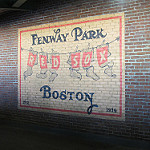
Photo by davidwilson1949 
A team hitting .300 for the season … It hasn’t happened for 68 years, but it’s not as rare as you might think. In fact, there have been 73 .300+-hitting teams – from the 1871 National Association Philadelphia Athletics, Boston Red Stockings and Troy Haymakers to the 1950 Boston Red Sox. Let’s look at the 1950 Boston Squad, the most recent team to rake at a .300+ pace for a full season. Note: You’ll find a full list of .300-hitting MLB team at the end of this post.
The Red Sox’ .302 team average was 31-points above the overall American League average and 20-points above the Tigers and Yankees, who shared the second-best AL team batting average at .282. If you take out the Red Sox’ numbers – the rest of the league hit just .266. It was not enough to bring the Red Sox the pennant, however. That went to the Yankees (98-56). Boston finished third, four games off the pace. Pitching was the culprit; the Red Sox led the AL in runs scored at 1,027 (the Yankees were second at 914), but Boston finished sixth out of eight teams in earned run average (4.88).
The Red Sox offense was led by: Walt Dropo (.322-34-144); Vern Stephens (.295-30-144); Ted Williams (.317-28-97); and Bobby Doerr (.294-27-120). But that .300 team batting average would not have been possible without Billy Goodman, who led the AL with a .354 average – and was the first (and still only) true utility (infield/outfield) player to win a batting crown. Read Goodman’s story here.

A few .300-hitting team tidbits:
- Of the 73 .300-hitting teams, 40 hit that mark after 1900;
- No team has had more .300-hitting seasons than the Pittsburgh Pirates – with seven;
- The 1876 National League Champion Chicago White Stockings (Cubs) outhit the league average by the widest margin – 72 percentage points. The White Stocking hit .337, the league average (which includes Chicago) was .265 (without Chicago, the rest of the NL hit .254);
- The National League has recorded the most .300+ seasons (38), followed by the American League (23), National Association (11) and American Association (1).
The highest team batting average ever recorded over a season belong to the 1894 National League Philadelphia Phillies at .350 – led by an all-.400 outfield (future Hall of Famers – Billy Hamilton, Sam Thompson and Ed Delahanty and super-reserve Tuck Turner, who outhit them all). You can read more on the Phillies all-.400 garden here.
The Phillies’ fourth-place finish should not come as a surprise – eight of the National Leagues’ 12-teams hit over .300 that season.

More .300-season tidbits:
- Only twice has MLB seen a league average of .300+ for a season: the 1894 National League with the MLB all-time high of .309 and the 1930 National League at .303;
- No decade saw more teams hit .300 or better for a season than the 1920s (1920-29), accounting for 26 (36 percent) of the 73 such campaigns in MLB history;
- 1930 saw the most teams hit .300 or better at nine (of 16 MLB teams) – six in the NL and three in the AL; 1894 is second, with eight of 12 NL teams topping the .300 mark;
- The National League Baltimore Orioles hold the record for the most consecutive .300+ seasons at five (1894-1898); the American League record is three, shared by the Detroit Tigers (1921-23) and Saint Louis Browns (1920-22); and the National Association record (five) belongs to the Boston Red Stockings (1871-75). Note: The Pittsburgh Pirates had four consecutive post-1900 seasons of .300+ (1927-30).
.300+ Seasons (team batting) By Decade
1870s … 12 1900s … 0 1930s … 13
1880s … 1 1910s … 0 1940s … 0
1890s … 20 1920s … 26 1950s … 1
1960s forward … 0
__________________________________________
MLB TEAMS THAT HAVE HIT .300 FOR THE SEASON
Avg. Lg. Avg.
1950
Boston Red Sox (AL) .302 .271
1936
Cleveland Indians (AL) .304 .289
New York Yankees (AL) .300
Detroit Tigers (AL) .300
1934
Detroit Tigers (AL) .300 .287
1930
New York Giants (NL) .319 .303
Philadelphia Phillies (NL) .315
St. Louis Cardinals (NL) .314
Chicago Cubs (NL) .309
Brooklyn Dodgers (NL) .304
Pittsburgh Pirates (NL) .303
New York Yankees (AL) .309 .288
Cleveland Indians (AL) .304
Washington Senators (AL) .302
1929
Philadelphia Phillies (NL) .309 .294
Chicago Cubs (NL) .303
Pittsburgh Pirates (NL) .303
1928
Pittsburgh Pirates (NL) .309 .281
1927
Pittsburgh Pirates (NL) .305 .282
New York Yankees (AL) .307 .286
Philadelphia Athletics (AL) .304
1925
Pittsburgh Pirates (NL) .307 .292
Philadelphia Athletics (AL) .307 .292
Washington Senators (AL) .303
Detroit Tiigers (AL) .302
1924
New York Giants (NL) .300 .283
1923
Cleveland Indians (AL) .301 .282
Detroit Tigers (AL) .300
1922
Saint Louis Browns (AL) .313 .285
Detroit Tigers (AL) .306
Pittsburgh Pirates (NL) .308 .292
New York Giants (NL) .305
Saint Louis Cardinals (NL) .301
1921
Detroit Tigers (AL) .316 .292
Cleveland Indians (AL) .308
Saint Louis Browns (AL) .304
New York Yankees (AL) .300
Saint Louis Cardinals (NL) .308 .299
1920
Saint Louis Browns (AL) .308 .284
Cleveland Indians (AL) .303
1899
Philadelphia Phillies (NL) .301 .282
1898
Baltimore Orioles (NL) .302 .271
1897
Baltimore Orioles (NL) .325 .292
Boston Braves (NL) .319
1896
Baltimore Orioles (NL) .328 .290
Cleveland Spiders (NL) .301
Boston Beaneaters (NL) .301
1895
Philadelphia Phillies (NL) .330 .296
Baltimore Orioles (NL) .324
Cleveland Spiders (NL) .305
1894
Philadelphia Phillies (NL) .350 .309
Baltimore Orioles (NL) .343
Boston Beaneaters (NL) .331
Chicago Colts (NL) .313
Brooklyn Grooms(NL) .312
Pittsburgh Pirates (NL) .312
Cleveland Spiders (NL) .303
New York Giants (NL) .301
1893
Philadelphia Phillies (NL) .301 .280
Cleveland Spiders (NL) .300
1887
Saint Louis Browns (American Assoc.) .307 .273
1876
Chicago White Stockings (NL) .337 .265
1875
Boston Red Stockings (National Assoc.) .321 .254
1874
Boston Red Stockings (National Assoc.) .312 .273
1873
Boston Red Stockings (National Assoc.) .340 .290
Baltimore Canaries (National Assoc.) .316
Philadelphia Athletics (National Assoc.) .301
1872
Philadelphia Athletics (National Assoc.) .317 .285
Boston Red Stockings (National Assoc.) .317
Troy Haymakers (National Assoc.) .300
1871
Philadelphia Athletics (National Assoc.) .320 .287
Boston Red Stockings (National Assoc.) .310
Troy Haymakers (National Assoc.) .308
Primary Resources: The ESPN Baseball Encyclopedia Fifth Edition; Gary Gillette/Pete Palmer; Sterling Publishing (2008) and Baseball-Reference.com.
I tweet baseball @DavidBBRT
Follow/Like Baseball Roundtable’s Facebook page here.
Member: Society for American Baseball Research; The Baseball Reliquary; The Negro Leagues Baseball Museum.