Game Six of the 2016 World Series was all Cubs – a 9-3 victory that fueled the anticipation of a Game Seven. It seems appropriate, somehow, that two teams with a combined 176-year title drought would see the difference between continued heartbreak and hardball heaven go down to a Game Seven. Game Six did have some highlights, mostly for the Cubs:
- Cubs’ SS Addison Russell had a double and a home run (Grand Slam) in five at bats – tying a World Series Single-Game record with six RBI;
- Cubs’ 3B Kris Bryant had four hits – including his second homer of the Series to start the Cubs’ scoring;
- Cubs’ 1B Anthony Rizzo had three hits, including an “insurance” two-run home run in the top of the ninth;
- Indians’ 2B Jason Kipnis had three hits, including his second home run of the Series; and.
- Cubs’ starter Jake Arrieta went 5 2/3 innings, giving up two runs on three hits and three walks with nine strikeouts.
Looking to the Future
The Cubs’ starting offensive nine in Game Six included seven players under the age of 28. The Indians’ starting lineup had five players under 28. Both teams seem to be looking toward a bright future,
Turning Point
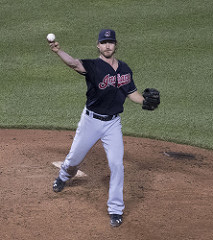
Josh Tomlin was one pitch away from a 1-2-3 first. Photo by Keith Allison 
The turning point in Game Six of the 2016 World Series came at a time that was both early and unexpected. Indians’ starter Josh Tomlin got off to a good start, retiring Cubs’ CF Dexter Fowler on a liner to third, DH Kyle Schwarber on a grounder to second and then getting 3B Kris Bryant down no balls-two strikes. Tomlin was one good pitch away from a 1-2-3 first. He didn’t get it, as Bryant took the 0-2 offering deep to center to give the Cubs an early 1-0 lead.
But that wasn’t the turning point – one run was not likely to win this contest. And, the Cubbies weren’t done. 1B Anthony Rizzo and LF Ben Zobrist followed with a pair of singles, putting runners on first and third (with Tomlin still one out away from a one-run inning). Then – wait for it, wait for it – came the turning point. SS Addison Russell hit what appeared to be an inning-ending soft fly ball to right center. In an apparent bout of miscommunication, CF Tyler Naquin and RF Lonnie Chisenhall (both seemingly in hot pursuit) let the ball drop in between them for a two-run double. To add insult to injury, Russell took third base on a throwing error by 2B Jason Kipnis. Cubs’ C Wilson Contreras then flied out to center to end the inning, but the damage was done: 3-0 Cubs and the Indians hadn’t batted. That “turning point “ inning had several effects: It took the crowd out of the game; put the Indians “under pressure” in the field and at the plate; most likely dampened Cleveland’s aggressiveness on the bases; and impacted how Indians’ manager Terry Francona used his usually fierce bullpen.
Star of the Game
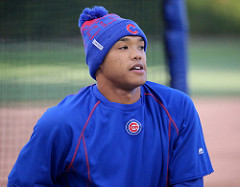
Photo by apardavila
The star of Game Six was Cubs’ 22-year-old SS Addison Russell with a double, home run and World Series record (tying) six RBI. Russell’s six runs driven in tied the Cardinals’ Albert Pujols (Game Three, 2011); Yankees’ Hideki Matsui (Game Six, 2009); and Yankees’ 2B Bobby Richardson (Game Three,1960). Russell’s Grand Slam was the first by a shortstop in the World Series and made him the second-youngest player to hit a Grand Slam in the Fall Classic (only Mickey Mantle was younger).
Pitching Decisions Questioned
The depth of the Cubs’ rotation came into play as Cubs’ starter Jake Arrieta started on his usual rest (the Cubs used a four-man rotation in the Series), while Josh Tomlin (the Indians’ went with a three-man rotation) started on short rest (and gave up six runs in 2 1/3 innings). The Indians’ Danny Salazar – who went 11-6, 3.87 in 25 starts, but came down with a right forearm strain late in the season – came in to pitch two scoreless innings (one hit and four strikeouts). Salazar’s performance led to some speculation that a Salazar start and game-by-committee (given Cleveland’s sparkling relief corps) might have better served the Indians. (Hindsight, however, is always 20/20 and Salazar was a big questins mark, while Tomlin has pitched well this post season.) Now, the Indians have ace Corey Kluber going in Game Seven, like Tomlin, on short rest.
Still the Indians have the bull pen advantage, as Cleveland Manager Terry Francona did not use any of his “lights-out” bullpen trio of Andrew Miller, Cody Allen and Bryan Shaw in Game Six. Five innings out of Kluber may be enough for the Tribe to take the finale.
Meanwhile, Cubs’ manager Joe Maddon surprised a lot of folks by using his two most trusted relievers – Mike Montgomery and closer Aroldis Chapman – in Game Six, despite a big lead.
The most engaging questions seem to be: 1) How effective will Kluber be pitching once again on short rest? 2) Has Maddon overused Chapman?. One thing for sure, there will be some intrigue.
Game Seven Starters
Let’s look at the Game Seven starting pitchers.
Corey Kluber – Cleveland
Kluber has been the Indians’ “ace” all season and in the post season. On the season he was 18-9, 3.14, with 227 strikeouts in 215 innings. His home and away stats were relatively even: 10-5, 3.24 at home and 8-4, 3.03 on the road. In the post season, he is 4-1, 0.89. with 35 strikeouts in 30 1/3 innings. And, while Kluber is going on short rest for the second straight start, he has a well-rested bullpen (Andrew Miller, Cody Allen and Bryan Shaw) behind him. This post season, that trio has pitched 38 innings, giving up just four runs (0.95 ERA), while fanning 62. Five quality innings from Kluber may be enough. BBRT will be watching Kluber’s early pitch count closely.
Kyle Hendricks – Chicago
The Cubs’ Kyle Kendricks wnet 16-8, with MLB’s lowest ERA (2.13) this season. During the regualr season, he fanned 170 batters in 190 innings. He was 9-2 1.32 at Wrigley and a still good, but less impressive, 7-6 2.95 on the road. Backing up Hendricks are likely a combination of starter Jon Lester and relievers Mike Montgomery and Aroldis Chapman. Lester, with a 1.93 ERA in five 2016 post-season starts could come in if Hendricks should falter early. Montgomery and Chapman – who both pitched yesterday – have made 22 appearances this postseason (28 1/3 innings), with a 2.86 ERA and 30 strikeouts. The Cubs need Hendricks to go deep in this game. If he could get into the seventh, it would make Maddon’s job a lot easier.
World Series Flashback – My Favorite Game Seven 1960
Game Seven of the 1960 World Series is my favorite World Series contest – which is saying a lot since I was in the park for Jack Morris’ 10-inniing shutout win in Game Seven of the 1991 Fall Classic. To understand why this is my favorite, it helps to set the stage:
- There were only 16 major league teams. If you didn’t finish with the most victories in your league, you went home.
- No one had ever heard of the designated hitter, the wild card, WAR or even WHIP.
- Home Run Derby was on TV – in black and white, with power hitters pairing off at Wrigley Field in Los Angeles.
- Ted Williams finished his career with a home run in his last at bat that season and Brooks Robinson won his first Gold Glove.
- MLB held two All Star Games.
- The 1960 White Sox became the first team to put players’ names on uniforms.
- Warren Spahn threw his first no-hitter taht season and won a league-leading 21 games – at age 39.
- Juan Marichal threw a one-hitter in his major league debut at age 22.
- Roger Maris won his first MVP Award in his first year as a Yankee (after being traded from the Kansas City Athletics).
I was thirteen and an avid baseball fan. The Game of the Week (in black and white), the radio – especially the radio – and an occasional trip to the ball park were my tickets to the national past time.
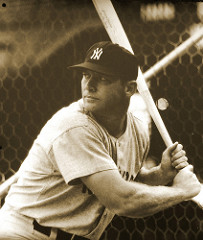
Mickey Mantle and the Yankees were a baseball dynasty going into the 1960s. Photo by Tony Fischer Photography
At the time, the Yankees were baseball’s dynasty. Since my birth in 1947, the Bronx Bombers had been to 11 World Series (including the 1960 Series, tied 3-3) and had won eight World Championships. Fans from pretty much everywhere but New York had made Yankee-hating a tradition. I was no exception. Milwaukee-born, I was a steadfast Braves fan, still smarting from the Yankees’ 1958 World Series comeback, when they downed my Braves after trailing three games to one.
The prognosticators had predicted a Yankee win in five or six games. They pointed out that the Yankees, with a 97-57 record (the Pirates were 95-59-1) came into the Series with the momentum of a 15-game, season-closing winning streak, while the Pirates lost four of their final seven. They also lauded the Yankees’ post-season experience and, they heralded the Yankees power (the Yankees led the AL with a record 193 home runs and 746 runs scored, while the Pirates led the NL with 734 runs scored, but only 120 round trippers) – the Yankees’ Game One starting lineup had belted 152 regular season homers to 98 for the Pirates’ starters. When it came to mound work, things appeared more balanced, maybe even a shade in favor of the Pirates. While the Yankees’ 3.52 ERA was the lowest in the AL, the Pirates’ NL third-best ERA (at 3.49) slightly bettered the Bomber mark. The Pirates did have the clear advantage in strikeouts (811-712) and fewest walks allowed (an NL low of 386 to an AL worst 609 for the Yankees). They also boasted the Cy Young Award winner in Vernon Law (20-9, 3.08), backed up by Bob Friend (18-12, 3.00), while no Yankee starter had topped 15 wins. The top relievers for the two teams were Elroy Face, with 24 saves for Pittsburgh and Bobby Shantz, who saved 11 for the Yanks.
YANKEE OFFENSE LEADING THE CARGE
To further set the stage, going into Game Seven (October 13 at Pittsburgh), the Series was tied 3-3, despite:
- The Yankees outscoring the Pirates 46 to 17 over the first six games;
- The Yankees out-hitting the Pirates 78 to 49 in the first six games; and
- The Yankees out-homering the Pirates eight to one in the first six games.
Still, the Pirates were looking forward the chance to win the Series at home behind Vernon Law (winner of Games One and Four.) The Yankees countered with Bob Turley, who, despite winning Game Two, had given up 13 hits and three walks in 8 1/3 innings. The Pirates also had their top left-handed hitter, Bob Skinner (injured in Game One), back at the number-three spot in the order, while the Yankees were missing Elston Howard (broken finger, Game Six).
PIRATE POWER TO THE LEAD
The Yanks went meekly in the top of the first inning (liner, popup, foul out), and the Pirates, homerless since 2B Bill Mazeroski’s blast in Game One, got a two-run homer from 1B Rocky Nelson (whom Murtaugh chose to start at first base over regular Dick Stuart).
In the second, Law set the heart of the Yankees down in order –CF Mickey Mantle, fly to center; LF Yogi Berra, grounder to third; 1B Bill Skowron, grounder to short. Pirates’ C Smoky Burgess started the bottom inning with a single and Yankee manager Casey Stengel immediately pulled starter Bob Turley in favor of the rookie Bill Stafford (who had stifled the Pirates for five innings in Game Five). The move, second-guessed by many, did not pay off. Stafford walked 3B Don Hoak and Mazeroski beat out a bunt single. Vernon Law was now at the plate (the Pirates’ pitcher was two for four, with a double, run scored and RBI in Games One and Four). Law hit back to Stafford for a pitcher-to home-to first double play, but CF/lead-off hitter Bill Virdon followed with a two-run single and a 4-0 Pirates lead. The Yankees were on the ropes.
YANKEE BATS WARM UP
Law handcuffed the Yankees through four innings, giving up only two singles. In the fifth, YankeeS’ 1bMoose Skowron made the score 3-1 with a lead-off homer just inside the right field foul pole. Law did not let the round tripper upset him, retiring C Johnny Blanchard, 3B Clete Boyer and P Bobby Shantz (who came on to pitch for New York in the third) in order.
The Yankees closed the gap – and then some – in the top of the sixth. Pesky New York 2B Bobby Richardson (who already had nine hits in the series) led off with a single to center, and SS Tony Kubek followed with a walk. With the Bombers appearing on the verge of a rally, Murtaugh replaced Law (who, it turns out had been pitching on a sore ankle throughout the Series) with his top reliever Elroy Face. Face got RF Roger Maris on a foul pop to 3B Don Hoak, but Mickey Mantle followed with a “seeing eye” single up the middle, scoring Richardson. Yogi Berra followed with a upper deck home run (like Skowron’s just inside the right field foul pole) to give New York a 5-4 lead in what was shaping up to be a nail biter. Veteran Bobby Shantz, meanwhile, was baffling the Pirates – giving up only a single and a walk from the third to the seventh innings.
In the top of the eighth, the Yankees appeared to put the game away – using a walk, two singles and a double to produce two more runs and a 7-4 lead. Notably, Stengel’s pitching decisions again came into play. He let Shantz bat with two out and runners at second and third (Boyer and Skowron) and a chance to extend the Yankee lead. Shantz flied out and the living-room and press-box managers were quick to point out: 1) The lost scoring opportunity; 2) The fact that Stengel left Shantz in for a sixth inning of work, despite the fact that Shantz had not gone more than four innings in the regular season.
A PEBBLE SENDS WAVES ACROSS THE DIAMOND
In the bottom of the eighth, things unraveled for the Yankees, thanks to a poorly placed pebble. Gino Cimoli pinch hit for Face and stroked a single to right-center field. Shantz, who had already induced two double plays appeared to have worked his magic again, as CF Bill Virdon hit a hard ground ball right at Yankee SS, sure-handed Tony Kubek. Just as Kubek was ready to field the ball, it appeared to hit a pebble (the Yankees had already been critical of the condition of the Forbes Field infield) and ricocheted into Kubek’s throat. Kubek went down, gasping for air and spitting up blood, with his windpipe rapidly swelling (doctors on the scene at first thought an emergency tracheotomy might be necessary). The end result? Kubek sent to the hospital and replaced by Joe DeMaestri and the Pirates had two on and no outs, instead of none on and two outs. (Read: Aha, the turning point.)
Pirates’ shortstop Dick Groat took advantage of Kubek’s mishap and lined singled to left, scoring Cimoli. Stengel came to the mound and replaced Shantz with right-hander Jim Coates (despite the fact that lefty Bill Skinner was coming to the plate). The righty-lefty matchup made little difference, as Skinner sacrificed the runners up one base. Next was Rocky Nelson, who flied out to medium right, with the Pirates choosing not to test Roger Maris’ arm. So, two outs, two on and the Yankees still in front 7-5. That brought up the Pirates’ best hitter, RF Roberto Clemente, who had been held hitless in his first three at-bats. Coates made a good pitch, getting Clemente to hit a weak ground ball toward first. A hustling Clemente beat both Coates and Skowron’s throw to the bag, while Virdon scored and Groat moved to third. Now, 7-6 and the Pirates still had life.
That brought up backup catcher Hall Smith (who had come into the game in the eighth after Joe Christopher ran for starting catcher Smoky Burgess in the bottom of the seventh). Smith took a 2-2 Coates’ pitch over the left-field wall for a 9-7 Pittsburgh lead. The Pirates, with only one round tripper in the first six games had homered twice for five runs in Game Seven.
YANKEES NEITHER GIVE IN NOR GIVE UP
To protect the lead in the ninth (and with Elroy Face already out of the game), Pirate Manager Danny Murtaugh called on starter Bob Friend, who had lost Games Two and Six, giving up seven earned runs in six innings (and had pitched in relief only once all season). Yankee lead-off hitter Bobby Richardson started off the ninth with a single to left. Veteran and former-Pirate Dale Long, pinch hitting for Joe DeMaestri (who had replaced the injured Kubek) singled to right and Friend was gone, replaced by Game-Five starter Harvey Haddix. Haddix got Roger Maris on a foul out, but Mickey Mantle drove in Richardson with a single to right center. Yogi Berra followed with a ground ball down the first base line. Rocky Nelson made a nice backhanded stop, but was out of position for a first-to second-to first, game-ending double play. Nelson took the sure out, stepping on the first base bag and retiring Berra, while Gil McDougald (pinch running for Long) headed toward home. It was at this point that Nelson realized Mantle had not run to second. Mantle, sizing up the situation, was returning to first (with the force at second now off). It was an unorthodox base-running move, but as Mantle dove head first back to the bag (avoiding Nelson’s desperate attempt to tag him), McDougald scored the tying run. Skowron then grounded out to Mazeroski (forcing Mantle) to end the inning in a 9-9 tie. Still, Mantle’s heads up baserunning had kept the Yankees in the game.
THE FIRST WORLD SERIES-ENDING WALKOFF HOME RUN
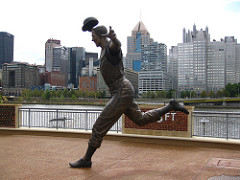
Bill Mazeroski’s Series-winning home run has been immortalized in Pittsburgh. Photo by daveynin
Stengel, like Murtaugh, was now using starters in relief, bringing Game Four-loser Ralph Terry in to pitch the ninth. Number-eight hitter Bill Mazeroski led off the inning. Terry’s first pitch was a high and inside fastball. The second pitch, another fastball, was in the strike zone and Mazeroski deposited it over the 406-foot marker in left center. Not sure the ball would carry out in the deep part of the park, Mazeroski ran full speed with his head down to first and toward second, before seeing the umpire making the circular home run signal. Mazeroski removed his helmet, waving his way to home plate where his team mates awaited the first player in major league history to end the World Series with a walk-off home run.
Trivia Tidbit: The seventh game of the 1960 Series is the only World Series game in which neither team recorded a single strikeout.
FINAL: Pirates 10 – Yankees 9; Pirates 4 games – Yankees 3 Games. M
When the Series was over, Pirate pitching made the difference, but you could never tell from the stats line:
- The Yankees scored a Series’ record 55 runs to 27 for the Pirates,
- The Yankees collected a Series’ record 91 hits to 60 for the Pirates.
- The Yankees hit a Series’ record .338 to .256 for the Pirates
- The Yankees collected a Series’ record 27 extra base hits to 15 for the Pirates.
- The Yankees out-homered the Pirates 10-4.
- The Yankees’ pitchers put up a 3.54 ERA to 7.11 for the Pirates.
- Bobby Richardson of the Yankees won the Series MVP award, hitting .367 with a Series’ record 12 RBI. The only player on a losing team to ever win the Series MVP Award.
- The Yankees’ Whitey Ford was the Series’ most effective pitcher, throwing two complete game shutout in two starts.
I tweet baseball @DavidBBRT
Member: Society for American Baseball Research (SABR); The Baseball Reliquary; Baseball Bloggers Alliance.