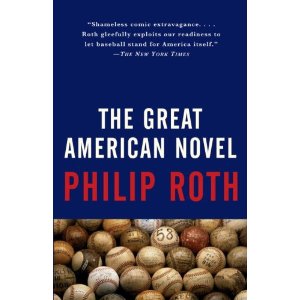
The Great American Novel by Philip Roth
 WARNING! If you are looking for political correctness – avoid this book.
WARNING #2! If you have an adverse reaction to laughing out loud – avoid this book.
Perhaps most famous for his novels American Pastoral (which earned a Pulitzer), Goodbye Columbus and Portnoy’s Complaint (thanks in part to their translation to the big screen), Philip Roth has made a unique contribution to hardball literature – The Great American Novel. BBRT considers this a must-read – well at least the first two-thirds of the book. Readers should be forewarned, however, that – like the movie “The Loved One,” the Great American Novel can promise something to offend everyone. Yet, it is this across-the-board irreverence that makes the offense tolerable and even comic.
The book, set in the 1940s, recounts the very-comic sufferings of the Port Ruppert Mundys – a baseball team of limited skill and unlimited neurosis that (due to losing its stadium to the war effort) must play an entire season on the road.
Written from the perspective of retired sport journalist “Word Smith,” The Great American Novel takes you into the hearts and (often dark) souls of a team made up of ex-cons, alcoholics, amputees, veteran players well beyond their primes, 90-pound adolescents not ready for the big-time, and even extremely vindictive lilliputians – and into ballparks in places like Asylum, Ohio, Terra Incognita, Wyoming, and Kakoola, Wisconsin. It also takes you from the dugout to an asylum (for an exhibition game) to the House UnAmerican Activities Committee. The prologue includes Word Smith’s encounter with Earnest Hemingway and the book wraps up with a letter written by Smith to China’s Chairman Mao.
In short, the book covers a lot of ground and smashes a lot of myths along the way. But, it’s first and foremost the story of a team of misfits and maniacs (when you read the book you’ll understand the alliteration) – and secondly a story of the Patriot League and a conspiracy (with roots deep in the Communist threat of the Cold War) to eliminate any reference to this third major league from the annals of baseball history. It is, in fact, in the final one-third of the book, when Roth turns from sport to conspiracy that The Great American Novel bogs down a bit, but – even if you only read the first 200 or so pages – The Great American Novel provides a real “experience” for the baseball fan.
Give it a read and let BBRT know what you think.