Yesterday (May 9), as the Marlins topped the Brewers 4-1 in Miami, Marlins’ catcher J.T. Realmuto had what would have been his third home run of the season turned into an out on the base paths and an RBI single. It came in the second inning, after Realmuto hit what appeared to be a two-run homer (Marlins’ CF Marcell Ozuna was on first base). Ozuna, however, thought Brewers’ CF Kirk Nieuwenhuis had a chance to track the ball down at the wall. So, Ozuna was returning to first base, in case he had to tag up – just as Realmuto was rounding the bag. For a brief couple of seconds, Realmuto passed Ozuna on the base paths and, in accordance with the rules, was called out – resulting in a 409-foot, RBI single.
Land of the Lost – Let’s Look at Some “Lost” Long Balls
BBRT brings this play up not because it is so rare (there have been dozens of “lost’ home runs) or even because it had an impact on the outcome of the game (the Marlins still won 4-1). Rather, I am using it as a segue into a look at my own very subjective list of the five most significant or interesting lost round trippers.
Now, for purposes of this post, I am eliminating unavoidably lost (from the players’ and coaches’ points of view) home runs. This includes those lost under such circumstances as rain outs, bad calls by umpires, forfeited games, unusual ground rules (catwalks, speaker wires, etc.). I’ll focus on those home runs lost due to what I would consider avoidable circumstances – such as players’ base running errors, coaches’ mistakes, batting out of order, etc. So, here are BBRT’s five most significant or interesting lost home runs.
- Number-one on the list is pretty easy. It was not only a lost home run, but a lost “extra-inning, walk-off Grand Slam – IN THE POST SEASON. In fact, had it not been lost, it would have been the first walk-off, Grand Slam in MLB post-season history.
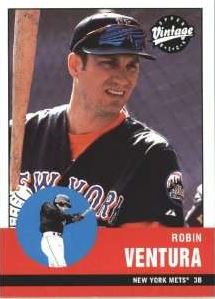
Robin Ventura – hit the true GRAND-daddy of lost home runs.
It came on October 17, 1999, in the fifteenth inning of Game Five of the National League Championship Series between the Braves and Mets (in New York). The Braves had a three games-to-one lead in the NLCS, and Game Five had been tied at 2-2 since the fourth inning. In the top of the fifteenth, Atlanta had taken a 3-2 lead on a single by SS Walt Weiss and a triple by 2B Keith Lockhart. The Mets, however, came right back in the bottom of the inning. It started with a single and stolen base by CF Shawon Dunston, followed by a walk to pinch hitter Matt Franco, a successful sacrifice by 2B Edgardo Alfonzo and an intentional walk to 1B John Olerud. Catcher Todd Pratt then drew a walk to force in the tying run. This brought 3B Robin Ventura to the plate with the game tied and the bases loaded – and that’s when the fun began.
Ventura launched a ball over the right field fence (off right-hander Kevin McGlinchy) for what appeared to be a game-winning, walk-off Grand Slam. However, once the winning run crossed the plate, Pratt turned and ran back to Ventura to give him a celebratory hug. At about the same time, a cadre of Mets poured out of the dugout and onto the field to celebrate the victory. Since, in the chaos, each runner advanced only one base before Ventura passed Pratt on the base paths, the Mets’ 3B was credited not with a Grand Slam, but with an RBI-single.
The lost home run would have been the first game-ending, walk-off Grand Slam in MLB post-season history. Instead, that honor went to the Rangers’ Nelson Cruz, in Game Two of the 2011 American League Championship Series.
_____________________________________
2. Number-two on my list of lost long balls, is significant for putting a dismal exclamation point on one of the best games ever pitched. Like number-one, it put an end to an extra-inning contest – this time in the thirteenth inning. More significant, it put an end to a game in which the starting, and losing, pitcher had been perfect for 12 innings. That’s right 36 up and 36 down going into the unlucky 13th.
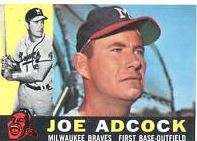
Joe Adcock – spoiled Harvey Haddix’ day.
On May 26, 1959, the Pirates’ Harvey Haddix took the mound against the powerhouse Milwaukee Braves (who had won the National League pennant the previous two seasons and came into the game again leading the league). Haddix retired the first 36 hitters in order (eight strikeouts), carrying a perfect game into the bottom of the 13th. Unfortunately, the Braves’ Lew Burdette, despite giving up 12 hits and fanning only two, had held the Pirates scoreless. Braves 2B Felix Mantilla led off the Braves’ half off the 13th by reaching on error by Pirates’ 3B Don Hoak. Slugging Milwaukee 3B Eddie Mathews bunted Mantilla over to second, which led to an intentional walk to RF Hank Aaron, bringing up 1B Joe Adcock. Adcock rapped a 1-0 pitch over the right field fence for what appeared to be a three-run home run. However, the Braves, in celebrating the tension-filled victory, forgot how to run the bases. Adcock passed Aaron between second and third and, after some deliberation, Adcock was called out – changing his three-run homer to a one-run double. So, despite 12 perfect innings, Haddix lost the no-hitter, the shutout and the game itself. Consolation for Adcock – all he lost was a home run and a couple RBI.
_________________________________________________
- Third place on this list goes to a lost home run that would have been the only home run in a player’s career.
On April 17, 1914, the Federal League Buffalo Blues were facing off against the Baltimore Terrapins in Baltimore. In that contest, Blues’ RF and cleanup hitter Luther Bonin bashed what he thought was his first major league home run. As Bonin rounded third base, Blues’ manager Larry Schlafy, coaching third, patted him on the back. Now, the rules prohibit such contact (touching or holding a runner) if, in the judgment of the umpire, the contact “assists” the runner. The umpire made that judgment and Bonin was called out on coach’s interference and credited with a triple. The faux pas did not affect the outcome of the game– the Blues topped the Terrapins 4-3. It did affect Bonin’s line in the record books; robbing him of the only home run he hit in his 21-game MLB career. On the bright side, it did earn him his only career three-bagger.
Honorable Mention. A lost home run that escaped Tigers’ SS Frank Sigafoos (had to get the name in here) on April 21, 1929 gets an honorable mention here. In a game in which the Tigers topped the Saint Louis Browns 16-9, Sigafoos hit what he thought was his first MLB home run. However, the umpire had called a balk on the pitch (which is why it doesn’t exactly fit the criteria for a spot on the list)– negating Sigafoos’ long ball. While it didn’t affect the outcomes of the game, it did cost Sigafoos the only round tripper in his three-year, 55-game MLB career.
______________________________________
4. Number four on this list is significant in that it gave Babe Ruth a share of the 1931 home run title – which sets the record for HR titles in a career at 12, rather than 11.
It happened on April 26, 1931, with the Yankees facing the Senators in Washington. In the top of the first, with Yankee SS Lyn Lary on first base and two out, New York 1B Lou Gehrig hit a home run to center field (off Senators’ starter Firpo Marberry – not significant, just like the name). The hard hit ball however, bounced back out of the bleachers to Senators’ CF Harry Rice. Lary thinking the ball was caught, headed to the dugout – without touching the plate. Gehrig was declared out for passing Lary and credited with a triple. This one did affect the game – which the Yankees lost 9-7 (after losing Gehrig’s two-run blast). Further, it cost Gehrig the outright AL home run crown, he ended the season tied with Ruth at 46. Gehrig also set the AL single-season RBI record at 185 in 1931, Had he not lost that home run, the record would be 187.
____________________________________________
5. No one likes to “lose” a home run – particularly a Grand Slam and, even more particularly, a pinch-hit Grand Slam. And that combination takes the five-spot on the list.
It happened on July 9, 1970, with the Red Sox facing the Tigers in Detroit. In the bottom of the seventh inning of a 3-3 game – with two outs and the bases loaded – the Tigers called on Dalton Jones (who had been traded from the Red Sox to the Tigers in the off season) to pinch hit for catcher Jim Price. Jones launched a long ball into the right field upper deck for an apparent Grand Slam. For some reason (Remember, this ball was in the upper deck.), the base runner at first (Don Wert) decided to tag up – and was passed on the base paths by Jones. Jones was called out and credited with a three-run single. Dalton’s three RBI did help the Tigers win the contest by a 7-3 score. Note: It would have Jones first MLB Grand Slam.
Honorable Mention: As I’ve noted, no one likes to lose a Grand slam – especially a pitcher. On September 20, 1972, Steve Busby started on the mound for the Royals against the Angels (in Anaheim). Rudy May started for California – and it was a rocky beginning. In fact, Busby – hitting in the nine-spot – came to bat in the top of the first with the bases loaded, four runs in (thanks to a Grand Slam by 1B John Mayberry) and just one out. Busby hit a Grand Slam off reliever Lloyd Allen – at least he thought he did. However, first base umpire had called time out before the pitch – negating the blast – which would have made Busby part of a record-tying two Grand slam inning. Busby did eventually touch Allen for a two-run single to center in his extended at bat, but I’m sure he would rather have had the Grand Slam. (By the way, the Royals won 9-2, Busby pitched a complete-game seven-hitter – and collected three hits and three RBI of his own.
I tweet baseball @DavidBBRT
Member: Society for American Baseball Research (SABR); The Baseball Reliquary; Baseball Bloggers Alliance.