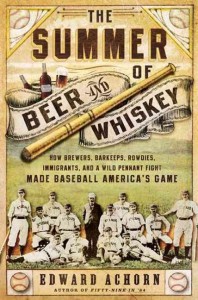
 The Summer of Beer and Whiskey – How Brewers, Barkeeps, Rowdies, Immigrants and a Wild Pennant Fight Made Baseball America’s Game
By Edward Achorn
2013, Public Affairs
$26.99
“Everyone who knew Chris Von der Ahe, it seems, had a story about him – his colossal pomposity; his wonderful generosity; his red-faced rages that inevitably recoiled catastrophically on himself; his thick German accent and wobbly use of the English language; and his insatiable appetite for beer, beautiful young women, song and life. As a baseball owner, he was George Steinbrenner, Charlie Finley and Bill Veeck rolled into one.”
That’s how Edward Achorn describes the central character in “The Summer of Beer and Whiskey – How Brewers, Barkeeps, Rowdies, Immigrants, and a Wild Pennant Fight Made Baseball America’s Game.” Achorn proved his ability to bring baseball’s early history to light and to life with his 2010 offering “Fifty-nine in ’94 – Old Hoss Radbourn, Barehanded Baseball & the Greatest Season a Pitcher Ever Had” (see BBRT review in post of March 28, 2013). In The Summer of Beer and Whiskey he reaffirms that talent.
The focal point of The Summer of Beer and Whiskey is the American Association pennant race of 1883 – a spirited battle between the Philadelphia Athletics and the St. Louis Browns that went down to the season’s final day. The book, however, really tells the story about how Van der Ahe and the upstart American Association helped revive, perhaps even save, the national pastime.
Ultimately, it’s a history lesson wrapped in a pennant race – and that combination turns out to be not only informative, but a lot of fun. Achorn has a proven ability to bring history to light and to life.
In the late 1870s and early 1880s, “base ball” (it was two words back then) was far from the national pastime. The game was in trouble, impacted by the depression of the 1870s and the influence of gambling interests, elitist ownership and the drunken, rowdy and sometimes corrupt players. On top of that, the National League’s fifty-cent admission price and ban on Sunday baseball kept most of the working class out of the ballpark.
Despite all of this, Van der Ahe – who immigrated to the United States in 1867 and knew a lot more about beer than he did about baseball – saw potential in the sport. Van der Ahe, who settled in St. Louis (then the nation’s sixth-largest city), started as a grocery clerk, but in just a few years had acquired ownership in a grocery store, a saloon and boarding house. But he wanted even more – and saw American baseball (and beer) as the door to wealth and fame. Ironically, it was the decline of professional baseball in St. Louis that opened that door for him. Scandals related to gambling had soured the city on the sport and, in 1878, St. Louis, for the first time in many years, found itself without a major league franchise. The fans still following the sport had to satisfy themselves with the play of the semipro Saint Louis Brown Stockings (the team had taken the name of the former National League squad).
In late 1880, Van der Ahe stepped into this situation, sinking his life savings into the Brown Stockings and the deteriorated “Grand Avenue (Ball) Park.” His vision was for “cheap tickets, booming beer sales and big crowds adorned by beautiful women.” That vision, however, was not shared by the National League and Van der Ahe’s hopes for St. Louis’ return to the League were quickly squelched. That rejection proved essential to the formation of the rival American Association and the reshaping of the national pastime.
Rejected by the National League, the Brown Stockings initially played as an independent – offering: an acceptable brand of baseball; admission prices only half of the NL (25 cents vs. 50 cents); Sunday baseball (banned by the NL); and the availability of alcoholic beverages (also banned by the NL) at the ballpark. Out of the St. Louis Brown Stockings’ rising popularity came the 1881 formation of the American Association termed, by critics “The Beer and Whiskey League” because of its heavy backing from brewers, distillers and tavern keepers. (The Association played its first official season in 1882.)
Achorn’s book tells the tale of how Van der Ahe and the American Association helped revive interest in baseball, create new legions of “fans” and position the game as America’s pastime.
Van der Ahe isn’t the only “character” who adds life to the Association and the story. Achorn also gives readers an inside look at the rough and rugged individuals who made the AA a success. Its pages are populated with players like the Louisville Eclipse’s premier batsman Pete Browning, from whom the Hillerich and Bradsby iconic “Louisville Slugger” got its name (and who was also known as “The Prince of Bourbon”); pitcher Jumping Jack Jones, who literally jumped from Yale University to the Philadelphia Athletics with his strange, leaping delivery; Bobby “Shrimp” Mathews, who pitched his heart and his arm out for the Athletics; St. Louis Brown Stockings’ infielders Arlie Latham and Charley Comiskey, of whom the Sporting News reported “Latham is the mouth of the St. Louis Club, Comiskey its head;” and many more.
There is also much to learn about the early days of baseball in the pages of Achorn’s book – which chronicles a time when it was a brutal game: players were without batting helmets or fielding gloves; teams carried only twelve or thirteen players and injury substitutions were almost unheard of; road trips could last a month; foul balls were not strikes; overflow crowds typically stood inside the outfield fence (with balls hit into the crows considered ground rule doubles); batters were not awarded first base when hit by a pitch, making the bean ball a useful (and frequent) weapon of intimidation; and umpires often needed a police escort to get out of the park.
Achorn depends a great deal on news reports of the time in this historical account and the language of the day is enjoyable (far more colorful and less forgiving than today’s reporting). Of one player, slowing with age, it is reported that “an ice wagon would have to be handicapped in a race with him;” another is described in daily news reports as “a wretched fielder and a very moderate batsman;” and a player guilty of an error is chided in print with he “couldn’t have stopped a part of the roof of the grandstand had it blown over his way;” another player’s miscue draws the media comment, “Such slouchy work is is calculated to disgust spectators and demoralize a nine.”
Achorn also dedicates some well-deserved prose to the plight and trials of Moses Fleetwood Walker, who made his foray across baseball’s color line nearly seven decade before Branch Rickey and Jackie Robinson made public their intention to erase it.
The Summer of Beer and Whiskey gives readers a look at the fast-paced America of the late 1800s: its changing culture and economy; its continuing conflicts of class and race; and its energy and opportunity. All of which were lived out on and off the “base ball” diamond.
“It (baseball) is a quick, nervous, dashing, brilliant kind of sport,in keeping with our American characteristics.” Philadelphia Evening Bulletin – Sept. 29, 1883
In the Epilogue, Achorn shares a look at what happened to many of the principal characters after the American Association’s exciting 1883 pennant race and ten-season run (1882-1891 – in 1892, the Association’s strongest franchises merged with the National League and four – Dodgers, Cards, Reds and Pirates – continue today).
All in all, The Summer of Beer and Whiskey is another enjoyable and informative offering from Edward Achorn – of particular interest to (and highly recommended for) baseball fans, but also a fun and fast-paced read for those who’d like to gain a better understanding of the American experience of the late 19th century.