It’s time again for Baseball Roundtable’s Trivia(l) Tidbit Tuesday. I hope you are enjoying this weekly presentation of baseball occurrences that for some reason caught The Roundtable’s eye. (I’m particularly fond of unexpected performances and statistical coincidences.) These won’t necessarily be momentous occurrences, just events, statistics or coincidences that grabbed my attention. I’m also drawn to baseball “unicorns,” one-of-a-kind MLB accomplishments or statistics. Usual Disclaimer: Negro League game-by-game stats from 1920-48 are not yet fully incorporated into the MLB record books.
At times, as I prepare these tidbits, my mind begins to wander towards statistical queries of questionable significance. For example, as I pondered this week’s post, I started with a look at MLB pitchers who had the most strikeouts in their debut MLB appearances. I found, of course, that (in the Modern Era) J.R. Richard and Karl Spooner lead the way – each sending 15 hitters back to the dugout bat-in-hand during their MLB mound debut. I also noted that there were only eight MLB pitchers who fanned at least a dozen batters in their big-league debut and, always on the lookout for a “unicorn,” only one of those also won 20 games in his debut season. (More on that coming up in a bit.)
Of course, with The Roundtable, one thing seems to lead to another. So, I went on to look at Modern Era pitchers who won 20 or more games in their debut season. I found 16 of those. (Side note: I looked at “debut” seasons, not season in which the player had “rookie” status. Looking for a unicorn from among that group, I discovered that only one of those sixteen also struck out at least 200 batters in his debut season and only one played just that lone season in the major leagues.
Side note: I looked at MLB-debut seasons, not seasons in which the pitcher retained “rookie” status. Russ Ford of the 1910 Yankees is a case in point. He went 26-6, 1.65, with 209 strikeouts in 1911, but had pitched three innings, giving up four runs, in one game for the Yankees in 1910. So, he did not make these lists.
Plenty more on hurlers to make these lists to come … after a (tid)bit of a diversion. Those of you who are not interested in pre-1900 statistics can skip over the diversion.
________________________________
I Digress … Why I’m Focusing Primarily on Modern Era Pitchers
I went with Modern Era for the bulk of this post because it offers a better comparison to today’s game. For those who like to know such things (I do), from 1871-1900, there were 33 pitchers who won 20 or more games in their MLB debut season – and eight of those won 30 or more, led by Larry Corcoran’s 43-win season for the 1880 Chicago White Stockings (43-14, 1.95 in 63 games/60 starts). Of the 33 20+ game winners, who qualified for pre-1900 listing) just six topped 200 strikeouts in their debut season, led by Matt Kilroy’s 513 strikeouts for the 1886 American Association Baltimore Orioles (29-34, 3.37 in 68 games – all starts, 66 complete games). The pre-Modern Era pitchers to notch 20 or more wins and 200 or more strikeouts in their debut season were: Corcoran (43-14, 1.95, 268K); Kilroy (29-34. 3.37, 513K); Ed Morris (34-13, 2.18 with 302 strikeouts for the 1884 American Association Columbus Buckeyes); George Derby (29-26, 2.20, 212K for the 1881 Detroit Wolverines); Charles “Kid” Nichols (27-19, 2.23, 222K for the 1890 Boston Beaneaters); Al Atkinson (20-26, 3.36, 247K in 1884, when he pitched for the American Association Philadelphia Athletics and the Union Association Baltimore Monumentals).
_____________________________
The only Modern Era pitcher to rack up 20 wins and 200+ strikeouts in his debut season was Grover Cleveland Alexander – 28-13, 2.57, with 227 strikeouts in 367 innings for the 1911 Phillies).
Alexander, of course, went on to the Hall of Fame with a 373-208, 2.56 record over 20 MLB seasons (1911-30 … Phillies, Cubs, Cardinals). He had nine seasons of 20 or more wins (three of 30 or more) and four seasons of 200 or more strikeouts. He led the league in wins and whiffs six times each and earned run average five time.
Henry Schmidt … A One and Done Unicorn – At Least for the Major Leagues
In 1903, five minor-league seasons, 30-year-old righty Henry Schmidt made his major-league debut with the Brooklyn Superbas and went 23-13, 3.83 in 40 appearances (36 starts/29 complete games/five shutouts). That season earned him “unicorn” status as the only pitcher who won 20 or more games in his sole MLB season. He did play in four more minor-league seasons after that lone MLB campaign. For more on Schmidt’s career, click here.
At the end of the full post, there is a full list of Modern Era players to reach 200 or more strikeouts in their MLB debut season.
Now, switching gears a little. The chart below shows the eight Modern Era pitchers to fan at least 12 batters in their MLB debut.
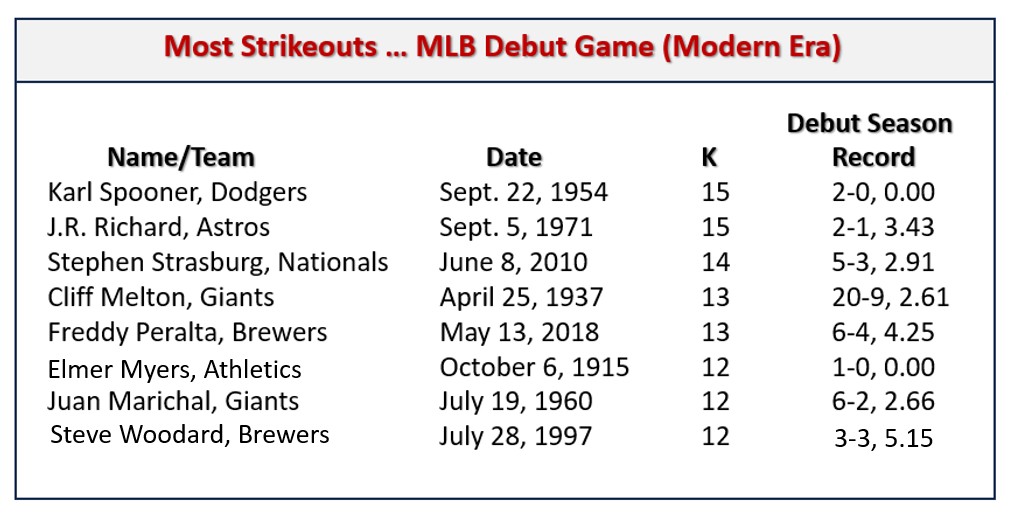 O. Let’s look at a few of them.
The Unicorn … Cliff Melton, LHP, 1937 Giants
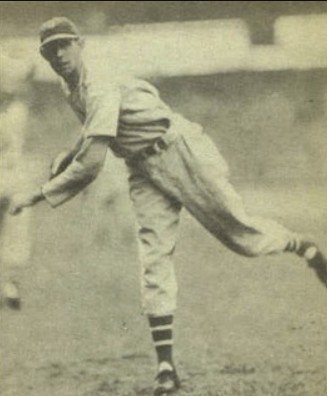
Photo: Melton Play Ball cards, published by Bowman Gum, Public domain, via Wikimedia Commons
We’ll start with the unicorn on this chart. Twenty-five-year-old southpaw Cliff Melton made his MLB debut for the Giants on April 25, 1937. (In 1936, his sixth professional season, he had gone 20-14, 3.39 for the Double-A Baltimore Orioles of the International League.)
In his MLB debut, Melton pitched well in a 3-1 loss to the Boston Bees in New York. He went all nine innings, giving up three runs (two earned) one six hits, walking two (one intentionally) and striking out 13. (To add some context, in 1937, the NL average strikeouts per nine innings was 3.7.) Although, he pitched reasonably well early in the season, Melton was just 1-3 (2.38 ERA) after five starts and his next 14 appearances were out of the bullpen, where he went 3-1, 1.65, with five saves (figured retroactively). Back in the rotation on June 20 (22 of his final 29 appearances were as a starter), Melton went 16-5, 2.80, with two saves to finish the season at 20-9, 2.61 with 14 complete games and two shutouts in 27 starts/46 appearances.
Melton’s rookie campaign proved to be his best in eight MLB seasons (1937-44 … Giants). In his debut season, he set what would be his career best in wins (20), winning percentage (.690), ERA (2.61), appearances (46), complete games (14), innings pitched (248) and strikeouts (142). (He never won more than 14 games in a season over the rest of his MLB career and finished with MLB stat line of 86-80, 3.42, with 16 saves, 65 complete games and 13 shutouts.
A Bit of a Unicorn In Nis Own Right … Karl Spooner, LHP 1954 Dodgers
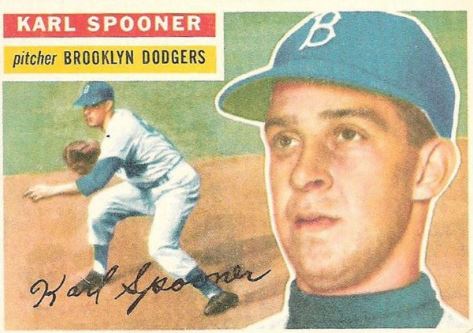 Southpaw Karl Spooner’s record MLB-debut 15 strikeouts (September 22, 1954) came in a three-hit, three-walk, 3-0 shutout win over the Giants) and gave him unicorn status until J.R. Richard tied that debut-K mark in 1971. However, in his very next start (September 26), Spooner cemented a spot as a unicorn that still stands. In his second MLB appearance, he threw another shutout (a four-hit, three-walk, 1-0 win over the Pirates) and fanned 12. The 27 whiffs in his first two MLB games stand as a record (closest to Spooner are Cliff Melton and Stephen Strasburg at 22 and only six Modern Era pitchers have fanned 20 or more batters in their first two games). Those 27 whiffs in his first 18 MLB innings are even more notable when you consider that, in 1954, the MLB average for strikeouts per nine innings was 4.2.
Spooner started the 1954 season with the Double-A Fort Worth Cats – and went 21-9, 3.14, with 262 strikeouts and 162 walks in 238 innings. That earned him a September call up to the Dodgers – and his place in MLB history.
Spooner is also one of just six Modern ERA pitchers to throw shutouts in their first two MLB appearances (Spooner, Joe Doyle (1906 Yankees); Johnny Marcum (1933 Athletics); Dave Ferriss (1945 Red Sox); Al Worthington (1953 Giants); and Tom Phoebus (1966 Orioles). Side note: Those two shutouts marked Spooner’s only two appearances in his debut MLB season
Spooner’s blazing start, smoldered quickly – dampened by a shoulder injury suffered in Spring Training the following year (1955). Long story short: Spooner didn’t get his first start of the 1955 season until May 15 and 1955 was his final MLB season. He finished with a career line of 10-6, 3.09 (1954-55 Dodgers). For much, much more on Spooner career, click here.
Nobody ever threw harder than that kid (Spooner) did in the first two games he pitched in the majors. He’s the greatest young pitcher I’ve ever seen.
Hall of Fame Dodger Catcher Roy Campanella
Let’s Get a righty in Here … J.R. Richard, RHP, 1971 Astros
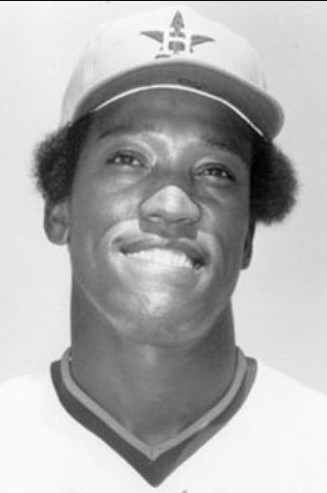
Photo: Houston Astros via tradingcarddb.com, Public domain, via Wikimedia Commons
Right-hander J.R. Richard made his MLB debut on September 5, 1971, tossing a complete-game, seven-hitter, as his Astros topped the Giants (in San Francisco) 5-3. Richard fanned 15 in the game – tying the MLB rerod for strikeouts in a debut game. (Richard was called up to the Giants after posting a 12-7, 2.45 record, with 202 strikeouts in 173 innings, with the Triple-A Oklahoma City 89ers.)
Richard pitched in three more games with the Astros that season, going 2-1, 3.43 on the season, with 29 strikeouts (16 walks) in 21 innings. A “You’ll probably never see that again” moment – Richard threw 155 pitches in his MLB debut.
Like Spooner and Melton before him, Richard’s potential was thwarted. He suffered a number of bouts of inconsistent control, as well as some health issues, and from 1971-1974 put up a major-league stat line of 11-6, 4.34, with 154 strikeouts and 98 walks in 163 2/3 MLB innings (spending time in the minor leagues in each season).
In 1975, things began to fall into place, as Richard spent the whole season with the Astros going 12-10, 4.39, with 176 strikeouts (but also leading the league in walks with 138 and wild pitches with 20) in 203 innings. Then, from 1976 through July of 1980, he was one of MLB’s most dominant pitchers, going 84-55, 2.79, with 1,163 strikeouts and 534 walks in 1,239 1/3 innings pitched. He won 20 games in 1976 (20-15, 2.75) and 18 games each season from 1977-79. Richard led the league in ERA in 1979 (2.71) and strikeouts in 1978-79 (303 & 313, respectively). In 1980, he started the All Star game (his first half record was 10-4, 1.96, with 115 strikeouts and 39 walks in 110 1/3 innings pitched). Then on July on July 30, disaster struck. Richard (who had previously noted some neck, shoulder and arm issues) suffered a severe stroke during pregame drills and underwent major surgery to remove a life-threatening blood clot in his neck. He attempted a comeback (minor leagues … 1982-83), but never pitched in the majors again. Richard’s final MLB stat line was 107-71, 3.15, with 76 complete games and 19 shutouts in 238 appearances (221 starts) and 1,493 strikeouts in 1,606 innings pitched.,
He (J.R. Richard) had the greatest stuff I have ever seen and it still gives me goosebumps to think of what he might have become.
Hall of Famer Joe Morgan
Now, Here’s that promised list of Modern Era players to notch 200 strikeouts in their debut season.
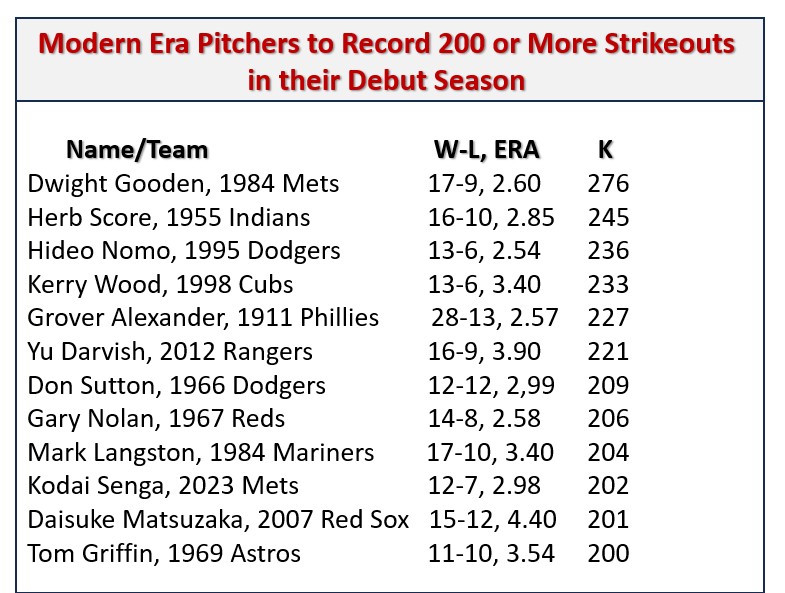
For those who like to know such things: From this list, Dwight Gooden, Herb Score, Hideo Nomo, Grover Alexander, and Mark Langston each led their league in strikeouts in their MLB-debut seasons. Of the player in the above chart, Grover Alexander and Don Sutton are currently in the National Baseball Hall of Fame.
Primary Resources: Baseball-Reference.com; J.R. Richards Tribute. AstrosDaily.com
Baseball Roundtable – Blogging Baseball Since 2012.
 Baseball Roundtable is on the Feedspot list of the Top 100 Baseball Blogs. For the full list click here.
I tweet (on X) baseball @DavidBaseballRT. Follow me there for post notifications and links.
Follow Baseball Roundtable’s Facebook Page here.
Member: Society for American Baseball Research (SABR); Negro Leagues Baseball Museum; The Baseball Reliquary.
P 1153