It’s time again for Baseball Roundtable’s Trivia(l) Tidbit Tuesday. I hope you are enjoying this weekly presentation of baseball occurrences that for some reason caught The Roundtable’s eye. (I’m particularly fond of unexpected performances and statistical coincidences.) These won’t necessarily be momentous occurrences, just events, statistics or coincidences that grabbed my attention. I’m also drawn to baseball “unicorns,” one-of-a-kind MLB accomplishments or statistics.
This week, a somewhat rare (but not unicorn) occurrence caught my attention – players who won an MLB Most Valuable Player Award while playing for a team with a losing record. It’s only happened ten times (accomplished by six different players). Even rarer is the capturing of an MVP Award by a player with a last place team. That has happened just twice.
Later in this post, we will go through these occurrences player-by-player and season-by-season, but first some overall observations.
- The first player to capture an MVP Award with a sub-500 team was the Cubs’ Ernie Banks in 1958 and, proving it was not a fluke, he recorded MLB’s second MVP season with a losing squad the very next year. Others to win two MVP Awards with sub-.500 squads are Mike Trout (Angels, 2016 & 2019) and Shohei Ohtani, (Angels, 2021 & 2023).
- The first player to earn an MVP Award while playing for a last place team was the Cubs’ Andre Dawson (1987). The only other time it has happened was in 2003 (Alex Rodriguez, Rangers).
- The Cubs (3) and Angels (4) account for seven of the ten instances in which a player for a sub-.500 team captured a league MVP Award.
I also took a look at what (statistically) might have swayed the voters in these ten instances. It appeared to be a “power struggle.”
First, I looked at raw numbers:
- Every one of the ten MVP winners had at least 300 total bases;
- Nine of the ten had 30 or more home runs in their MVP season;
- Nine of ten had at least 100 RBI;
- Seven of the ten had at least 100 runs scored.
Notably, the batting averages of these ten MVP winners ranged from .257 to .323, with five at .300 or better and five below .300.
A prime defensive position also seemed to help. In six of these ten seasons, the honored player played with SS or CF. (There were three Gold Glovers among the ten MVPs.)
I also looked at league leadership in specific categories. Again, we appeared to be looking at a power game:
- Slugging percentage led the way, with five of the ten MVPs leading their league in that category;
- Four of the ten led in home runs;
- Four led in total bases;
- Four led in extra-base hits;
- Three each led in on-base percentage and RBI and, of course, there were the three Gold Gloves;
- Two led in runs scored;
- There were no batting champions and no league leaders in base hits nor stolen bases.
Now, let’s look deeper into the ten MVP winners from losing teams. Note: In the charts, league leadership is designated by bold face.
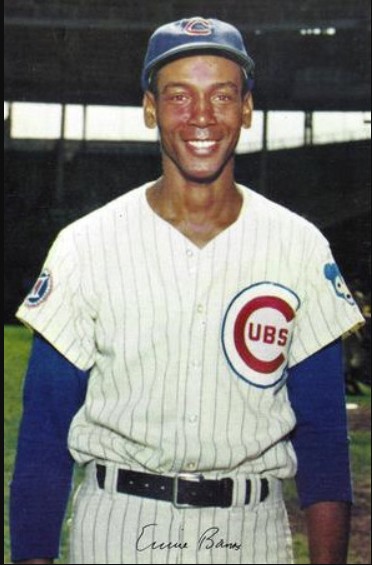
Photo: Tea via tradingcarddb.com, public domain, via Wikimedia Commons
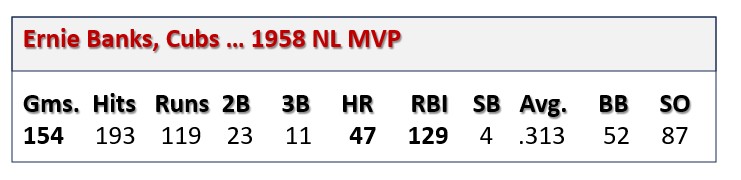
Ernie Banks, SS, Cubs … 1958 & 1959 NL MVP
Cubs, 1958: 72-82, fifth place, 20 games out of first.
Cubs, 1959: 74-80, fifth place, 13 games out of first.
Ernie Banks was the first player to take a home a league MVP Award while toiling for a team a sub .500 record – and he did it two seasons in a row.
In 1958, Banks (in his sixth MLB season) led the NL in games played (154), home runs (47), RBI (129), slugging percentage (.614), extra base hits (81) and total bases (379). He was also second in the league in runs scored (119) and triples (11). He finished second in the league in (among shortstops) in assists (468) and double plays (100) and was third in putouts (292).
Ernie Banks was the first National League Player to win back-to-back (1958-59) MVP Awards.
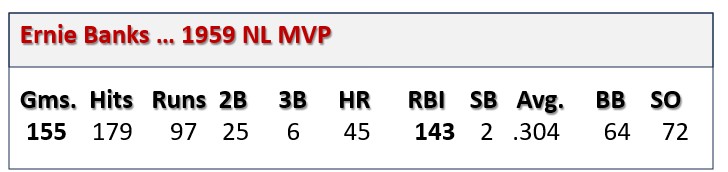
In 1959, Banks again led the NL in games played (155) and RBI (143). He also led the senior circuit in intentional walks (20). He finished second in the NL in home runs (45) and third in total bases (351). In the field, he led NL shortstops in assists (519), and was second in putouts (271) and double plays (95).
Hall of Famer Banks played in 19 MLB seasons (1953-71 … Cubs), hitting .274-512-1,636. He was an All Star in 11 seasons (played in 14 All Star Games due to the fact that two AS Games were played each season from 1959-62) and a one-time Gold Glover. He hit 40 or more home runs in five seasons (twice leading the league), drove in 100+ runs in eight (twice leading the league) and scored 100+ runs twice. He also led the NL in games played six times.
__________
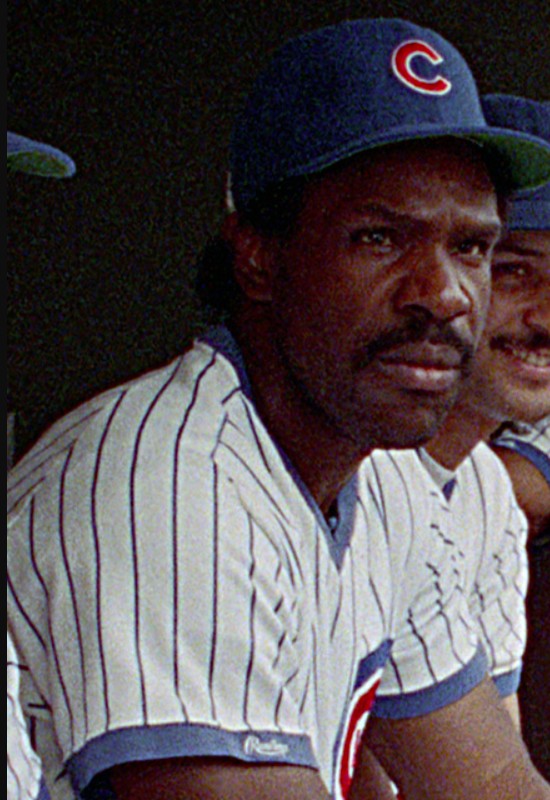
Photo: Dawsonhttps://catalog.archives.gov/id/276564967, Public domain, via Wikimedia Commons
Andre Dawson, RF, Cubs … 1987 NL MVP
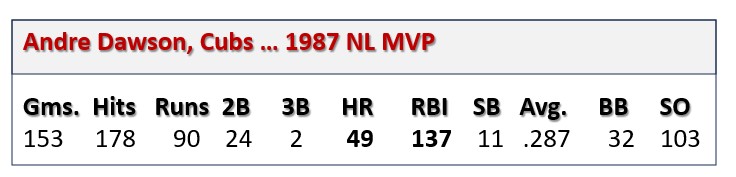
Cubs, 1987: 76-85, sixth place (last in NL East), 18 ½ games out of first.
Andre Dawson, in his age-32 season, was in his 12th MLB season when he captured the 1987 NL MVP Award. It was his first season with the Cubs. He had played with the Expos from 1976-86, was granted free agency by the Expos (Oops!) after the 1986 season and signed with the Cubbies.
In 1987, Dawson hit .287 for the Cubs and led the NL in home runs (49) and RBI (137) – reaching what would be his career highs in both categories. He was third in extra base hits (75). He also won a Gold Glove for his play in right field.
Andre Dawson was the first MLB player to win an MVP Award while playing for a last place team.
Hall of Famer Dawson played in 21 MLB seasons (1976-96 … Expos, Cubs, Red Sox, Marlins), going .279-438-1,591, with 314 steals and 1,373 runs scored. He was an eight-time All Star, eight-time Gold Glover and the 1977 NL Rookie of the Year (.282-19-65, with 21 steals and 64 runs scored for the Expos). He hit 20 or more home runs in 13 seasons, drove in 100 or more runs in four, twice scored 100 or more runs, hit .300+ five times and stole 20 or more bases in seven seasons. He led the NL in hits in 1983 (189) and in intentional walks with 21in 1990.
__________
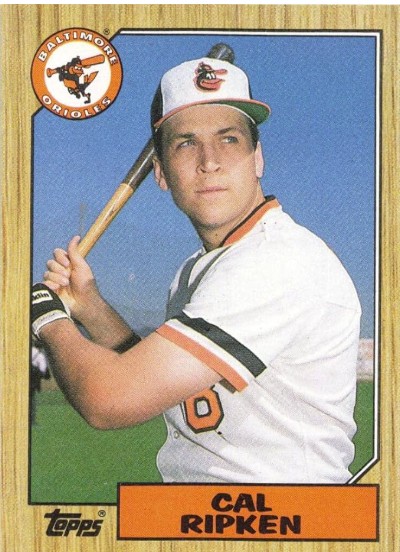 Cal Ripken, Jr., SS, Orioles … 1991 AL MVP
Orioles, 1991: 67-95, Sixth Place, (AL East) 24 games out of first.
Playing in all 162 games, Ripken (in his eleventh MLB season) combined a strong offensive season (.323-34-114), with Gold Glove-winning defense. He led the AL in total bases (368) and extra-base hits (85). He finished second in the AL in hits (210), doubles (46) and slugging percentage (.566); and third in home runs (34). In the field, he led AL shortstops in assists (528), putouts (267), double plays (72) and fielding percentage (.986)
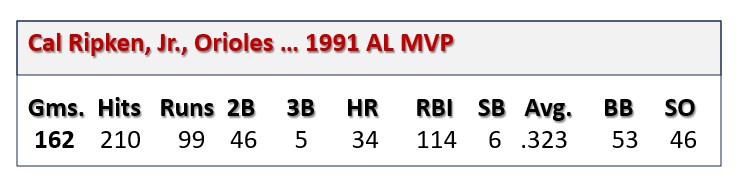
Hall of Famer Ripken played in 21 MLB seasons (1981-2001, Orioles), hitting .276-431-1,695, with 1,647 runs scored. He was an All Star in 19 seasons, a two-time MVP, two-time Gold Glover and the 1982 AL Rookie of the Year (.264-28-93). Ripken hit 20 or more home runs in 12 seasons, drove in 100+ runs in four, scored 100+ runs in three.
In his first full MLB season, Cal Ripken was the AL Rookie of the year (at ag 21). The very next season, he won his first AL MVP Award, after a .318-27-102 season for the Orioles – in which he led the AL in Games (162), Runs (121), hits (211) and doubles (47).
__________
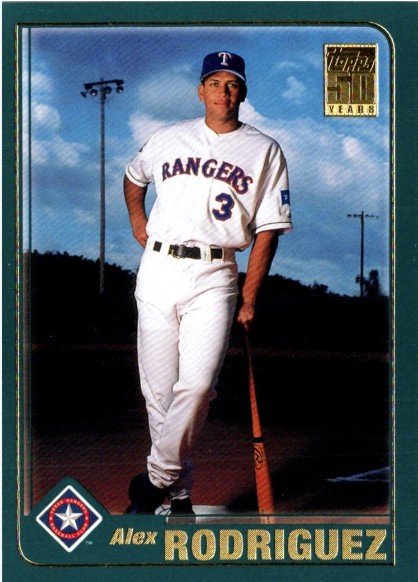 Alex Rodriguez, SS, Rangers … 2003 AL MVP
2003 Rangers: 71-91, fourth place (last in AL West), 25 games out of first.
In 2003, Alex Rodriguez (in his tenth MLB season) won his first of three MVP Awards. (He had finished in the second or third in AL MVP voting in three of his first seven full MLB seasons.) In 2003, Rodriguez went .298-47-118, with 124 runs scored and 17 stolen bases (leading the league in runs and home runs). He led the AL in slugging percentage (.600), was second in RBI (118) and third in extra base hits (83) and total bases (364). For good measure, he also picked up a Gold Glove for his play at SS. At SS, he was first in the AL in double plays (111) and fielding percentage (.989) and third in the AL in putouts (227) and assists (464).
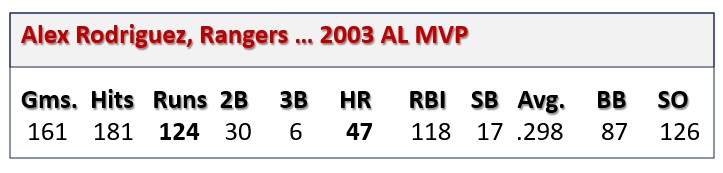
Rodriguez played in 22 MLB seasons (1994-2013, 2015-16 … Mariners, Rangers, Yankees), going .295-696-2,086, with 2,021 runs scored and 329 stolen bases. He led the league in runs scored five times (scoring 100 or more runs in 13 seasons); led in hits once (topping 200 hits three times); led in doubles once (54 in 1996); led in home runs five times (hitting 40+ in eight seasons … 50+ in three of those) and hit .300 or better nine times (winning one batting title, with a .358 average in 1996). He also topped 20 steals in six seasons and led the AL in slugging percentage and total bases four times each. He was a 14-time All Star, two-time Gold Glover and three-time MVP.
Alex Rodriguez is in MLB’s all-time Top Ten in such key offensive categories as runs batted in (fourth); home runs (fifth); total bases (seventh); extra-base hits (seventh); and runs scored (eighth).
__________
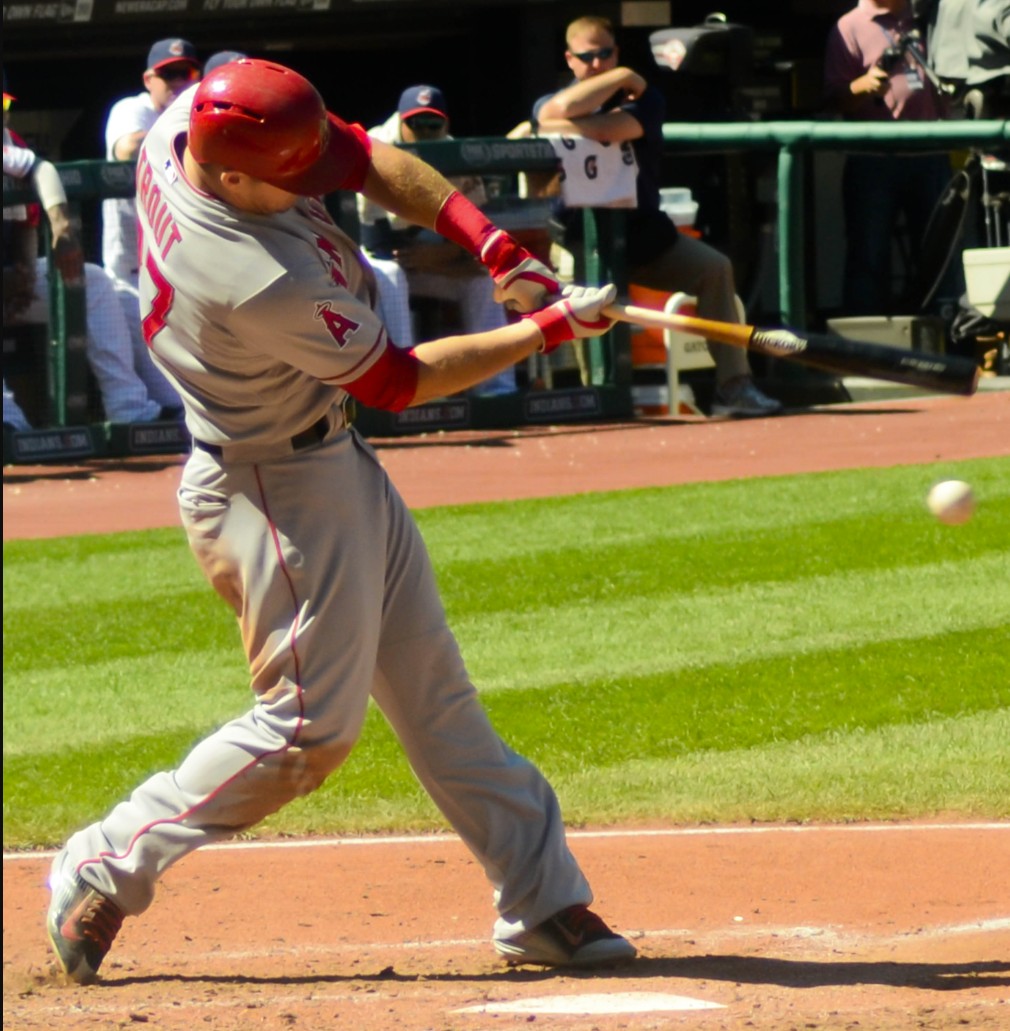
Photo: Erik Drost, CC BY 2.0 <https://creativecommons.org/licenses/by/2.0>, via Wikimedia Common
Mike Trout, CF, Angels …. 2016 & 2019 AL MVP
2016 Angels: 74-88, fourth place (AL West), 21 games out of first.
2019 Angels: 72-90, fourth place (AL West), 35 games out of first.
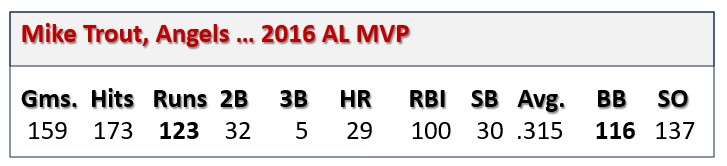
Mike Trout won his second (of three, to date) MVP Award in 2016 (in his age-24 season). Trout hit .315-29-100, with 123 runs scored and 30 steals. He led the AL in runs scored, walks (116) and on-base percentage (.441) and was second in stolen bases. He was also third in putouts as a CF (360) and fourth in assists (7).
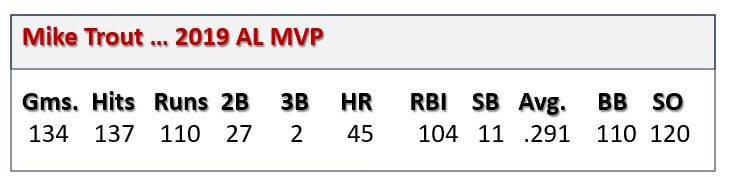 In 2019, Trout picked up his third MVP Award (his second for a sub-.500 team). He put up a .291-45-104, line, with 110 runs scored and 11 steals. Although he didn’t lead the league in any of the traditional straight-number offensive categories, he did top the AL in on-base percentage (.438) and slugging percentage (.645). He was second in the AL in home runs.
Trout has played in 15 MLB seasons (2011-25 … Angels), going .294-404-1,018, with 1,196 runs scored and 214 stolen bases. He is an 11-time All Star, three-time MVP and 2012 AL Rookie of The Year (.326-30-83, with 129 runs scored and 49 steals in his age-20 season). Trout has led the league in runs four times (topping 100 runs in seven seasons); led in RBI once (with 100 or more RBI in three seasons); led in steals once (with 30 or more SB in three seasons). He has topped 25 home runs in ten seasons (hitting forty or more in three). He has also led the AL in total bases once, on-base percentage four times, slugging percentage three times and intentional walks three times.
__________
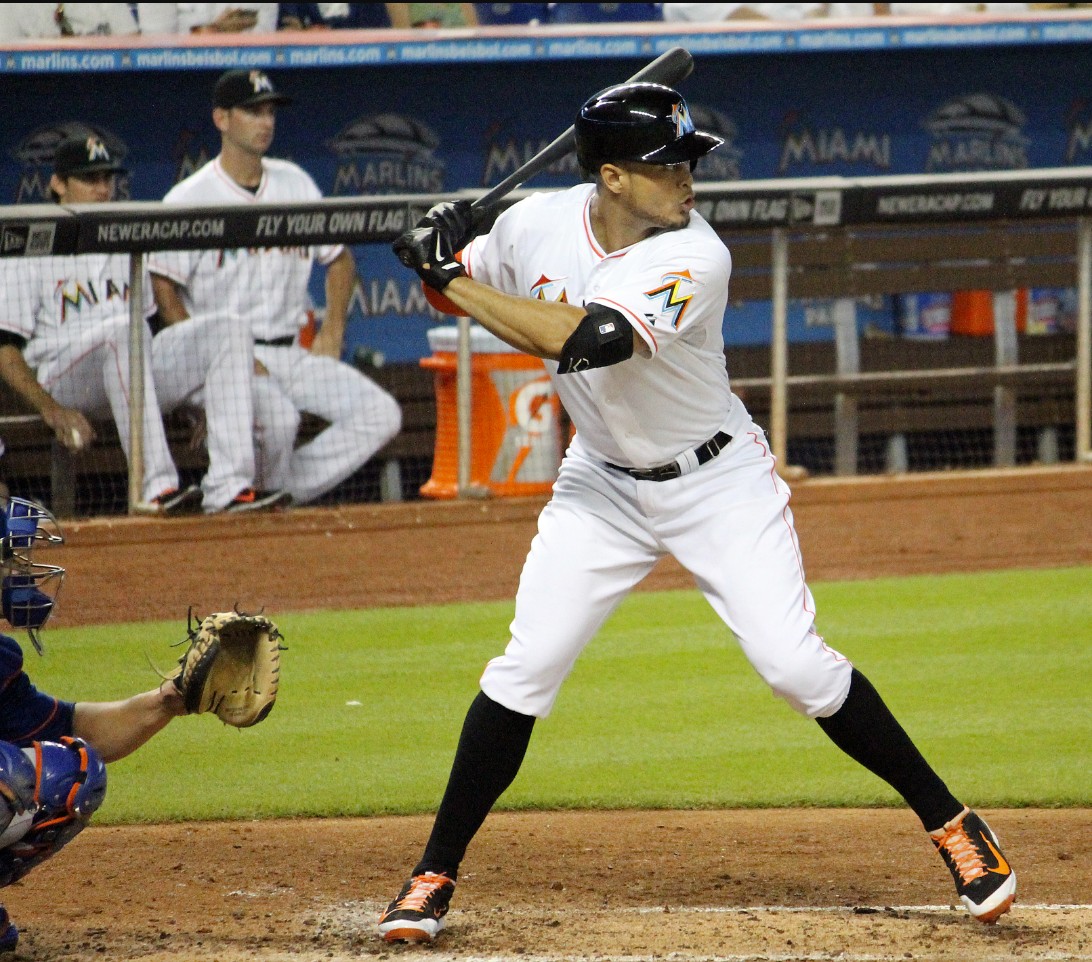
Photo: Jeffrey Hayes, CC BY 2.0 <https://creativecommons.org/licenses/by/2.0>, via Wikimedia Commons
Giancarlo Stanton, RF, Marlins … 2017 NL MVP
Miami Marlins, 2017: 77-85, second place, (NL East), 20 games out of first.
Giancarlo Stanton turned on the power for the 2017 Marlins, going .281-59-132, with 123 runs scored. He led the NL in home runs and RBI, as well as extra-base hit (91) and slugging percentage (.631). He was also second in runs scored. (An aside here: The very next season, Stanton was a Yankee – traded to New York for Starlin Castro, Jose Devers and Jorge Guzman).
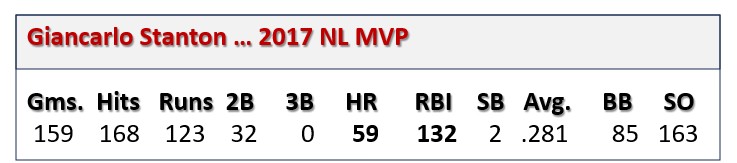
Stanton (still active) has played in 16 MLB seasons (2010-2025 … Marlins, Yankees), going .258-453-1,169, with 943 runs scored. He has led the league in home runs twice (hitting 25 or more home runs in ten seasons); led in RBI once (with 100 or more RBI three times); and scored 100+ runs twice. He had also led the league in slugging percentage three times, total bases once and intentional walks once.
__________
Shohei Ohtani, DH/P, Angels … 2021 & 2023 AL MVP
Angels 2021: 77-85, fourth place (AL West), 19 games out of first.
Angels 2023: 73-89, fourth place (AL West), 17 games out of first.
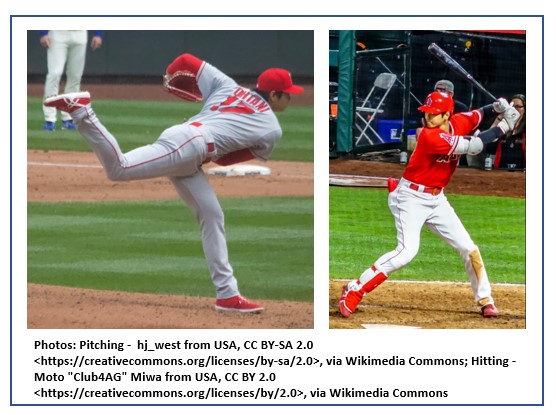
Shohei Ohtani is the wild card on this list (let’s face it, his stats … and talent … are kind of wild) – winning two (of his four) MVP Awards for a sub-.500 Angels squad and, in both cases, winning as a DH/P.
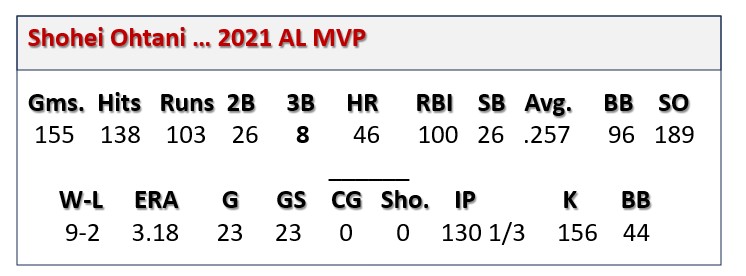
In 2021, Ohtani went .257-46-100, with 103 runs scored and 26 stolen bases. While he did appear in seven games in the outfield, he was primarily used as a DH and pitcher. Offensively, he led the league in just two categories: triples (8) and intentional walks (20). However, his 46 home runs ranked third in the AL; his 80 extra-base hits and .592 slugging percentage second; his 318 total bases fourth; his 96 walks third; and his .372 on-base percentage and 26 stolen bases fifth. On top of that, Ohani went 9-2, 3.18 in 23 starts on the mound, fanning 156 batters (44 walks) in 130 1/3 innings.
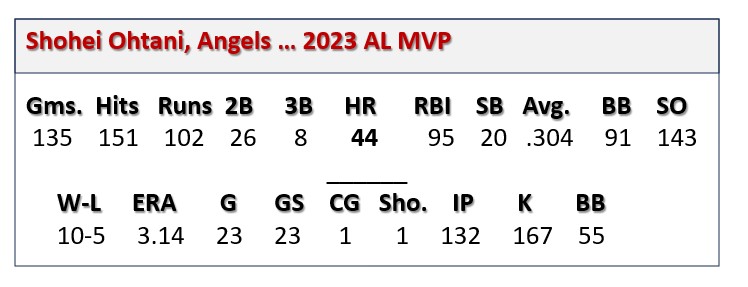
In 2023, Ohtani had an even better offensive season. He went .304-44-95, with 102 runs and 20 steals in 135 games. He led the league in home runs, as well as in extra base its (78), total bases (325), on-base percentage (.412) and slugging percentage (.654). He also finished third in triples (8), fifth in walks (91) and second in intentional walks (21). The cherry on top of the sundae? On the mound, he went 10-5, 3.14 in 23 starts, with one complete game (shutout) and 167 strikeouts (55 walks) in 132 innings.
This Week’s Unicorn.
In 2024, Shohei became the first (still only) MLB player to fashion a 50/50 (HR/SB) season, as he racked up 54 homers and 59 steals (in 63 attempts) to go with a .310 average, 130 RBI and 134 runs scored.
Ohtani (still active) has now played eight MLB seasons (2-18-25 … Angels, Dodgers). He is a five-time All-star, the 2018 AL Rookie of the Year and a four-time MVP. At the plate, he has gone .282-280-669, with 708 runs scored and 165 stolen bases. He has led the league in home runs twice (topping 40 long balls in four seasons, surpassing 50 in two of those); led the league in runs scored twice (with 100+ runs in four seasons); led in RBI once (with 100 or more RBI three times); led in slugging percentage and total bases three times each (topping 400 total bases once); and led in on-base percentage twice. On the mound, he has gone 39-20, 3.00 in 100 starts; fanning 670 batters in 528 2/3 innings. In 2022 (Angels), Ohtani had enough innings to qualify for the ERA title and other ratio measures. He went 15-9, 2.33 in 28 starts – leading the AL in strikeouts per nine innings (11.9); finishing third in overall strikeouts; and fourth in earned run average.
One More Unicorn
Frank Robinson and Shohei Ohtani are the only players to win the Most Valuable Player Award in both the AL and NL. Robinson was the 1961 NL MVP (Reds) and the 1966 AL MVP (Orioles). The unicorn? Ohtani is the only player to win multiple MVP Awards in both leagues: 2021 & 2023 AL MVP (Angels) and 2024 & 2025 NL MVP (Dodgers).
Primary Resources: Baseball-Reference.com; Baseball-Almanac.com.
Baseball Roundtable – Blogging Baseball Since 2012.
 Baseball Roundtable is on the Feedspot list of the Top 100 Baseball Blogs. For the full list click here.
I tweet (on X) baseball @DavidBaseballRT. Follow me there for post notifications and links.
Follow Baseball Roundtable’s Facebook Page here.
Member: Society for American Baseball Research (SABR); Negro Leagues Baseball Museum; The Baseball Reliquary.
P 1155