It’s time again for Baseball Roundtable’s Trivia(l) Tidbit Tuesday. I hope you are enjoying this weekly presentation of baseball occurrences that for some reason caught The Roundtable’s eye. (I’m particularly fond of unexpected performances and statistical coincidences.) These won’t necessarily be momentous occurrences, just events, statistics or coincidences that grabbed my attention. I’m also drawn to baseball “unicorns,” one-of-a-kind MLB accomplishments or statistics.
Special thanks to reader Dean Mauro for asking a question in response to last week’s Tidbit on players who had the longest careers without ever getting hit by a pitch (Mark Lemke – 1,069 games) and sending me on another statistical adventure. Dean asked “Has there ever been player who was hit by a pitch in his only major league plate appearance?” Just the kind of question the RoundTable loves to explore. (Dang, I wish I’d have thought of it myself.) It sent me off on a journey that took me to players like Charles Victor (Victory) Faust, who made his mark as an eccentric/erratic good luck charm and has a unique tie to Rube Marquard; Cy Malis, who appeared in movies with the likes of Gregory Peck, Lucille Ball, John Wayne and Cary Grant; and Fred Van Dusen, who jumped to the major leagues at age 18.
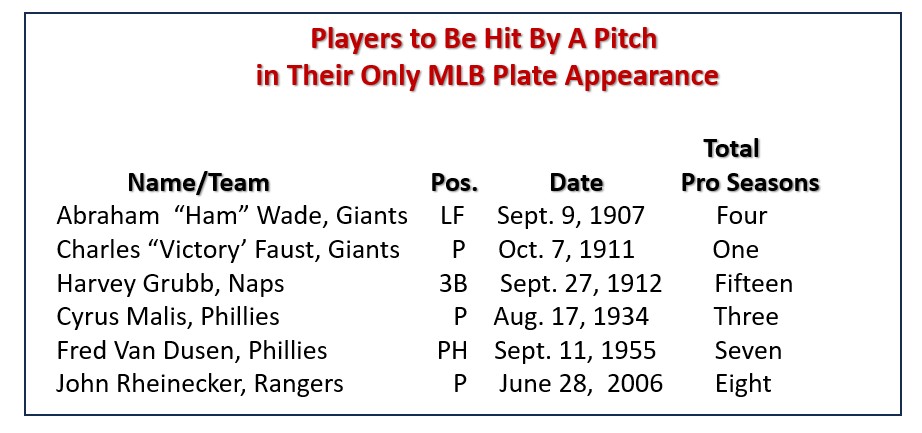
Now, at first I thought I might have a unicorn here, but it turns out a half dozen players (from 1911 to 2006) have been plunked in their one and only MLB plate appearance.
Here’s the obligatory chart, followed a bit about each of the qualifiers – with quite a bit on the unusual life and times of Charlie Faust.
Abraham Lincoln “Ham” Wade – Giants, September 9, 1907
Ham Wade, an outfielder, played in just one MLB game. (He hit .239 in 357 minor-league contests in four minor-league seasons, during which he pitched and played outfield.) In his lone MLB game, Wade came in as a late-inning replacement for Giants’ starting LF Spike Shannon in a 10-0 loss to the Boston Doves. A noted, he got just one plate appearance, got plunked (by Doves’ righty Vive Lindaman) and never came to the plate in an MLB game again. Wade also recorded two putouts as an outfielder in his one and only major-league contest. The hit by pitch was probably no surprise, as Lindaman tied for second with 15 HBPs in 1907.
Charlie “Victory” Faust — Giants, October 12, 1911
Photo: http://davyjonesbats.com/about-us/memorials, Public domain, via Wikimedia Commons
Charlie Faust is probably the most renowned player on this list – known for his status as a good luck charm, rather than his talents as a ballplayer. His story is one of legend, bordering on myth. And, while the details of its telling are sometimes slightly different, there is enough consistency to validate Faust’s place in MLB history. My sources for the Faust story are listed under “Primary Resources” at the end of this post; but special recognition goes out to Society for American Baseball Research (SABR) members Thomas S. Busch and Gabriel Schechter, whose work supplied much of the foundation for this Faust-ian tale. What follows are the most consistently recounted details of his career.
In 1911, the 30-year-old Faust, who was not a ballplayer at the time, was told by a fortune teller at a country fair that he would pitch the New York Giants to a championship, meet and marry a girl named Lulu and father a future generation of baseball stars. So, Faust traveled from Marion, Kansas to St. Louis, Missouri (where the third-place Giants were facing the Cardinals) in mid-summer, introduced himself to Giants’ manager John McGraw in a hotel lobby and told him of his predicted destiny. Perhaps impressed by Faust’s commitment and enthusiasm, swayed by his own superstitions or merely because McGraw had a sense of humor, the Giants’ placated Faust, inviting him to an on-field tryout before that afternoon’s (July 28) game. The eccentric Faust showed up in a “Sunday” suit, dress shoes and derby hat. McGraw sent Faust to the mound to display his stuff (or lack thereof) and then sent him to the plate, with instructions to run out anything he hit. Faust dribbled an easy grounder to short, but the players – essentially “playing along” with the situation, kept mishandling the ball as Faust awkwardly rounded the bases (reportedly having to slide into more than one – again, still in his Sunday suit – before reaching home plate). The crowd and players, it was reported, loved Faust’s stumbling performance. Faust, however, was not yet established as a good luck charm. The Giants lost 5-2.
When the determined and enthusiastic Faust – still convinced of his foretold destiny to lead the Giants to a championship – showed up the next day, he was outfitted with an ill-fitting uniform, seriously repeated his pregame antics (to the joy of the fans and players alike) and the Giants won the game 8-0. The next two games, again with Faust in uniform, were won by the Giants 6-0 and 3-2.
Then the team left for Pittsburgh – without a disappointed Faust – and fell into a slump, going 2-4 in Pittsburgh and Chicago. (Reportedly, when Faust showed up at the train station, he was told his ticket must have been left at the hotel and, while he was dashing back to the hotel to retrieve the non-existent ticket, the team left without him.)
Undaunted, and still convinced of his destiny (and apparently short on cash), Faust made his way from St, Louis to New York by hopping freight trains – and a disheveled Faust was waiting for McGraw and the Giants when they returned to the Polo Grounds. McGraw relented and let Faust continue his pre-game “entertainment,” as well as take a spot on the bench during games. The Giants won nine of their next eleven and the die was cast, with the team (somewhere along the way) issuing a uniform, giving Faust a spot on the bench (and even sending him to the bullpen on occasion) and taking him on the road.
Faust became sort of a mascot, pre-game entertainer and good luck charm, shagging flies in warmups, occasionally pitching batting practice and cheering on his teammates during the games. However, he still maintained that his destiny was to pitch the Giants to a championship. Finally on October 7, with the pennant already clinched, McGraw relented and put Faust into a game. He pitched the final inning of a 5-2 loss to Boston – giving up one earned run. Five days later, Faust made his second and final MLB appearance, pitching one scoreless inning (the ninth) in a 5-2 loss to the Dodgers. In this one, he made his only MLB plate appearance, reached base on a Hit By Pitch, stole second and third (apparently with the visiting Brooklyn squad “playing along” with the Faust experience) and scored on a sacrifice fly.
Backtracking a bit, Faust’s reputation as either a good luck charm for the Giants or a bench-bound jinx for opponents (which grew with each New York win) got a boost, when the now very popular (almost folk hero) New York benchwarmer left the team to take on a vaudeville engagement. The Giants lost the first three games they played during Faust’s foray into show business – and Faust quickly returned to the team (which won the first ten games after his return.).
Was the eccentric (maybe even erratic) Faust really a good luck charm? As Gabriel Schechter reported in his SABR bio of Faust “From the day he (Faust) met McGraw in St. Louis to the day the Giants clinched the pennant, the team had a record of 39-9. When he was in uniform and exerting his jinxing powers, their record as an astonishing n 36-2.” Unfortunately, Faust’s mojo did not work as well in the World Series, which the Giants lost to the Athletics Four Games to two. When the Giants lost the World Series, his good luck charm status faded a bit and, perhaps the novelty was wearing off.
In 1912, McGraw, kept Faust on the bench, but reportedly did not allow him to don a Giants uniform and the team no longer paid his expense on road trips. Faust, still convinced of, even obsessed with, the belief that his destiny was as a pitcher, responded by repeatedly asking the league to force McGraw to reinstate him. The rift was widening. Still, Faust hung in there and the Giants got off to a blazing start, going 54-11 over the first 65 games (through July 3). Still, Faust’s constant, vigorous and unbending insistence that he was a pitcher who belonged on the mound pitching the Giants to a championship was apparently getting on McGraw nerves (and likely causing clubhouse tension). While considerable efforts to convince Faust to voluntarily leave the team were not successful, a bit of deception got him to depart (he thought temporarily) in early July. The players convinced Faust he should go back to Kansas and, when his absence made it clear to McGraw how important he was, a victorious recall would be in the offing. The recall never came. Note: I wasn’t able to pinpoint the date Faust left the team, but after going 54-11, with a 16 ½ game lead over the second-place Cubs through July 3, the club went 49-37 (with the lead dwindling to 10 games) over the remained of the season. Going back to Schechter’s article, he tells us Giants’ pitcher Rube “Marquard won his first 19 decisions in 1912; in the week after Faust’s departure, he lost three times, and he was a sub-.500 pitcher the rest of the season.” For the sake of timing Faust’s departure, Marquard was 19-0 on July 3 and lost three games between July 7 and 14.
In the end, Giants won the pennant, but lost the World Series to the Red Sox in seven games.
While Faust was out of baseball in 1913, he continued to pursue reinstatement to the Giants and fulfillment of his destiny (some reports indicate he also wanted back pay for his contributions to the Giants’ two pennants.) By 1914, he had been diagnosed with dementia, spent time institutionalized and he died in June 1915 (tuberculosis) at Western State Hospital (near Tacoma).
But no matter the final outcome, you can – as they say – look it up, Charlie Faust was a major leaguer. You’ll also find his name – along with such luminaries as Bob Feller, Catfish Hunter, Al Kaline, Harmons Killebrew and Dave Winfield – among those who bypassed the minor leagues and went directly to the majors.
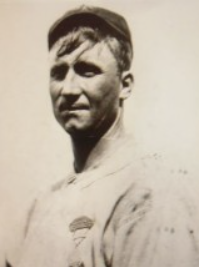
Now back to the rest of the One Plate Appearance – One Hit By Pitch Club.
Harvey Grubb – Naps, September 27, 1912
Harvey Grubb came into the game at third base in the top of the seventh inning (replacing Terry Turner). At the time, his Naps were leading the Tigers 14-5 (in Cleveland). He immediately saw action in his first (and only) MLB game, as the immortal Ty Cobb led off the inning and popped out to Grubb. Grubb came to the plate in the bottom of the frame with one runner (Ray Chapman) on base and one out. Grubb was hit by a pitch from Charlie Wheatley, sending Chapman to second. Grubb finished the game (won by the Naps 16-5), but did not come to the plate again and did not get another fielding chance. Grubb’s lone plate appearance came in his fourth professional season. He took the field in a total of 15 minor-league campaigns.
Cy Malis – Phillies, August 17, 1934
Cy Mallis was a right-handed pitcher whose only MLB game – and only MLB plate appearance – came in a 12-2 Phillies’ loss to the Cardinals. Malis came on with one out in the bottom of the fifth, with his Phillies trailing 7-2, Cardinal runners on second and third and one out. He gave up a two-run double to the first batter he faced (Ripper Collins) – and went on to pitch 3 2/3 innings, giving up two of his own runs on four hits and two walks (one strikeout). Malis came to the plate leading off the top of the seventh and was hit by a pitch from Paul “Daffy” Dean.
Malis played several seasons of semi-pro ball and information about his professional minor-league experience is sketchy. However, an article by baseball historian, artist and writer Gary Joseph Cieradkowski indicates he played in the minor-leagues at least in 1927, 1928, 1929, 1935; was a World War II Navy veteran; and built a successful career as an actor (working in movies with the likes of Gregory Peck, Lucille Ball, Cary Grant and John Wayne). A Naval training accident and subsequent treatment for pain (morphine) led to drug and alcohol dependence issues and, ultimately, Malis was among a small group that laid the foundation for Narcotics Anonymous. He also also spurred efforts to build prison-based addiction-treatment programs. I include that here to explain why, in the Primary Resources section, the title for Cieradkowki’s article on Malis is “Cy Malis: The Best Friend We Dope Fiends Have.”
Fred Van Dusen – Phillies, September 11, 1955
And outfielder by trade, Fred Van Dusen’s only taste of the major-leagues came as a pinch hitter – at the tender age of 18.
A highly rated prospect, Van Dusen was signed out OF Bryant High School in Altoona New York, under the “Bonus Baby” rule that existed from 1947-1958 and 1962-65 (before the establishment of the MLB draft). At the time of Van Dusen’s signing a team that signed a player to a contract in excess of $4,000 was required to keep that player on the 25-man roster for two seasons (or expose the player to the Waiver Wire.) Side note: Included among past Bonus Babies are: Harmon Killebrew, Roberto Clemente, Sandy Koufax and Catfish Hunter.
In his only MLB appearance (also his first professional plate appearance), Van Dusen came to the plate (pinch hitting for pitcher Lynn Lovenguth) in the top of the ninth inning, with his Phillies’ trailing the Braves (in Milwaukee) 9-1, with one out and one runner on base. Van Dusen was hit by a pitch from Humberto Robinson. The next two batters went strikeout/flyout, VanDusen was stranded and his MLB career was over.
VanDusen went on to play in six minor-league seasons, going .260-86-350 in 650 games. His best season was in 1957 (his age-19 season), when he went .310-25-93 in 119 games for the Class-B High-Point-Thomasville Hi-Toms (not exactly a creative team moniker).
John Rheinecker – Giants, June 28, 2006
John Rheinecker appeared in the most MLB games of all the players on this list. He secured his spot largely due a combination of the Designated Hitter Rule and interleague play. A left-handed pitcher, Rheinecker pitched in the major leagues, for the Texas Rangers, in 2006-2007, putting up an 8-9, 5.65 record in 44 appearances (20 starts). He was in his sixth professional season and first MLB season when he made his one and only plate appearance. At the time, the Designated Hitter rule was in place in the American League only and Rheinecker, in his seventh career MLB appearance, was starting on the mound against the NL Giants in San Francisco, taking the ninth spot in the batting order. Rheinecker found himself at the plate leading off the top of the third inning of a scoreless game. He was plunked on an 0-1 pitch from Noah Lowry, but left stranded. In the top of the fifth, with his Rangers trailing 5-0, Rheinecker was pinch hit for (by Jason Botts) and his game (and his MLB career as a hitter) were over.
Primary Resources: Baseball-Reference.com; Cy Malis: The Best Friend We Dope Fiends Have, by Gary Joseph Cieradkowski; Charlie Faust, Society for American Baseball Research (SABR) bio, by Gabriel Schechter; Searching for Victory: The Story of Charles Victor(y) Faust, by Thomas S. Busch, 1983 Baseball Research Journal; Destined by a Fortune Teller: Charlie Faust’s Kansas Roots and the Magic That changed the Giants, The Pechko Perspective (the-pechko-perspective.com), June 14, 2025; Farewell: What’s Left of Charlie Faust, FoxSports.com, March 4, 2020.
Baseball Roundtable – Blogging Baseball Since 2012.
 Baseball Roundtable is on the Feedspot list of the Top 100 Baseball Blogs. For the full list click here.
I tweet (on X) baseball @DavidBaseballRT. Follow me there for post notifications and links.
Follow Baseball Roundtable’s Facebook Page here.
Member: Society for American Baseball Research (SABR); Negro Leagues Baseball Museum; The Baseball Reliquary.
P 1147