Once again, it’s time for Baseball Roundtable’s Trivia(l) Tidbit Tuesday. I hope you are enjoying this weekly presentation of baseball occurrences that for some reason caught The Roundtable’s eye. (I’m particularly fond of unexpected performances and statistical coincidences.) These won’t necessarily be momentous occurrences, just events, statistics or coincidences that grabbed my attention. I’m also drawn to baseball “unicorns,” one-of-a-kind MLB accomplishments or statistics.
In this Tidbit post, we’re taking a look at Trea Turner’s 2025 National League Batting Championship – and some trends that point toward the “disappearing .300 hitter. “
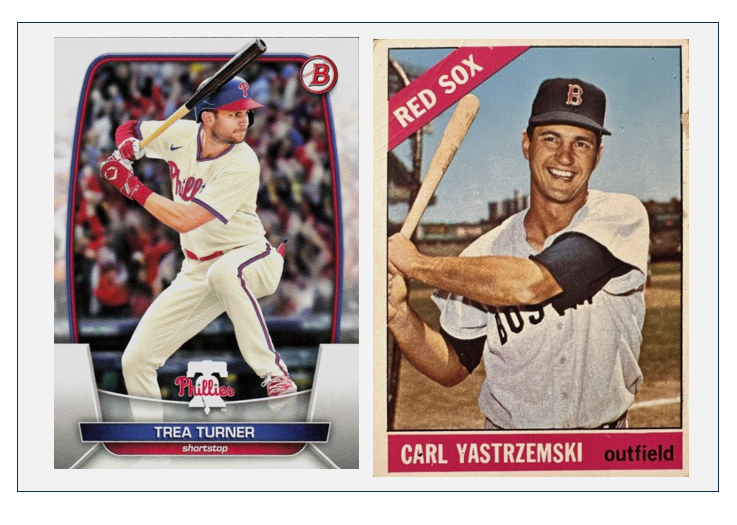
In 2025, Turner won the National League batting title with a.304 average, the lowest average ever to capture an NL title (unicorn status) and the second-lowest to earn an MLB title (Carl Yastrzemski won the AL title in 1968 – which became known as The Year of the Pitcher – with a .301 average.) Turner was also the only qualifying National Leaguer to hit at least .300 – just as Yaz was the only qualifying American Leaguer to hit .300 in 1968. (There have been only four batting crowns awarded to qualifying hitters with an average under .310: Turner; Yastrzemski; Snuffy Stirnweiss, 1945 Yankees at .309; and Elmer Flick, 1905 Naps, at .308.)
All this makes Turner’s .304 memorable … and that .304 average sent me deeper into to the record books (as always, with Baseball Roundtable, one thing led to another). I first went back to 1953 – the first year I attended an MLB game and the year that launched my obsession with all things baseball. Turns out, that season, MLB (with just 16 teams) had 27 qualifying hitters with averages of .300 or better (as compared to just seven qualifying hitters with .300+ averages among 2025’s 30 teams).
Next, I took a look at 1968 – again The Year of the Pitcher – and found there were just six qualifying .300+ hitters that season (there were 20 teams versus 30 in 2025). A little math shows with an additional ten teams, we could have expected nine 300+ qualifying hitters in 1968 – pretty close to the 7,7,9 of 2025, 2024, 2023. So, I wondered if 1968 was a sign of the times (as 2025 appears to be) or was it an outlier. Turns out, it was more of an outlier. The .300+ qualifying hitter total for the years around 1968 were: 1966 – 12; 1967 – 16; 1968 – 6; 1969 – 18.
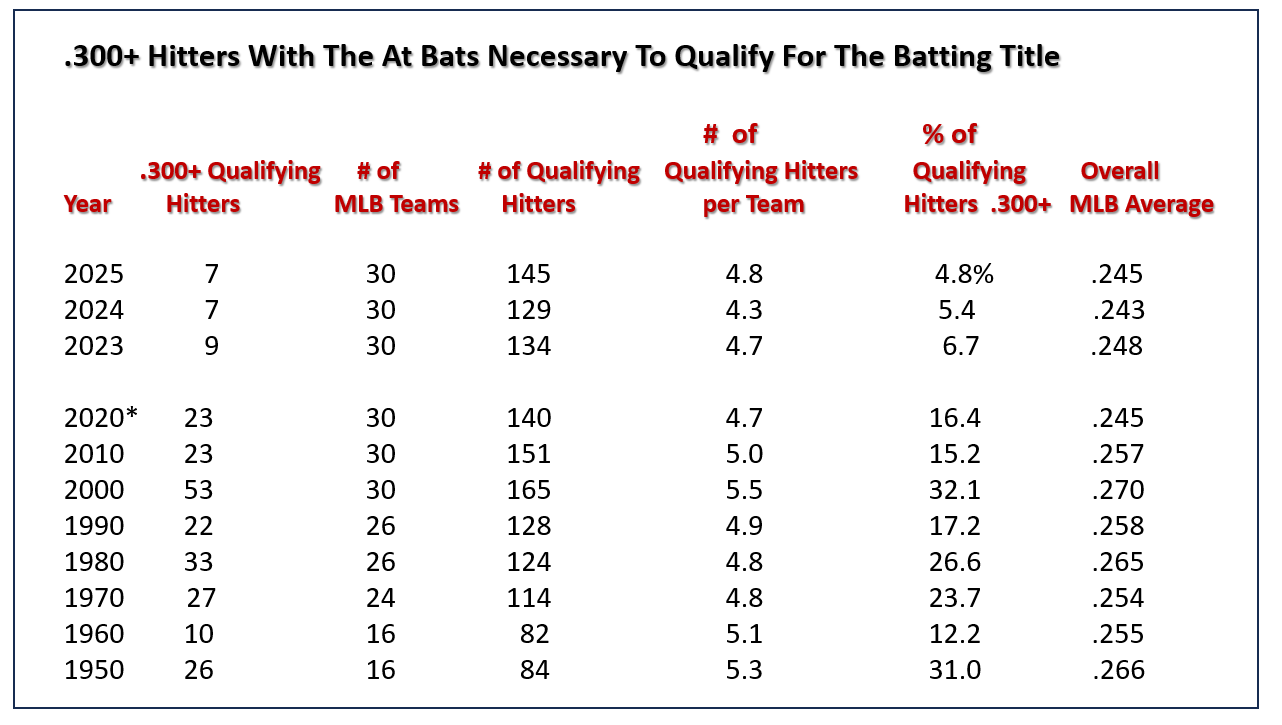
Well, loving statistics, I keep digging to see if the numbers would back up the theory that .300+ qualified hitters are truly on a decline. First, I wanted to see if the numbers qualifying hitters were on a downward slope. A it turns out (and the chart below shows), that is not the case. Of the 11 seasons I called up, 2025 had the third-most qualifying hitters. Further, in those seasons, the number of qualifying hitters per team fell into a fairly small range (4.3 to 5.5) and 2025 fell in the middle of that group (tied for the sixth most).
Then came the most telling statistic, at least for The Roundtable, the percent of qualifying hitters in each season that hit .300+. Of the 11 seasons in the chart, 2023, 2024 and 2025 occupied the three bottom positions at 5.7%, 5.4% and 4.8%, respectively (declining, as you might notice, each year). Further, no other season on the chart saw less than 12.2 percent of qualifying hitters hit .300+.
So, it does appear that qualifying .300+ hitters are fading from the scene. The question becomes why? Better (or at least higher-velocity) pitching? Changing pitcher-use strategies? More emphasis on the long ball (versus making contact)? As usual with Baseball Roundtable, one thing has led to another, and I have more research to do.
Primary Resource: Stathead.com
Baseball Roundtable – Blogging Baseball Since 2012.
Baseball Roundtable is on the Feedspot list of the Top 100 Baseball Blogs. For the full list click here.
I tweet (on X) baseball @DavidBaseballRT
Follow Baseball Roundtable’s Facebook Page here.
Member: Society for American Baseball Research (SABR); Negro Leagues Baseball Museum; The Baseball Reliquary.

P 1137