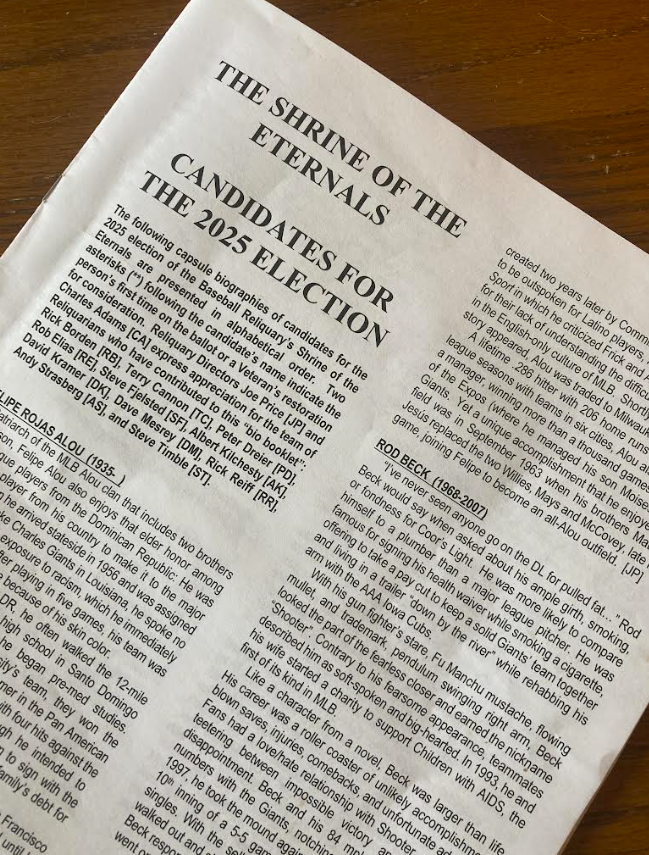
 Early this week, a welcome sign of spring appeared in the mail – my 2025 Baseball Reliquary Shrine of the Eternals Ballot – which means I can look forward to some joyous time pondering the character and characters that helped shape the history of our grand game (as presented in the always informative and creative biographies included with the ballot).
I’ll take a look at my choices from this year’s ballot in a bit, but first – for those not familiar with The Baseball Reliquary – a little background.
The Baseball Reliquary is an organization of fans dedicated to the free-spirited celebration of the human side of baseball’s history and heritage. The Reliquary defines itself as “an educational organization dedicated to fostering an appreciation of American art and culture through the context of baseball history and to exploring the national pastimes’ unparalleled creative possibilities.”
Reliquary (rel′ə kwer′ē)
Noun- a container or shrine in which sacred relics are kept and displayed for veneration.
While its “home” is at Whittier College (also home to the Institute for Baseball Studies), the Reliquary is more than just a place. The Reliquary really resides in the hearts of its founders, members, contributors and honorees – who all are important parts of the organization’s joyful (often irreverent, but always well-informed and fan-centric) celebration of all things baseball. This celebration is fueled through The Reliquary’s Shrine of the Eternals, collection of historic artifacts, exhibitions and extensive baseball-related research collection – books, periodicals and papers from distinguished authors, historians and journalists.
The Whittier (CA) College Institute for Baseball Studies is the first humanities-based baseball research center associated with a U.S. college or university,
The Shrine of the Eternals
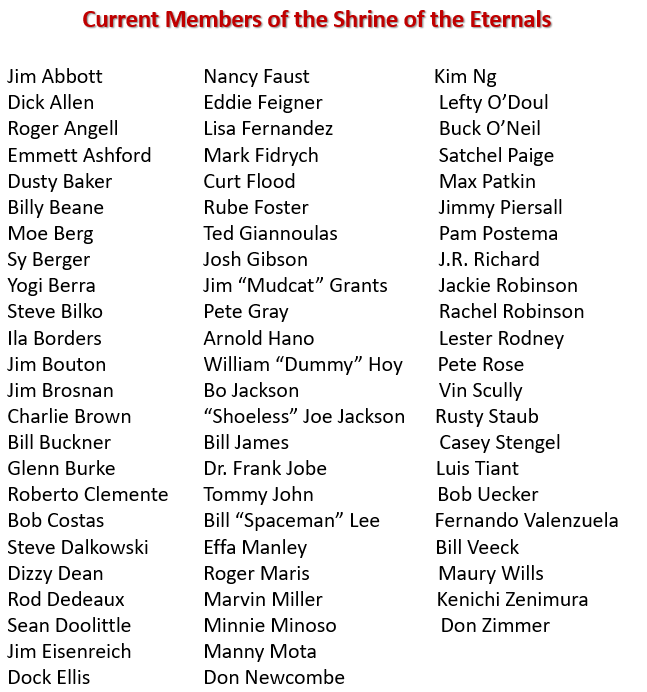
The Shrine of the Eternals is the Reliquary’s best-known element and its honorees include (among others) a one-armed major league outfielder, a pitcher who once threw a no-hitter while high on LSD, a team owner who sent a midget to the plate, a man in a chicken suit, a member of Major League Baseball’s 3,000-hit club, a manager who won eight World Championships, a surgeon whose pioneering work has extended the life of many arms, a cartoon character who pitched his team to more than 1,000 losses, more than one best-selling author, a statistical wizard and a bevy of “Jims” (Abbott, Bouton, Brosnan, Grant,Piersall). The honorees are each unique in their roles in – and contributions to – the national pastime, but they all share the distinction of having made a significant impact on the game.
It’s a shrine to “our” great game that connects:
- Mark “The Bird” Fidrych and the San Diego Chicken;
- Dr. Frank Jobe and Dr. Mike Marshall (not to mention Dock Ellis (Oh, I just did);
- Backstops Bob Uecker and Yogi Berra;
- Moundsmen Luis Tiant and Charlie Brown;
- Outfielders Roberto Clemente and Pete Gray;
- Characters Rube Waddell and Bill “Spaceman” Lee.
This year’s candidates include players like Rube Waddell, Mike Marshall, Julio Franco, Gravy Cravath, Luke Easter and Mamie Johnson; such luminaries as renowned baseball photographer Charles M. Conlon, WIFFLE(R) Ball inventor David Nelson Mullany and Country Music Hall of Fame member Charlie Pride; authors W.P. Kinsella and Jack Kerouac; Morganna “The Kissing Bandit” Roberts; the fictional Annie Savoy; and the dual mother-son candidacy of All American Girls Professional Baseball League star Helen Callaghan and nine-season, major-league utility player Casey Candaele.
You get the idea.
Note: The Reliquary also recognizes distinguished service to baseball by a fan (The Hilda Award) and contributions to the preservation of baseball history (The Tony Salin Award).
Artifacts
The Baseball Reliquary’s Collection of what The Roundtable would term “art-ifacts” is as diverse as its roster of Shrine honorees. The collection includes (but is “oh-so not limited” to) the Walter O’Malley Tortilla, the Roger Bresnahan Potato, the Eddie Gaedel Jock Strap, a Babe Ruth cigar, a Mother Teresa autographed baseball (a whole case actually), a heat-twisted 45-rpm record from the White Sox’ ill-fated Disco Demolition Night and a San Diego Chicken game-worn costume.
Exhibits
The Baseball Reliquary’s Exhibits have covered such varied topics as Latino and Black baseball history, baseball in foreign policy, baseball literature and art, a celebration of baseball cards, and even the self-defining “Lasordapalooza.”
Join Now
Sound like an organization you’d like to belong to? Just go to The Baseball Reliquary website – click here.
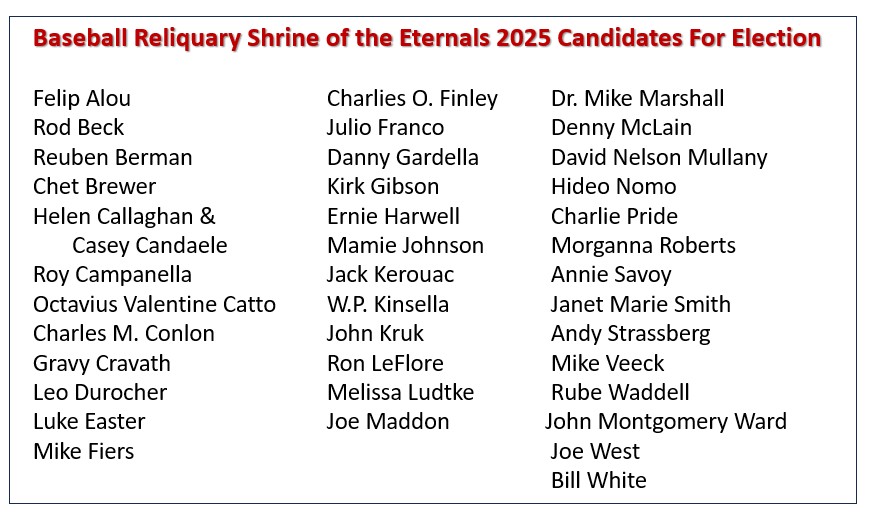
—–THE SHRINE OF THE ETERNALS 2025 BASEBALL ROUNDTABLE BALLOT—–
Now, on to the Shrine of the Eternals. Before I share my ballot, here’s what the Reliquary has to say about this honor.
“Similar in concept to the National Baseball Hall of Fame, the Shrine of the Eternals differs philosophically in that statistical accomplishment is not the principal criterion for election. The Baseball Reliquary believes that the election of individuals on merits other than statistics and playing ability will offer the opportunity for a deeper understanding and appreciation of baseball than has heretofore been provided by “Halls of Fame” in the more traditional and conservative institutions.
“Criteria for election shall be: the distinctiveness of play (good or bad); the uniqueness of character and personality; and the imprint that the individual has made on the baseball landscape. Electees, both on and off the diamond, shall have been responsible for developing baseball in one or more of the following ways: through athletic and/or business achievements; in terms of its larger cultural and sociological impact as a mass entertainment; and as an arena for the human imagination.”
Each year, the Baseball Reliquary submits a list of candidates to its members and the top three vote-getters are honored. Reliquaries can vote for up to nine nominees.
Here’s a look at those who are getting my votes for this year.
Helen Callaghan (1923-92) & Casey Candaele (1961 – ) … A Two-Fer
Ah, the sight of a father and son having a game of catch, it’s a part of baseball lore. For me, it’s time we considered the mother-son (and, hopefully, someday soon, the mother-daughter) baseball connection. (Side note: I fondly remember my mother willingly participating in a game of catch or a bit of batting practice in the front yard as we waited for the school bus to arrive – and Hall of Famer Eddie Mathews once recalled that , in his youth, “My mother used to pitch to me and my father would shag balls. If I hit one up the middle close to my mother, I’d have some extra chores to to do. My m0ther was instrumental in making me a pull hitter.”) It seems the right time to recognize, as noted in the Reliquary ballot booklet, the “only mother/son combination to play professional baseball.”
The fact is, I probably would have voted for Callaghan even without the mother-son connection. A superb athlete (in high school she played softball, soccer, roller hockey, basketball, lacrosse, track and field), she was an instant star in the All American Girls Professional Baseball League (1944-49). As noted in the Reliquary ballot booklet, as a rookie with the 1944 Minneapolis Millerettes, she hit .287 (second in the league) and swiped 112 bases in 111 games. In 1945, with the Fort Wayne Daisies, she led the league in average, home runs, hits, total bases and doubles – and was second in runs scored and steals.
Her son Casey Candaele followed in her footsteps. Candaele played baseball in high School and was part of the 1980 College World Series Champion University of Arizona squad. He played professionally for 17 seasons, nine in the major leagues (.250-11-139 in 754 games), where he appeared in 50 or more game at 2B, 3B, SS, LF and CF). After retiring from the playing field, he served as a coach with the Blue Jays and Mariners and currently manages the Blue Jays Triple-A affiliate Buffalo Bisons.
Side note: Adding to the worthiness of this vote, Helen Callaghan’s older sister Margaret also played on the Millerettes and their sisterhood and rivalry became part of the basis for the film “A League of Their Own,” (written by Callaghan’s son/Casey Candaele’s brother) Kelly Candaele.
CHARLES M. CONLON (1868-1945) … Picture Perfect
Charles M. Conlon is responsible for some of the most iconic images from baseball history. From 1904 to 1942, he documented the course of the national pastime (as a hobby), while working as a proofreader for the New York Evening Telegram (later the World-Telegram). Carrying a large Graflex camera and cumbersome glass plate negatives to the ballpark, Conlon produced at least 30,000 portraits and action photos, capturing history in black and white.
Although his photos appeared regularly in the Spalding and Reach Base Ball Guides, The Sporting News, and Baseball Magazine, Conlon’s contribution to the images and history of the game really came to the fore with the publication of Neal and Constance McCabe’s books: Baseball’s Golden Age: The Photographs of Charles M. Conlon (1993); and The Big Show: Charles M. Conlon’s Golden Age Baseball Photographs (2011).
The McCabes, making the case that Conlon ranks among the masters of documentary photography, asserted: “The ballpark was Conlon’s universe, an inexhaustible source of unforgettable images: a catcher’s mangled hand, a madman kicking up his heels, an umpire lost in thought. He documented baseball obsessively at a time when critics of photography—had they known of his existence—would have questioned his sanity for taking thousands of photographs of so trivial and ephemeral a subject.”
Conlon gets my vote for contributing so significantly to the visual history of the game.
______________________________________
LUKE EASTER (1915-79) – Scrambling Some Eggs
“Luscious” Luke Easter was one of the most prodigious home run hitters of all time. His titanic blasts were known as “Easter Eggs.” Among his notables, Easter:
- Was the first player to a homer into the farthest reaches of center field in the Polo Grounds;
- Hit the longest home run in the history of old Cleveland Municipal Stadium – clearing the distant right field scoreboard; and
- Was the first player to hit a drive over the CF scoreboard in Buffalo’s Offerman Stadium (at age 42), proving it was no fluke by hitting the second drive to ever to clear the scoreboard just a month later.
Easter began his baseball career in 1937, as an OF/1B and cleanup hitter for the St. Louis Titanium Giants (a company team) – and didn’t play his final game until 27 years later. Everything about the 6’4”, 240-pound Easter was big – his stature, his bat, his love of the game, his love of life, his relationship with teammates and the fans and, later, even his Buick.
While he began showing his prowess at the plate in the late 1930’s, he really began carving his name into baseball history after getting out of the military in 1943. In 1945, he starred with the barnstorming Cincinnati Crescents (for whom he hit the Polo Grounds home run noted above).
In 1947, he joined the Homestead Grays, where he hit .311, with 10 home runs in 219 at bats. Research by Society for American Baseball Research member Justin Murphy indicates Easter followed that up by hitting .363 for the Grays and tying teammate Buck Leonard for the Negro National League (NNL) lead in home runs (13) – helping the Grays to the NNL World Series Championship.
In 1949, Easter signed with the Cleveland Indians and made (what was then considered) his major-league debut on August 1 of that season – at age 34 – just the eleventh black player in the major leagues. (MLB has since declared the Negro Leagues from 1920-48 to be major leagues.) While he hit only .222 in 54 games for the Indians, due in part to an injured knee, Easter showed his (already long-proven) power by going .363-25-92 in 80 games at Triple-A San Diego.
Then, in 1950, he hit .280-28-107 in 141 games for the Indians – earning recognition from the Sporting News as the AL’s Most Outstanding Player. In 1951, he went .270-27-103 for the Tribe and, in 1952, .263-31-97. Age and injuries were already taking their toll, however, and on May 4, 1954, the 38-year-old Easter played his final MLB game.
Ah, but Luscious Luke was not done. He played on in the minor leagues until 1964 – putting up four seasons of 30 or more home runs and 100+ RBI – earning his way into the International League Hall of Fame.
Over his career, Easter also played winter ball in Puerto Rico, Venezuela, Mexico and Hawaii. A Winter-League star, Easter hit .402 for Mayaguez in the Puerto Rican League in 1948-49 (winning league MVP honors); led the Mexican Pacific Coast League (for Hermosillo) in homers in 1954-55; and lead the Puerto Rican Winter League in homers in 1955-56 and 1956-57.
Why does Luke Easter get my vote? Consider that none-other than Bill James rated him the second-best Negro Leagues’ first baseman of all time (behind only Buck Leonard) and Al Rosen (a teammate of Easter on the Indians, as well as a four-time All Star, two-time AL home run leader, 1953 American League MVP and 1989 National Executive of the Year) maintained, “Had Luke come up to the big leagues as a young man, there’s no telling what numbers he would have had.”
____________________________
JULIO FRANCO (1958 –) … One For The Ages (Aged?)
If you believe “Old Guys Rule” – Julio Franco should be your king.
Franco is the oldest player to homer in an MLB game. Franco went deep at age 48 years, 254 days, hitting a two-run shot off Arizona’s Randy Johnson as Franco’s Mets topped the Diamondbacks 5-3 on April 26, 2006. In that same game, Franco also became the second-oldest MLB player to steal base – and, thus, the oldest player to homer and steal a base in the same game.
Franco is also the:
- Oldest player to hit a grand slam (46 years, 308 days) – connecting as a pinch hitter for the Atlanta Braves in a 7-2 win over the Marlins on June 27, 2005;
- Oldest player to record a multi-homer game, belting a pair of homers on June 18, 2005 (age 46 years, 299 days), as his Atlanta Braves topped the Reds at Great American Ball Park. Franco started at first base and went two-for-four with two homers and three RBI;
- Oldest player to hit a pinch-hit home run, in the eighth inning of a Mets’ 7-2 win over the Padres at San Diego (April 20, 2006 – 47 years, 240 days);
- Oldest player to steal two bases in a game (and in an inning) – (June 16, 3005 – 46 years, 297 days); and
- Oldest player to be put into a game as a pinch runner (July 29, 2006 – 47 years, 340 days) … he delivered, promptly stealing second base, going to third on an errant throw.
From 1982 to 1994, Franco played primarily as a middle infielder and DH for the Phillies, Indians, Rangers and White Sox – making three All Star teams (MVP of the 1990 All Star Game), earning five Silver Slugger Awards and leading the American League in hitting at .341 for the Rangers in 1991. In that 1991 campaign, Franco collected 201 hits, 15 homers, 78 RBI, 108 runs scored and 36 steals in 45 attempts. At season’s end, he had hit .300+ in five of the previous six seasons – the lone exception being .296 in 1990.
In 1994, when the remainder of the MLB season was lost to a strike, Franco was in the midst of possibly his best campaign. After 112 games, he was hitting .319, with 138 hits, 20 home runs, 98 RBI, 72 runs scored, and eight steals. Franco was determined to keep swinging the bat and signed to play in Japan with the Pacific League Chiba Lotte Marines. In the 1995 Japanese season, Franco hit .306 and won the Pacific League’s equivalent of the Gold Glove at first base.
Franco returned to MLB in 1996, joining the Cleveland Indians, hitting .322-14-76 in 112 games. In August of the following season, the Indians released Franco – who was hitting .284-3-25 at the time. He finished the 1997 campaign with the Brewers, hitting .241 in 14 games with Milwaukee.
In 1998, at age 39, Franco was back in Japan playing for Chiba Lotte; where he hit .290, with 18 home runs and 77 RBI in 131 games. Then, in 1999, he celebrated turning 40 (when most ballplayers are retired or coaching) by hitting for a .423 average in the Mexican League and getting one late-season MLB at bat with Tampa Bay.
As he moved into his forties, Franco was far from finished as a player. He played in South Korea in 2000 (age 41), hitting .327-22-110. In 2001, the well-traveled batsman was back in the Mexican League (Mexico City Tigers), where stellar play (a .437 average in 110 games) earned him a spot on the Atlanta Braves’ roster in September. Franco hit .300, with three home runs and 11 RBI over the final 5 ½ weeks of the MLB season.
From 2001 to 2007, the ageless wonder – professional hitter and pretty darn good first sacker – played for the Braves and Mets. From 2001 through 2006 – ages 42 to 47 – Franco averaged .290 over 581 games. He hit .222 in 55 games in his final MLB season – 2007 with the Mets and Braves.
Even at 49, Franco was not done battering baseballs. In 2008, he could be found at first base with the Tigres de Quintana Roo of the Mexican League (where he hit .250 in 36 games). That season, Franco – after 23 Major League seasons and 30 years after his first professional baseball game – announced his retirement as a player.
Oops? Not so fast. In 2014, at the age of 55, he appeared in seven games for the Fort Worth Cats of the independent United League – going six for 27. Then in 2015, Franco was signed as player-manager of the Ishikawa Million Stars of the Japanese independent Baseball Challenge League (identified as a semi-pro league).
In 23 MLB seasons, Franco hit .298, with 2,586 hits, 173 homers, 1,285 runs, 1,194 RBI and 281 stolen bases. He also collected 618 minor-league (U.S) hits, 316 in the Mexican League, 286 in Japan, 267 in the Dominican Winter League and 156 in South Korea and six in independent ball (U.S.).
Forever young, Mr. Franco – baseball’s Energizer Bunny – got my vote.
_____________________________________________
MAMIE “Peanut” JOHNSON (1935 – 2017) … Playing Big
Mamie Johnson was one of three females to play for the Indianapolis Clowns during the declining days of the Negro Leagues (and the only woman ever to pitch in the Negro Leagues). At 5’3” Johnson looked a little small for the baseball diamond, but she played above her height. Johnson took the mound to the Clowns for three seasons (1953-55), running up a 33-8 record – utilizing a deceptive fastball, curve, change, screwball and knuckleball. Her exploits are chronicled in the children’s book “A Strong Right Arm: The Story of Mamie ‘Peanut’ Johnson,” by Michelle Y. Green.
________________________________
W.P. Kinsella (1935-2016) … The Write Stuff
I have to throw my support behind the author who gave us“Shoeless Joe,” which, of course, led to the movie “Field of Dreams” – combining fantasy, the lure of the diamond and a bit of baseball history. What fan does not immediately recognize the phrase “Build it and they will come” or relate to the father-son game of catch that captured the enduring, generation-leaping spirit of the national pastime? While Shoeless Joe may be Kinsella’s most famous baseball work, he also brought readers the “magic” of the game with such works as The Iowa Baseball Confederacy, The Thrill of the Grass, Go The Distance, The Further Adventures of Slugger McBatt, Box Socials.
_________________________
MIKE MARSHALL (1943 – 2021) … Is There A Doctor in The House?
This former major-league reliever (14 seasons … 1967, 1969-81) earned three college degrees, including a Ph.D. in Kinesiology from Michigan State University. Kinesiology is the study of muscle movement and Marshall used his knowledge to develop his own exercise program focused on minimizing stress, reducing injury and accelerating recovery time. While his unorthodox methods, advanced education and outspoken approach often had him at odds with baseball’s traditionalists (and may be part of the reason he pitched for nine teams in 14 seasons), they did get the job done.
The fact is, we never saw a closer quite like Mike Marshall before he came along – and we’re not likely to see one like him again. In 1974, as a Dodger, he put up the granddaddy of all relief seasons – setting the single-season MLB records for appearances with 106 and innings pitched in relief at 208 1/3. He finished the campaign 15-12, with a league-topping 21 saves and a 2.42 ERA. That season, Marshall was called on to go more than one inning in 74 games (68.5 percent of the time) and he toiled three or more innings 22 times. He also relieved in 13 consecutive regular-season games – an MLB record later tied (1986) by the Rangers’ Dale Mohoric. Marshall’s efforts won him the 1974 Cy Young Award and recognition as The Sporting News NL Pitcher of the Year.
Marshall led his league in games pitched four times and saves three times – finishing 97-112, 3.14 with 188 saves.
A true “fireman” from an era when closers came in to put out fires and stayed on the mound to ensure they were no flare ups, Marshall gets my vote for the Shrine.
_____________________________________
DAVID NELSON MULLANY (1908-1990) … A New Meaning To Going Yard
Everyone who has ever swung a plastic bat at a whistling WIFFLE® Ball owes a debt of gratitude to David Mullany.
It all started in 1953, when Mullany saw his 12-year-old son trying to use a plastic golf ball for a game of baseball in their Connecticut backyard. Mullany saw the possibilities (and need) for a ball that could be put in play in a confined area without the risk of damage. He set about developing a light, hollow, plastic ball with eight oblong slots cut into one side (which allowed pitchers to fashion a curve, slider, or knuckleball that could produce a great many a good number of swings and misses or “whiffs.”
Mullany, (by the way played baseball for the University of Connecticut) went on to form WIFFLE® Ball, Inc. in 1954 and was granted a patent for the innovative sphere in 1957.
Has the Wiffle Ball impacted the game and those who play it (particularly in their backyards)? Well, there has been no change in the basic product over time and more than 60 million wiffle balls have been sold since it came to the market. There are now even Wiffle Ball tournaments and leagues around the country. More than 60 million Wiffle Balls sold. How many millions of hours of baseball pleasure does that equate to? Enough for my vote.
In 2017, the WIFFLE® Ball was inducted into the National Toy Hall of Fame at The Strong National Museum of Play in Rochester, New York.
. ______________________________________
Rube Waddell (1876-1914) … Walk On The Wild Side
Rube Waddell is almost universally recognized as the zaniest player in MLB history (that alone should earn him a spot in the Shrine). Add the fact that he also was one of the best pitchers (at least when he was focused) in the game and Waddell seems a perfect fit for Reliquary honors.
Waddell was known to:
- Leave a ball game to chase fire engines;
- Miss a game he was scheduled to start because he was fishing or playing marbles with neighborhood kids;
- Bring his outfielders in to sit on the grass and then proceed to fan the side;
- Wrestle alligators in the off-season; and
- Much too frequently do battle with owners and managers.
Waddell simply was more interested in the freedom to enjoy life and do things his way than in money or professional stability. But, when Waddell was on his game, he was arguably the best pitcher of his time. The 6’1”, 195-lb. lefty led the AL in strikeouts six consecutive seasons (1902-1907) – by a wide margin.
In 1902, Waddell joined the Philadelphia Athletics in June – making his first start on June 26 (with just 86 games left in the season). Waddell proceeded to win 24 games (the league’s second-highest total) against seven losses, with a 2.05 ERA. Despite his shortened season, he led the AL with 210 strikeouts, fifty more than the runner-up (none other than Cy Young).
In 1904, Waddell set a modern (post-1900) MLB record with 349 strikeouts that stood until 1965. Waddell, elected to the National Baseball Hall of Fame in 1946, finished with a 193-143, 2.16 stat line – leading the AL in strikeouts six times, ERA twice, wins once and complete games once. For more on Waddell, BBRT suggests: “Rube Waddell: The Zany, Brilliant Life of a Strikeout Artist,” by Allan Howard Levy.
Honoring the zaniest player in history – a title it appears Waddell will hold into eternity – just seems right for the Shrine of the Eternals. Rube gets my vote.
A Few Other Candidates, I’d Like To Vote For
There really isn’t room to look at all the 2025 candidates, but here are a few more I would have cast votes for (if I had more than nine votes.) As we most often hear in late September, “Maybe next year.”
Chet Brewer (1907-1990)
One of the Negro Leagues great moundsmen (consider a 15-2, 1.93 record with the 1929 Kansas City Monarchs), Brewer’s baseball career spanned three decades (1923-53) – playing (per LADodgerTalk.com) in the U.S., Canada, China, Cuba, the Dominican Republic, Japan, Mexico, Panama, the Philippines, and Puerto Rico. However, his legacy was built and after his playing days, when Brewer dedicated himself to working (unpaid) with Los Angeles inner-city you. He organized and funded a youth baseball program in Los Angeles and was known for teaching not only the basic of the game, but imparting the work habits, values and attitudes to help hundreds young men become good citizens. He has been referred to as the “soul of Black baseball in Los Angeles.” Among Brewer-mentored youth to to make it the big leagues were Bobby Tolan, Reggie Smith, Ellis Valentine (and more).
Roy Campanella (1921-93)
Campanella is a Member of the Baseball Hall of Fame in Cooperstown, whose career was cut short by a tragic auto accident. Campy was a three-time National League Most Valuable Player and an All Star in eight of his ten National League seasons, as well as in three Negro League Campaigns. And, his accomplishments are amplified by the fact that he faced the pressure of being among the earliest Black ballplayers to play in the major leagues.
Gravy Cravath (1881-1963)
Cravath was the deal ball era’s “Sultan of Swat. Cravath led the NL in home runs six times. (In 1915, when his 24 home runs led the major leagues, no other player had more than 17 and only nine players hit ten or more.)
Morganna Roberts (1947 – )
Becoming known as “The Kissing Bandit) of baseball, Roberts rushed onto ball fields to plant kisses on more than three dozen major leaguers (including such notables as Cal Ripken, Jr. Johnny Bench, Pete Rose and George Brett), as well as managers, umpires and the San Diego Chicken). With today’s ballpark security, it is unlikely will see the likes of that again. Despite her more prominent attributes and qualifications for the Shrine – young folks go ahead and “Google” her – Roberts also became a part-owner of the Utica Blue Sox, was pictured on baseball cards and endorsed her own brand of peanuts. She also appeared on the Today Show, The Tonight Show.and To Tell The Truth (again, younger fans, Google it).
Bill White (1934 – )
A little of everything for this candidate: Eight-time MLB All Star, seven-time Gold Glover; 18 years as a baseball broadcaster (first Black major-league play-by-play announcer); (first Black) President of the National League.
Primary Resources: Baseball Reliquary 2025 Shrine of the Eternals Ballot; Baseball-Reference.com
Baseball Roundtable – Blogging Baseball Since 2012.
Baseball Roundtable is on the Feedspot list of the Top 100 Baseball Blogs. For the full list click here.
I tweet (on X) baseball @DavidBaseballRT
Follow Baseball Roundtable’s Facebook Page here. More baseball commentary; blog post notifications; PRIZES.
Member: Society for American Baseball Research (SABR); Negro Leagues Baseball Museum; The Baseball Reliquary.

P 1108