Fifty-nine in ’84, by Edward Achorn, Smithsonian Books (2010)
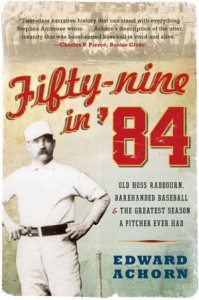 “Fifty-nine in 84” is story of grit, passion and accomplishment which – if it wasn’t really true – would be truly unbelievable. It’s the story of one of the greatest professional baseball players of the 19th century and a story of the (often sordid) conditions of the times. It’s a story for baseball fans – for historians – and for those who just appreciate a well-written tale of adversity and achievement.
The centerpiece of Fifty-nine in 84 is the 1884 season of the National League pennant-winning Providence Grays and star pitcher Charles Old Hoss Radbourn – who that season won a record 59 games (against 12 losses), tossed 678 2/3 innings, struck out 441 and compiled a 1.38 era. Need more proof of author Edward Achorn’s assertion that this was the “greatest season a pitcher ever had”? Radbourn started 73 games and completed 73 games – and, as his plaque in the Baseball Hall of Fame notes, Old Hoss pitched the last 27 games of the season, winning 26. For his 11-year big league career, Radbourn won 309 games, against 195 losses (with a 2.67 era), amassed more than 4,500 innings pitched, completed 489 of 503 starts, and struck out 1,830 batters.
But this book is not about statistical achievements, it’s about American life in the late 1800s – on and off the field. It’s about a time when both baseball and life were hard fought, dirty and often dangerous undertakings. It’s about the pain and pleasure of winning at a game that took a tremendous physical toll on its participants. It’s also about passion, Radbourn’s passion for the game, for victory (at any cost), for recognition, and for Carrie Stanhorpe (who ran a very suspect “boarding house”). And, it’s about pride, envy, anger, stubbornness, commitment and all the other emotions that go into an “epic” tale. Ultimately, it provides a vivid picture of American society and culture – and the national pastime – in the 19th century.
Again, all of this centers primarily on the 1884 National League season of the Providence Grays, a season in which the Grays’ rotation was initially made up of the proven veteran Radbourn and a hot-shot, up-and-coming young hurler (Charlie Sweeney) who brought out the worst in Radbourn when they were team mates and the best in Radbourn later in the season (after Sweeney was expelled from the team due to a combination of insubordination, alcohol and womanizing). In a less than altruistic move, Radbourn offers to essentially become a one-man rotation. In return, Radbourn wants his and Sweeney’s salary and his unconditional release from his contract if he pitches the then second-place Grays to the pennant. Motivated by arrogance, ambition and his desire to impress Carrie Stanhorpe, he does just that.
In a late-season run, Radbourn started 40 of the final 43 games (winning 36) – often pitching with such pain (primarily with alcohol as a pain reliever) that he needed help just putting on his shirt in the morning. He followed that up by pitching Providence to victory in what many consider the first World Series – defeating the American Association’s New York Metropolitans three games to none, with (true to form) Radbourn pitching all three games, winning 6-0, 3-1, and 12-2 on consecutive days. Ultimately, Radbourn retired at age 36, had an equally tumultuous life outside of baseball (dying in his forties of syphilis) and was elected to the Baseball Hall of Fame in 1938.
BBRT recommends Fifty-nine in 84 as a compelling true story about baseball, 19th century society and culture, love and life.