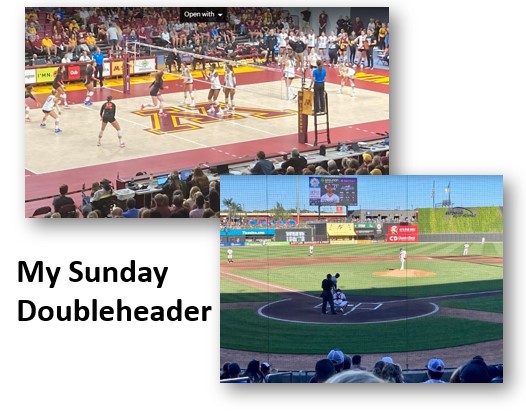
Yesterday (September 4) marked the anniversary of the day in 1928 when the Boston Braves began an MLB-record streak of nine consecutive doubleheaders (over as 12-day span). Pretty sure we’ll never see that again. I was going to commemorate that anniversary with a post on doubleheaders, but I had to delay that for a day because I was taking part (as a spectator) in a doubleheader of my own yesterday – taking in the number-four ranked University of Minnesota (volleyball) Gophers’ victory over number-13 Florida and the Triple-A Saint Paul Saints loss to Omaha. So, I’ll revisit some doubleheader trivia a day late.
Note: Some of these records/lists may change as the Negro League records from 1920-48 are further documented and incorporated into MLB records.
18 Games in 12 Days
The 1928 Boston Braves played a record nine consecutive doubleheaders over a 12-day span (September 4-15). During the streak, they swept one doubleheader, were swept six times and split two – for a four win-fourteen loss record. Notably, six players played every inning of those games (RF Lance Richbourg; LF Eddie Brown; 1B George Sisler; 2B Rogers Hornsby; 3B Les Bell; SS Doc Farrell). The team used eight different starting pitchers during the 18-game stretch – none more often than Bob Smith, who started four contests (including both ends of one doubleheader).
The stretch of twin bills may have been taxing on the hurlers’ arms. The Braves got just five complete games during the span (27.8 percent of the starts) – well below the MLB average for the year of 50.7 percent and short of the Braves’ average for the rest of the season (36.2 percent). Smith’s record may be indicative of that wear and tear. In his first start of the stretch (September 5), he tossed a complete-game two-hitter as Boston topped Brooklyn 7-1. On September 10, he tossed a second complete game, a seven-hitter, as Boston lost to the Giants 4-1. Then on September 14, he failed to make it out of the first inning of the first game against the Giants, giving up four runs without recording an out. Undeterred, the Braves sent him back out to start the second game of the twin bill – in which he gave up five runs (three earned) in 6 1/3 innings – taking his second loss of the day. Side note: Smith recovered from that tough two-loss day. He had three more starts that season, pitching 31 1/3 innings in those games (1-2, 2.87). He finished the season 13-17, 3.87 for a Braves team that went 50-103.
Nearly 60 percent doubleheaders … Now, that’s a Tough Schedule
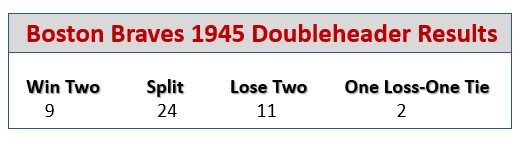
The 1945 Boston Braves played an MLB-record 46 doubleheaders. Let’s put that in perspective – 59.7 percent of the games they played that season were part of doubleheaders. How did they do? They won 42 of those games, lost 48 and tied two. Basically, they played .466 ball in twin bills, a bit better than their .403 winning percentage on days when they played just one game. By the way, just so you don’t think those 46 doubleheaders were a one-off event, the 1943 White Sox hold the AL record for doubleheaders in a season at 44.
Let’s Play …. Three?
While, there have been three occasions in which major-league teams have played three games in a single day, research by Society for American Baseball Research (SABR) member Bill Nowlin indicates there has been only one “true” (read single-admission) triple header. That came on October 2, 1920, with the 80-69 Reds facing the 77-73 Pirates at Pittsburgh’s Forbes Field. With four contests left in the season, the previous two Pirates-Reds games cancelled due to weather and third place (and a World Series’ share) at stake, the teams faced off in a one-day, three-game series starting at noon. Long story short, the Reds won the first two games (13-4 and 7-3), while the Pirates took the final game 6-0 (called – darkness – after six innings).
Only five players played in all three games (making them all, of course, single-day MLB record holders). They were the Reds’ Morrie Rath (2B-RF) and Pat Duncan (LF) and the Pirates’ Cotton Tierney (2B-SS), Clyde Barnhart (3B) and Fred Nicholson (PH-RF-LF).
The two other instances of three-games-in-a-day matchups have occurred – on September 1, 1890 (Brooklyn Bridegrooms versus Pittsburgh Innocents) and September 7, 1896 (Baltimore Orioles versus Louisville Colonels). In both of those, the first contest was a separate-admission morning game, with a second admission required for the afternoon doubleheader.
Putting Up Crooked Numbers
The record for runs scored in a doubleheader – both teams – is 54. It has been done twice. On August 21, 1894,the National League Boston Beaneaters swept a doubleheader from the Cincinnati Reds by score of 18-3 and 25-8. Then, on Independence Day in 1939, there were lots of fireworks on the field in Philadelphia, as the Red Sox topped the Athletics 17-7 and 18-12.
Well, That Didn’t Take Long
The fewest runs scored in a doubleheader? It may surprise you (because it’s not two.) The answer is one. On September 4, 1902, the Pittsburgh Pirates and Boston Beaneaters matched up in a doubleheader in Boston. Game One went to Boston 1-0 (in one hour and twenty minutes). Game Two ended in a nine-inning 0-0 tie (one hour and 30 minutes).
A Hero’s Performance
Ted Williams, the fighter pilot, was a true hero – earning the Presidential Medal of Freedom and three Air Medals, among other decorations. Teddy Ballgame demonstrated a different kind of bravery in a doubleheader on September 28, 1941. It was the final day of the season and William was hitting .3995 – which, when rounded, would make him the first Al or NL .400 hitter since 1930. Offered the chance to sit it out and sit on the .400 average, Williams declined. Williams went four-for five in Game One of the twin bill, helping Boston top the Athletics in Philadelphia 12-11, (He had three singles, a home run, two runs scored and two RBI. ) He now had a .404 average and another chance to rest on his laurels, Instead, he went out and produce a two-for-three second games (in a 7-1 Red Sox loss) finishing the season at .406.
A Good Day’s Work
On September 26, 1908, Cubs’ righty Ed Reulbach started both games of a doubleheader against Brooklyn (Superbas). He went the distance in both contests, giving up just nine hits – and no runs – over the 18 innings. Reulbach is the only MLB pitcher ever to record two complete-game shutouts in a single day. The final scores were 3-0 and 6-0.
Another Good Day’s Work – and Baseball Roundtable’s Favorite “Coincidence”
On May 2, 1954, Cardinals’ right fielder Stan Musial hit five home runs in doubleheader (versus the Giants in Saint Louis). Sitting in the stands that day was eight-year-old Nate Colbert who – On August 1, 1972 – would become just the second player ever to hit five home runs in a twin bill. Colbert was playing first base for the Padres, who were taking on the Braves in Atlanta. In his five-homer twin bill, Colbert set the record for RBI in a doubleheader (13). The Cardinals, by the way, split their doubleheader on Musial’s big day, beating the Giants 10-6 in Game One and losing the second game 9-7. The Padres swept the Braves (9-0 and 11-7) on Colbert’s record-tying day.
I Call Trade-Zees
On May 30, 1922, the Cardinals and Cubs matched up in a Memorial Day doubleheader in Chicago. The Cubs took Game One by a 4-1 score – with one of the four tallies driven in by RF Max Flack. Playing CF for the Cardinals was Cliff Heathcote, who went zero-for-three. In Game Two, Heathcote and Flack were both starting in the garden – but for the teams they had opposed in Game One. Traded between games, Flack started in RF, leading off, for the Cardinals, while Heathcote started in RF, batting fifth for the Cubs. The Cubs won this one 3-1, with Heathcote going two-for-four. Flack went one-for-four for his new team.
Don’t Worry – I Got This
In August of 1903, the Giants’ Joe McGinnity started both games of a doubleheader three times – August 1, Augusts 8 and August 31. In those starts, he picked up six complete-game victories – giving up a total of 10 runs in the six contests. By the way, the Giants played 11 doubleheaders that month. Surprisingly, on the August days when he pitched only one game (another six starts), McGinnity went 1-5 and gave up 28 runs. For the season, he was 31-20, 2.43, with 44 complete games in 48 starts. No wonder his nickname was “Iron Joe.”
Way Too Much Overtime
On May 31, 1964, Mets fans faced a long day of suffering. Not only did the New Yorkers lose both ends of a doubleheader to the San Francisco Giants – it took them a doubleheader-record 32 innings (9 hours and 52 minutes) to do it. The Giants won game one 5-3 in a brisk 2:29. The second game, however, went 23 innings (7:23), with the Giants winning 8-6. This is the longest doubleheader by innings and the longest in time – without a weather delay.
On July 2, 1993, the Padres and Phillies split a twin bill in Philadelphia that kept the fans (who stayed on) in the park for more than 12 hours. Consider the patience needed. The first game was delayed one hour and ten minutes before the first pitch; another one hour and 56 minutes in the fourth inning; and two hours and 48 minutes in the sixth. The teams began play at 4:35 p.m. on Friday, July 2 and wrapped up at 4:40 a.m. Saturday – a doubleheader record 12 hours and five minutes.
Nine-for-Nine
Nine players have a record collected nine hits in a doubleheader. Here’s the list.
Lee Thomas, Angels …. September 5, 1961
Lee Thomas collected his nine hits as the Angels were swept in a doubleheader by the Athletics (in Kansas City) – losing Game One by 7-3 score and Game Two 13-12. Thomas (playing right field and batting second) went five-for-five in the first game (four singles and a double) without scoring or driving in a run. He had half of the Angels’ ten hits. Thomas was more productive in Game Two, going four-for-six – with three home runs, three runs scored and eight RBI. He took the field in right field batting second in that contest. The Athletics won the game on a two-run walk-off home runs by CF Bobby Del Greco with two outs in the bottom of the ninth.
Thomas played eight MLB seasons (1961-68 … Yankees, Angels, Red Sox, Braves, Cubs, Astros). He went .255-106-428 in 1,027 games., His best season was as an Angel in 1962, when he was an AL All Star and hit .290-26-104 (all career highs).
Pete Runnels, Red Sox …. August 30, 1960
Pete Runnels was on his way to the 1960 AL batting championship when he had his nine-hit doubleheader on August 30 – as the Red Sox swept the Tigers (in Boston), winning the first game 5-4 (15 innings) and taking the night cap 3-2 (10 innings). Runnels, started Game One batting seventh and playing 2B (he later moved to first base). He went six-for-seven, with one double, one RBI and one run scored. Three of his hits came in extra innings and his RBI double with one out in the fifteenth frame was a walk-off game winner. Runnels was at 2B batting sixth in Game Two and went 3-4 with two doubles and one run scored.
Runnels finished the 1960 season with a .320-2-35 stat line (80 runs scored) – winning the first of two career batting titles. (He won again with a .326 average for the Red Sox in 1962), The three-time All Star played 14 MLB seasons (1951-64), hitting .291-49-630 in 1,799 games.
Roundtable Extra – More #OneThingLeadsToAnother”
I interrupt this list to once again show how, when Baseball Roundtable begins looking at one thing, it often lead to another. As I was looking at players who had a record nine hits in a doubleheader, I (of course) came across the record for hits in a nine-inning game (seven) shared by Wilbert Robinson (who is on this list) and Rennie Stennett. I also came across another nine-hit record. On July, 10, 1932, as the Athletics topped the Indians in 18 innings, Indians’ SS Johnny Burnett set a record with nine hits in a game (of any length). Ironically, the 18 innings played match up with the innings in most doubleheaders. Burnett went 9-for-11, with two doubles, four runs scored and two RBI.
Burnett, a utility player, played nine MLB seasons (1927-35) – eight for the Indians and one for the Browns. His final stat line was .284-9-213 in 588 games. He played 100 or more games at 2B, SS and 3B; but only twice topped 100 games in a season.
George Case, Senators … July 4, 1940
George Case had a big day for the Senators on Independence Day 1940 – lashing out nine hits as the Senators swept a doubleheader from the Philadelphia Athletics 5-1 and 9-5. Case went four-for-five in Game One, with a triple and a run scored. He did even better in Game Two – five-for-five, with a double, two runs scored and two RBI. Surprisingly, despite all those times on base, Case (a CF known for his speed) did not steal a base in the twin bill. (He would lead the AL with 35 steals that seasons, one of six stolen base titles he would earn.)
Case was a three-time All Star who played 11 MLB seasons (1937-47 … all but his 1946 season with the Senators). He hit .282-21-377 (785 runs scored and 349 steals) in 1,226 games.
Bill Terry, Giants…. June 18, 1929
Bill Terry’s Giants managed to lose both ends of a double header to the Robins (Dodgers) in Brooklyn – despite a nine-for-ten day by Terry. The Giants lost Game One 8-7 and dropped Game Two 7-6. In Game One, Terry – playing first base and batting fifth – went five-for-five, with a home run, run scored and three RBI. In Game Two, he went four-for-five (all singles) with two RBI.
Hall of Famer Terry should be no surprise on this list. He was a career .341 hitter over 14 MLB seasons (1923-36), all with the Giants. He had 154 career home runs, 1,078 RBI and 1,120 runs scored. He hit over .300 in 11 seasons, hitting .350 or better four times (a high of .401 when he won the 1930 batting title).
Freddie Lindstrom, Giants … June 25, 1928
Freddie Lindstrom’s nine-hit twin bill came as the Giants topped the Athletics 12-4 and 8-2 in Philadelphia. Lindstrom, batting third and playing third base, went five-for-six (all singles), with three runs scored and three RBI in Game One and four-for-five (three singles and a double), with one run and one RBI in Game Two.
A Hall of Famer, Lindstrom hit .358 and led the league with 231 hits in 1928. He played in 13 MLB seasons (1924-36 … Giants, Pirates, Cubs, Dodgers) and hit .311-103-779 in 1,438 games.
Ray Morehart, White Sox … August 31, 1926
Ray Morehart may be the least known player on this list. He picked up nine hits as his White Sox played a doubleheader with the Tigers (in Detroit), winning Game One 19-2 and losing Game Two 7-6. Morehart, batting second and playing second base, went five-for-six with a double, a stolen base, a hit-by-pitch , two runs scored and six RBI in Game One. He came back to go four-for-four, with a double, a walk, one run and two RBI in Game Two. So, for the day, he reached bases 11 times in 12 plate appearances. Why is he a surprise? Morehart played in just three MLB seasons (1924, 1926-27 … White Sox, Yankees), going .269-1-47 in-177 games. His claim to fame may be playing in 73 games for the 1927 Yankees (considered by many to be the best team of all time). Then, of course, there was the 1926 doubleheader.
Joe Kelly, Baltimore Orioles … September 3, 1894
Joe Kelly celebrated Labor Day 1894 with nine hits in a doubleheader – as his Baltimore Orioles topped the Cleveland Spiders 13-2 and 16-3. In the second game of that twin bill, he laced four doubles off none other than Cy Young. In that 1894 season, the 22-year-old outfielder hit .393-6-11, with 46 steals. Kelly, a Hall of Famer, played 17 MLB seasons (1891-1906, 1908) and hit .317-65-1,194.
Wilbert Robinson, Baltimore Orioles… June 10, 1892
Wilbert Robinson collected nine hits in a doubleheader, as his Orioles topped the St. Louis Browns 25-4 and 9-3. While Robinson still shares the record for hits in a doubleheader, he is better known for a record he set in the first game of the twin bill – seven hits in a nine-inning game. That record has been matched just once in MLB history, by the Pirates’ Rennie Stennett in a 22-0 Pittsburgh win over the Cubs (in Chicago) on September 16, 1975. Robinson also drove in a then-record 11 runs in the first game of his nine-hit doubleheader – a record that stood until September 16, 1924, when Jim Bottomley drove in 12 runs in a Cardinals’ 17-3 win over the Brooklyn Robins in Brooklyn. (Another Cardinal, Mark Whiten, matched Bottomley’s 12 RBI on September 7, 1993, in a 15-2 Cards win over the Reds in Cincinnati.)
Robinson, who went on to become a Hall of Fame Manger, played 17 MLB seasons (1886-1902), hitting .273-18-722 in 1,371 games.
Fred Carroll, Pittsburgh Alleghenies … July 5, 1886
Fred Carroll collected nine hits in a doubleheader as his Alleghenies swept the Baltimore Orioles 15-1 and 13-2 in Pittsburgh. The 21-year-old Carroll hit .288-5-64 for the American Association (major league ) that season. He enjoyed an eight season MLB career – going .284-26-366 in 754 games (C-OF-1B).
Primary Resources: Baseball-Reference.com; Baseball-Almanac.com; MLB.com; Joe Kelly, SABR Biography by Jimmy Keenan; Seven Hits in Seven Tries for Wilbert Robinson, SABR, by Jimmy Keenan; This Week in Pittsburgh Sports History, July 5, 2017, by Charles Dietch; The Last Triple Header, by A.D. Suehsdorf, SABR Research Journals Archive.
BASEBALL ROUNDTABLE
BLOGGING BASEBALL SINCE 2012
BASEBALL ROUNDTABLE ON THE TOP 100 BASEBALL BLOG LIST
 Baseball Roundtable is on the Feedspot list of the Top 100 Baseball Blogs. To see the full list, click here.
I tweet (on X) baseball @DavidBaseballRT
Follow Baseball Roundtable’s Facebook Page here. More baseball commentary; blog post notifications.
Member: Society for American Baseball Research (SABR); The Baseball Reliquary; The Negro Leagues Baseball Museum.