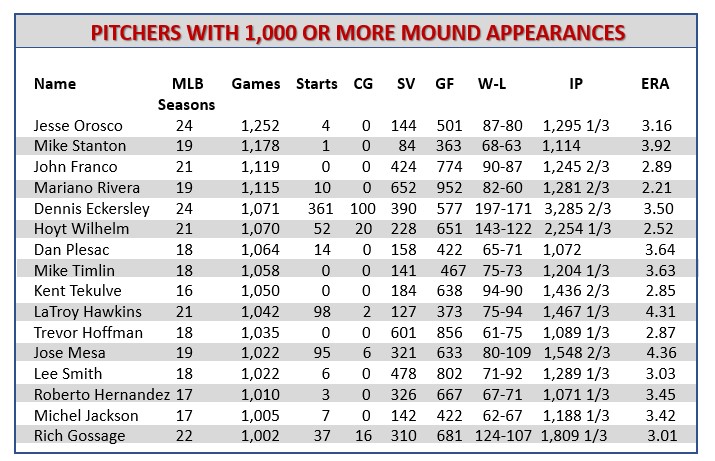
Playing in 1,000 MLB games is a major accomplishment. Pitching in 1,000 MLB games is not only a major accomplishment, but a rare one as well. In fact, only 16 pitchers in MLB history have made 1,000 or more MLB appearances. Baseball Roundtable would like to use this post to look at the careers of those 16 mound veterans. Here’s just a few facts you can pick up along the way. Among the 1,000+ game hurlers:
- Jesse Orosco and Dennis Eckersley pitched in the most MLB seasons (24); while Kent Tekulve labored in the fewest (16);
- LaTroy Hawkins pitched for the most MLB teams (11); Mariano Rivera for just one;
- Mariano Rivera had the lowest career earned run average (2.21); Jose Mesa the highest (4.36);
- Trevor Hoffman had the highest strikeout ratio (9.4 per nine innings); Kent Tekulve the lowest (4.9);
- Dennis Eckersley had the most wins (197); complete games (100); starts (361); and the fifth-most saves (390);
- H0yt Wilhelm got the latest start on his journey to 1,000+ games pitched, making his MLB debut less than 100 days shy of his thirtieth birthday (of course, he did pitch until he was just 15 days shy of his fiftieth birthday);
- Four of the 16 1,000+ game pitchers did not start a single MLB game (John Franco, Mike Timlin, Kent Tekulve; Trevor Hoffman).
And, you’ll find out some less stats-oriented facts, like:
- Hoyt Wilhelm earned a Purple Heart and Two Bronze stars at the Battle of the Bulge;
- Trevor Hoffman started his professional career as a shortstop;
- Dennis Eckersley was an All Star as a starter and a closer;
- Hoyt Wilhelm qualified for and won an ERA title as a starter and a reliever;
- After 1991 surgery for blood clots in his arm, doctors gave Roberto Hernandez no better than a 50-50 chance to return to the mound. He not only pitched in the major leagues that season, but for the each of the next 16.
Read on, for fall this and more. First a chart and then brief bios of the principals.
- Jesse Orosco, LHP … 1,252 MLB Mound Appearances … Nine MLB Teams
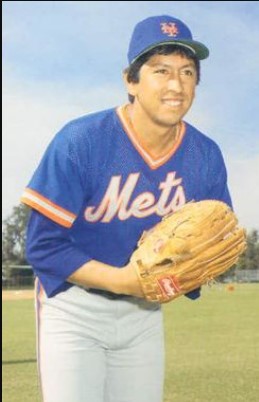
Photo: Barry Colla Photography, Public domain, via Wikimedia Commons
Jesse Orosco spent 24 seasons in an MLB uniform … tied for the most among 1,000+ appearance pitchers and for 11th all-time, all positions.
California-born, Orosco was selected (out of Santa Barbara City College) by the Twins in the second round of the 1978 MLB Draft. In 1978, in rookie ball, the 22-year-old established his credentials as a relief specialist – posting a 1.12 ERA in 20 relief outings. Before the 1979 season, he was included in a trade (to the Mets) that brought Jerry Koosman to Minnesota. Orosco split 1979 between the Mets and their Triple-A Tidewater Tides (where he went 4-4, 3.89 in 16 appearances/15 starts). While he spent part of 1981 with the Mets (0-1, 1.56, one save in eight relief appearances), he wasn’t a full-time major leaguer until 1982 (at age 25). He went on to pitch at the MLB level until age 46 (2003) – taking the mound for the Mets, Orioles, Dodgers, Indians, Brewers, Twins, Cardinals, Padres and Yankees.
In his 24 MLB seasons, Orosco made 1,248 appearances out of the bullpen and four starts. He finished with an 87-80 record, a 3.16 earned run average and 144 saves (averaging 8.2 strikeouts per nine innings). The two-time All Star’s best season was 1983 (Mets), when he went 13-7. 1.47 with 17 saves (in 62 appearances and finished third in the NL Cy Young Award balloting. He followed up in 1985 with a 10-6, 2.59 record and a career-high 31 saves. In the 17 seasons from 1982-99, Orosco averaged 62.6 appearances a year.
Tea for Two
On July 3, 1983, Jesse Orosco earned the win in both games of a Mets’ doubleheader against the Pirates. In the first game, he pitched four scoreless frames as the Mets topped the Pirates 7-6 in 12 innings. He came back to pitch the final frame of the second game, as the Mets won 1-0, again in 12 frames.
Orosco pitched in 24 post-season games, going 3-1, 4.15 with two saves. In the 1986 National League Championship Series – won by the Mets (over the Astros) – Orosco appeared in four games and picked up three wins. In Game Three, he came on in the eighth with the Mets down 5-1 and pitched two scoreless innings as the Mets came back to score two in the bottom of the ninth to win it. In Game Five, Orosco came on in the eleventh inning of 1-1 tie, again pitching two scoreless frames, with the Mets scoring in the bottom of the twelfth to win the contest. In the clinching Game Six – won by the Mets 7-6 in 16 innings – Orosco pitched three innings. He came on in the bottom of the fourteenth with the Mets up 4-3, but gave up a home run to Billy Hatcher to blow the save. He gave up two more tallies in the bottom of the sixteenth, but the Mets had scored three in the top of the inning to give the Mets the win.
————————————————————-
- Mike Stanton, LHP … 1,178 MLB Mound Appearances … Eight Teams
Mike Stanton was a 13th round pick in the 1987 MLB Draft (by the Braves), out of Alvin Junior College. He made his MLB debut on August 24, 1989 (22-years-old) – pitching a scoreless ninth inning as the Braves lost to the Cardinals 4-1 in Atlanta. Stanton pitched in the majors (until age 40) from 1989-2007, toiling for the Braves, Yankees, Red Sox, Mets, Nationals, Giants, Rangers and Reds over those 19 seasons. His final stat line was 68-63, 3.92 (7.2 strikeouts per nine innings) – and his 84 saves are the fewest, by far, of any pitcher on the 1000+ appearance list. (Twenty-seven of Stanton’s 84 saves came for the 1993 Braves). His best season was 1997, when he went 3-1, 2.57 with three saves in 50 appearances for the Yankees. He was a one-time All Star (2002 Yankees – 9-4, 2.58 in 76 appearances).
Once in a Lifetime Opportunity
Mike Stanton made one start in his MLB career. On May 9, 1999, he made a spot start for the Yankees (against the Mariners). He pitched four scoreless innings (two hits, one walk and three whiffs) and left with a 4-0 lead (but did not qualify for the win).
Stanton pitched in 80 or more games three times in his career (1996, 2004 and 2006), the last time in his age-39 season. While he never led the league in appearances, he was in the top-five six times.
Mike Stanton made 53 post-season MLB pitching appearances, going 5-2, 2.10 with one save.
————————————————-
- John Franco, LHP … 1,119 MLB Mound Appearances … Three Teams
John Franco was a fifth-round draft pick (1981, Dodgers), out of St. John’s University, where he had gone 5-1, 2.22 in his junior year (1981). He was traded to the Reds in 1983 and made his MLB debut April 24, 1983 (at age 23). He went on to pitch in 21 MLB seasons (1984-2001, 2003-2005 … Reds, Mets, Astros) – retiring as an Astro as age 44.
Franco put up a 90-87, 2.89 record, with 424 saves. He never started a major-league game, but did finish 774 of them. Franco was a four-time All Star (all in the five-year span from 1986 through 1990) and three times led the NL in saves, notching 30 or more saves in eight seasons. Over his career, the southpaw averaged 7.0 strikeouts per nine innings.
Franco’s best season was 1988, when he went 6-6, 1.57 with a league-leading 39 saves in an also NL-leading 61 appearances for the Reds. He went 2-0, 1.88 with one save in 15 post-season appearances.
You Can Look It Up
John Franco’s 424 saves are the MLB record for a southpaw.
————————————————————————
- Mariano Rivera. RHP … 1,115 MLB Mound Appearances… One Team
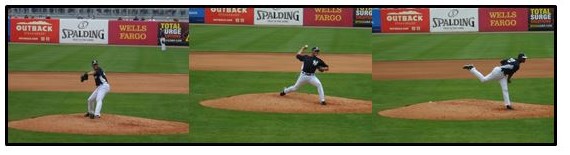
Photo: Baseball Roundtable
Hall of Famer and all-time MLB saves leader Mariano Rivera was signed (out of Panama) by the Yankees for a $2,000 bonus in 1990. It proved to be money well spent. Rivera made it to the Yankees’ roster (as a 25-year-old) in 1995 – although his role as a premier closer was not yet defined. That first MLB season he appeared in 19 games – starting ten of them. He wasn’t particularly effective, going 3-3, 5.94 as a starter and 2-0, 4.24 as a reliever.
Change Can Be Very, Very Good
Mariano Rivera’s first eight MLB appearances were as a starting pitcher.
Still, he had shown chops in the minor leagues, with a 27-18, 2.36 record over six minor-league seasons (102 games, 67 starts). Late in 1995, he moved to the bullpen full-time and, in 1997, he became the Yankees’ closer – and the rest is history.
Rivera pitched in 19 MLB seasons (1995-2013), all for the Yankees. He went 82-60, 2.21 with 652 saves. The right-hander was a 13-time All Star and 15 times had 30 or more saves (topping 40 in nine seasons, with a high of 53 in 2004), leading the league three times. He recorded an ERA under 2.00 in 11 campaigns. In his final season, at age 44, Rivera went 6-2, 2.11, with 44 saves. He averaged 8.2 whiffs per nine innings in his career.
Rivera also pitched in 96 post-season games and, in 141 innings, put up a 0.70 earned run average and an 8-1, 42-save record.
Lots to choose from, but Baseball Roundtable would pick 2004 as Rivera’s best season. He went 4-2, 1.94 with a league-leading 53 saves in a league-topping 69 appearances.
———————————————————
- Dennis Eckersley. RHP … 1,071 MLB Mound Appearances … Five Teams
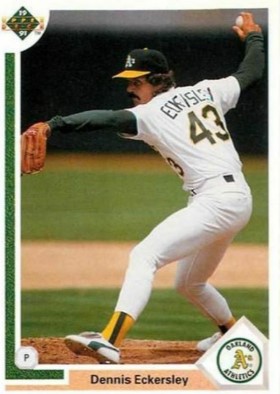 Hall of Famer Dennis Eckersley is the unicorn on this list. Consider these facts:
- His 1,071 appearances included 361 starts;
- He recorded 390 saves and 100 complete games;
- He recorded a season of 50+ saves and a 20-win season;
- He had a season during which he appeared in 50 games, but threw just 39 2/3 innings … and one in which he appeared in 35 games and tossed 268 1/3 innings.
- He pitched a complete-game no-hitter (May 30, 1977).
The right-hander was drafted by the Indians in the third round of the 1972 draft (out of Washington High School in Fremont, California). In 1974, after a 14-3, 3.40 season as a starter at Triple-A, the 20-year-old made the Indians’ roster, going 13-7, 2.60 as a rookie (34 games, 24 starts, six complete games, two shutouts). From 1975 through 1986, working primarily as a starter (Indians, Red Sox, Cubs), Eckersley went 151-128, 3.67 (with 100 complete games and 20 shutouts).
In April of 1987, Eckersley was traded from the Cubs to the Athletics and when A’s closer Jay Howell was injured, manager Tony LaRussa turned to Eckersley to fill the closer’s role. It turned out to be a fortuitous decision. From 1987-1998 (A’s, Cardinals, Red Sox), Eckersley appeared in 695 games (just two starts) and went 46-43, 2.96 with 387 saves.
Nice Set of Bookends
Dennis Eckersley was an All Star as a starting pitcher (twice) and as a closer (four times).
Eckersley led the league in saves twice and had 30 or more saves in eight seasons (a high of 51 in 1992). His final stat line was 197-191, 3.50, with 390 saves. He fanned 6.6 batters per nine innings over his career.
Eckersley’s best season was 1992, when he went 7-1, 1.91 for the A’s, with a league-leading 51 saves in an also league-leading 65 appearances, earning the AL Cy Young and MVP Awards.
As a starter, his best season was 1978, when he went 20-8, 2.99 and threw 16 complete games in 33 starts.
Eckersley appeared in 28 post-season games, going 1-3, 3.00 with 15 saves. He was the MVP of the 1988 American League Championship Series, when he saved all four A’s wins over the Red Sox.
—————————————————————–
- Hoyt Wilhelm, RHP …. 1,070 MLB Mound Appearances … Nine Teams

Photo: Public Domain via WikiCommons
Hoyt Wilhelm didn’t make his first MLB appearance until he was just 98 days shy of his 30th birthday – and the right-handed knuckleballer pitched until just 15 days shy of his 50th birthday. He managed to not only “float” his way through 21 MLB seasons, but also into the Hall of Fame.
Wilhelm made his professional debut as a 19-year-old with the Independent Class-D Mooresville Moors in 1942 – going 10-3, 4.25. He then lost three years of playing time serving in the U.S. Army.
A Hero On and Off the Field
Hoyt Wilhelm earned earning a Purple Heart and two Bronze Starts at the Battle of the Bulge.
After returning from the military, Wilhelm rejoined the Moors. Seasons of 21-8, 2.47 in 1946 and 20-7, 3.38 in 1947, earned him a shot in the Giants’ system, where he made it to the major leagues for the 1952 season.
As a rookie , the 29-year-old Wilhelm went 15-3 for the Giants , leading the NL in winning percentage (.833), earned run average (2.43, with his 159 1/3 innings in relief qualifying for the title) and games pitched (71). He also notched 11 saves. He finished second in the NL Rookie of the Year balloting and fourth in the MVP voting.
________________________________________
Side note: 1952 NL Rookie of the years winner Joe Black and runner-up Wilhelm had pretty comparable seasons:
- Black with 15-4, with 15 saves, while Wilhelm went 15-3 with 11 saves.
- Wilhelm won the ERA title at 2.43, Black’s ERA was 2.15 (but he was 11 2/3 innings shy of qualifying.
- Wilhelm appeared in 71 games, Black in 56.
____________________________________________
Wilhelm pitched in the majors from 1952-1972 (Giants, Cardinals, Indians, Orioles, White Sox, Angels, Braves, Cubs, Dodgers), going 143-122, 2.52 with 228 saves. Wilhelm fanned 6.4 batters per nine innings. He was an All Star in five seasons and a league-leader in ERA and winning percentage twice each. In the five years from 1964 through 1968, Wilhelm recorded a 1.74 ERA over 539 1/3 innings.
A Two-Way Pitcher
Hoyt Wilhelm won the NL ERA title in 1952 as a reliever and won the AL ERA title in 1959 as a starter.
Wilhelm’s 1,871 inning pitched in relief are the MLB record, as are his 124 career wins in relief.
—————————————————————
- Dan Plesac, LHP …1,064 MLB Mound Appearances … Six Teams
Dan Plesac was a first-round selection (Brewers) in the 1983 MLB Draft – out of North Caroline State University. Primarily a starter in the minors (in three minor-league seasons, he made 62 appearances, all but one in a starting role), the Brewers converted the left-hander to a bullpen role after he made the MLB squad in 1986. In his rookie MLB season, Plesac went 10-7, 2.97 with 14 saves in 51 appearances. Plesac recorded 124 of his 158 saves in his first five MLB seasons.
He pitched in 18 seasons (1986-2003 … Brewers, Cubs, Pirates, Blue Jays, Diamondbacks, Phillies), going 65-71, 3.64 with 158 saves, fanning 8.7 batters per nine innings. Plesac was a three-time All Star (1987-88-89) and twice recorded 30 or more saves in a season. Plesac spent most of his career as a left-handed relief specialist, eight times he pitched in 60 or more games in a campaign.
————————————————————-
- Mike Timlin, RHP … 1,058 MLB Mound Appearances … Six Teams
Mike Timlin was a fifth-round draft pick (Blue Jays, 1987), out of Southwestern University. He made his MLB debut with the Blue Jays in April of 1991 – after a 8-4, 1.53, 30-save season at High-A and Double-A in 1990.
In his inaugural MLB season, Plesac went 11-6, 3.16 with three saves in 63 games (three starts). Timlin went on to pitch in 18 MLB seasons (1991-2008 … Blue Jays, Mariners, Orioles, Cardinals, Phillies, Red Sox). He had four starts among his 1,058 appearances – going 1-2, 3.32 at a starter. Timlin saved 10 or more games in seven seasons, with a high of 31 saves for the 1996 Blue Jays. In 2005, at the age of 38, he led the AL with 81 appearances – going 7-3, 2.24 with 13 saves for the Red Sox. Over his career Timlin, was 75-73, 3.63, with 141 saves. He fanned 6.5 batter per nine innings. Timlin appeared in 46 post-season games, going 0-3, 4.26, with one save. In the 2003-06 seasons (his age-37 to age-40 seasons), Timlin averaged 74.3 appearances per campaign.
Post-Season Thrills
Timlin played on four World Series Champion teams – 1992 Blue Jays, 1993 Blue Jays; 2004 Red Sox; and 2007 Red Sox.
———————————————————-
- Kent Tekulve, RHP …1.050 MLB Mound Appearances … Three Teams

Photo: George Gojkovich, Public domain, via Wikimedia Commons
Submariner Kent Tekulve was a true workhorse on the mound – leading the NL in appearances in four seasons – and reaching 90 or more appearances three times.
Tekulve played for Marietta College, where the was named to the All-Ohio conferences second team in his senior year. Tekulve, however, went undrafted and was later signed out or a Pirates’ tryout camp. In his first pro season (1969), at Low-A Geneva, the 22-year-old righty was used primarily as a starter and went 6-2, 1.70 in nine games (seven starts, six complete games and two shutouts). The next season, he moved up to Double-A Sherbrooke, where he was converted to a reliever and began to refine his sidearm delivery. From 1971 through 1974, Tekulve went 32-16, 2.57 with 38 saves, while working his way up to Triple-A.
Tekulve made his MLB debut on May 20, 1974, but spent the bulk of the season at Triple-A, where he went 6-3, 2.25, with seven saves (he had a 6.00 ERA in eight appearances for the Pirates). He finally made the majors to stay in June of 1975, and went on to log a 16-season MLB career (1974-89 … Pirates, Phillies, Reds). From 1977 through 1984, Tekulve averaged 77 appearances a season – leading the league in games pitched three times in that span.
Celebrating 40
In 1987, at age 40, Kent Tekulve led the NL in appearances (for the Phillies) with 90, pitching 105 innings in relief and putting up a 3.09 ERA.
Over his MLB career, Tekulve was 94-90, 2.85, with 184 saves. He fanned 4.9 batters per nine innings.
——————————————————-
- LaTroy Hawkins, RHP … 1,042 MLB Mound Appearances … 11 Teams
LaTroy Hawkins was drafted out of West Side High School (Gary , Indiana) by the Twins in the seventh round of the MLB 1991 draft. He opened his career as a starter and from 1991-1996, he made 99 minor-league appearances (96 starts), moving from rookie ball to Triple-A and going 40-17, 2.96. The 22-year-old Hawkins made his MLB debut on April 29, 1995 in a start against Baltimore and gave up seven earned runs in just 1 2/3 innings. By mid-May he was back at Triple-A, where he went 9-7, 3.55 in 22 starts, earning a return to the Twins in September. On the season, his MLB line ended at 2-3, 8.67.
From 1996-99, Hawkins pitched in 93 games for the Twins (92 starts) and went 24-41, 6.03. (At this time, his career record, after five MLB seasons was 26-44, 6.16). In 2000., the Twins moved Hawkins to the bullpen and he showed notable improvement, going 2-5, 3.89 with 14 saves in 66 games. He made 943 MLB appearances, over 16 more seasons, without another start. Hawkins’ final record, after 21 seasons (Twins, Rockies, Cubs, Astros, Brewers, Mets, Giants, Angels, Yankees, Orioles, Blue Jays) was 75-94, 4.31. He fanned 6.0 batters per nine innings over his MLB career.
A Travelin’ Man
After spending his first nine MLB seasons with the Twins, LaTroy Hawkins pitched for 10 different MLB teams over the next 12 seasons. His 11 MLB teams pitched for is the most of any of the 1,000+ game pitchers in this post.
Hawkins’ best season was with the 2004 Cubs, when he went 5-4, 2.63 with 25 saves in 77 appearances. Hawkins also pitched in 22 post-season games, gong 1-1, 6.75.
———————————————————
- Trevor Hoffman, RHP … 1,035 MLB Mound Appearances … Three Teams
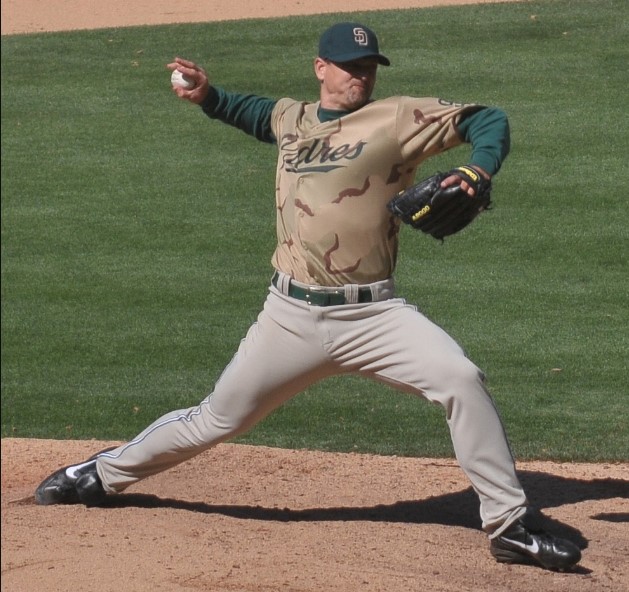
Photo: Djh57, CC BY 3.0 <https://creativecommons.org/licenses/by/3.0>, via Wikimedia Commons
Hall of Famer Trevor Hoffman’s 601 saves are second only to Mariano Rivera in MLB. While he did start 12 games in 94 minor-league appearances, Hoffman never made at start at the major-league level. Hoffman was an eleventh-round pick (Reds), out of the University of Arizona, in the 1989 MLB draft.
Let’s Change Things Up a Bit
Trevor Hoffman was originally signed as a shortstop and, in his first two minor-league seasons, played 122 games at short and 41 at 3B. The Reds , however, were more impressed with his arm than his bat and, in 1991, he was moved to the mound – where he showed good promise (based on a mid-90s fastball.)
In 1992, Hoffman was taken by the newly minted Marlins with the eighth pick in expansion draft. He started the 1993 season with Florida and was 2-2, 3.28, with two saves and 26 whiffs in 35 2/3 innings, before being traded (in mid-June) to the Padres in a multi-player deal that brought Rich Rodriguez and Gary Sheffield to Florida. It was a trade that initially did not “sit well” with Padres’ fans, but certainly proved a solid move over the years.
Hoffman went on to pitch for the Padres through the 2008 season; after which the 41-year-old signed as a free agent with the Brewers (where he became an All Star for the seventh time in his career).
Hoffman pitched 18 MLB seasons (1993-2010 … Marlins, Padres, Brewers) going 61-75, 2.87 with 601 saves. He led the NL in saves twice and topped 40 saves in nine seasons. He averaged 9.4 whiffs per nine innings over his career.
Hoffman’s best season was for the 1998 Padres, when he went 4-2, 1.48 with a league-leading (and career high) 53 saves – finishing second in the Cy Young Award voting to Tom Glavine.
Let’s Change Things Up Again
Trevor Hoffman, known for his mid-90s fastball, suffered a shoulder injury before the 1995 season (he had surgery after the season) and had to find and refine new weapons to get hitters out . He put the effort in his change up – and it became a devastating out pitch.
After eight straight seasons of 30+ saves, Hoffman missed most of the 2003 season recovering from shoulder surgery. He came back as good as ever, recording six consecutive seasons of 30+ saves after the layoff. (The first four of those were 40+ save campaigns).
Hoffman pitched in 12 post-season games, going 1-2, 3.46 with four saves.
—————————————————————–
- Jose Mesa, RHP …. 1,022 MLB Mound Appearances … Eight Teams
Joe Mesa was signed out of the Dominican Republic as a 15-year-old in 1981 by the Toronto Blue Jays. (Mesa had tried out as an outfielder, but the Blue Jays were impressed enough with his arm to sign him as a pitching prospect.) In 1982 (as a 16-year-old) Mesa made his professional debut in the Gulf Coast (Rookie) League, going 6-4, 2.70 with six complete games and three shutouts in 12 starts (13 total appearances). From 1982-87, he went 48-52, 4.68 in the Blue Jays’ minor-league system, primarily as a starter (142 starts in 156 appearances).
In September of 1987 (at age 21), Mesa was traded to the Orioles, and he made his MLB debut on September 20, starting against the Red Sox in Fenway and giving up three runs in six innings (no decision). He ended the season 1-3, 6.03 for the Orioles (six appearances five starts) – and spent the bulk of the next three seasons in the minors, where his progress was hampered by a pair of elbow surgeries.
From 1987 through 1993, Mesa ran up a 27-40, 5.03 MLB record (Orioles, Indians) with 95 starts in 98 appearances – gaining a reputation as a hard-thrower (mid- to high-90s) who needed to harness his control. Then, in 1994, the Indians moved Mesa and his fastball to the bullpen and his career path changed dramatically. Working primarily in middle relief, Mesa went 7-5, 3.82 with two saves for Cleveland in 1994. Then in 1995, he was all All Star closer – going 3-0, 1.13 with an AL-leading 46 saves (in 62 appearances) – finishing second in the AL Cy Young Award voting.
From 1994 until his retirement after the 2007 season (at age 41), Mesa pitched for the Indians, Giants, Mariners, Phillies, Pirates, Rockies and Tigers – appearing in another 924 games (all in relief and going 53-69, 3.97 with 321 saves). As noted, he led the league in saves in 1995 and had four seasons of 40+ saves. He finished his career 80-109, 4.36, with 321 saves. Mesa also pitched in 27 post season games, going 3-1, 5.14 with six saves. He fanned 6.0 batters per nine frames over his MLB career.
———————————————————-
- (Actually a tied for 12th) Lee Smith, RHP … 1,022 appearances … Eight Teams
 Hall of Famer Lee Smith was signed by the Cubs in the second round of the 1975 MLB Draft (out of Caster, Iowa, High School). He began his professional career as a 17-year-old – going 3-5, 2.32 in ten starts in the Rookie-Level Gulf Coast League. Like many of the pitchers on this list, he started out as a starting pitcher. From 1975-1978, he made 92 appearances (minor-league) of which 71 were starts. He displayed a lights-out fastball, but a lack of command. This led to a decision to move Smith to the bullpen – a move he originally resisted, but one that turned out to put him on the path to the Hall of Fame.
Pitching out of the pen, Smith earned his way to the Cubs’ staff by September of 1980 and, by 1983, was an All Star closer for Chicago – leading the NL with 56 appearances and 29 saves (and putting up a 1.65 ERA in 103 1/3 relief innings). Smith went on to pitch at the MLB level until 1997 (Cubs, Cardinals, Red Sox, Angels, Expos, Reds, Yankees, Orioles). He made just six starts in 1,022 appearances. Smith was a seven-time All Star, led the NL in saves three times and the AL once – and saved 30 or more games in 11 seasons (four times exceeding forty saves). His final MLB stat line was 71-92, 3.03, with 478 saves (third all-time). He fanned 8.7 batters per nine innings over his MLB career.
Smith’s best season was 1991 (Cardinals), when he went 6-3, 2.64, with a league-leading 47 saves. That season, he finished second in the Cy Young balloting (to Tom Glavine) and eighth in the MVP voting. In his six MLB starts, Lee Smith was 0-5, 4.62.
—————————————————–
- Roberto Hernandez, RHP … 1,010 MLB Mound Appearances … Ten Teams
Roberto Hernandez was a first-round pick (Angels) in the 1986 MLB Draft. From 1986-1992, pitching in the Angels’ and White Sox’ minor-league systems, Hernandez went 34-41, 3.92 in 107 appearances (106 starts).
The Comeback Kid
Roberto Hernandez’ 1991 season was interrupted by surgery for blood clots in his pitching arm (for which doctors gave him no better than a 50-50 chance of ever returning to the pitching ranks). Hernandez , however, made a remarkable recovery and a 6-2, 2.58 record in 12 minor-league starts earned him a September call up to the White Sox – where he made his MLB debut on September 2 – getting a win over the Royals and going seven one-hit/one-run innings. Hernandez got bounced around in his next two 1991 starts and was moved to the bullpen. Little did he know, he would never start again, but would pitch for 16 more MLB seasons.
Hernandez pitched in the majors from 1991-2007 (White Sox, Devil Rays, Royals, Mets, Pirates, Giants, Phillies, Braves, Dodgers, Indians). He was a two-time All Star and recorded 30 or more saves in six seasons. His best season was 1996 (White Sox), when he went 6-5, 1.91, with 38 saves in a league-leading 61 appearances. His final stat line was 67-71, 3.45, with 326 saves. He pitched in 11 post-season games, going 0-1, 3.12, with one save.
—————————————————
15. Michael Jackson, RHP …. 1005 MLB Mound Appearances … Eight Teams
Michael Jackson was a Philllies’ second-round pick in the 1984 MLB Draft (out of Hill College in Hillsboro, Texas).
A Pretty Good Start
As a 19-year-old professional rookie, with the 1984 Class-A Spartanburg Suns, Michael Jackson went 7-2, 2.68 on the mound (14 starts) and .368-0-7 at the plate (7-for-19, with three doubles.
Jackson made his MLB debut with the Phillies in August of 1986. He went on to pitch in 17 MLB seasons (1986-2004 … missing 2000 and 2003), taking the mound for the Mariners, Giants, Indians, Phillies, Twins, Reds, Astros and White Sox. His final MLB stat line was 62-67, 3.42, with 142 saves. His best season was 1998 (Indians), when he went 1-1, 1.55, with 40 saves in 69 appearances. He made a total of nine MLB starts, going 1-4, 6.68. (His ERA as a reliever, in 998 appearances, was 3.33. ) He fanned 7.6 batters per nine innings over his MLB career.
16. Rich Gossage, RHP … 1,002 Mound Appearances …. Nine Teams
Hall of Famer Rich “Goose” Gossage was selected by the White Sox in the ninth round of the 1970 MLB Draft (out of Wasson High School in Colorado Springs). As an 18-year-old (1970), he went 0-3 4.94 in Rookie and A-Level ball. The following year, Gossage showed his true potential, going 18-2, 1.83 in 25 games (24 starts, 15 complete games and seven shutouts) for the A-Level Appleton Foxes.
By 1972 (at age 20), Gossage was pitching for the White Sox – going 7-1, 4.28 (with two saves) in 36 games (one start). Over his first four MLB seasons (1972-75), Gossage went 20-19, 3.72, with 29 saves in 157 games (eight starts). He was an All Star for the White Sox in 1975, when he went 9-8, 1.84 and led the AL with 26 saves. In 1976, Gossage made the AL All Star squad again, this time as a starting pitcher. The White Sox had brought in Paul Richards to manage the squad and he moved Gossage into a starting role. Gossage was 5-7, 2.91 at the All Star break, but slumped to 4-10, 5.08 in the second half. Notably, he tossed 15 complete games in 29 starts for a woeful (64-97) Chicago team.
After the 1977 season, Gossage was traded to the Pirates, where, he was again an All Star, going 11-9, 1.62, with 26 saves in 72 appearances (no starts). From 1977 through his final season (1994), Gossage made 601 appearances without a start – picking up 95 wins and 280 saves.
Gossage’s final MLB stat line 124-107, 3.01, with 310 saves. He pitched in 22 MLB seasons (Yankees, White Sox, Padres, A’s, Giants, Rangers, Pirates, Cubs, Mariners). Gossage was a nine-time All Star and led the league in saves three times. He fanned 7.5 batters per nine innings over his MLB career. He also pitched in 19 post-season games, going 2.1, 2.87, with eight saves.
Primary Resources: Baseball-Reference.com; Baseball Almanac.com; SABR Bios on Hoyt Wilhelm (by Mark Armour), Trevor Hoffman (by Max Mannis) and Roberto Hernandez (by Mark Merullo and Alan Cohen).
BASEBALL ROUNDTABLE ON THE TOP 100 BASEBALL BLOG LIST
 Baseball Roundtable is on the Feedspot list of the Top 1oo Baseball Blogs. To see the full list, click here.
I tweet baseball @DavidBBRT
Follow/Like Baseball Roundtable’s Facebook Page here. More baseball commentary; blog post notifications; PRIZES.
Member: Society for American Baseball Research (SABR); The Baseball Reliquary; The Negro Leagues Baseball Museum.