On this day (May 9) in 1999, Florida State University 2B Marshall McDougall had a game that wrote his name into the NCAA record books. As Florida State topped Maryland 26-2 in an Atlantic Coast Conference game, McDougall went seven-for-seven. A pretty good day’s work. Even more spectacular is the fact that after a first inning single, McDougall launched six straight home runs: a solo shot in the second; a three-run homer in the fourth; a two-run home run in the sixth; a three-run homer in the seventh; a Grand Slam in the eighth; and a third three-run shot in the ninth. That outburst gave McDougall the NCAA single-game records for home runs (6); RBI (16); and total bases (25). You can hear the audio (from YouTube) below.
As surprising as it was, the big day fit right into McDougall’s performance for the season. McDougall, who played his first two college seasons at Santa Fe Community College (Gainesville, FL), came into that May 9 game hitting .405, with 17 home runs and 70 RB in 52 games. Here are a few other tidbits from McDougall’s 1999 college season:
- He hit .419 on the year – with 126 hits in 71 games;
- His average went above .400 in the third game of the season and never dipped below .400 thereafter;
- His season included a 33-game hitting streak, during which he went .437-13-48;
- He recorded hits in 63 of f 71 games played, with 34 multi-hit games;
- McDougall also stole 21 bases in 24 attempts.
A few other noteworthy tidbits from that 1999 season. McDougall was a consensus All-American; the Atlantic Coast Conference Player of the Year; and the 1999 College World Series “Most Outstanding Player.” He was also a finalist for the Golden Spikes Award and National Collegiate Baseball Writers Association Dick Howser Player of the Year Award. Note: The 1999 Golden Spikes and Howser Awards were won by Jason Jennings of Baylor University – who went 13-2, 2.58 on the mound (22 games, 18 starts) and hit .386-17-68 in 65 games at the plate.
The following season, McDougall hit .346-15-67 for Florida State and was a selected (for the second consecutive year) to the ACC All-Conference Team.
For those who are interested, here’s a look at Marshall McDougall’s path to (and from) the major leagues – which gives us all reason to reflect on just how challenging playing ball at the major league level can be; no matter what your past performance and future potential may look like.
In high school (Valrico, FL), McDougall had already shown his promise as a second-team All-State player (selected by the White Sox in the 41st round of the 1996 MLB Draft). He chose to attend Santa Fe Community College, where he played well enough to be picked by the Yankees in 37th round of the 1997 draft). Once again, he declined to sign, instead moving on to Division I ball at Florida State University; where, as you’ve already read, he carved out a spot in college baseball history.
After his big 1999 season, McDougall was drafted again (26th round, Red Sox), but chose to play his senior college season. He was then drafted again (2000, ninth round) and signed with the A’s organization.
After signing with the A’s, McDougall worked his way up to the AA Midland Rockhounds – where, in 2002, he hit .303-9-56 in 84 games, before being traded to the Indians for Ricardo Rincon during the season. He suffered an injury after the trade and played only nine games in the Indians’ system (Double-A and Low-A). In December 2002, he was taken by the Rangers in the Rule 5 Minor League draft.
The 6′ 1″, 200-lb. McDougall showed solid potential in the Rangers’ system (at Double- and Triple-A). In 2003, he hit .261-15-78 in 140 games; in 2004, .288-21-83 in 112 games; and, in 2005, he was hitting .341-11-64 (75 games) when he got the “call to the show.” He joined the Rangers as a utility player and manned five positions for Texas (2B/3B/SS/RF/DH). Still, he got only 18 MLB at bats in 18 games (three hits, three runs, one double, and ten strikeouts.) Hampered by injury (wrist), McDougall later played in both the Dodgers’ and Padres’ systems, but never made it back to the major leagues. He also played in the Mexican League, Mexican Winter League and Chinese P{professional Baseball League. In his final professional season (at age 33), McDougall hit .341,with ten home runs in 35 games for the Reynosa Broncos of the Mexican League. McDougall’s story clearly reflects how hard it is to get to the big leagues (he made it) and how challenging it is to stay there. Still, he played the game at the highest level – and still holds a place (several places) in the college record books.
Bonus Tidbit – Professional Baseball’s Only Home Run Cycle
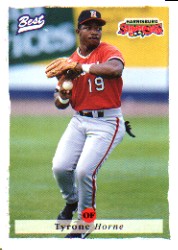 In the opening story of this post, you may have noted that Marshall McDougall’s six-homer game for Florida State University included a “home-run cycle ” – a solo, two-run, three-run and Grand Slam homer all by the same player in the same game. That feat has been accomplished only once in professional baseball. It’s a story I’ve shared before, but bears retelling – especially for those who may have missed the original post.
It happened on July 27, 1998. That day, (Roger) Tyrone Horne, playing for the Double-A Arkansas Travelers, became the only professional player (to date) to hit for the “Home Run Cycle” – bashing a solo, two-run, three-run and Grand Slam home run in a 13-4 win over the San Antonio Mission. They were the only home runs in the game, in which Arkansas collected 13 hits. Horne ended the day four-for-five, with four runs scored and ten RBI.
Horne hit three of his four dingers off San Antonia starter Pete Zamora – a two-run shot in the first inning, a Grand Slam in the second and a solo homer in the fifth. His final homer, a three-run long ball, came in the sixth off reliever Miguel Garcia. Horne came up once more, with two on, in the eighth, but reliever Jeff Kubenka struck him out.
Horne’s feat was the highlight of an outstanding Double-A season, in which the 27-year-old outfielder would go .312 with 37 home runs, 139 RBI, 94 runs scored and even throw in 18 stolen bases in 123 games. His performance at Double-A earned Horne a call up to the AAA Memphis Redbirds at the end of the season, where ht hit .364 (four-for-eleven) in three games, with one double, one run scored and one RBI. The 5’10”, 185-pounder showed not just power, but also good speed, throughout his minor-league career, racking up 185 steals in 13 seasons, hitting double digits in steals eight times and topping 20 twice. He also hit double digits in home runs seven times, topping 20 twice.)
Appropriately, right after his historic “homer cycle” game, Horne headed off to the Texas League All-Star Game, where he proceeded to win the Home Run Derby.
Horne never made it to the major leagues – completing a 13-year (1,286 games; 1989-2001) minor-league career (in the Expos, Yankees, Mets, A’s, Marlins, Cardinals and Phillies systems) with a .288 average and 143 home runs. The bat he used on his historic day with Arkansas, however, did make it to the Baseball Hall of Fame in Cooperstown.
Primary Resources: Baseball-Reference.com; TheBaseballCube.com; “Six Homers, 16 RBI for McDougall,” Bart Jansen, Associated Press, May 10, 1999; MiLB.com; and Nolefan.org.
BASEBALL ROUNDTABLE ON THE TOP 100 BASEBALL BLOG LIST
 Baseball Roundtable is on the Feedspot list of the Top 100 Baseball Blogs. To see the full list, click here.
I tweet baseball @DavidBBRT
Follow/Like Baseball Roundtable’s Facebook Page here. More baseball commentary; blog post notifications; PRIZES.
Member: Society for American Baseball Research (SABR); The Baseball Reliquary; The Negro Leagues Baseball Museum.