When the Cleveland Indians (now Guardians) were considering a new name, the legendary Cleveland Spiders were on the tip of more than a few tongues. Best remembered for their 1899 all-time worst 20-134 record, the Spiders of that season were an unusual band of characters forced to play more than 70 percent of their games on the road. Now, in this post, I will look at how this misfortune fell upon the Spiders (who, by the way, were Cy Young’s first MLB team), but first a bit of Baseball Roundtable’s “one thing leads to another” musings.
Digging into the plight of the Spiders, reminded me of my favorite work of baseball fiction – The Great American Novel , by Pulitzer Prize-winner Philip Roth. The book, set in the 1940s, recounts the very-comic sufferings of the (Port) Ruppert Mundys – a baseball team of limited skill and unlimited neurosis that (due to losing its stadium to the war effort) must play an entire season on the road.
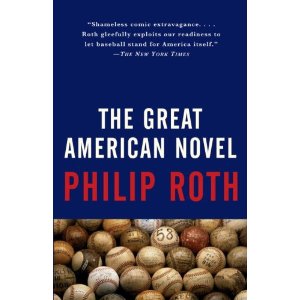 Written from the perspective of retired sport journalist “Word” Smith,” The Great American Novel takes you into the hearts and (often dark) souls of a team made up of ex-cons, alcoholics, amputees, veteran players well beyond their primes, 90-pound adolescents not ready for the big-time, and even extremely vindictive Lilliputians – and into Patriot League (the third major league) ballparks in places like Asylum, Ohio; Terra Incognita, Wyoming; and Kakoola, Wisconsin. It also takes you from the dugout to an asylum (for an exhibition game) to the House Un-American Activities Committee. The prologue includes Word Smith’s encounter with Earnest Hemingway and the book wraps up with a letter written by Smith to China’s Chairman Mao.
BBRT considers this a must-read for fans of baseball fiction. Readers should be forewarned, however, that – like the movie “The Loved One,” the Great American Novel can promise something to offend everyone. Yet, it is this across-the-board irreverence that makes the offense tolerable and even comic.
Oddly enough, in this case, fiction (at least somewhat) follows fact and, as noted earlier, this post will focus on the 1899 Cleveland Spiders, who played 112 games of its 154-Game National League schedule “on the road” – finishing in last place, 84 games off the pace and earning snickering nicknames around the league like the “Exiles,” “Wanderers,” “Forsakens” and “Misfits.”

The Spiders, however, were not always so woeful. They were, in fact, the first MLB team to put Cy Young on the mound and, in 1898, Young went 23-15, 3.00 in a Spiders’ uniform. The year before their dismal 1899 season, the Spiders boasted a winning record (81-68-7) and finished fifth in the National League. In ten NL seasons (1889-98), the Spiders had a winning record seven times and finished among the league’s top three four times. In fact, from 1892 through 1898, the Spiders had the third-best winning percentage in the league. The 1898 team also included three future Hall of Famers – Cy Young, Jesse Burkett and Bobby Wallace (all three of whom ended up in St. Louis in 1899, bit I’m getting ahead of myself).
So, what happened? As in Roth’s tale of the Mundys, there were some shenanigans involved. Spiders’ owners Frank and Stanley Robison were disappointed in the level of fan support (attendance) in Cleveland (despite a respectable won-lost history), as well as with Cleveland’s Sunday Blue (liquor) Laws. At the same time, the Saint Louis Browns were suffering on the field and at the gate – and went bankrupt after the 1898 season. Still, Saint Louis was the nation’s fourth-largest city and the Robisons saw an opportunity. The Robisons purchased the Saint Louis team, renamed it (optimistically the “Perfectos” and came up with a plan to draw Saint Louis fans into the park with a super team.
You see, the Robisons still owned the Spiders and quickly set about strengthening the Saint Louis squad with the best players from the Spiders (and replacing them on the Spiders with lessor players – a number of whom had been on the last-place Browns – as well as minor-league and semipro players). It was indeed the Robison’s’ series of lopsided trades and misguided (perhaps intentionally) signings that opened the door to the basement for the Spiders.
More than a dozen Spiders from 1898 found themselves in Perfectos’ uniforms in 1899 – and former Spiders made up eight of the most used positions players – including the teams top three in RBI, top two home run hitters and top four in runs scored. In addition, former Spiders started on the mound in 124 of the Perfecto’s games and got the win in 69 of the team’s 84 victories. (The Perfectos were far from perfect, they finished 84-67-5, fifth place in the NL).
With their woeful team, 1899 attendance dropped even lower – averaging less than 150 fans per contest. Other teams began to refuse to play in Cleveland (since their share of the gate would not even cover expenses) and that’s how the Spiders came to play 112 games on the road.
The Best of the Spiders
The two best players to open the 1899 season as Spiders were veteran infielders Lafayette Napoleon “Lave” Cross (3B and manager) and Joe Quinn (2B). Cross managed the team to an 8-30 record, while fielding well at third base and hitting at a .286-1-20 clip. The “Perfectos” were having some infield issues, however, and (true to form) Cross found himself at the hot corner in St, Louis by early June (where he hit .303-4-64 in 103 games). When Cross departed, the 36-year-old Quinn became manager and led the team in RBI (.286-0-72 in 147 games) – as well as leading them 12 wins and 104 losses.
A few other tidbits from the Spiders’ 1899 season:
- The team’s longest winning streak was two games – achieved just once.
- The team’s longest losing streak was 24 games, they also had two 11-game losing streaks and individual losing streaks of 13, 14 and 16 games.
- They lost 40 of their last 41 games.
- Eight of the Spiders 20 wins were by one run; as were 18 of their losses.
- They lost 69 games by five or more runs (24 of those by ten or more).
In 1899, the Cleveland Spiders played just 42 home games, averaging 145 fans per game. They were 9-33 at home and 11-101 on the road. (The Saint Louis Perfectos average 4,298 fans per game, second-highest in the National League.
- The Spiders scored the league’s fewest runs (529) and gave up the most (1,252) – a minus-723 run differential.
- The team finished last in the league in batting average, hits, runs, doubles, triples, home runs, RBI and steals
- The pitching staff had the league’s highest ERA and hits allowed; the fewest strikeouts; and the second-most home runs and walks allowed
- The ‘ace” of the pitching staff, Jim Hughey went 4-30, 5.41. He had the staff’s most wins (tied); most starts (34); most complete games (32); most strikeouts 54); and lowest ERA (among qualifiers).
Jim Hughey might have been the poster-boy for the Spiders’ situation. He was sent from St. Louis (where he had gone 7-24, 3.93 in 1898) to the Spiders for the 1899 season (where, as noted, he went 4-30, 5.41. He had a seven-season MLB career (1891, 1893, 1896-1900) in which he went 29-80 4.87.
- The Spiders hit 12 home runs (no one with more than two). Former Spider Bobby Wallace, who went to the Perfectos in 1899, hit 12 homers on his own. that season.
- Cy Young and Jack Powell (also former Spiders) each won more games for the Perfectos in 1899 than the Spiders won as a team; 26 and 23, respectively.
- The Spiders used 15 pitchers in 1899 and only two had earned run averages south of 5.00 – Jack Harper, who went 1-4, 3.89 in five starts and Harry Lochhead, who went 0-0, 0.00 in one 3 2/3-inning relief appearance. It was the only career mound appearance for Lochhead, who also appeared in 146 games at SS and one at 2B for the 1899 Spiders.
- Against their former teammates (on the Perfectos), the Spiders went 1-13.
A Name to Remember
Harry Colliflower made his MLB debut with the Spiders on July 21, 1899, and picked up a win (by a 5-3 score) as the Spiders topped the Senators. It would be the 30-year-old rookie’s only win in his only MLB season. He finished the campaign (and his MLB career) with a 1-11, 8.17 record. Notably, Colliflower also appeared in four games at 1B, four in CF and two in RF. In 23 games for the Spiders, he put up a .303 average (23-for-76) and drove in nine runs.
________________________________________
What a Way to End the Franchise
On the final day of the 1899 season (October 15), the Cleveland Spiders played a doubleheader against the Reds (in Cincinnati, of course) – and were outscored 35-4 in the two games. It turned out to be the final two games for the franchise, which was disbanded after the seasons as the NL contracted from 12 to eight teams. Also disbanded were the Louisville Colonels, Baltimore Orioles and Washington Senators.
___________________________________________
Primary Resources: Baseball-Reference.com; Baseball-Almanac.com; It’s Time to Bring Back the Cleveland Spiders (who really weren’t that bad, you know) … By Bradley Doolittle, ESPN.
 Baseball Roundtable is on the Feedspot list of the Top 100 Baseball Blogs. To see the full list, click here.
I tweet baseball @DavidBBRT
Follow/Like Baseball Roundtable’s Facebook Page here. More baseball commentary; blog post notifications; PRIZES.
Member: Society for American Baseball Research (SABR); Negro Leagues Baseball Museum; The Baseball Reliquary.



The story of the historical, hysterical 1899 Cleveland Spiders resides in the book “MISFITS! Baseball’s Worst Ever Team” by J. Thomas Hetrick, published by Pocol Press.