Baseball Roundtable recently sent out a link to a survey soliciting fan opinions on some of the issues facing MLB today … from the length of games to a lack of on-field action to the cost of attendance to the current owners/players financial bargaining. Thirty-nine readers responded and they represented a cross-section in terms of attendance – with the bulk (59 percent) falling in the 1-10 MLB games attended per season categories.

Editors’ Note: This is a self-selected (as opposed to random) sampling. Those who responded were both interested enough in the national pastime to seek baseball info and news on the internet and also felt strongly enough to take the time to respond.
Respondents were asked to rate the importance of several issues on a zero-to-five scale – with zero being “not important at all” and five being “extremely important.” Here are the raw results followed by a bit of commentary.
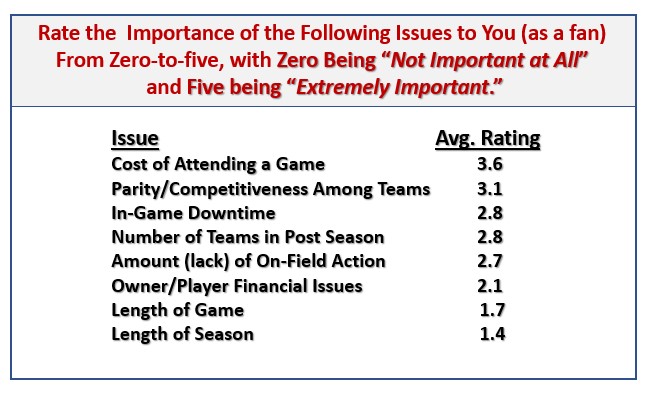
The Number-One issue, with a 3.6 rating was the cost of attending a game (tickets, parking, concessions, etc.) Notably, 41 percent of the respondents rated this at the top of the scale (five-extremely important). This would indicate a need for MLB to examine its financial structure with an eye to its impact of the cost of an afternoon/evening at the ballpark.
Number Two, at 3.1, was parity/competitiveness among teams. Just over a quarter (25.6 percent) gave this issue a “five” rating. This topic would relate to such issues as salary caps/floors, MLB draft rules, the luxury tax, etc.
At Number Three (2.8) was in-game downtime. The most common rating here was “four” – 25.6 percent. Here, we’re looking at such issues as pitch clocks, making batters stay in the batters’ box, making pitchers remain on the mound, challenges/replays, mound visits, etc.
FAN OPINIONS ON SPECIFIC RULES ISSUES/PROPOSALS
Baseball Roundtable recently did a fan survey on a host of specific rules proposals (more than 200 respondents to that one) – ranging from pitch clocks to infield shifts to robot umpires (and more). For the results of that detailed survey, click here.
Number Four (2.8) was the number of teams in the post-season, just slightly behind downtime. The debate here seems to center on balancing the positive impact of having more teams stay “in the hunt” for a post-season spot and having so many team it overly reduces the importance of baseball’s “marathon-not-a-sprint” season. As they negotiate, owners and player need to get this right – and not just in terms of its on-the-surface financial impact. More post-season games may mean more post-season revenues, but what impact does it have on regular-season attendance (if regular-season games mean less in terms of making it into October).
Number Five was the lack of on-field action at 2.7. Four was the most common response (35.9 percent). Here we are dealing with possible rules changes aimed at reducing walks and strikeouts (more balls in play), leading to more baserunners (no shifts) and promoting the running game (limiting pick-off throws, bigger bases). Seeing both in-game downtime and lack of on-field action finish notably ahead of length of games, indicates (at least to me) that fans are fine with long afternoons and evenings at the ballpark – if something is happening on the field.
Number Six (2.1) was owner/player financial issues. Notably, here the most common response was zero-not all all important at 28.2 percent. It appears fans find all the dollar-and-cents … my share versus your share … talk less compelling then a look at the product on the field (and, of course, the cost to the fan).
Bring up the rear at Seven and Eight were length of game (1.7) and length of season (1.4) – again reinforcing the importance of the on-field product (in terms of action and parity/competitiveness).
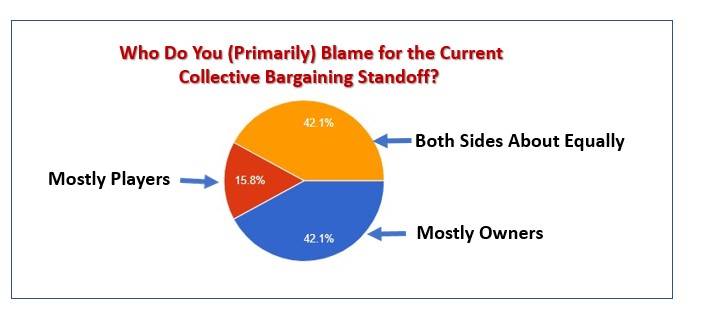
Of course, right now, there is no action on the field. With that in mind, Baseball Roundtable also asked fans whom they blamed for the current standoff. Owners seem to be getting more blame than players, but more than 40 percent of the respondents did place the blame equally on both sides.
Finally, respondents were asked if they expected their attendance to go up or down in the future. Not surprisingly, given the current CBA negotiations and the prospect of empty ballparks, more than one-third said they expected their attendance to go down (and this follows a response that indicated 48.7 percent had already seen their attendance go down in recent seasons). But still, just over half of the respondents expected their level of attendance to stay the same. Some good news for MLB there.

The survey also included an open-ended (write your own answer) question on what would most influence each respondent’s decision to go (or not go) to an MLB game going forward. In order ot the number of mentions, the leading factors were:
1) Cost/price (mentioned more than twice as often as any other issue);
2) Duration/outcome of lockdown;
3) Parity/competitiveness;
4) COVID;
5) Family-friendly atmosphere/safety.
___________________________________________
Finally, here is a representative selection of written responses from the comments section.
I’ve been more distressed by players and owners taking extreme political stances than by financial issues around the game; not just in baseball but in all sports.
——-
The question on playoffs, I would prefer LESS playoff teams than further expansion. Four teams per league is fine, expanding to 14 or more does not make sense to me, without shortening the regular season.
—–
PLEASE get the games back to two hours. Your popularity will skyrocket….and lower the cost of a family to attend…not just on a Tuesday night/upper deck/D-Backs game. and stop with this changing the rules business. This isn’t the NFL.
—–
The major league game is being played at a very high standard these days, but the owners don’t much care about the fan experience or the minor leagues — they are short-sighted.
—–
Get rid of or modify the shift and offense will go up. Singles, doubles and triples make the game exciting. Home runs are rally killers.
—–
Lets play ball, lets learn to go the other way to beat the shift, lets put the bat on the ball.
—–
And, finally, a condensed version of the most detailed comment provided by a reader.
I’m for:
- moving the mound back six to eight inches and lowering it to 7.5 inches;
- two infielders needing to be on each side of second base
- a pitch clock for pitchers (count a ball for each five seconds over time);
- hitters not allowed to step out of the batters’ box except as granted by the home plate umpire, and then only once per PA, special exemptions at the umpire’s discretion;
- in-between innings transitions timed to something TBD as reasonable (60-90 seconds, perhaps?);
- pitchers required to step off the rubber to throw to any base;
- all fences made to conform to deeper minimums at four points in each stadium built after 1980, with two exceptions at each team’s discretion;
- ghost runners added only when a game goes to the 13th inning;
- a separate replay umpire to make calls in real time (to immediately correct bad calls without a team petitioning for review). This is not for calling balls and strikes; I am also against the robo-ump, and believe that TV strikezone boxes be disallowed.
Once again, for a look Baseball Roundtable’s more detailed survey on specific rules and rules proposals (taht address many of these issues), click here.
 Baseball Roundtable is on the Feedspot list of the Top 100 Baseball Blogs. To see the full list, click here.
I tweet baseball @DavidBBRT
Follow/Like Baseball Roundtable’s Facebook Page here. More baseball commentary; blog post notifications; PRIZES.
Member: Society for American Baseball Research (SABR); Negro Leagues Baseball Museum; The Baseball Reliquary.





Appreciate this platform to express our opinions.
One last thought. There’s been a pretty substantial pop shift away from the north east and toward the mid atlantic. Those are baseball fans relocating to a baseball barren region.
Raleigh needs a team. We tick every box needed with the exception of a group of investors. Please consider.
Good day my friends.