Okay, we’re past the date when we should have heard or read those most exciting words – Pitchers and Catchers Report – and there’s no relief in sight. So, here’s another installment in Baseball Roundtable’s effort to provide some “relief” from CBA banter, focusing, appropriately, on relief pitchers. (For Installment One, click here. For Installment Two click here.) Side note, the time it takes you just to read this post should be roughly equal to the time owners and players spent in the lat negotiating session.
This time, I’ll focus on a relief pitcher who showed unexpected and bittersweet power at the plate – and a power hitter who showed unexpected and bittersweet talent on the mound.
The Rick Camp Game … The Perfect Storm
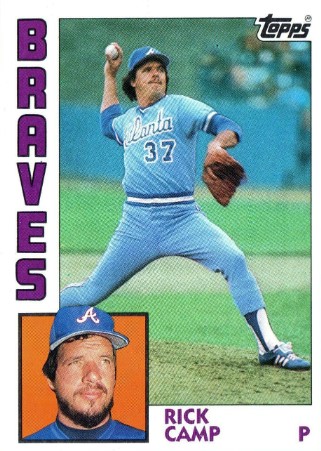
On July 4 (and July 5) , 1985, the Atlanta Braves and New York Mets took part in one of the wildest games in either franchise’s history. In Atlanta, it’s known as the “Rick Camp Game” in honor of the role(s) the Braves’ reliever played in the 19-inning marathon.
That the game happened at all is a bit of a surprise. The Independence Day contest did not start until 9:04, thanks to a 94-minute rain delay. Still, attendance was reported at 44,947 (many fans likely attracted by the planned post-game fireworks). In addition, the hometown Braves were 34-41, in fifth place, ten games off the pace. I should also note here that the inclement weather continued, with another 40-plus minute delay in the third inning.
 The fans who stayed in the park not only enjoyed the post-game fireworks, but plenty of in-game fireworks as well. The 19-inning contest featured 29 runs and 46 hits. Mets’ first baseman Keith Hernandez hit for the cycle and Mets’ C Gary Carter collected five hits and a walk in ten plate appearance. Seven Mets had at least three hits in the game – including Howard Johnson, who didn’t come into the game until the ninth inning (and still went three-for-five, with a home run, a walk, four runs scored and two RBI). Johnson, by the way, entered the game hitting just .194 (in 58 games) on the season. On the Braves’ side, LF Terry Harper went five-for-ten, with a home run, four RBI and three runs scored. Harper was one of four Braves with at least three hits in the game.
It was a back-and-forth battle, with the teams tied at one run apiece after one inning, the Braves up 3-1 after three, the Mets up 5-3 after four, the game tied at eight after nine and tied again at 10-10 after 13 – with more still to come. You get the idea.
So, why, given all this, did the contest become known at the Rick Camp Game?
Let’s pick up the action in the top of the 17th, when Camp came on to pitch in a tie game (10-10). He held the Mets scoreless in the inning (one walk, two whiffs and a groundout). The Mets’ Tom Gorman returned the favor in the bottom of the inning and the game went into the 18th frame still knotted. That’s when things got a little “Campy.”
Camp gave up a single to Mets’ SS Howard Johnson, LF Danny Heep attempted to sacrifice and was safe on an error by Camp, with Johnson going to third. Johnson then scored the go-ahead run on a sacrifice fly by CF Lenny Dykstra. Camp retired the next two batters.
In the bottom of the eighteenth, Met’s reliever Tom Gorman retired the first two batters on easy ground outs. That brought up Camp. The Braves were out of position players, so Camp came to the plate. At this point in his career, Camp was batting 0.60 (10-for-162), with no home runs and five RBI. As you might expect, he quickly fell behind 0-2. He was now one strike away from being the final out in the marathon (and, of course, taking the loss). Then the unexpected happened. On an 0-2 pitch, at approximately 3:30 a.m. on July 5, Camp hit what was to be the only home run in his MLB career – tying the game and sending it into the 19th inning. (After Camp’s home run, Gorman gave up a walk before getting the final out of the frame.)
In the July 4, 1984 contest, the Mets used 21 players (including seven pitchers), while the Braves used 22 players (including seven pitchers).
Unfortunately, Camp did not avoid the “loss” for long. In the top of the nineteenth, Camp gave up five runs on four hits and two walks (both intentional). But Camp’s Day was not over. In the bottom of the inning, facing Ron Darling, the Braves scored two runs and – with two outs – had two on and the tying run at the plate in the person of (Who else?) Rick Camp. Camp struck out to end the game. The time? Approximately 3: 55 a.m. News reports indicate that about 8,000 fans stayed for the duration – and for the 4:00 a.m. fireworks.
The Mets’ Gary Carter caught all 19 innings of the game and, consequently, Mets’ backup catcher Ronn Reynolds was the only position player to not take the field that day.
Rick Camp played in nine MLB seasons (1976-78, 1980-85), all for the Braves. He went 55-49, 3.37, with 57 saves in 414 appearances (65 starts). His best seasons were 1980 and 1981, when he went a combined 15-7, 1.86 with 39 saves. As a hitter, he went 13 for 175 (0.74), with one home run and seven RBI. He struck out in 43.1 percent of his plate appearances.
In is first six seasons, Rick Camp hit 0.26, with no home runs and no RBI (two hits in 78 at bats). In his final three seasons, he “improved” to .113 (11-for-97) and collected his only home run and all seven of his career RBI.
____________________________________________________
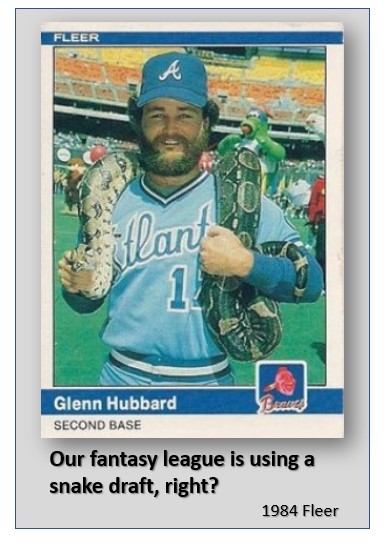
One of my favorite all-time baseball cards. For a look at 16 other “cardboard classics” that brought me smiles, click here.
_______________________________________
A Camp-to-Foxx Segue
 Rick Camp’s only MLB home run (see story above) came in his final season. Jimmie Foxx also delivered some unexpected results in his final season. We all know about Foxx’s power. In 20 MLB seasons (1925-42, 1944-45). Foxx hit .325 and mashed 534 home runs. The three-time AL MVP led the league in home runs four times, hitting fifty or more twice. In 1932, he hit .364 and led the AL in home runs (53), RBI (169) and runs scored (151).
When Neil Armstrong set foot on the moon, he and all the space scientists were puzzled by an unidentifiable white object. I knew immediately what it was. That was a home run ball hit off me in 1933 by Jimmie Foxx.
Hall of Famer Lefty Gomez
In 1945, at age 37, Foxx delivered some unexpected results. He was playing for the Phillies at the time (he went .268-7-38 in what would be his last season as a player; which is what makes this pitching stat bittersweet). The Phillies were short on pitching (it was wartime, there were plenty of shortages). So, Foxx volunteered to take the mound. He had pitched in high school and in one game for the Red Sox in 1939 (one inning pitched – a 1-2-3 frame with one strikeout). Foxx’s first two mound appearances for the Phillies were in relief – and he tossed 4 2/3 innings, giving up no runs, walking five and fanning two. Those relief appearance qualify Foxx for this CBA relief post. To make a long story short, Foxx finished the season having appeared on the mound in nine games (two starts), going 1-0 and putting up a 1.59 earned run average in 22 2/3 innings. In the process, he gave the Phillies some much needed relief. So, for his MLB career, this well-known power hitter, finished with a 1.52 ERA in ten mound appearances; eight (for the purposes of this post) in relief.
Primary Resources: Baseball-Reference.com; Remembering the Rick Camp Game, Cliff Corcoran, Sports Illustrated, April 26, 2013
 Baseball Roundtable is on the Feedspot list of the Top 100 Baseball Blogs. To see the full list, click here.
I tweet baseball @DavidBBRT
Follow/Like Baseball Roundtable’s Facebook Page here. More baseball commentary; blog post notifications; PRIZES.
Member: Society for American Baseball Research (SABR); Negro Leagues Baseball Museum; The Baseball Reliquary.