Minnesota winters are a good time to sit down and randomly browse through baseball statistics … looking to sources like the Elias Book of Baseball Records, The Baseball Maniac’s Almanac and The ESPN Baseball Encyclopedia, supplemented by online resources like Baseball-Reference.com, Baseball-Almanac.com and Retrosheet.org.

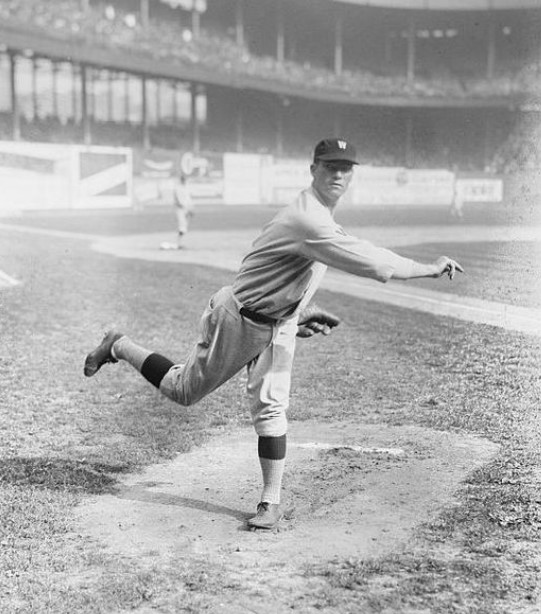
Fred Marberry …. Photo: Bain News Service, Public Domain, Wiki Commons
It’s always rewarding to run across a player or stat that makes you think “Why didn’t I already know that?” Today was one of those days for me, as I came across the record of Fred “Firpo” Marberry, who may very well have been MLB’s first-ever star relief specialist (perhaps even the first true “closer,” or at least the first true “finisher”). And, it’s quite likely that, at the time, very few recognized his status. A bit of explanation here. The “save” statistic was first offered up in 1959 by Chicago Sun-Times sportswriter Jerome Holtzman. The save was officially adopted as an MLB stat in 1969 (and applied retroactively to previous seasons, which is why this post is possible). Retroactively applied stats can, at times, prove challenging to confirm and, of course, do not always represent the thinking or strategies of the time. Still, Fred Marberry’s career deserves review and recognition.
Had the save stat been developed during his career, Marberry and his peers would have known that he:
- was the first MLB pitcher to record 15 saves in a season, becoming the single-season save record holder (retroactively) as of 1924;
- was the first MLB pitcher with 20 saves in season (22 saves in 1926);
- held the single-season saves record for 25 years (1924-1949, when Joe Page saved 27 games);
- was the first MLB pitcher to make fifty or more relief appearances in a season (1925);
- was the first MLB pitcher to reach 100 career saves – maybe.
So, why the maybe on that last bullet point? One of the challenges of digging into early (and especially retroactive) stats is determining their reliability. I usually look for multiple, respected sources as I develop these posts. In this case, ESPN.com; Baseball-Alamanc.com credit him with 101 career saves. Baseball-Reference.com and Retrosheet.org, however, set the figure at 99. Either way, he was the first to get there.
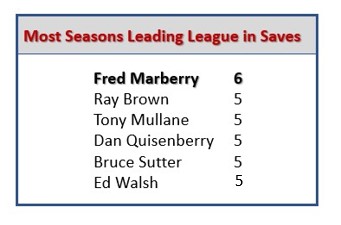
A few other facts from Marberry’s career. He led his league in saves more times than any other MLB pitcher (six) … maybe.
Why the maybe? A range of sources agree Marberry led the AL in saves in 1924, 1925, 1926, 1929 and 1932. That’s five. Baseball-Reference.com and Retrosheet.org credit Marberry with a sixth league-leading season (tying Wilcy Moore for the AL lead with eight saves) in 1931. Baseball Almanac.com and the Baseball Encyclopedia credit Moore with ten saves in 1931, which would give him the save title (on his own) in that campaign. Still, depending on which source you prefer, Marberry either holds the record outright of shares it.
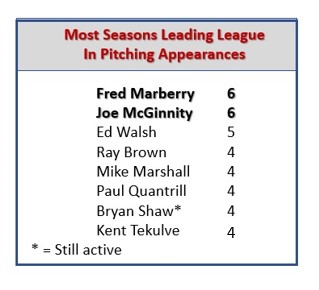
Marberry led his league in pitching appearances in more seasons than any other major leaguer except “Iron” Joe McGinnity (with whom Marberry is tied in this category).
As usual, when Baseball Roundtable starts wandering through stats, “one things leads to another.”
In August of 1903 , the Giants’ Joe McGinnity started both games of doubleheaders three times – and picked up six complete-game victories, surrendering a total of ten runs in the six games. (The Giants played eleven doubleheaders that month.) The surprise stat is that on the six days that August when he was called on to pitch just one game, McGinnity was 1-5 and gave up 28 runs. Gives new meaning to Ernie Banks’ “Let’s Play Two!”
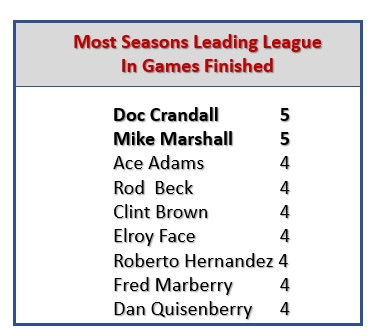
Marberry led the league in games finished four times – third all-time.
Marberry made his major-league debut with the Senators on August 11, 1923 – at the age of 24 – after going 11-10, 3.29 for the Class A Little Rock Travelers (23 starts/14 relief appearance). After his call up, the big right-hander went 4-0, 2.82 in 11 appearances (four starts/two complete games) for Washington manager Donie Bush (who was leading the Senators to a 75-78-2 finish). Marberry was primarily a high-kicking, fastball pitcher (he wouldn’t develop a curve util later in his career) with good control.
Bucky Harris took over the Senators’ helm in 1925 and put Marberry “to work” – getting him into a league-leading 50 games (14 starts) and using him to “finish” 31 contests (with Marberry recording – retroactively – a record 15 saves). Marberry went 11-12, 3.09 – with a 3.66 ERA as a starter and 2.82 as a reliever, impressing Harris with his durability, versatility, fearlessness and ability to get big outs in late innings. Marberry’s mound work helped the Senators to an AL-best 92-62-2 record, as well as to the World Series victory over the Giants. Note: Marberry’s ERAs as a starter and a reliever were both well below the American League average of 4.23 that season.
Al “The Mad Hungarian” Hrabosky may have been channeling Fred Marberry with his “aggressive” demeanor on the mound. In Marberry’s Society for American Baseball Research bio, writer Mark Armour notes that Marberry had a reputation for stomping around the mound, throwing and kicking dirt, glaring angrily at the batter.
In 1925, Harris went all in on Marberry as a reliever. Marberry appeared in a league leading 55 games (all in relief). He finished a league-topping 39 games and recorded nine wins (five losses) and a league-leading 15 (Baseball-Almanac.com) or 16 saves (Baseball-Reference.com). Much like today’s closers, Marberry pitched one inning or less in 22 of those appearances and averaged 1 2/3 innings (1.70 for those who want to be more exact) per trip to the mound.
In 1926, Marberry put up what was retroactively declared MLB’s first 20-save season, going 12-7, 3.00 with 22 saves. Notably, he still had the stamina to go deep as a starter. He started five games (out of a league-topping 64 appearances) and completed three of them.
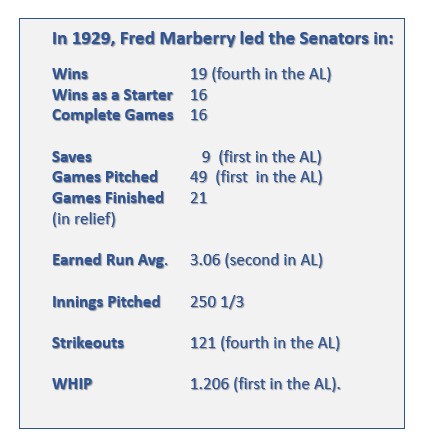
From 1927-32, Marberry was both a valued starter and ace reliever for the Senators. During that period, he went 81-45, 3.77, with 41 saves. He started 109 games (53 complete games and five shutouts) and relieved in 176. His best season was 1929, when he went 19-12, 3.06, with a league-leading nine saves. (O0ps, another maybe. Baseball-Reference and Retrosheet each credit Marberry with a league-leading nine saves that season; Baseball-Almanac and the Baseball the ESPN Baseball Encyclopedia each credit him with a league-leading eleven saves.) That season, Marberry was 16-8, 2.86 as a starter (with 16 complete games) and 3-4, 4.40 as a reliever, with those nine (or eleven) saves and 21 games finished. He also led the AL in WHIP. The overall AL earned run average was 4.24 in 1929. He led the Senators in pitching appearances, wins, complete games, saves, innings pitched, earned run average and strikeouts – and was second in starts.
Between 1929 and 1932, Fred Marberry went 58-25, 3.60, with 31 saves for the Senators – going 49-16 as a starter, tossing 44 complete games and picking up 31 saves (leading the AL in saves three times).
In 1929, when he led the American League in saves, Marberry also led the Senators in wins and wins as a starter, complete games, innings pitched, ERA and strikeouts.
Marberry was traded to the Tigers in December of 1932 and pitched four more seasons in MLB (Tigers, Giants, Senators) continuing to start and relieve (54 starts and 32 relief appearances). He went 31-19, 3.81 over that period, tossing a pair of shutouts and saving five games. His final MLB stat line was 148-88, 3.63, with 101 (or 99) saves.
S0, how good was Marberry? Let’s look at some more stats – comparing him with his on-the-field peers.
In twelve of his fourteen seasons, his earned run average was better than the league average – and in five of those it was more than one run better (in three additional seasons it was between 0.92 and 0.99 better.)

Marberry finished in the American League’s best six in ERA four times; among the best ten in WHIP six times (notching the league’s lowest WHIP twice); and among the AL’s top ten in strikeouts per nine innings four times.
While 1936 was Marberry’s final MLB season, he pitched in the minors until 1941 – and had a 13-9, 3.07 season for the Texas League Fort Worth Cats as a 40-years-old in 1939,
There can be little doubt about Marberry’s talent, his durability or his desire to “take the ball.” One wonders what kind of numbers he might have put up if he had been used solely as a starter or reliever. For much of his career, he showed the ability to be – at times in the same season – a front-line starter and top-drawer reliever. Clearly, he deserves recognition for his mound mastery.
Primary Resources: Baseball-Reference.com; Baseball-Almanac.com, Retrosheet.org.
 Baseball Roundtable is on the Feedspot list of the Top 100 Baseball Blogs. To see the full list, click here.
I tweet baseball @DavidBBRT
Follow/Like Baseball Roundtable’s Facebook Page here. More baseball commentary; blog post notifications; PRIZES.
Member: Society for American Baseball Research (SABR); Negro Leagues Baseball Museum; The Baseball Reliquary.