 On this date (October 10) in 1920, the Cleveland Indians faced off against the Brooklyn Robins (Dodgers) in Game Five of the Word Series. The nearly 27,000 fans in attendance were about to get much more than they bargained for – a General Admission ticket was $1.10, a First Level Pavilion seat $3.30 and Main Level Grandstand seat $5,50.
The Series (best-of-nine) was knotted at two games apiece and the Indians sent ace righty Jim Bagby – who had led the AL with 31 wins (12 losses, 2.89 ERA) and a .721 winning percentage. The Robins countered with future Hall of Famer, right-hander Burleigh Grimes – who had gone 23-11, 2.22 and led the NL in winning percentage at .676.
The expected pitchers’ duel did not materialize. In the bottom of the first inning, Indians’ LF Charlie Jamieson singled to right, 2B Bill Wambsganss singled to left (Jamieson moving up to second), CF Tris Speaker dropped a bunt single down the third base line and and RF Elmer Smith hit a Grand Slam home run to right field – giving the Indians a four-run lead before Grimes had recorded a single out. (Smith had hit .316-12-103 during the regular season – finishing fifth in the AL in home runs – Babe Ruth led with 54, no one else had more than 19 – and tenth in RBI.) Grimes retired the next three batters and the Indians closed out the frame with a 4-1 lead.
Well, that was a Bit of History – Part One
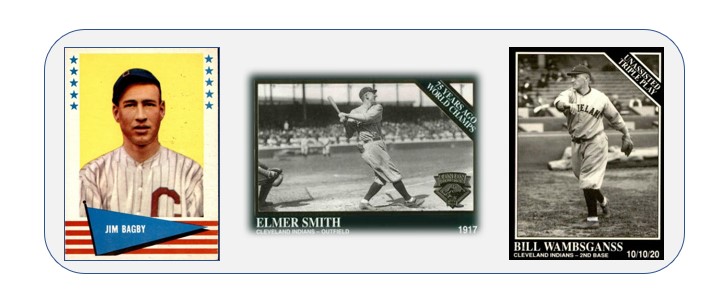
The Indians’ Elmer Smith’s Game Five Grand Slam was the first-ever World Series Grand Slam home run.
The score remained 4-0 until the bottom of the fourth, when Cleveland 1B Doc Johnston opened the inning with an infield single off Grimes, moved to second on a passed ball and to third on a Joe Sewell (SS) ground out. Grimes then walked number-eight hitter C Steve O’Neill to get to Bagby, who homered to center to up the lead to 7-0.
Well, that was a Bit of History – Part Two
Jim Bagby’s three-run home run in Game Five of the 1920 World Series was the first-ever World Series homer hit by a pitcher. Bagby was a decent hitting pitcher. On the 1920 season, he had gone .252-1-14.
In the top of the fifth, trailing 7-0, the Robins looked to mount a rally. 2B Pete Kilduff opened with a single to left-center off Bagby and C Otto Miller followed with another single to center, Kilduff going to second. The next batter, was P Clarence Mitchell (who had come on in relief of Grimes). Sending a pitcher to the plate with a couple of runners on did not work as well for the Robins as it had for the Indians. Mitchell hit a liner up the middle – a hit that seemed headed for the outfield. Indians’ 2B Wambsganss, however, moved to his right, leapt high and snagged the liner. With the runners on the move, Wambsganss stepped on second to retire Kilduff and then turned and tagged Miller who was approaching the keystone bag. One play, one defender, three outs.
Well, that was a Bit of History – Part Three
Ed Wambsganss’ unassisted triple play in Game Five of the 1920 World Series remains the only unassisted triple killing in World Series history.
The game ended in an 8-1 Indians victory – despite the fact that the Robins outhit the Indians 13-12. Bagby went the distance, giving up just one tally on 13 hits. He did benefit from three double plays: LF-C; 3B-2B-1B; 1B-SS-1B; and, of course, one triple play.
The Indians went on to win the best-of-nine series five games-to-two, with Stan Coveleski picking up three complete-game wins (giving up just 15 hits and two runs in 27 innings). Notably, the Indians gave up just six earned runs in the seven games (0.89 ERA).
The Indians’ two historic home runs in Game Five of the 1920 World Series were their only home runs of the Series. There were, in fact, the only two home runs by either squad in the 1920 Fall Classic
The principals:
Jim Bagby
Bagby pitched in nine MLB seasons (1912, 1916-23) – primarily for the Indians. His best season was 1920 (31-12. 2.89, with 30 complete games). He also went 23-13, 1.99 for the 1917 Indians. His final stat line was 127-89, 3.11. As a hitter, he went .218-2-60 in 660 at bats.
Elmer Smith
Smith played in ten MLB seasons (1914-17, 1919-23, 1925). 1920 was his best campaign (.316-12-103), as he reached full-season career highs in average and RBI and recorded his second-highest, single-season home run total (he had 16 homers in 1921). He played in 1,012 MLB games, hitting .276-7-540.
Bill Wambsganss
Wambsganss played in 13 MLB seasons (1914-1926), hitting .259-7-521. His best season at the plate was 1918, when he went .295-0-40 for the Indians, stole 16 bases and scored 34 runs in 87 games. He scored 80 or more runs in four seasons and stole 16 or more bases in four seasons. He led the AL in double plays at second base twice, and in putouts and assists at 2B once each. He also led in errors at 2B four times.
Primary Resource: Baseball-Reference.com
BASEBALL BLOG LIST
 Baseball Roundtable is on the Feedspot list of the Top 100 Baseball Blogs. To see the full list, click here.
I tweet baseball @DavidBBRT
Follow/Like Baseball Roundtable’s Facebook Page here. More baseball commentary; blog post notifications; PRIZES.
Member: Society for American Baseball Research (SABR); The Baseball Reliquary; The Negro Leagues Baseball Museum.