As Baseball Roundtable continues to wait (and hope) for the start of the MLB season, I continue to muse over past baseball events and occurrences – the stats and stories or our national pastime. As I do that, it comes to me that timing, while not everything, can be pretty darn important: like Jim Thome’s MLB-record lucky thirteen walk-off home runs; Rick Wise’s hitting only 15 MLB home runs in 18 MLB seasons, but hitting two of them in the same game in which he tossed a no-hitter; Bob Feller tossing a no-hitter on Opening Day; or Ted Williams’ home run in his last at bat. These are all examples of pretty good timing, how about a look at some less well-timed accomplishments.
Twenty-five Wins and Not a Sniff of a Cy Young Award Vote
Since the Cy Young Award was established in 1956, MLB as seen 19 seasons of 25 or more wins by 15 different pitchers. In 13 of those campaigns, the pitcher accumulating those 25+ wins has gone home with the Cy Young Award. In the area of bad timing, Juan Marichal can “boast” three of the six seasons in which a pitcher put up 25 or more wins and was not granted Cy Young Award honors. (By the way, Marichal and Sandy Koufax are the only two MLB hurlers with three seasons of 25 or more wins since 1956.)
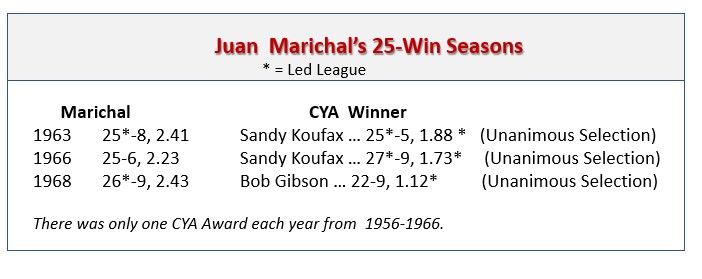 Hall of Famer Marichal (the only National Leaguer to win 25 or more games in a season without capturing the CYA) won 20+ games in six seasons during his 16-year MLB career. He, however, never won a Cy Young Award (and, in his three seasons of 25 or more wins, did not get a single CYA vote).
Other pitchers with 25-win seasons that did not earn them the CYA include: Jim Kaat (25-13, in 1966 – CYA Winner, Sandy Koufax, 27-9, 1.73); Mickey Lolich (25-14, 2.92 in 1971 – CYA winner, Vida Blue, 24-8, 1.82); Fergie Jenkins (25-12, 2.82 in 1974 – CYA winner Catfish Hunter, 25-12 2.49).
.386-40-170 … and Leading the League in None of the Triple Crown Categories
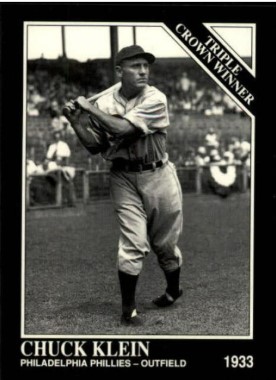 Depending on your source of information, there have either been seven seasons of 170 or more RBI, by five different players (Baseball-Reference.com) – or nine such seasons, by six different players (MLB.com). Side note: BBRT leans toward the Baseball-Refeence.com stats. No matter which set of stats you use, however, one thing is consistent – Chuck (the Hoosier Hammer) Klein’s 1930 season of 170 RBI represents the only season of 170 or more RBI in which the player did not lead his league in runs batted in. Klein had the misfortune of plating 170 tallies (for the Phillies) in the same season that Hack Wilson drove in his MLB-record 191 runs for the Cubs.
It was in fact, an ill-timed season for Klein all around. He went .386-40-170 – and failed to lead his league in any of the three Triple Crown categories. There was, of course, Wilson’s 191 RBI. Klein was also second to Wilson in home runs (Wilson had 56), In addition, the Giants’ Ralph Terry led the NL with a .401 average (Klein was third). Hall of Famer Klein, by the way, had a 17-season MLB career (.320-300-1,201.) He led his league in runs scored three times, hits twice, doubles twice, home runs four times, total bases four times, RBI twice and (surprise) stolen bases once.
Timing, Good or Bad? Your Call.
Chuck Klein went .368-28-120 for the Phillies to win the National League Triple Crown in 1933, but he didn’t get all the Triple Crown glory that season. In fact, he didn’t even get all the Triple Crown glory in his own city. In 1933, Jimmie Foxx of the Philadelphia Athletics also won the Triple Crown, leading the American League with .356-48-163. It remains the only time both leagues boasted a Triple Crown winner. Tough to share that glory, but there really isn’t a bad time to notch a Triple Crown.
Sixty-Times-Three Equals Zero
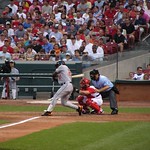
Photo by Ryosuke Yagi 
Major League Baseball has seen only eight seasons of 60 or more home runs and only Sammy Sosa has three such campaigns. Yet, he did not win the league home run crown in any of them. In 1998, the Cubs’ Sosa hit 66 home runs, but lost the home run race to the Cardinals’ Mark McGwire, who became the first to reach 70 long balls; in 1999, Sosa had 63 bombs and again trailed the Redbirds’ McGwire (65); and, in 2001, Sosa rapped 64 home runs, but lost the dinger race to the Giants’ Barry Bonds (73). Sosa remains the only player to hit 60 or more taters in a season and not win the home run crown. For his 18-season MLB career, Sosa hit .273-609-1,667. He won a pair of NL home runs crowns (50 in 2000 and 49 in 2002) and led the NL in runs scored three times, RBI twice and total bases three times.
So, Close … Yet so Far
In 1886, Thomas “Toad” Ramsey of the Louisville Colonels (American Association, considered a major league) went 38-27, 2.45 and struck out 499 batters – so close to that magic 500 number. Thanks to some unfortunate timing, his 499 whiffs (second-most in major-league history) were not even enough to lead the league. That season, Matt Kilroy of the Baltimore Orioles went 29-34, 3.37 (leading the American Association in losses). He also fanned an all-time major-league record 513 batters in 583 innings pitched.
1900 and Beyond, Seasons When 300 Was Not Enough
When we look at MLB from 1900 forward, we see that there have been 38 seasons of 300 or more strikeouts (19 different pitchers). Of those 38 seasons of 300 or more whiffs, there have been only four instances when a pitcher fanning 300 batters did not lead his league – and, in two of those, the pitcher did not even lead his own team. That could be considered a bit of bad timing.
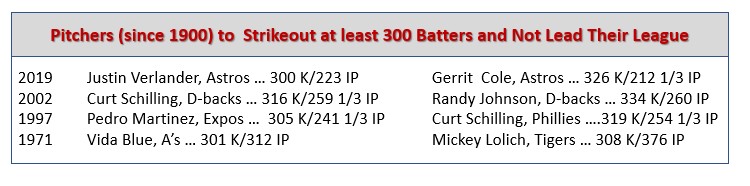 Vida Blue’s 300 strikeout season was both well- and ill-timed. It came as part of a 24-8, 1.82 season and helped him win the Cy Young and Most Valuable Player Awards. It was also his only 300-strikeout campaign, but came in the same season that Mickey Lolich had his only 300+ strikeout campaign (and took the AL strikeout crown).
.400 Average? Yeah, So What?
Hall of Famer Billy Hamilton (.344 career average, two batting titles, five stolen base crowns) hit .400 or better once in his career (.403 in 1894) – and it was not the best season to do it. Not only did he not win the National League batting crown, he average was only fourth-best on his own team. Note: That season the overall National League Batting Average was .309 and Hamilton’s Phillies hit .350 as a team.
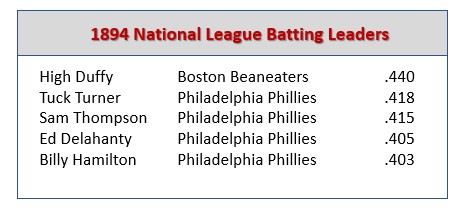
Hamilton’s .400+ season came in the same campaign in which Boston’s Hugh Duffy had his only .400+ season – setting the all-time MLB record with a .440 average. Tuck Turner’s .418 is the highest average ever by a player to not capture the batting title. In 1894, the Phillies finished fourth, despite their record four .400+ hitters.
Since 1900, the Cleveland Naps’ Shoeless Joe Jackson has the highest average without winning a batting title – with his .408 average in 1911 finishing second to Ty Cobb’s .420 for the Tigers. It was Jackson’s only .400 or better season. Cobb had three .400+ campaigns.
The Cycle? We don’t Need No Stinkin’ Cycles
On June 3, 1932, as the Yankees topped the Philadelphia Athletics 20-13, New York third baseman Tony “Poosh ‘Em up” Lazzeri hit for the cycle (single, double, triple home run in one game) – scoring three times and driving in six runs He had a pairs of singles in the five-for-six game. He became just the third player to hit for a natural cycle (1B, 2B, 3B, HR in that order) and the third to include a Grand Slam in his cycle. Still he didn’t the attention nor press you might have expected. The headiness went to Lazzeri’s teammate Lou Gehrig, who became just the third major leaguer to hit four home runs in a single contest (four-for-six, four runs, six RBI).
Stingy, but Not Stingy Enough
In 1910, Jack Coombs of the of the Philadelphia Athletics put up some startling numbers – a league-leading 31 wins (nine losses) and a minuscule 1.30 earned run average (the only time in his career, Coombs’ ERA would be south of 2.00). Still, it wasn’t enough to get him the ERA crown. That season, the White Sox’ Ed Walsh – despite going 18-20 (his 20 losses leading the league) – pitched to a 1.27 ERA. Coombs still holds the record for the lowest qualifying ERA for a player not taking the ERA title.
Can a One-Hitter Be Badly Timed?
Right-hander Bob Hendley – who went 48-52, 3.97 in a seven-year MLB career (Braves, Giants, Cubs, Mets) – threw arguably the best game of his career on September 9, 1965. He could, however, have tossed the gem at a more opportune time. That day, Hendley and his eighth-place Cubs faced off against the second-place (and eventual 1965 World Series winners) Los Angeles Dodgers and their “ace” Sandy Koufax in LA.
Hendley was on top his game. After eight innings, he had given up just one hit and one walk (versus three strikeouts). The only hit had been a harmless double by Dodgers’ LF Lou Johnson in the bottom of the seventh. Hendley had allowed just one run (unearned) in eight frames – and even that wasn’t his fault. The pesky Johnson had led off the fifth with a walk; moved to second on a sacrifice by RF Ron Fairly; stole third; and then scored as Cubs’ catcher Chris Krug made a wild throw past third baseman Ron Santo.
Unfortunately, Hendley’s efforts weren’t nearly enough. Koufax, who came into the game already a 20-game winner (21-7), threw a perfect game – striking out 14 Cubs. While his ill-timed one-hitter didn’t even get Hendley a win, it did earn him a piece of the record for playing/pitching in the MLB game with the fewest combined hits ever.
Baseball Roundtable Pick for Worst MLB “Timing” Ever
On June 2, 2010, Armando Galarraga of the Tigers was one out away from a perfect game (and baseball immortality). Galarraga had retied 26 consecutive Indian and held a comfortable 3-0 lead, He went to a 1-1 count on the 27th batter (Indians’ SS Jason Donald), who then hit a grounder to the right side. Tigers’ first basemen Miguel Cabrera backhanded the soft grounder and threw to Galarraga covering first. Although the fans and Tigers’ player thought Donald was clearly out on the play (and replays later confirmed that observation), veteran umpire Jim Joyce (at this very untimely moment) missed the call and Donald was awarded an infield single – ending both the perfect game and no-hitter. To make a long story short, Galarraga retired the next batter on a ground out – notching his first career complete game. After the contest, Joyce admittedly to missing the call and apologized. Galarraga, by the way, pitched in six MLB campaigns (2007-12 … Rangers, Tigers, Diamondbacks and Astros (going 26-34, 4.78). The near-perfect game was his only shutout and one of only two career complete games. Jim Joyce retired as an MLB umpire after the 2016 season (MLB career 1987-2016).
It’s Miller Time – Sometimes, the Timing Does Work Out
It wouldn’t be fair to only look at ill-timed events, so here’s one for the positive side of the ledger.
John Allen Miller played just parts of two seasons in the major leagues (1966 and 1969, with the Yankees and Dodgers, respectively). An outfielder/first baseman, he appeared in a total of 32 major league games, getting 61 at bats and just ten hits (.164 career average), two home runs and three RBI. His two round trippers, however, were very well timed. They came in Miller’s very first and very last MLB at bats – making him just one of two players in MLB history to homer in their first and final big league at bats. The other is Paul Gillespie – whose MLB career spanned three seasons during World War II (1942, 1944, 1945), all with the Cubs. Gillespie, a catcher, appeared in 89 games – hitting .283, with six home runs and 31 RBI; and went zero-for-six in the 1945 World Series. For more on Miller, click here.
Primary Resources: Baseball-Reference.com; Stathead.com; MLB.com; ESPN.com
 Baseball Roundtable is on the Feedspot list of the Top 100 Baseball Blogs. To see the full list, click here.
I tweet baseball @DavidBBRT
Follow/Like Baseball Roundtable’s Facebook Page here. More baseball commentary; blog post notifications; PRIZES.
Member: Society for American Baseball Research (SABR); The Baseball Reliquary; The Negro Leagues Baseball Museum.