Baseball Roundtable Trivia Teaser
Your task is to name the two MLB Players who:
- Were born on the same day (May 27, 1968) … approximately 1,200 miles apart;
- Were both were selected in the 1989 MLB draft;
- Each played their first full MLB seasons in 1991 (although one lost his rookie status in a 1990 call up);
- Each recorded nine seasons of 30 or more home runs;
- Made their mark as MLB first basemen;
- Both played their way into the Hall of Fame;
- Were the 11th and 12th players to be unanimously selected Most Valuable Players in their league;
- Were the first pair 0f first basemen to be selected as league MVPs in the same season.
Trivia Teaser Answer: The White Sox’ Frank Thomas and the Astros’ Jeff Bagwell. (You can find their bios among the unanimous MVP’s listed below.)
Bonus Trivia: Who are the only two players to be unanimous selections both as Rookie of the Year and Most Valuable Player? (Not earning both awards in the same year, of course.)
Bonus Trivia Answer: Albert Pujols and Mike Trout.
Note: This trivia teaser is intended as a lead-in to BBRT’s latest post – looking at MLB’s unanimous MVPs.
—–MAJOR LEAGUE BASEBALL’S UNANIMOUS MVP’S—–
1935 … Hank Greenberg, First Base, Tigers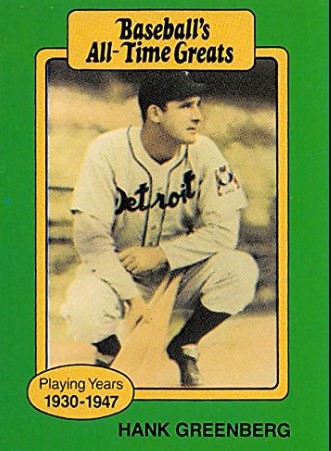
Nicknames: Hammerin’ Hank and The Hebrew Hammer (Putting these in because so many of these stars had slid nicknames.)
In 1935, The Tigers’ Hank Greenberg, at age 24, won his first of two AL Most Valuable Player Awards – and was the first unanimous MVP selection. The future Hall of Famer hit .328 and led the AL in home runs (36), RBI (168) and total bases (389). He collected 203 hits, rapped 46 doubles, legged out 16 triples and scored 120 runs.

Greenberg led his Tigers to a 93-58 season and the American League pennant. That season, the Tigers led MLB in batting average (.290) and runs scored (918) – and were third in home runs (106). The Bengals pitching staff finished sixth in ERA. Greenberg led the Tigers in hits (203), doubles (46), triples (16), home runs (36), RBI (168) and was second on the team to Charlie Gehringer in average (.328 to .300).
MAJOR LEAGUE ALL-STAR SNUB
In his 1935 unanimous MVP season, Hank Greenberg was not selected to the AL All Star team – despite hitting .317 with 25 home runs and 101 RBI at the All Star break (some statistical sources list the RBI figure at 103. In either case, it is a record that still stands – although Juan Gonzalez of the Rangers reached 101 RBI before the 1998 AS break.) Lou Gehrig (.320-11-51 at the 1935 break) got the nod at 1B on the 21-player AL All Star squad.
Between 1930 and 1947, Greenberg played 13 MLB seasons (losing three campaigns to World War II military service) – all but his final season with the Tigers. He was a four-time All Star and two-time MVP. Greenberg, who played 125 or more games in just eight seasons, led his league in home runs four times (a high of 58 in 1938); RBI four-times (topping 100 in seven seasons, with a high of 184 in 1937); doubles twice; and runs scored once. He hit over .300 in eight seasons and his 63 doubles in 1934 are the fourth-most in an MLB season. Greenberg retired with a .313 average, 331 home runs and 1,274 RBI.
The runner-up to Greenberg in the 1935 AL MVP balloting was Red Sox RHP (and accomplished pinch hitter) Wes Ferrell, who went 25-14, 3.52 – leading the league in wins, complete games (31) and innings pitched (322 1/3).
———————————————
1936 … Carl Hubbell, LHP, Giants
Nicknames: King Carl and The Meal Ticket
In 1936, Carl Hubbell won his second of two MVP Awards, leading MLB in wins (26 victories versus 6 losses), winning percentage (.813), and earned run average (2.31). The future Hall of Famer completed 24 games in 34 starts and threw three shutouts. The Giants’ finished the season fourth in the league in runs scored, but (thanks primarily to Hubbell) gave up the NL’s second fewest runs.

Hubbell’s 1936 Giants’ squad won the NL pennant with a 92-62 record. On offense, they were led by OF Mel Ott (.328-33-135). No other player on the team reached ten home runs or 70 RBI. Hubbell was the only pitcher to top 14 wins (Al Smith was next at 14-13, 3.78).
A WIN? YOU CAN TAKE IT TO THE BANK!
Between July 17, 1936 and May 27, 1937, Carl Hubbell won a record 24 straight MLB decisions. During that 24-0 run, he pitched 207 2/3 innings (27 appearances/22 starts), threw 19 complete games, fanned 104 batters and put up a 1.30 earned run average.
The runner-up to Hubbell for NL MVP in 1936 was another pitcher – The Cardinals’ Dizzy Dean (24-13, 3.17).
Hubbell pitched 16 MLB seasons, going 253-154, with a 2.98 ERA. He notched 265 complete games and 36 shutouts in 433 starts. He was a nine-time All Star and led his league in wins three times (and had five consecutive seasons of 20 or more victories – 1933-37). He also led his league in ERA three times, and in complete games, shutouts, strikeouts and saves once each. “King Carl was 4-2, 1.79 in six World Series starts (four complete games).
—————————————
1953 … Al Rosen, 1B-3B, Indians
Nicknames: Flip and The Hebrew Hammer (Yep, two “Hammers” on this list.)
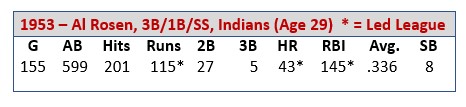
Al Rosen hit.336 for the Indians in 1953 – topping MLB in home runs (43), RBI (145), runs scored (115) and total bases 367); numbers all worthy of a unanimous MVP selection. (Note: Rosen also led AL third basemen in assists and double plays that season.)
Rosen’s stellar year did not quite bring a pennant to Cleveland. His Indians (with a 92-62 record) finished second, a full 8 ½ games behind the Yankees.
The runner-up to Rosen in the 1953 NL MVP voting was the pennant-winnings Yankees’ Yogi Berra (.296-27-108). Ironically, the following year – when the Yankees finished second to the Indians, Berra would be the American League MVP.
NOT A BAD ENDORSEMENT
“The two best clutch hitters in the game are (Yogi) Berra and (Al) Rosen.“
Hall of Fame pitcher Early Wynn
Rosen played 10 MLB seasons (1947-56), hitting .285, with 192 home runs and 717 RBI. In 1953, he reached career-highs in games played (155), hits (201), runs scored, home runs, RBI and total bases. He was a four-time All Star, a two-time home run champion and twice led the AL in RBI.
——————————————–
1956 … Mickey Mantle, CF, Yankees
Nicknames: The Mick and The Commerce Comet
You can probably anticipate a unanimous selection as MVP when your team wins the pennant and you capture the Triple Crown (Avg.-HR-RBI). That’s just what Mickey Mantle did in 1956, leading all of MLB in average (.353). home runs (52) and RBI (130) – as well as in runs scored (132) and total bases (376). It truly was a career year in a Hall of Fame career for the 24-year-old Mantle. In fact, with the exception of home runs, all the numbers noted above were Mantle’s career highs. (He did pop 54 round trippers in 1961.)
Mantle’s spectacular season helped the Yankees to a 97-57 record – and left the second-place Indians nine games off the pace.
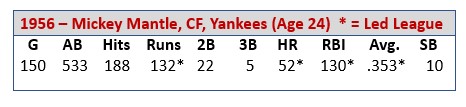
The runner-up to Mantle for 1956 AL MVP was a familiar name, his Yankee teammate Yogi Berra (.298-30-105).
ON THE BIG STAGE IN THE BIG APPLE
Mickey Mantle holds the World Series’ career records for runs scored (42), total bases (123), home runs (188), runs batteD in (40), walks (43) and strikeouts (54). He played in 65 World Series games, hitting .257.
Mantle played 18 MLB seasons (1951-1968) and was an All Star in 16 of those campaigns. He was a three-time Most Valuable Player and won a Gold Glove in 1962. Mantle led his league in batting average once, home runs four times, triples once, RBI once, runs scored (five times), walks (five times) and total bases three times. Mantle hit 30 or more home runs in nine seasons, topped 100 RBI in four and scored 100+ runs in nine. He finished his career with a .298 average, 536 home runs, 1,509 RBI, 1,676 runs scored and 153 stolen bases.
———————————————————-
1966 … Frank Robinson, OF, Orioles
Nicknames: The Judge and Pencils
How do you like me now? After the 1965 season, the Reds traded Frank Robinson to the Orioles for Jack Baldschun, Milt Pappas and Dick Simpson, with Reds’ General Manager Bill DeWitt reportedly referring to Robinson (who had gone .296-33-113 for the Reds in 1965) as an “old thirty.” What did the 30-year-old do for Baltimore the next season? The future Hall of Famer won the American League Triple Crown with a .316 average, 49 home runs and 122 RBI. He also led the AL with 122 runs scored and 367 total bases – and was the unanimous choice for AL Most Valuable Player. Not only that, he went on to eleven more MLB seasons, during which he hit .284, with 262 more home runs and 803 additional BI – making six All Star teams in the process.
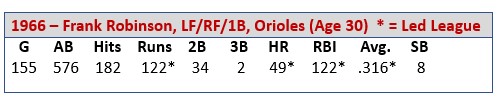
Robinson’s 1966 Orioles’ team went 97-63, leading the American League (and winning the World Series). The squad featured four future Hall of Famers – Robinson, Jim Palmer, Luis Aparicio and Brooks Robinson. The Orioles led the AL in runs scored, and were fourth in earned run average (Palmer was the only starter to reach 15 wins). Frank Robinson led the team in batting average, home runs RBI, and runs scored.
A REWARDING CAREER
What awards did Frank Robinson take home? Might be easier to ask which awards didn’t he capture. Robinson was a Most Valuable Player in both the AL and NL; the 1956 NL Rookie of the Year; the 1966 World Series MVP; the 1971 All-Star Game MVP; and the 1989 AL Manager of the Year
The runner-up for AL MVP in 1966 was Frank Robinson’s teammate Brooks Robinson, who went .269-23-100 and earned his seventh (of an eventual 16) Gold Gloves at third base. Finishing third was another Oriole, 1B Boog Powell (.287-34-109).

Frank Robinson played 21 MLB season (1956-76) and was an All Star selection in 12 of them. He was a two-time MVP and led his league in runs scored three times, doubles once, home runs once, RBI once and batting average once. He also picked up one Gold Glove, topped a.300 batting average in nine seasons, drove in 100 or more runs six times and popped 30 or more round trippers in ten seasons. He retired with a .294 average (2,943 hits), 586 home runs, 1,812 RBI, 1,829 runs scored and 204 stolen bases.
BEST TO BE FIRST
Frank Robinson was the first Black manager in the AL (Indians – 1974) and the NL (Giants – 1980).
———————————————————
1967 … Orlando Cepeda, 1B, Cardinals
Nicknames: Baby Bull and Cha Cha
Traded from the Giants to the Cardinals in May of 1966 (for pitcher Ray Sadeki), Cepeda delivered a unanimous MVP season in 1967. The 29-year-old first-sacker (and future Hall of Famer) hit a career-high .325, with 25 home runs and a league-topping 111 RBI.

Cepeda helped the Cardinals reach 100 wins (101-60) and capture the World Series – leading the team in home runs and RBI. Lou Brock led the squad in average (.335), hits (206)and runs scored 113 (and finished seventh in the MVP voting). Dick Hughes led the pitching staff with 16 wins (six losses) – future Hall of Famers Steve Carlton and Bob Gibson went 14-9 and 13-7, respectively.
FIRST OUTSTANDING DH
Orlando Cepeda was the first winner of the Outstanding Designated Hitter Award (1973) for a season in which he hit .289-20-86 for the Red Sox.
The runner-up to Cepeda in the NL MVP Voting was his Redbirds’ teammate – catcher Tim McCarver, who went .295-14-69.
Cepeda played in 17 MLB seasons (1958-74), finishing with a .297 average (2,351 hits), 379 home runs, 1,365 RBI and 1,131 runs scored. An All Star selection in seven seasons, he hit over .300 in nine seasons, topped 100 RBI five times (leading the league twice) and hit 30 or more home runs five times (leading his league once). He was also Rookie of the Year in 1958, when he went .312-26-96 for the Giants.
————————————————
1968 … Denny McLain, RHP, Tigers
Denny McLain was the unofficial Pitcher of the Year in the Year of the Pitcher – and his performance in 1968 earned him a unanimous AL selection for both the Cy Young and Most Valuable Player Awards. And, it wasn’t even close. In 1968, McLain went 31-6, with a 1.96 earned run average – while fanning 280 batters in 336 innings. He led all of MLB in wins, innings pitched, games started (41). He was fifth in ERA, second in strikeouts and complete games (28 – leading the AL).
PLAYING IN SOME RARE AIR
McLain’s historic 31-win season in 1968 was the first 30-win campaign by an MLB pitcher since Dizzy Dean in 1935 (and there have been no 30-win seasons since 1968). Since 1900, a total of 13 pitchers have won 30 more games in a season (a total of 21 30+-victory seasons among them).
McLain’s Tigers went 103-59, winning the AL crown and the World Series. The keys on offense were Willie Horton (.285-26-85), Jim Northrup (.264-21-90) and Bill Freehan (.263-25-84). Second to McLain among pitchers was Mickey Lolich (17-9, 3.19).
McLain, a two-time Cy Young Award winner (1968 & 1969), played 10 MLB seasons (1963-72), going 131-91, 3.39 with 1,282 strikeouts in 1,886 innings and 105 complete games in 264 starts. He was a three-time All Star a three-time winner of 20 or more games in a season (leading the AL twice). He also led the AL in starts twice, complete games once and innings pitched twice.
LONG BALLS – WHAT TO WORRY?
In both of his CYA seasons, Denny McLain led the American League in home runs allowed.
——————————————————–
1973 …. Reggie Jackson, RF, A’s
Nickname: Mr. October
In 1973, Reggie Jackson led the American League in runs scored (99), home runs (32) and RBI (117), while also hitting .293 with 22 stolen bases. The future Hall of Famer helped the A’s to a 94-68 record (first in the AL West) and a World Series title. Jackson led the A’s regular lineup in average, home runs, runs scored and RBI. On the mound that A’s championship squad boasted a trio of 20-game winners: Catfish hunter (21-5); Ken Holtzman (21-13); and Vida Blue (20-9). No other A’s pitcher won more than seven games.
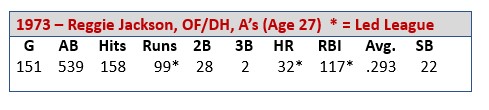
Finishing second to Jackson in the 1973 AL MVP race was Orioles’ pitcher Jim Palmer, who went 22-9, 2.40.
A MAN FOR ALL SEASONS
Reggie Jackson was a multi-sport star in high school (baseball, football, basketball, track) – and was awarded a football scholarship from Arizona State University.
Jackson played 21 MLB seasons (1967-87) hitting .262, with 563 home runs, 1,702 RBI, 1,551 runs scored and 228 stolen bases. He also holds the all-time MLB record for batter’s strikeouts (2,597). He was an All Star in 14 seasons and the MVP of the World Series in 1973 and 1977. Jackson led his league in home runs four times, hitting 30 or more round trippers in seven seasons. He also led his league in runs scored twice and RBI once, slugging percentage three times and intentional walks twice. Jackson his .278-18-48 in 77 post-season games.
———————————————————-
1980 … Mike Schmidt, 3B, Phillies
Nickname: Schmitty
In 1980, Phillies’ third-sacker Mike Schmidt won his first of three Most Valuable Player Awards – and the vote was unanimous. That season, the future Hall of Famer hit .286, leading all of MLB in home runs (48) and total bases (342). He also led the NL in RBI (121) and picked up his fifth consecutive Gold Glove at 3B. To top it off, he scored 104 runs and stole a dozen bases.
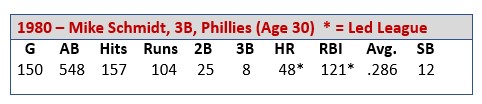
Schmidt helped the Phillies achieve a 91-71 record (first in the NL East), as well as the 1980 World Series Championship.
THE OLD COLLEGE TRY
Mike Schmidt was a College All-American shortstop in baseball (Ohio University) in 1970 and 1971.
The runner-up to Schmidt for 1980 NL MVP was Expos’ catcher Gary Carter (.264-29-101; with a Gold Glove).
Schmidt played 18 MLB seasons (all with the Phillies) from 1972 through 1989. He was an All Star in 12 seasons, a ten-time Gold Glover and a three-time NL MVP; as well as the MVP of the 1980 World Series. Schmidt retired with a .267 career average, 548 home runs, 1,595 RBI and 1,506 runs scored. He led the NL in home runs eight times (topping 30 home runs in 13 seasons), led the league in RBI four times (nine seasons of 100+) and topped the NL in total bases three times.
———————————————————
1988 … Jose Canseco, OF, A’s
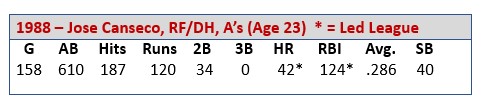
IN 1988, the A’s Jose Canseco led all of MLB I home runs (42) and RBI (124). He also tossed in 120 runs scored, 40 stolen bases and a .307 average – leading his Oakland team to 104-58 record (first in the AL West). Also on that squad were Mark McGwire (32 homers and 99 RBI) and Dave Henderson (.304-24-94). The pitching was led by Dave Stewart (21-12); Bob Welch (17-9), Storm Davis (16-7) and Dennis Eckersley (45 saves).
40-40 … ABOUT TIME
In his 1988 unanimous MVP season, Jose Canseco became the first major leaguer to achieve 40 home runs and 40 stolen bases in the same campaign. Today, the 40-40 Club includes Canseco, Barry Bonds, Alex Rodriguez and Alfonso Soriano.
Finishing second in the 198 AL MVP balloting was the Red Sox’ Mike Greenwell, who hiT .325-22-119, with 16 steals.
Canseco played 17 MLB seasons (1985-2001). He was a six-time All Star and the 1986 AL Rookie of the Year. Canseco retired with a .266 average, 462 home runs, 1,407 RBI and 1,186 runs scored. He led his league in home runs twice (topping 30 long balls in eight seasons) and in RBI once. He drove in 100 or more runs in six seasons and scored 100+ twice.
————————————————————–
1993 …. Frank Thomas, 1B, White Sox
Nickname: Big Hurt
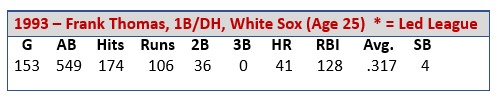
While Frank Thomas didn’t lead his league in any offensive categories in his unanimous MVP season, he finished third in home runs (41), second in RBI (128) sixth in the AL in average (.317), tenth in runs scored (106), third in total bases (333). Thomas would repeat as AL MVP in 1994 (not unanimously). In 1993, the White Sox finished 94-68, first in the AL West.
The runner-up to Frank Thomas in the 1993 AL MVP balloting was the Blue Jay’s Paul Molitor, who put up a .332-22-111 season, with 121 runs scored and 22 stolen bases.
THERE HAS TO BE A FIRST
In his 1993 MVP season, Frank Thomas became the first White Sox player to reach 40 home runs in a campaign.
Frank Thomas slugged his way into the Hall of Fame over 19 MLB seasons (1990-2008). He was a five-time All Star and two-time MVP. He was the 1997 AL batting champ with a .347 average – and hit .301 over his career, topping .300 in ten seasons. While he never led his league in home runs, he tallied 521 round trippers (reaching 30 or more in ten seasons; topping 40 five times). He also drove in 1,704 runs (again without ever leading his league, but topping 100 RBI in 11 times). Thomas also scored 1,494 runs, leading the league once and surpassing 100 tallies in nine seasons. He also led his league in doubles once, walks four times and intentional walks twice.
—————————————————————
1994 …. Jeff Bagwell, 1B, Astros
Nicknames: Baggy and Bag Pipes
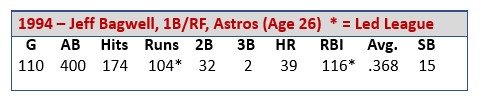
Future Hall of Famer Jeff Bagwell put up some truly MVP numbers in 1994. He logged a .368 average, popped 39 home runs and led MLB with 116 RBI, 104 runs scored, 300 total bases and a .750 slugging percentage. Oh yes, he also stole 15 bases and brought home a Gold Glove. The Astros finished second that season, with a 67-48 record.
The runner-up to Bagwell in the 1994 NL MVP balloting was the Giants’ Gold Glove third baseman Matt Williams (.267-43-96).
PUT ME IN COACH
Jeff Bagwell was a work horse, leading his league in games played four times (playing all 162 games in each of those campaigns) – and logging 156 or more games played in ten of 15 seasons (two of the five seasons in which he did not play in at least 156 games were strike-shortened.).
Bagwell played in 15 MLB seasons (1991-2005). He was an All Star four times, the 1991 NL Rookie of the Year and a one-time Gold Glover. He led his league in runs scored three times (topping 100 runs in nine seasons); hit 30 or more home runs nine times; led his league in RBI once and drove in 100 or more runs eight times. He also led his league in double once; stole 20 or more bases in three times; and topped 300 total bases six times (leading the league once). He retired with a .297 average, 449 home runs, 1,529 RBI, 1,517 runs scored and 202 stolen bases.
—————————————————-
1996 – Ken Caminiti, 3B, Padres
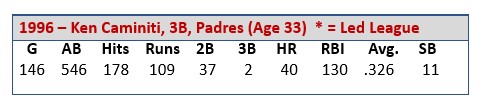
The Padres’ Ken Caminiti turned in a .326-400130 stat line in 1996, adding 109 runs and earning a Gold Glove. The switch-hitter’s performance helped the San Diego squad finish atop the NL West with a 91-71 record.
PULLING THE OLD SWITCHEROO
In his 1996 unanimous MVP season, Ken Caminiti set the MLB record for most times hitting a home run from both sides of the plate in a game (four). He accomplished the feat on August 1, August 21, August 28 and September 11. Caminiti also hold the National League career record for games with home runs both left- and right-handed at 10. Nick Swisher holds the AL record at 13 – and Swisher and Mark Teixeira share the MLB mark at 14.
The runner-up to Caminiti in the 1996 NL MVP race was Dodgers’ catcher Mike Piazza (a future Hall of Famer), who went .336-36-105.
Caminiti played in 15 MLB seasons (1987-2001) and was a three-time All Star and three-time Gold Glover. He had a .272 career average with 239 home runs and 983 RBI. His MVP season was the only campaign in which he reached 100 runs, 100 RBI or 30+ home runs.
—————————————
1997, Ken Griffey, Jr., CF Mariners
Nicknames: Junior and The Kid
Future Hall of Famer Ken Griffey, Jr. really showed his stuff in 1997. He hit .304 and led MLB with 147 RBI. In addition, his 56 home runs and 125 runs scored led the American League. He also led the AL in total bases (393) and intentional walks (23). He was a force to be reckoned with. And, by the way, he also picked up a Gold for his play in CF.
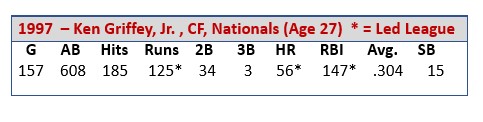
Griffey led Seattle to a 90-72 record, good for first in the American League West. He got plenty of support from Of Jay Buhner (.243-40-109), DH Edgar Martinez (.330-28-108), SS Alex Rodriguez (.300-23-84) and Randy Johnson (20-4, 2.28) on the mound.
Finishing second to Griffey in the AL MVP voting was Yankee first baseman Tino Martinez, who put up a .296-44-141 line.
LIKE FATHER-LIKE SON
On September 14, 1990 – with the Mariner visiting the Angels – Ken Griffey, Sr. and Ken Griffey, Jr. started for the Mariners in LF and CF, respectively. In the bottom of the first inning Ken Griffey, Sr. hit a two-run home run to left-center of Kirk McCaskill). Next up was Ken Griffey, Jr., who also homered (solo shot, of course) to left-center. It’s the only time in MLB history when a father and son have gone deep back-to-back.
Useful for you next trivia dust-up: What are Ken Griffey Jr. and Sr.’s first names? The answer “George” – George Kenneth Griffey, Sr. and Jr. Oh yeah, other famous baseball “Georges” include George Thomas Seaver and George Herman (Babe) Ruth.
Griffey, Jr. played 22 MB seasons (1989-2010) from age 19 to 40. He hit .284 (2,781 hits), with 630 home runs, 1,836 RBI and 1,662 runs scored. He was a 13-time All Star and ten-time Gold Glover. He led his league in: runs scored once (scoring at least 100 times in six seasons); home runs four times (hitting 30 or more ten times – with a high of 56 in two seasons); RBI once (with eight campaign of 100 or more); total bases twice; and intentional walks twice. In 19 post-season games, Griffey hit .290, with six home runs, 11 RBI and five stolen bases.
————————————————–
2002 … Barry Bonds, LF. Giants
In 2002, Barry Bonds won his fifth of seven (and second of four consecutive) NL MVP Awards (this one unanimously). He led all of MB in average (.370), while launching 46 home runs, scoring 117 times and driving in 110 runs. He might have put up even stronger numbers if he hadn’t also led all of MLB in walks (198) and intentional walks (68). That season, the Giants finished second in the NL West, with a 95-86 record.
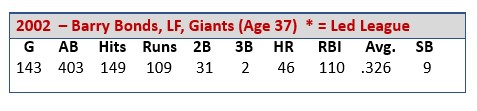
The runner-up to Bonds in the NL MVP voting was Cardinals’ first baseman Albert Pujols, (.314-34-127).
YOU’RE GONNA GET A FREE RIDE
In 2004, Barry Bonds drew an MLB single-season record 232 walks. They came in 617 plate appearances – that’s one walk in every 2.66 trips to the dish. A total of 120 of those free passes were intentional (another single-season MLB high mark). Bonds holds MLB’s career record for walks (2,558) and intention walks (688) – not to mention home runs (762).
Bonds played 22 MLB seasons (1986-2007). He was a 14-time All Star, a record seven-time MVP and an eight-time Gold Glover. His 762 homer runs are the MLB career record, although he only led his league in round trippers twice (he hit 30 or more home runs 14 times – 40 or more seven times – and an MLB record 73 in 2001). His 1,996 RBI are sixth all time. He led his league in RBI once, but topped 100 12 times. Bonds’ 2,227 runs scored are second all time, and he led his league once (scoring 100+ time in 12 campaigns). He was also a two-time batting champion (.298 career average) and led his league in walks eleven times and intentional walks 12 times.
HERE’S A COMPLIMENTARY RUN
Barry Bonds is one of only six players to be walked intentionally with the bases loaded.
————————————————————
2009 … Albert Pujols, 1B, Cardinals
In 2009, Albert Pujols put up a typical Pujols’ season, and it earned him his third NL Most Valuable Player recognition (this time in a unanimous vote). Pujols hit .327, and led MLB with 47 home runs, 124 runs and 374 total bases. That campaign, he also drove in 135 runs, swiped 16 bases and drew an MLB-topping 44 intentional passes. This performance helped the Redbirds to a 91-71 record, good for fist place in the NL Central. Pujols was the only player on the Cardinals to reach 100 RBI that campaign, as well as the only Cardinal with more 22 round trippers.
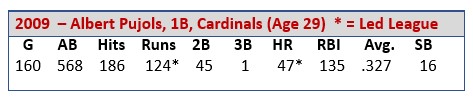
The runner-up to Pujols in the NL MVP race was the Marlins’ Hanley Ramirez (.342-24-106, with 27 steals.
CONSISTENCY IS NOT ALWAYS A HOBGOBLIN
In his first ten MLB seasons, Albert Pujols never hit under .312, never launched less than 32 home runs, never drove in fewer than 103 tallies. His season average from 2001-2010 was .331-41-123,
Pujols, still active, has now played in 19 MLB seasons, hitting .300 (3,202 hits, 15th all-time) with 656 home runs (sixth all-time) and 2,075 RBI (fourth all-time). He was a unanimous choice for NL Rookie of the Year (2001), is a ten-time All Star, two-time Gold Glover and three-time National League MVP. He has led his league in runs scored five times (topping 100 ten times), home runs twice (reaching forty or more seven times) and RBI once (exceeding 100 in 14 campaigns) and batting average once (topping .300 in ten seasons). In the post-season, he has hit .323 (77 games), with 19 home runs and 54 RBI.
I’LL BRING HOME FOUR AND PUT DOWN THREE
In his first-ever college baseball game, Albert Pujols hit a Grand Slam and turned an unassisted Triple Play. He finished that freshman season with a .461 average and 22 home runs and 80 RBI.
————————————————————
2014 … Mike Trout, CF, Angels
Nickname: The Millville Meteor
Mike Trout won his first of three (to date) American League MVP Awards (this one in a unanimous vote) in 2014 at the age of 23 (he turned 23 on August 7 of that season). He was already in his fourth MLB season and had finished second in the MVP voting in each of the previous two campaigns. In 2014, Trout hit .287, with 36 home runs, an MLB-leading 115 runs scored and MLB-tops 338 total bases. He also led the AL with 111 RBI. In 2014, Trout’s Angels topped the AL West with a 98-64 record, with Trout leading the team in nearly every offensive category.

The runner-up to Trout for 2014 AL MVP was the Tigers’ Victor Martinez (.335-32-103).
Mike Trout was a unanimous choice for AL Rookie of the Year in 2012 (although he did see action in 40 MLB games in 2011). In his Rookie of the Year season, Trout became the youngest MLB player ever to have a 30-30 season (30 home runs/30 stolen bases) – accomplishing it at age 20. He hit 30 home runs, stole a league-leading 49 bags, drove in 83 and scored a league-leading 129 runs.
Still active, over his first nine MLB seasons, Trout has hit .305, with 285 home runs, 752 RBI, 903 runs scored and 200 stolen bases. He is an eight-time All Star and, in addition to winning the AL Most Valuable Player Award three times, has finishing second four times. He’s led the AL in runs scored four times (topping 100 in seven seasons) and RBI once (topping 100 three times). He’s also topped the junior circuit in walks three times, on-base percentage four times and stolen bases once.
——————————————————
2015 … Bryce Harper, RF, Nationals
In 2015, 22-year-old Bryce Harper became the youngest player to win a league MVP award (and did on a unanimous vote). That season, Harper hit .330, with an NL-leading 42 home runs and 118 runs scored. He also drove in 99 runs. His Nationals’ squad finished second in the NL East, with an 83-79 record. Harper led the team in average, home runs, runs scored, RBI, hits, doubles, walks, and total bases.
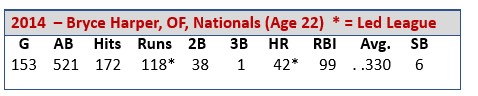
The runner-up to Bryce Harper for 2015 NL Most Valuable Player was the Diamondbacks’ Paul Goldschmidt (.331-33-110, with 21 stolen bases).
GOT TO COLLEGE EARLY …. LEFT EARLY
Bryce Harper graduated from High School early and attended the College of Southern Nevada at age 17 (2010). In 66 collegiate games, he hit .443, with 31 home runs and 98 RBI and was named Scenic West Athletic Conference Player of the Year. He was the first overall selection (Nationals) in the 2010 MLB drat.
The still active Harper has eight MLB seasons under his belt. He has put up a .276 average, with 219 home runs, 635 RBI, 708 runs scored and 90 steals., The six-time All Star and 2012 NL Rookie of the Year has led the NL once each in home runs, runs scored, walks and intentional walks. He has topped 30 home runs in three seasons, reached 100 or more RBI in two and scored 100+ ruins in two.
Primary Resource: Baseball-Reference.com
For a look at unanimous Rookie of the Year choices, click here. For unanimous Cy Young Award winners, click here.
Coming Soon: A comparison of the BBWAA Hall of Fame Vote with BBRT’s Fan Hall of Fame Voting – and announcement of BBRT balloting prize winners.
BASEBALL ROUNDTABLE ON THE TOP 100 BASEBALL BLOG LIST
 Baseball Roundtable is on the Feedspot list of the Top 100 Baseball Blogs. To see the full list, click here.
I tweet baseball @DavidBBRT
Follow/Like Baseball Roundtable’s Facebook Page here. More baseball commentary; blog post notifications; PRIZES.
Member: Society for American Baseball Research (SABR); The Baseball Reliquary; The Negro Leagues Baseball Museum.