Today (October 13, 2010) marks the 59th anniversary of one of the most exciting World Series games of all time – the Pittsburgh Pirates 10-9, Game-Seven win over the New York Yankees. It was a victory that got the decade of the sixties off to a great start for me.
 Let me set the stage. There were only 16 major league teams. If you didn’t finish with ‘the best record in your league, you didn’t get even the slightest taste of the post-season. No one had ever heard of the designated hitter, the wild card, WAR or even WHIP. (For that matter, no one had ever seen a computer mouse, a Ford Mustang, an Etch-A-Sketch or Star Trek – or listened to a Beatles record.) The news was headed by the Cold War, Space Race, Kennedy-Nixon Debates, Civil Right Movement, Sexual Revolution and Year of Africa. Gunsmoke, Wagon Train and Have Gun Will Travel were the top three TV shows and Home Run Derby was a TV-must in our house – with power hitters, in black-and-white, pairing off at Wrigley Field in Los Angeles.
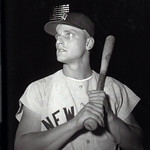
Roger Maris Photo by rchdj10 
Babe Ruth still held the MLB single-season home run record – and Roger Maris was about to collect his first AL MVP Award (earned in his first year as a Yankee; after being traded from the Kansas City Athletics). Ted Williams had just finished his career with a home run in his last at bat, Brooks Robinson was about to collect his first Gold Glove. MLB held two All Star Games. The White Sox had become the first team to put players’ names on uniforms. That season, Warren Spahn had thrown his first no-hitter at age 39 (and won a league-leading 21 games) and 22-year-old Juan Marichal had tossed a one-hitter in his major league debut.
The Pirates’ Dick Groat won the NL batting title and would be named the NL MVP. Mickey Mantle had led the AL in home runs, Roger Maris in RBIs, Pete Runnels in batting average and Minnie Minoso in base hits. In the NL, Ernie Banks won the home run crown, Hank Aaron the RBI title and Willie Mays topped the senior circuit in hits. Don Drysdale and Sandy Koufax finished one-two in the NL strikeout race, while Jim Bunning topped the AL. Lindy McDaniel of the Cardinals set a new record with 26 saves, while the Tigers’ Frank Lary’s 15 complete games were the lowest ever to lead either league.
This is Getting A Little Old … For the Rest of Us
Going into the 1960 World Series, the Yankees had played in eight of the Worlds Series held in the decade of the 1950’s – winning six of them. The Pirates had last appeared in the Fall Classic in 1927 and last won it in 1925.
I was thirteen and an avid baseball fan. The Game of the Week, the radio – especially the radio – and an occasional trip to the ballpark were my tickets to the national past time.
At the time, the Yankees were baseball’s dynasty. Since my birth in 1947, the Bronx Bombers had been to 11 World Series (including the 1960 Series, yet to be played) and had won eight World Championships. Fans from pretty much everywhere but New York had made Yankee-hating a tradition. I was no exception. Milwaukee-born, I was a steadfast Braves fan, still smarting from the Yankees’ 1958 World Series comeback, when they downed my Braves after trailing three games to one. The Yankees were in the 1960 Series – and I had an emotional interest in seeing them lose.
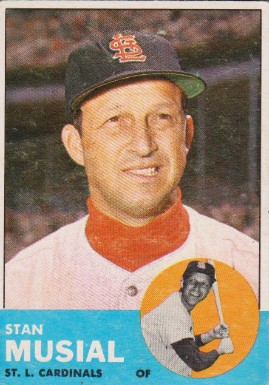 Being of Polish descent, I also took pride in the fact the great Stan Musial was Polish and wondered why Milwaukee-born Hall of Famer Al Simmons had changed his name from Al Symanski. I was a fan of the sleeveless power hitter Ted Kluszewski, regretted that Tony Kubek (also of Polish descent) played for the Yankees, was rooting for the Pirates’ Bill Mazeroski. I also was firm in my belief that Steve Dalkowski threw that fastest fastball ever … you can look it up.
Put all of this together and you can see why I looked to the 1960 World Series with excitement – and why I was rooting for the underdog Pirates.
The prognosticators predicted a Yankee win in five or six games. They pointed out that the Yankees, with a 97-57 record (the Pirates were 95-59-1) came into the Series with the momentum of a 15-game, season-closing winning streak, while the Pirates lost four of their final seven. They also lauded the Yankees’ post-season experience and heralded the Yankees power (the Yankees led the AL with a record 193 home runs and 746 runs scored, while the Pirates led the NL with 734 runs scored, but only 120 round trippers). The Yankees’ Game-One starting lineup had belted 152 regular season homers to 98 for the Pirates’ starters. When it came to mound work, things appeared more balanced, maybe even a shade in favor of the Pirates. While the Yankees’ 3.52 ERA was the lowest in the AL, the Pirates’ NL third-best ERA (at 3.49) slightly bettered the Bombers’ mark. The Pirates did have the clear advantage in strikeouts (811-712) and fewest walks allowed (an NL low of 386 to an AL worst 609 for the Yankees). They also boasted twenty-game winner Vernon Law (20-9, 3.08), backed up by Bob Friend (18-12, 3.00), while no Yankee starter had topped 15 wins. The top relievers for the two teams were Elroy Face, with 24 saves for Pittsburgh and Bobby Shantz, who saved 11 for the Yanks.
To the surprise of many fans (and analysts), the Series was tied after six games – despite the fact that the Bronx Bombers had outscored the Pirates 46 to 17, outhit them 78 to 49 and out-homered them 8 to 1. (The Yankees had won Game Two 16-3, Game Three 10-0 and Game Six 12-0. The Pirates had prevailed in Game One 6-4, Game Four 3-2 and Game Five 5-2).
Then came Game Seven – 60 year ago today – in Pittsburgh. Here’s how it went down.
The Pirates were started Vernon Law, 20-9, 3.08 on the season and the winner of Games One and Four. The Yankees countered with Bob Turley, 9-3, 3.27 on the season. Turley had won Game Two, despite giving up 13 hits and three walks in 8 1/3 innings. The Pirates had their top left-handed hitter, Bob Skinner (injured in Game One), back at the number-three spot in the order, while the Yankees were missing Elston Howard (broken finger, Game Six). An upset did seem possible.
The Yanks went meekly in the top of the first inning (liner, popup, foul out), and the Pirates, homer-less since a Bill Mazeroski blast in Game One, got a two-run homer from Rocky Nelson (whom Manager Gene Murtaugh chose to start at first base over regular Dick Stuart).
In the second inning, Law set the heart of the Yankees down in order – Mickey Mantle, fly to center; Yogi Berra, grounder to third; Moose Skowron, grounder to short. In the bottom of the inning, manager Casey Stengel appeared to put his managerial position in further jeopardy. Smoky Burgess started the inning with a single and Stengel immediately pulled Turley in favor of the rookie Bill Stafford (who had stifled the Pirates for five innings in Game Five). The move did not pay off. Stafford walked third baseman Don Hoak and Mazeroski beat out a bunt single. Law was now at the plate (the Pirates’ pitcher was two for four, with a double, run scored and RBI in Games One and Four). Law hit back to Stafford for a pitcher-to home-to first double play, but center-fielder/lead-off hitter Bill Virdon followed with a two-run single and a 4-0 Pirates lead.
Casey Stengel, despite ten pennants and seven World Series titles in 12 seasons as manager of the Bronx Bombers, was fired by the Yankees five days after the 1960 Game Seven loss to the Pirates.
Law handcuffed the Yankees through four innings, giving up only two singles. In the fifth, Yankee first sacker Skowron made the score 3-1 with a lead-off homer just inside the right field foul pole. Law did not let the round tripper upset him, retiring Johnny Blanchard, Clete Boyer and Bobby Shantz (who came on to pitch for New York in the third) in order.
The Yankees closed the gap – and then some – in the top of the sixth. The pesky Bobby Richardson (who already had nine hits in the series) led off with a single to center, and Tony Kubek followed with a walk. With the Bombers appearing on the verge of a rally, Murtaugh replaced Law (who, it turns out had been pitching on a sore ankle throughout the Series) with his top reliever Elroy Face. Face got Roger Maris on a foul pop to Don Hoak at third base, but Mickey Mantle followed with a “seeing eye” single up the middle, scoring Richardson. Yogi Berra followed with an upper deck home run (like Skowron’s just inside the right field foul pole) to give New York a 5-4 lead in what was shaping up to be a Game Seven nail-biter.
The veteran Bobby Shantz, meanwhile, was baffling the Pirates – giving up only a single and a walk from the third to the seventh innings.
In the top of the eighth, the Yankees seemed to dash the Pirates’ upset hopes – using a walk, two singles and a double to produce two more runs and a 7-4 lead. Notably, Stengel’s pitching decisions again came into play. He let Shantz bat with two out and runners at second and third (Boyer and Skowron) and a chance to extend the Yankee lead. Shantz flied out and the living-room and press-box managers were quick to point out: 1) the lost scoring opportunity; 2) the fact that Stengel left Shantz in for a sixth inning of work, despite the fact that Shantz had not gone more than four innings in the regular season.
So, that was the situation as the game went into the bottom of the eighth – when the Pirates (and Forbes Field) proved they still has some life left in them. Gino Cimoli pinch hit for Face and stroked a single to right-center field. Shantz, who had already induced two double plays appeared to have worked his magic again, as Bill Virdon hit a hard ground ball right at shortstop Tony Kubek. Just as Kubek was ready to field the ball and begin the sure double play, it appeared to hit a pebble (the Yankees had already been critical of the condition of the Forbes Field infield) and ricocheted into Kubek’s throat. Kubek went down, gasping for air and spitting up blood, with his windpipe rapidly swelling (doctors on the scene at first thought an emergency tracheotomy might be necessary). The end result? Kubek sent to the hospital and replaced by Joe DeMaestri and the Pirates with two on and no outs, instead of none on and two outs.
Pirates’ shortstop Dick Groat took advantage of Kubek’s mishap and lined singled to left, scoring Cimoli. Stengel came to the mound and replaced Shantz with right-hander Jim Coates (despite the fact that lefty Bill Skinner was coming to the plate). The righty-lefty match-up made little difference, as Skinner sacrificed the runners up one base. Next was Rocky Nelson, who flied out to medium right, with the Pirates choosing not to test Roger Maris’ powerful arm. So, two outs, two on and the Yankees still in front 7-5. That brought up the Pirates’ best hitter, right-fielder Roberto Clemente, who had been held hitless in his first three at-bats. Coates made a good pitch, getting Clemente to hit a weak ground ball toward first. A hustling Clemente beat both Coates and Skowron’s throw to the bag, while Virdon scored and Groat moved to third. Now, 7-6 and the Pirates still had life.
Trivia Tidbit: The seventh game of the 1960 Series is the only World Series game in which neither team recorded a strikeout.
That brought up backup catcher Hall Smith (who had come into the game in the eighth after Joe Christopher ran for starting catcher Smoky Burgess in the bottom of the seventh). Smith took a 2-2 Coates’ pitch over the left-field wall for a 9-7 Pittsburgh lead. The Pirates, with only one round tripper in the first six games had homered twice for five runs in Game Seven.
To protect the lead in the ninth (and with Elroy Face already out of the game), Pirates’ Manager Danny Murtaugh called on starter Bob Friend, who had lost Games Two and Six, giving up seven earned runs in six innings (and had pitched in relief only once all season). Yankee lead off hitter Bobby Richardson started off the ninth with a single to left. Veteran and former-Pirate Dale Long, pinch hitting for Joe DeMaestri (who had replaced the injured Kubek) singled to right and Friend was gone, replaced by Game Five starter Harvey Haddix. Haddix got Roger Maris on a foul out, but Mickey Mantle drove in Richardson with a single to right center. Yogi Berra followed with a ground ball down the first base line. Rocky Nelson made a nice backhanded stop, but was out of position for a first-to second-to first, game-ending double play. Nelson took the sure out, stepping on the first base bag and retiring Berra, while Gil McDougald (pinch running for Long) headed toward home. It was at this point that Nelson realized Mantle had not run to second. Mantle, sizing up the situation, was returning to first (with the force at second now off). It was an unorthodox base-running move, but as Mantle dove head first back to the bag (avoiding Nelson’s desperate attempt to tag him), McDougald scored the tying run. Skowron then grounded out to Mazeroski (forcing Mantle) to end the inning in a 9-9 tie.

Mazeroski’s 1960 home run trot immortalized at PNC Park.
Stengel, like Murtaugh, was now using starters in relief, bringing Game Four-loser Ralph Terry in to pitch the ninth. Number-eight hitter Bill Mazeroski led off the inning. Terry’s first pitch was a high and inside fastball. The second pitch, another fastball, was in the strike zone and Mazeroski deposited it over the 406-foot marker in left center. Not sure the ball would carry out in the deep part of the park, Mazeroski ran full speed with his head down to first and toward second, before seeing the umpire making the circular home run signal. Mazeroski removed his helmet, waving his way to home plate where his team mates awaited the first player in major league history to end the World Series with a walk-off home run.
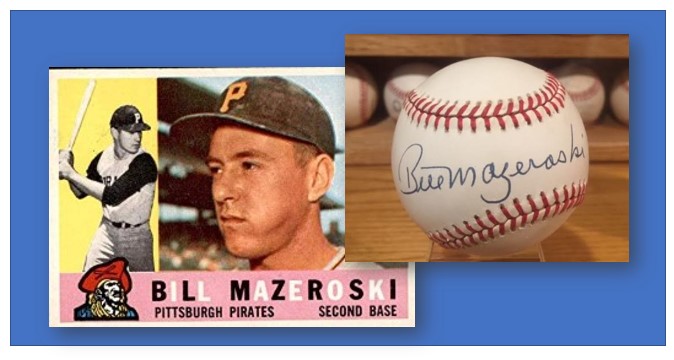
When the Series was over, the Pirates were World Series Champs,
but you could never tell by the stat line.
The Yankees scored a Series’ record 55 runs to 27 for the Pirates,
The Yankees collected a Series’ record 91 hits to 60 for the Pirates.
The Yankees hit a Series record .338 to .256 for the Pirates
The Yankees collected a Series’ record 27 extra base hits to 15 for the Pirates.
The Yankees out-homered the Pirates 10-4.
The Yankees’ pitchers put up a 3.54 ERA to 7.11 for the Pirates.
Bobby Richardson of the losing Yankee squad won the Series MVP award, hitting .367 with a Series’ record 12 RBI.
Primary Resources: Baseball-Reference.com; Chronicle of the 20th Century (Chronicle Publications).
BASEBALL ROUNDTABLE ON THE TOP 100 BASEBALL BLOG LIST
 Baseball Roundtable is on the Feedspot list of the Top 100 Baseball Blogs. To see the full list, click here.
I tweet baseball @DavidBBRT
Follow/Like Baseball Roundtable’s Facebook Page here. More baseball commentary; blog post notifications; PRIZES.
Member: Society for American Baseball Research (SABR); The Baseball Reliquary; The Negro Leagues Baseball Museum.