 May 5, the Baseball Reliquary announced the 2019 electees to the its Shrine of the Eternals. This annual announcement is a highlight of Baseball Roundtable’s year. (This commentary is a couple days late, as the announcement came as I was in transit to California.) Anyway, let’s start with a glimpse into The Baseball Reliquary and its “Shrine” to the game – then go on to this year’s electees, the BBRT ballot, the final 2019 vote totals and a list of all the “Shrine” members. When you consider the Shrine of the Eternals, it all starts with a question.
What do the following have in common – a pitcher who once threw a no-hitter while high on LSD; a team owner who sent a midget to the plate; a man in a chicken suit; a member of Major League Baseball’s 3,000-hit club; an MLB catcher who one season led the National League in passed balls, despite starting only 59 games behind the plate; another backstop known as much for his malapropisms as his record 71 World Series base hits; an MLB manager who won eight World Championships; a one-armed outfielder; a one-handed pitcher; a cartoon character who managed and pitched his team to more than 1,000 losses (and just a handful of wins); a baseball card designer; a surgeon and his pitcher-patient; a labor leader; an organist with a razor-sharp wit; a statistical wizard; and more than one best-selling author?
These diverse individuals are all among the past electees to The Baseball Reliquary’s Shrine of the Eternals – an honor that recognizes individuals who have had impact on our national pastime that goes beyond statistics and touches upon the culture and character of the game. In essence, the Shrine of the Eternals is our national pastime’s fan-focused Hall of Fame. (This year, you can add the first National League right-hander to record 300 whiffs in a season; a General Manager who was far ahead of the curve in applying advanced analytics to the game; and the greatest female softball pitcher to ever take the mound.
The 2019 inductees – who will be enshrined during ceremonies Sunday, July 14, at the Donald R. Wright Auditorium, Pasadena Central Library, 285 E. Walnut Street, Pasadena, California – include former MLB pitcher, J.R. Richard, “Moneyball” legend Oakland A’s General Manager Billy Beane and four-time All American (fast pitch softball) and three-time Olympic Gold Medalist Lisa Fernandez.
Before taking a closer look at this year’s electees, I’d like to provide a brief overview of both the Baseball Reliquary and its Shrine of the Eternals.
Spoiler Alert: Unabashed membership recommendation to follow. If you are a baseball fan, I would highly recommend you consider membership in the Baseball Reliquary – a truly free-spirited (if somewhat eccentric) organization dedicated to celebrating the human side of baseball’s history and heritage. The Baseball Reliquary is an open and fan-focused organization, committed to recognizing baseball’s place in American culture and to honoring the character and characters of the national pastime. It pursues that mission through its collection of artifacts, traveling exhibitions, ties to the Whittier College Institute for Baseball Studies and its own version of the Baseball Hall of Fame – the Baseball Reliquary Shrine of the Eternals. For more on the Baseball Reliquary, and why you should become a member, click here.
Now, to the Shrine of the Eternals. Here’s what the Reliquary has to say about this honor.
Similar in concept to the National Baseball Hall of Fame, the Shrine of the Eternals differs philosophically in that statistical accomplishment is not the principal criterion for election. The Baseball Reliquary believes that the election of individuals on merits other than statistics and playing ability will offer the opportunity for a deeper understanding and appreciation of baseball than has heretofore been provided by “Halls of Fame” in the more traditional and conservative institutions.
Criteria for election shall be: the distinctiveness of play (good or bad); the uniqueness of character and personality; and the imprint that the individual has made on the baseball landscape. Electees, both on and off the diamond, shall have been responsible for developing baseball in one or more of the following ways: through athletic and/or business achievements; in terms of its larger cultural and sociological impact as a mass entertainment; and as an arena for the human imagination.
Each year, the Baseball Reliquary submits a list of candidates to its members and the top three vote-getters are honored. Reliquarians can vote for up to nine nominees.
——-2019 Shrine of the Eternals Electees—–
J.R. Richard (1950 – ) … 27 percent of the vote
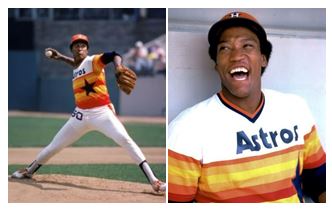
J.R. Richard. Photos courtesy of The Baseball Reliquary.
At 6’8” and 222-pounds, Astros’ righty J.R. Richard was one of the most intimidating moundsmen ever. He hit his stride, literally, at age 26 in 1976 – when he went 20-15 with a 2.75 earned run average. That campaign, he fanned 214 batters in 291 innings, but the best was yet to come.
Richard won 18 games in each of the next three seasons, becoming (in 1978) the first NL right-hander to fan 300 batters in a season (303 strikeouts in 275 1/3 innings). In that 1978 campaign, Richard was the only MLB pitcher to fan more than 260 batters. He topped his K total the following season, with 313 whiffs in 292 1/3 innings and a league-best 2.71 earned run average. In that 1979 season, the next best MLB whiff total was 223 by Nolan Ryan. That season, Richard also allowed MLB fewest hits per nine innings (6.77), notched the most strikeouts per nine (9.64); threw the second-most innings (292 1/3) and the second-most complete games (19); and had the second best strikeouts-to-walks ratio (3.19).
Richard started 1980 with ten wins against four losses and a 1.90 ERA, before suffering a mid-season stroke. Richard had been feeling under-the-weather for some time, but his concerns were not taken seriously. (He was, in fact, at times accused of malingering.) The stroke not only ended his MLB career, but put him on a downhill slide (two broken marriages and some bad investments) that ultimately saw him living under an overpass near the Astrodome. He has since gotten “back on his feet,” is the subject of the film “Resurrection: The J.R. Richard Story” and spent time counseling at-risk youth, the homeless and others in need.
Richard’s final MLB line was 107-71, 3.15, with 1,493 strikeouts in 1,606 innings pitched.
__________________________________________
Billy Beane (1962- ) … 26.5 percent of the vote.

Billy Beane. Photo courtesy of The Baseball Reliquary.
Billy Beane was a ballplayer before he was a baseball executive – if he disappointed at the former, he excelled beyond expectations at the latter. Beane was a first-round (23rd overall) draft choice (Mets) in 1980 – out of Mount Carmel High School (Rancho Bernardo, CA). In high school, Beane excelled in baseball, football and basketball – and was recruited by Stanford University on a joint baseball-football scholarship. He chose instead to sign with the Mets and was considered a top prospect. Note: Beane played in 148 MLB games over six seasons – going .219-3-29. He played for the Mets, Twins, Tigers and A’s. Between 1980 and 1989, he also logged 965 games in the minors – with a .262-91-482 line.
Tiring of the ups-and-down of a career of bouncing between the major and minors, Beane signed on as an advance scout for the A’s in 1990 and stayed the position until 1993, when he was promoted to Assistant General Manager. At that time, he and GM Sandy Alderson were faced with building a team with a shrinking payroll. That budget pressure continued as Beane succeeded Alderson as GM in 1997. This led Beane to look for new (sabermetric-based) ways to generate the maximum victories for the dollar. Turns out he was pretty good at it. He looked for pitchers who kept batters off base and hitters who got on base (no matter what the means for either). He didn’t want stars, he wanted empty bases on defense and base runners on offense. And, it worked. The budget-restricted, no-name A’s made the playoffs every year from 2000 through 2003, even logging a 20-game winning streak in 2002 (winning 103 games that season). In December 2009, Sports Illustrated named Beane one of the Top Ten GM’s/Executives of the decade across all sports. And then, of course, there was the 2003 book and 2011 movie ‘Moneyball.” I mean, here’s a guy who saw the romance in baseball, was played in film by Brad Pitt and who changed the way many front-office executives evaluate “talent.”
____________________________________________________
Lisa Fernandez (1971 –)
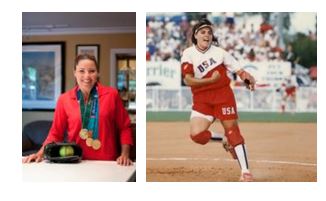
Lisa Fernandez. Photo courtesy of The Baseball Reliquary.
Sandy Koufax was sometimes referred to as the “left arm of God.” If that’s the case, Lisa Fernandez was the supreme right arm – the most dominating fast pitch softball hurler of all time. Fernandez was a four- time All-American for UCLA, where she also won the Honda-Droderick Award as the top female college athlete (In any sport) three times.
How good was she? In her senior year, she went 33-3, 0.23 on the mound and hit .509, with 11 home runs and 45 RBI. For her college career, Fernandez went 93-7, from the bump – including a 97-inning scoreless streak and 42 consecutive wins. With Fernandez leading the charge, UCLA won the NCAA Championship in 1990 and 1992 and finished as runner up in 1991 and 1993. She also led the U.S. women’s softball team to the Gold in the 1996, 2000 and 2004 Olympics – and was a 2012 inductee to the U.S. Olympic Hall of Fame.
Fernandez currently coaches softball at UCLA (her 21st season with the Bruins) and devotes time to conducting softball clinics and encouraging female athletes. Lisa Fernandez – a great athlete, a leades on and off the field and worthy role model.
—–BASEBALL ROUNDTABLE’S 2019 SHRINE OF THE ETERNALS BALLOT—
Unfortunately, none of the ten nominees BBRT voted for finished in the top three. But here’s my ballot, and justifications, alphabetically.
Luke Easter (1915-79)
“Luscious” Luke Easter was one of the most prodigious home run hitters of all time – whose titanic blasts were known as “Easter Eggs.” Among his notables:
- Easter was the first player to a homer into the farthest reaches of center field in the Polo Grounds;
- He hit the longest home run in the history of old Cleveland Municipal Stadium – clearing the distant right field scoreboard; and
- Luscious Luke was the first player to hit a drive over the CF scoreboard in Buffalo’s Offerman Stadium (at age 42) and proved it was no fluke by becoming the second to achieve the feat just a month later.
Easter began his baseball career in 1937, with as an OF/1B and cleanup hitter for the St. Louis Titanium Giants (a company team) – and didn’t play his final game until 27 years later. Everything about the 6’4”, 240-pound Easter was big – his stature, his bat, his love of the game, his love of life, his relationship with teammates and the fans and, later, even his Buick.
While he began showing his prowess at the plate in the late 1930’s, he really began making name for himself after getting out of the military in 1943.
In 1945, he starred with the barnstorming Cincinnati Crescents (for whom he hit the Polo Grounds home run noted above).
In 1947, he joined the Homestead Grays, where he hit .311, with 10 home runs in 219 at bats. Research by Society for American Baseball Research Member Justin Murphy indicates Easter followed that up by hitting .363 for the Grays and tying teammate Buck Leonard for the Negro National League (NNL) lead in home runs (13) – helping the Grays to the NNL World Series Championship.
In 1949, Easter signed with the Cleveland Indians and made his major league debut on August 1 of that season – at age 34 – just the eleventh black player in the major leagues. While he hit only .222 in 54 games for the Indians, due in great part to an injured knee, Easter showed his (already long-proven) power by going .363-25-92 in 80 games at Triple A San Diego.
Then, in 1950, he hit .280-28-107 in 141 games for the Indians – earning recognition from the Sporting News as the AL’s Most Outstanding Player. In 1951, he went .270-27-103 for the Tribe and, in 1952, .263-31-97. Age and injuries were already taking their toll on Easter, however, and on May 4, 1954, the 38-year-old Easter played his final MLB game – ending his MLB career with a .274-93-340 line in 491 games.
Ah, but Luscious Luke was not done. He played on in the minor leagues until 1964 – putting up four seasons of 30 or more home runs and 100+ RBI – earning his way into the International League Hall of Fame.
Over his career, also played winter ball in Puerto Rico, Venezuela, Mexico and Hawaii. A Winter-League star, Easter hit .402 for Mayaguez in the Puerto Rican League in 1948-49 (winning league MVP honors); led the Mexican Pacific Coast League (for Hermosillo) in homers in 1954-55; and lead the Puerto Rican Winter League in homers in 1955-56 and 1956-57.
Easter, later serving as a Union Steward for TRW in Ohio, was murdered during a payroll robbery in 1979.
Why did Luke Easter get my vote? Consider that non-other than Bill James rated him the second-best Negro Leagues’ first baseman of all time (behind only Buck Leonard) and Al Rosen (a teammate of Easter on the Indians, as well as a four-time All Star, two-time AL home run leader, 1953 American League MVP and 1989 National Executive of the Year) maintained, “Had Luke come up to the big leagues as a young man, there’s no telling what numbers he would have had.” Easter comes up big on the BBRT “Shrine” ballot.
____________________________
Rube Foster (1879-1930)
Andrew “Rube” Foster was an outstanding hurler, confined – by history – to pitching primarily for Black teams; such squads as the Chicago Union Giants, Cuban X-Giants and Philadelphia Giants. How good was Foster on the mound? Records are sketchy, but the Baseball Hall of Fame reports that, in 1902, Foster ran off a streak of 44 straight victories and the Negro League Baseball Museum credits Foster with a 54-1 record that season.
Rube Foster’s tireless efforts earned him the unofficial title of “The Father of Black Baseball.”
Foster’s contributions to the national pastime, however, went beyond the mound. In 1911, he partnered with John Schorling (son-in-law of Charles Comiskey) to establish the Chicago American (Black) Giants – who, under Foster’s leadership, became Black baseball’s most dominant team.
But Foster wasn’t done yet. In 1920, he was a key player (cited by many as THE key player) in the founding of the Negro National League. As the league flourished, Foster wore many hats. He served not only as the league’s president and treasurer, but also was the owner and manager of the Chicago American Giants – winning the NNL’s first three pennants. By 1926, his demanding schedule had taken a toll and Foster suffered a nervous breakdown. He never fully recovered and passed away prematurely in 1930. Fans might enjoy Larry Lester’s book “Rube Foster in His Time: On the Field and in the Papers with Black Baseball’s Greatest Visionary.”
Rube Foster was elected to the National Baseball Hall of Fame in 1981.
__________________________________________________________
Julio Franco (1958 – )
If you believe “Old Guys Rule” – Julio Franco should be your king.
Consider this fact, Only 25 Major League home runs have been hit by players who had passed their 45th birthday – and Julio Franco hit 20 of them.
Also consider a handful of the “old guys rule” records held by the ageless Franco:
- The oldest player to homer in a MLB game. Franco went deep at age 48 years, 254 days, hitting a two-run shot off Arizona’s Randy Johnson, as Franco’s Mets topped the Diamondbacks 5-3 on April 26, 2006). In that same game, Franco also became the second-oldest MLB player to steal base – and, thus, the oldest player to homer and steal a base in the same game.
- The oldest player to hit a grand slam (46 years, 308 days) – connecting as a pinch hitter for the Atlanta Braves in a 7-2 win over the Marlins on June 27, 2005.
- The oldest player to record a multi-homer game, belting a pair of homers on June 18, 2005 (age 46 years, 299 days), as his Atlanta Braves topped the Reds at Great American Ball Park. Franco started at first base and went two-for-four with two homers and three RBI.
- The oldest player to hit a pinch-hit home run, in the eighth inning of a Mets’ 7-2 win over the Padres at San Diego (April 20, 2006 – 47 years, 240 days).
- The oldest player to steal two bases in a game (and in an inning) – (June 16, 3005 – 46 years, 297 days).
- The oldest player to be put into a game as a pinch runner (July 29, 2006 – 47 years, 340 days). And he delivered, promptly stole second base, going to third on an errant throw.
From 1982 to 1994, Franco played primarily as a middle infielder and DH for the Phillies, Indians, Rangers and White Sox – making three All Star teams (MVP of the 1990 All Star Game), earning five Silver Slugger Awards and leading the American League in hitting at .341 for the Rangers in 1991. In that 1991 campaign, Franco collected 201 hits, 15 homers, 78 RBI, 108 runs scored and 36 steals in 45 attempts. At season’s end, he had hit .300+ in five of the previous six seasons – the lone exception being .296 in 1990.
In 1994, when the remainder of the MLB season was lost to a strike, Franco was in the midst of possibly his best campaign. After 112 games, he was hitting .319, with 138 hits, 20 home runs, 98 RBI, 72 runs scored, and eight steals. Franco was determined to keep swinging the bat and signed to play in Japan with the Pacific League Chiba Lotte Marines. In the 1995 Japanese season, Franco hit .306 and won the league’s equivalent of the Gold Glove at first base.
Franco returned to MLB in 1996, joining the Cleveland Indians, hitting .322-14-76 in 112 games. In August of the following season, the Indians released Franco – who was hitting .284-3-25 at the time. He finished the 1997 campaign with the Brewers, hitting .241 in 14 games with Milwaukee.
In 1998, at age 39, Franco was back in Japan playing for Chiba Lotte; where he hit .290, with 18 home runs and 77 RBI in 131 games. Then in 1999, he celebrated turning 40 (when most ballplayers are retired or coaching) by hitting for a .423 average in the Mexican League and getting one late season MLB at bat with Tampa Bay.
As he moved into his forties, Franco was far from finished as a player. He played in South Korea in 2000 (age 41), hitting .327-22-110. In 2001, the well-traveled batsman was back in the Mexican League (Mexico City Tigers), where stellar play (a .437 average in 110 games) earned him a spot on the Atlanta Braves’ roster in September. Franco hit .300, with three home runs and 11 RBI over the final 5 ½ weeks of the MLB season.
From 2001 to 2007, the ageless wonder – professional hitter and pretty darn good first sacker – played for the Braves and Mets. From 2001 through 2006 – ages 42 to 47 – Franco averaged .290 over 581 games. He hit .222 in 55 games in his final MLB season – 2007 with the Mets and Braves.
Even at 49, Franco was not done battering baseballs. In 2008, he could be found at first base with the Tigres de Quintana Roo of the Mexican League (where he hit .250 in 36 games). That season, Franco – after 23 Major League seasons and 30 years after his first professional baseball game – announced his retirement as a player.
Oops? Not so fast. In 2014, at the age of 55, he appeared in seven games for the Fort Worth Cats of the independent United League – going six for 27. Then in 2015, Franco was signed as player-manager of the Ishikawa Million Stars of the Japanese independent Baseball Challenge League (identified as a semi-pro league).
In 23 MLB seasons, Franco hit .298, with 2,586 hits, a .298 average, 173 homers, 1,285 runs, 1,194 RBI and 281 stolen bases. He also collected 618 minor league (U.S) hits, 316 in the Mexican League, 286 in Japan, 267 in the Dominican Winter League and 156 in South Korea and six in independent ball (U.S.).
Forever young, Mr. Franco got my vote.
_____________________________________________________
Mamie “Peanut” Johnson (1935 – 2017)
Mamie Johnson was one of three females to play for the Indianapolis Clowns during the declining days of the Negro Leagues (and the only woman ever to pitch in the Negro Leagues). Johnson took the mound to the Clowns for three seasons (1953-55), running up a 33-8 record. Her exploits are chronicled in the children’s book “A Strong Right Arm: The Story of Mamie ‘Peanut’ Johnson,” by Michelle Y. Green.
________________________
Ted Kluszewski (1924-1988)
I love to recognize players who do something we are not likely to see again. Therefore, I again cast a ballot for Ted “Big Klu” Kluszewski – perhaps the last of the true power hitters who also practiced exceptional plate discipline. In 1954, for example, Big Klu hit .326, with 49 home runs and 141 RBI – a season made even more remarkable by the fact the Kluszewski struck out only 35 times (versus 78 walks). I doubt if we’ll ever see another player top 40 home runs without reaching 40 whiffs. Kluszewski, in fact, had a streak of four seasons (1953-56) when he hit over .300, drove in 100+ runs, bashed 35+ home runs – and struck out no more than 40 times in any season. In those four seasons, Kluszewski hit 171 home runs – and fanned 140 times.
It should also be noted that Kluszewski led NL first baseman in fielding percentage every year from 1951 through 1955. Unfortunately, a back injury in 1956 hampered his performance in the later years of his career (he played until 1961).
Ted Kluszewski is noted for adding a bit of style and flair to the game, making his own intimidating fashion statement. Klu complained that his uniform jersey was too tight for his large and powerful biceps. He went on to have the sleeves cut from his jersey – exposing his bare arms from the shoulder. (This was considered a bold move at that very conforming time in the game’s history.)
Kluszewski only appeared in one post-season – hitting .391, with three homers and ten RBI in the 1958 World Series (for the White Sox). True to his form – Big Klu did not strike out even once (25 plate appearance) in the Series. For trivia buffs, left unprotected in the 1960 expansion draft, Kluszewski hit the first-ever home run for the expansion Angels (a two-run shot in the first inning of the Angels’ first game – April 11 versus the Orioles). He added a punctuation mark, by hitting the Angels’ second–ever home run (a three-run shot) the very next inning. The Angels won 7-2, and (of course) Kluszewski did not strikeout.
____________________________
Mike Marshall (1943 – *)
I should probably say Doctor Mike Marshall, since this former major league reliever (14 seasons … 1967, 1969-81) earned three college degrees, including a Ph.D. in Kinesiology from Michigan State University. Kinesiology is the study of muscle movement and Marshall used his knowledge to develop his own exercise program focused on minimizing stress, reducing injury and accelerating recovery time. While his unorthodox methods, advanced education and outspoken approach often had him at odds with baseball’s traditionalists (and may be part of the reason he pitched for nine teams in 14 seasons), they did get the job done.
The fact is, we never saw a closer quite like Mike Marshall before he came along – and we’re not likely to see one like him again. In 1974, as a Dodger, he put up the grand-daddy of all relief seasons – setting the single-season MLB records for appearances with 106 and innings pitched in relief at 208 1/3. He finished the campaign 15-12, with a league-topping 21 saves and a 2.42 ERA. That season, Marshall was called on to go more than one inning in 74 games (68.5 percent of the time); and he toiled three or more innings 22 times. He also relieved in 13 consecutive regular-season games – an MLB record later tied (1986) by the Rangers’ Dale Mohorcic. His efforts won him the 1974 Cy Young Award and Sporting News NL Pitcher of the Year.
Marshall holds the MLB and NL record for games pitched in relief in a season (106 – Dodgers, 1974), as well as the AL record (89 in relief – Twins, 1979 – he also had one start that year). The Blue Jays’ Mark Eichhorn tied Marshall’s AL record in 1987. Marshall led his league in games pitched four times and saves three times – finishing 97-112, 3.14 with 188 saves.
A true “fireman” from an era when closers came in to put out fires and stayed on the mound to ensure they were no flare ups, Marshall got my vote for the Shrine.
______________________________________
Pete Reiser (1919-1981)
Combine Willie Mays’ skill set (younger folks, think Mike Trout) with Pete Rose’s hustle and on-field abandon and you have Pete Reiser. In his first full MLB season (CF, Dodgers), a 22-year-old Reiser dazzled defensively and led the NL in runs scored (117), doubles (39), triples (17), batting average (.343), total bases (299) and hit by pitch (11) – tossing in 14 home runs and 76 RBI for good measure. Unfortunately, unpadded outfield walls, helmet-less at bats (the fiery Reiser was a frequent bean ball target) and aggressiveness on the base paths (Reiser twice led the NL in stolen bases and holds the NL record for steals of home in a season at seven) took their toll.
In his ten-season career, the switch-hitting Reiser endured five skull fractures, a brain injury, a dislocated shoulder and a damaged knee. He was carted off the field 11 times during his career (six times unconscious) and once actually given last rites at the stadium – and he played on. The three-time All Star retired as a player with a .295 career average, playing in 861 games over ten seasons. No telling what he might have done with padded outfield walls and batting helmets. Pete Reiser was a true – and talented – gamer. For more on Reiser, try “Pete Reiser: The Rough and Tumble Career of the Perfect Ballplayer,” by Sidney Jacobson.
__________________________________________
Bing Russell (1926-2003)
Nate Oliver “Bring Russell” is probably best known to the general populace as Deputy Clem Foster in the TV series Bonanza. His TV and film credits, in fact, ran long and deep. He was cast in the film The Magnificent Seven and had guest roles in such television series as Wagon Train, Johnny Ringo, The Rifleman and the Big Valley. And he was more than just a cowboy, he was also seen in television roles in series ranging from The Rockford Files to The Twilight Zone to The Monkees.
For baseball fans, Russel’s greatest role may have been as owner of the Portland Mavericks – an independent entry into Northwest League. Shepherding the the only independent team in the league – Russell took a group of ballplayers described in his Shrine of the Eternals nomination as “misfits, reprobates, hangers-on and washouts” and turned them into winners and the toast of the town – much to the chagrin of baseball’s organized franchises.
It all came about after organized ball moved the struggling Triple A Portland Beavers out of the city after the 1972 season. Russell led a move to establish the Class C Portland Mavericks (as an independent franchise) in the city. As an owner, Russell focus was fun – and perhaps a bit of rebellio . He had no ties to any MLB franchise, banned corporate advertising in the ball park and filled his team from open tryouts. (He also, eventually, hired professional baseball’s first female General Manager, as well as its first Asian-American General Manager.)
How’d all of this work out? Well, major league baseball did not expect the ragtag Mavericks to do well against their “in-the-system” prospects. They underestimated the impact of ‘Russell’s focus and style – and the determination of his last-change hopefuls.
In 1973, the Mavericks went 45-35 and finished first in the league’s South Division.
In 1974, they went 50-34 and finished second in the West Division – just two games behind the Dodgers’ Bellinger farm club. (See what I did there? I got Dodgers and Bellinger in the same sentence. Foreshadowing of things to come?)
In 1975, it was 42-35 and first place in the North Division.
In 1976, it was 40-32 and another North Division first place finish.
In 1977, 44-22 and first place in the South Division. The Mavericks, that season, had the best record in the league, won their division by 22 games and drew 125,000 fans to 33 regular season home games (a minor league short-season record. (The average attendance was 3,788 fans per game).
Russell and his Mavericks had rekindled Portland passion for baseball with a combination of fun , irreverence and winning. They had proven that an independent franchise could compete and win on the field and at the turnstiles. And, organized baseball took notice. They wanted the territory back and eventually – after some hard-fought legal battles – got it (although they had to pay Russell what was, at the time, by far the highest ever minor-league territorial rights payment; a victory for Russell and independent baseball).
So, in 1978, the Mavericks were dissolved and replaced by PCL Portland Beavers. By the way, the Beavers drew an average of just 1,397 per game. Oh, and Russell’s success was ultimately document in the 2014 film “The Battered Bastards of Baseball.” You should see it.
Three final fun facts about Russell and his life=long love affair with baseball. 1) He grew up near the Yankees Spring Training Camp in St. Petersburg, Florida and – as youngster – became a kind of unofficial mascot for the team – mingling with the likes of Joe DiMaggio, Lefty Gomez and Lou Gehrig. (Reportedly, Gehrig gave Russell the bat he used to hit his late major league home run); 2) Later, pre-Mavericks, Russell created a number of detailed baseball training/instructional films. 3) Bing Russell’s son, noted actor Kurt Russell, played four seasons of minor league baseball and his grandson Matt Franco played eight MLB seasons (Cubs, Mets, Braves).
____________________________________
Rube Waddell (1876-1914)
Rube Waddell is almost universally recognized as the zaniest player in MLB history – but he also was one of the best (at least when he was focused on the game).
Waddell was known to: leave a ball game to chase fire engines; miss a game he was scheduled to start because he was fishing or playing marbles with neighborhood kids; bring his outfielders in to sit on the grass and then proceed to fan the side; wrestle alligators in the off-season; and (frequently) do battle with owners and managers. Waddell simply was more interested in the freedom to enjoy life and do things his way than in money or professional stability. But, when Waddell was on his game, he was arguably the best pitcher of his time. The 6’1”, 195-lb. lefty led the AL in strikeouts six consecutive seasons (1902-1907) – by a wide margin.
In 1902, Waddell joined the Philadelphia Athletics in June – making his first start on June 26 (with just 86 games left in the season). Waddell proceeded to win 24 games (the league’s second-highest total) against seven losses, with a 2.05 ERA. Despite his shortened season, he led the AL with 210 strikeouts, fifty more than the runner-up (none other than Cy Young).
In 1904, Waddell set a modern (post-1900) MLB record with 349 strikeouts that stood until 1965. Waddell, elected to the National Baseball Hall of Fame in 1946, finished with a 193-143, 2.16 stat line – leading the AL in strikeouts six times, ERA twice, wins once and complete games once. For more on Waddell, BBRT suggests: “Rube Waddell: The Zany, Brilliant Life of a Strikeout Artist,” by Allan Howard Levy and “Just a Big Kid: The Life and Times of Rube Waddell,” by Paul Proia.
_____________________________________
–—THE SHRINE OF THE ETERNALS: 2019 VOTING PERCENTAGES—–
J.R. Richard – 27%
Billy Beane – 26.5%
Lisa Fernandez – 26%
Bob Costas – 25%
Mamie “Peanut” Johnson – 24.5%
Charlie Finley – 24%
Charles M. Conlon – 23%
Rube Waddell – 22.5%
Chet Brewer – 22%
Dr. Mike Marshall – 21.5%
Leo Durocher – 21%
Effa Manley – 21%
Denny McLain – 21%
Julio Franco – 20%
Rocky Colavito – 19%
Bill White – 19%
Annie Savoy – 18.5%
Rube Foster – 18%
Octavius V. Catto – 17%
Luke Easter – 17%
Melissa Ludtke – 17%
Fred Merkle – 17%
Tug McGraw – 16.5%
Bing Russell – 16.5%
Janet Marie Smith – 16.5%
Ralph Branca – 16%
Hideo Nomo – 16%
Vic Power – 16%
Charley Pride – 16%
Masanori Murakami – 15.5%
Tony Conigliaro – 15%
Dave Parker – 15%
Pete Reiser – 15%
Justine Siegal – 14%
John Thorn – 14%
Mike Veeck – 13.5%
John Young – 13.5%
Joe Pepitone – 13%
Jim Thorpe – 13%
Chris Von der Ahe – 13%
Bert Campaneris – 11%
Ernie Harwell – 11%
Ted Kluszewski – 10.5%
Kurt Bevacqua – 10%
Cleon Jones – 10%
Phil Pote – 10%
Shorty Perez – 9%
Dave Raymond – 9%
Boog Powell – 8.5%
Joe Schultz Jr. – 8.5%
_____________________________________
—-FULL ROSTER OF SHRINE OF THE ETERNALS INDUCTEES – INCLUDING 2019—–
Following is an alphabetical list of individuals who have been inducted into the Shrine of the Eternals between 1999 and 2019. Year of induction in parenthesis.
Jim Abbott (2003)
Dick Allen (2004)
Roger Angell (2010)
Emmett Ashford (2008)
Billy Beane (2019)
Moe Berg (2000)
Sy Berger (2015)
Yogi Berra (2007)
Steve Bilko (2015)
Ila Borders (2003)
Jim Bouton (2001)
Jim Brosnan (2007)
Charlie Brown (2017)
Bill Buckner (2008)
Glenn Burke (2015)
Roberto Clemente (2004)
Steve Dalkowski (2009)
Dizzy Dean (2014)
Rod Dedeaux (2005)
Jim Eisenreich (2009)
Dock Ellis (1999)
Nancy Faust (2018)
Eddie Feigner (2013)
Lisa Fernandez (2019)
Mark Fidrych (2002)
Curt Flood (1999)
Ted Giannoulas (2011)
Josh Gibson (2006)
Jim “Mudcat” Grant (2012)
Pete Gray (2011)
Arnold Hano (2016)
William “Dummy” Hoy (2004)
Bo Jackson (2016)
Shoeless Joe Jackson (2002)
Bill James (2007)
Dr. Frank Jobe (2012)
Tommy John (2018)
Bill “Spaceman” Lee (2000)
Roger Maris (2009)
Marvin Miller (2003)
Minnie Minoso (2002)
Manny Mota (2013)
Don Newcombe (2016)
Lefty O’Doul (2013)
Buck O’Neil (2008)
Satchel Paige (2001)
Jimmy Piersall (2001)
Pam Postema (2000)
J.R. Richard (2019)
Jackie Robinson (2005)
Rachel Robinson (2014)
Lester Rodney (2005)
Pete Rose (2010)
Vin Scully (2017)
Rusty Staub (2018)
Casey Stengel (2010)
Luis Tiant (2012)
Bob Uecker (2017)
Fernando Valenzuela (2006)
Bill Veeck, Jr. (1999)
Maury Wills (2011)
Kenichi Zenimura (2006)
Don Zimmer (2014)
Primary Resources: The Baseball Reliquary; Baseball-Reference.com; The Society for American Baseball Research.
BASEBALL ROUNDTABLE ON THE TOP 100 BASEBALL BLOG LIST
 Baseball Roundtable is on the Feedspot list of the Top 100 Baseball Blogs. To see the full list, click here.
I tweet baseball @DavidBBRT
Follow/Like Baseball Roundtable’s Facebook Page here. More baseball commentary; blog post notifications; PRIZES.
Member: Society for American Baseball Research (SABR); The Baseball Reliquary; The Negro Leagues Baseball Museum.