The Thirteenth unlucky for Mike Trout … and Cleveland fans
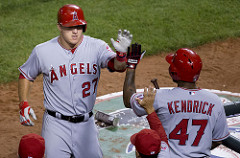
Mike Trout .. . Hit long ball, round bases, high five repeat.
Photo by Keith Allison 
Yesterday (September 13, 2022), Mike Trout went zero-for-three (one walk) as his Angels lost to the Guardians 3-1 in Cleveland. While I’m sure the Cleveland fans enjoyed the win, they did miss the chance to see a bit of MLB history. Trout’s zero-for-three ended a streak of seven straight games in which he had gone yard – leaving him one shy of the record consecutive games with a home run. Surprisingly, during his hot streak, the Angels went 3-4 (outscoring their opponents just 33-28, with Trout driving home one-third of the Angels’ tallies).
Trout’s offensive outburst should not be too much of a surprise. A first-round (25th overall) 2009 draft pick out of Millville (NJ) Senior High, Trout made his MLB debut July 8, 2011 (at the age of 19). In three minor-league seasons, the teenager had risen from rookie ball to Double-A, hitting a combined .338, with 22 home runs and 102 stolen bases in 266 games.
As high school senior, Mike Trout hit .531 (81 at bats), with 18 home runs and 21 steals.
While he hit just .220 in 40 2011 games for the Angels, Trout became a regular in the Angels’ outfield in 2012, hitting .326-30-83, leading the league in runs scored (129) and steals (49) – and winning Rookie of the Year honors. To date, he has been a 10-time All Star (missing just 2020) and three-time AL MVP. He had topped hit 30 or more home runs in seven seasons (35 so far this year), driven in 100+ runs three times, scored 100+ runs in seven campaigns, hit over .300 in six seasons and stolen 30 ore more bases three times. Even without the eighth consecutive games with a home run, he is building quite a Hall of Fame Legacy.
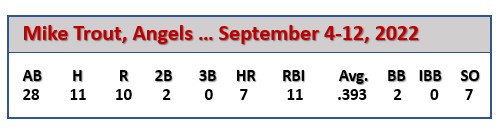
With that on the books, let’s take a look at the players who are on the short list of those with homers in eight consecutive games. Dale Long, Don Mattingly and Ken Griffey, Jr. (Side note: All thee began their professional careers as teenagers. Not really that important, but the kind of coincidence The Roundtable notices.)
______________________________________________________
A brief interruption before we return to our regular programming.
Time here for a short rant about #HowTheGameHasChanged. Yesterday, I was at a Twins game and Twins’ rookie starter Joe Ryan coasted through the first seven innings with a no-hitter (versus the Royals). After seven frames, he had given up two walks, fanned nine, tossed 106 pitches and was enjoying a 6-0 lead.

My very clean scorecard during Kershaw’s outing and a very clean scoreboard during Ryan’s.
As the eighth opened, Twins’ Rocco Baldelli brought in rookie reliever Jovani Moran (to significant booing from the crowd). Now, I didn’t join in the chorus of displeasure, but (as a fan) I was not really happy with the decision. Still, we could at least hope for the Twins’ first-ever combined no-hitter (and by two rookies no less). Alas, it was not to be, as Moran lost the no-no with one out in the ninth – giving up two walks, followed by an RBI double to Bobby Witt, Jr. (Moran eventually gave up a another hit and a total of three runs in the inning.)
All of this took me back to a game I attended on April 13 – with the Twins facing the Dodgers at Target Field. Despite the fact that the Twins were down 3-0, there was plenty of drama on the field and plenty of excitement in the crowd – as many of us anticipated a chance to see Dodgers’ starter Clayton Kershaw try for MLB’s 24th-ever Perfect Game. After seven innings (Does this timing sound familiar?), Kershaw had thrown just 80 pitches (53 strikes) and had fanned 13 batters – with only three balls had been hit out of the infield. He was cruising and it was a masterful performance to watch.
Like Ryan, Kershaw did not come out to pitch the eighth. Dodgers’ manager Dave Roberts instead put in Alex Vesia. The change was met with a chorus of boos, from Twins’ fans and a large contingent of Dodger Faithful seated behind the third base dugout.
Now, there’s never been a combined Perfect Game, so I had a bit of hope. One out and five pitches after Vesia took the mound, Twins’ catcher Gary Sanchez lined a single to right and the Perfect Game and even the no-hitter were gone. (The Twins, ultimately, lost 7-0 and Sanchez’ single was their only safety.)
Side note: I later learned, via the Elias Sports Bureau, that only once before ( since 1900) has an MLB pitcher been pulled after the seventh inning with a Perfect Game intact. Both times, Roberts was the manager. (The first was on September 10, 2016, when he pulled Rich Hill – a reported finger issue – after seven innings with Perfect Game intact against the Marlins (and the Dodgers up 5-0). Hill had thrown 89 pitches (62 strikes) and fanned nine. Hill was replaced by Joe Blanton and ten pitches and two outs later, Marlins’ LF Jeff Francoeur collected the first of two Miami hits in the game.
In both the Ryan and Kershaw games, I found myself trying to imagine what would have happened in the same situation with the likes of Jack Morris, Bob Gibson or Don Drysdale on the bump. I understand managers looking ahead and trying to protect their pitchers, so I can’t be too critical. But, as a fan, I can be disappointed when a pitcher is pulled with a late-inning no-hitter or perfect game intact. I’ll resist starting the next sentence, “Back in the day ….”
_________________________________________________
Now, back to the three players who share the record for consecutive games with a home run at eight.
Dale Long … 1956 Pirates
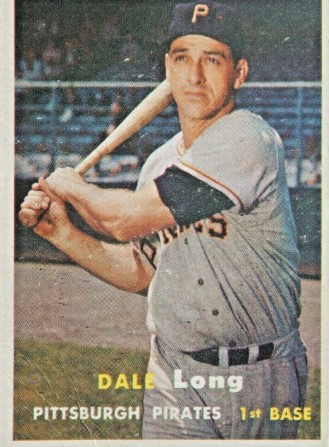 Dale Long’s path to the big leagues was not an easy one. Signed, in 1944, at age 18, after a stint in the Navy, Long made his major-league debut on April 21, 1951 (after seven minor-league seasons … and 11 minor-league teams with four different franchises.). He was back in the minors by mid-season (after hitting .231-3-12 in 44 games for the Pirates and Browns).
He didn’t make its back to the MLB diamond until 1955, again with the Pirates. In his first season as a big-league regular, the lefty first basemen hit .291-16-79 and the led NL in triples with 13.
The following season – the year of his eight-game home run streak – Long made his only All Star team, hitting .263-27-91 in 148 games for Pittsburgh. (The 27 long balls and 91 RBI would prove to be career highs.
Overall, long played ten MLB seasons (Pirates, Browns, Cubs, giants, Yankees, Senators,), hitting .267-132-467 in 1,013 games. He hit 20 or more homers in four season and .290 or better twice.
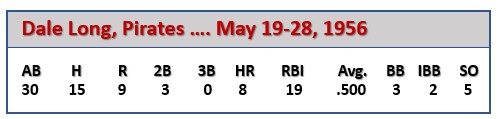
The Pirates went 7-1 during Long’s home run streak, outscoring their opponents 44-22, with Long driving in 19 of the 44 runs.
______________________________________________
Don Mattingly, 1987 Yankees
 Don Mattingly had his eight-game home run streak in 1987, in the midst of his fourth straight All Star campaign, third straight season of 30 or more home runs, fourth straight season of 100+RBI and fourth straight season hitting .325+. He was, in fact, at the peak of his career. The previous three seasons, he had led the league in hits twice, doubles three times, RBI once, batting average once, total bases twice and slugging percentage once.
Mattingly was 19th round draft choice, out of Reitz Memorial High School. He had worked his way from Low-A to Triple-A over four seasons (1979-82), hitting .332 in 457 games. He had yet to develop his power stroke, however, with only 20 home runs on his resume. He made his MLB debut, as a 21-year-old, for the Bronx Bombers on September 8, 1982 and earned a spot as a regular in the Yankee lineup by the following June. In 1984, his first full MLB season, the 23-year-old Mattingly was the AL batting champ – putting up a .343-23-110 line. He went on to a 14-season MLB career (1982-95), all for the Yankees – hitting .307-222-1,099; was an All Star six straight seasons (1984-89); earned nine gold Gloves at first base; and was the 1985 AL MVP.
In 2020, Don Mattingly was the NL Manager of the Year – leading the Marlins to a 31-29 record – good for second place (NL East) in the COVID-shortened season.
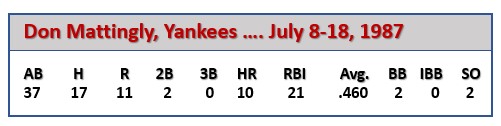
Despite Mattingly’s eight-game output – 10 home runs and 21 RBI – the Yankees only went 5-3 in his streak. (They did outscore their opponents 55-36, but that included a 13-4 win over the Twins and a 12-3 victory over the Rangers.)
_____________________________________________
Ken Griffey, Jr., 1993 Mariners
Ken Griffey Jr. was signed, as a 17-year-old, in the first round (first overall) of the 1987 draft (Mariners).
Ken Griffey Jr. (Archbishop Moeller High School, Cincinnati) was the 1987 U.S. High School Baseball Player of the Year.
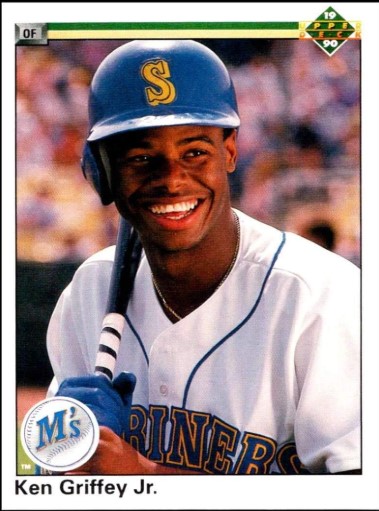 As a 17-year-old, Griffey hit .313-14-40, with 13 steals at Low-A Bellingham (54 games). The following season, he hit .325-13-52, with 36 steals at A and Double-A (75 games.)
In 1989, at 19-years-old), Griffey was a regular in the Seattle outfield. The rest is history. He went on to a 22-season, Hall of Fame career – hitting .284-620-1,836, with 184 steals in 2,671 games. Griffey hit 40 or more home runs in seven seasons, with two seasons (1997-98) of 56 roundtrippers. He also collected 100 or more RBI eight times. He was a 13-time All Star, ten-time Gold Glover and the 1997 AL MVP (when he hit .304, and led the league with 56 home runs, 125 runs scored, 147 RBI and 398 total bases.
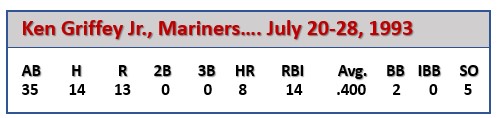
During Griffey’s 1993 home run streak, the Mariners won five of the eight games – outscoring their opponents by just four runs 52-48.
______________________________________________
Just a Little (Big, Really) Baseball Roundtable Long Ball Bonus
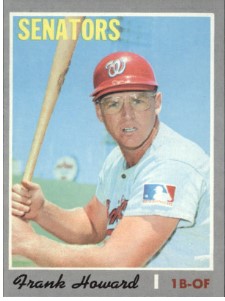 Most fans recognize 1968 as “The Year of the Pitcher.” The overall MLB earned run average was 2.98; Bob Gibson put up a 1.12 ERA; Denny McLain won 31 games; only six qualifying MLB hitters hit .300 or better and Carl Yastrzemski won the AL batting title with a .301 average. Pitching was so dominant, MLB lowered the mound five inches for the 1969 season.
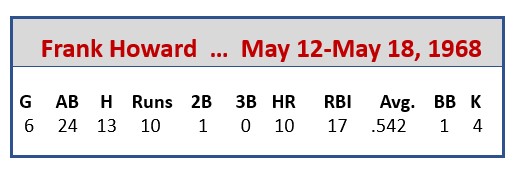
Yet, somehow – in the midst of all this pitching dominance – the Washington Senators’ big (6’8” – 260-lb.) OF/1B Frank Howard put together one of the most explosive offensive weeks in MLB history. From Sunday May 12 through Saturday May 18, in just 25 plate appearances (in six games), Howard banged out thirteen hits – including ten home runs and one double – and drew one walk (for a .542 average). He also scored ten times and drove in 17 tallies. Side note: Surprisingly, the Senators went 3-3 over Howard’s streak. Howard’s ten home runs remain MLB’s record for home runs in a week.
Howard’s game lines during the streak looked like this:
- May 12 … two-for-four, two runs scored, two RBI, two home runs.
- May 14 … three-for-four, two runs scored, three RBI, two home runs.
- May 15 … two-for-four, one run scored, two RBI, one double, one home run.
- May 16 .… two-for-four, two runs scored, four RBI, two home runs.
- May 17 … one-for-four, one run scored, two RBI, one home run.
- May 18 … three-for-five, two runs scored, four RBI, two home runs.
Howard picked on some pretty good hurlers during his streak. Three of the long balls came off the Tigers’ Mickey Lolich, who went 17-9, 3.19 on the season and won three games in the 1968 World Series. Another pair of the record-setting round trippers came off “Sudden” Sam McDowell, who – while he only went 15-14 that season – put up a 1.81 earned run average and led the AL with 283 strikeouts. Howard also showed he could “hit ‘em anywhere.” Only two of the ten long balls came at home – and his streak also included home runs in Boston, Cleveland and Detroit.
Howard came into the streak with a.300 average on the season (which he raised to .347 during the six games). Notably, he didn’t “come in hot,” he had just three hits (.130 average) over his previous six games.
Primary Resources: Baseball-Reference.com; MLB.com; Elias Sport Bureau.
Baseball Roundtable – Blogging Baseball Since 2012.
BASEBALL ROUNDTABLE ON THE TOP 100 BASEBALL BLOG LIST
 Baseball Roundtable is on the Feedspot list of the Top 100 Baseball Blogs. To see the full list, click here.
I tweet (on X) baseball @DavidBaseballRT
Follow Baseball Roundtable’s Facebook Page here. More baseball commentary; blog post notifications.
Member: Society for American Baseball Research (SABR); The Baseball Reliquary; The Negro Leagues Baseball Museum.